Dark Ways

October 2 – Proverbs 2 (& surrounding chapters)
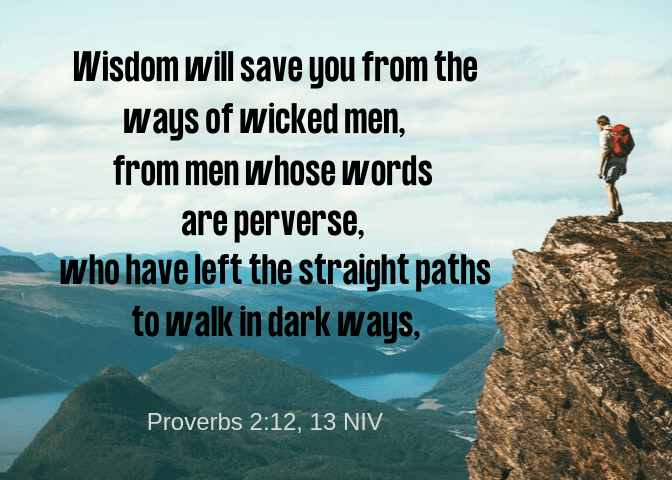
Proverbs 2 12 13 NIV

Let’s continue to look at Proverbs 1-4.  Today we are going to focus in on the sections dealing with avoiding sin and living a righteous life.

Proverbs 1:10-19 issues a warning about hanging out with the wrong crowd.  “My son, if sinners entice you, Do not consent.”  (Proverbs 1:10) It is critical to quickly and firmly resist even the smallest temptation.  Immoral people are often not satisfied with just doing bad things on their own, but they will instead often try to persuade others to join in their wrongdoing.  But Proverbs warns, “My son, do not walk in the way with them (sinners).  Keep your feet from their path, For their feet run to evil, And they hasten to shed blood.”  (Proverbs 1:15-16) The wise will not give into negative peer pressure, but they will quickly flee from temptation and those doing wrong.  It is dangerous thinking to believe that you can associate with habitual sinners, but not be affected yourself.  Verses 18 and 19 then explain that those that set out to do evil will ultimately harm themselves.  “But they lie in wait for their own blood; They ambush their own lives.  So are the ways of everyone who gains by violence; It takes away the life of its possessors.”

In chapter two Solomon continues to stress that a wise person will resist evil.

12 Wisdom will save you from the ways of wicked men,
from men whose words are perverse,
13 who have left the straight paths
to walk in dark ways,
14 who delight in doing wrong
and rejoice in the perverseness of evil,
15 whose paths are crooked
and who are devious in their ways.

However, it is not enough to just avoid sin, but it is important to go beyond that, and treat others with goodness and generosity.

27 Do not withhold good from those to whom it is due,
when it is in your power to act.
28 Do not say to your neighbor,
“Come back tomorrow and I’ll give it to you”—
when you already have it with you. (Proverbs 3:27-28)

In chapter four a stark comparison is given between the righteous and the wicked.

18 The path of the righteous is like the morning sun,
shining ever brighter till the full light of day.
19 But the way of the wicked is like deep darkness;
they do not know what makes them stumble. (Proverbs 4:18-19)

How important to realize that with every choice we make, we are choosing to either live in the light or the darkness.

Then Solomon ends chapter four with some straightforward advice about how to keep choosing to live in the light.

20 My son, pay attention to what I say;
turn your ear to my words.
21 Do not let them out of your sight,
keep them within your heart;
22 for they are life to those who find them
and health to one’s whole body.
23 Above all else, guard your heart,
for everything you do flows from it.
24 Keep your mouth free of perversity;
keep corrupt talk far from your lips.
25 Let your eyes look straight ahead;
fix your gaze directly before you.
26 Give careful thought to the paths for your feet
and be steadfast in all your ways.
27 Do not turn to the right or the left;
keep your foot from evil.

We must read the word of God, not only looking on it, but keeping it in our heart, or following through and acting on it.  We have to guard our heart and mind, always being vigilant of our thoughts, actions and priorities. We must be careful of what we say.  We must keep our eyes focused on God and his plans for our lives.  And finally, we must make sure that we are always moving in the right direction, drawing closer to God, and never turning away from him.

Jill McClain
 

The Source of Wisdom

PROVERBS 1

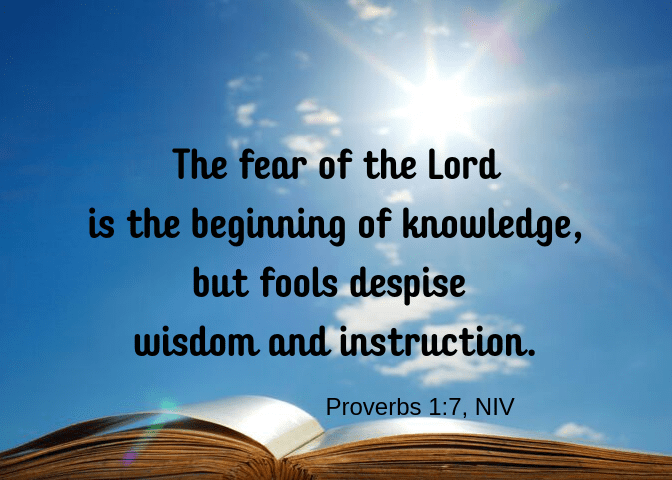
Proverbs 1 7 NIV

For the rest of the week we will be examining the first five chapters of Proverbs.  The writer of this portion of Proverbs is Solomon, the man who asked God for wisdom.  The book of Proverbs was written as an instruction guide, offering advice, and teaching fundamental truths about life.

Proverbs 1:1-7 introduces the book of Proverbs.  This section implores the reader to study continually, always in search of knowledge and wise instruction so that he may gain wisdom and develop the discernment necessary for righteous living.  Discernment is the ability to judge well, make the right decisions or proper choices.

1The proverbs of Solomon son of David, king of Israel:

for gaining wisdom and instruction;
for understanding words of insight;
for receiving instruction in prudent behavior,
doing what is right and just and fair;
for giving prudence to those who are simple,
knowledge and discretion to the young—
let the wise listen and add to their learning,
and let the discerning get guidance—
for understanding proverbs and parables,
the sayings and riddles of the wise.

                                    (Proverbs 1:1-6)

Then in verse seven we have the theme.  “The fear of the LORD is the beginning of knowledge, but fools despise wisdom and instruction.”  All knowledge and wisdom begins with God.  Knowing and obeying God is the foundation for every Christian.  The Creator used wisdom to create the entire world, and wisdom is fundamental to all of life.  “By wisdom the LORD laid the earth’s foundations, by understanding he set the heavens in place; by his knowledge the watery depths were divided, and the clouds let drop the dew.” (Proverbs 3:19-20)  We can know nothing, without it first coming from God.

The proverb of greatest importance is to fear God.  There is nothing more important than to know and obey God.  The next instruction for a successful life is to obey your parents.  In Proverbs 1:8-9 Solomon warns us to honor our parents’ teachings. He says that a parent’s instructions should be seen as treasures, valued and obeyed.  “Listen, my son, to your father’s instructions and do not forsake your mother’s teaching.  They are a garland to grace your head and a chain to adorn your neck.”  (Proverbs 1:8-9)

Skipping ahead a little to the beginning of chapter 2, we hear again the importance of pursuing wisdom.  We are told to purse wisdom, just as we would pursue a hidden treasure.  Then we are told again that God is the source of all wisdom.  And finally that wisdom will lead us to righteousness, justice and protection.

1My son, if you accept my words
and store up my commands within you,
turning your ear to wisdom
and applying your heart to understanding—
indeed, if you call out for insight
and cry aloud for understanding,
and if you look for it as for silver
and search for it as for hidden treasure,
then you will understand the fear of the Lord
and find the knowledge of God.
For the Lord gives wisdom;
from his mouth come knowledge and understanding.
He holds success in store for the upright,
he is a shield to those whose walk is blameless,
for he guards the course of the just
and protects the way of his faithful ones.

Then you will understand what is right and just
and fair—every good path.
10 For wisdom will enter your heart,
and knowledge will be pleasant to your soul.
11 Discretion will protect you,
and understanding will guard you.

(Proverbs 2:1-11)

Just as surely as God gave Solomon wisdom, he can give it to you, too.  “For the LORD gives wisdom; from his mouth comes knowledge and understanding” (Proverbs 2:6). However, it does require a constant searching, as if searching for a hidden treasure.  Actively studying your Bible every day is a great way to search out the treasure of wisdom.
Jill McClain

Wise Enough to Know We are Not Wise Enough on Our Own

1 Kings 3 9

Yesterday, we looked at the relationship between King David and Bathsheba that led to the birth of Solomon.  When King David died, Solomon became king.  “Solomon son of David established himself firmly over his kingdom, for the LORD his God was with him and made him exceedingly great.” (2 Chronicles 1:1)

God appeared to King Solomon in a dream and asked Solomon what he would most like to receive.  Solomon could have asked for remarkable good looks, great bravery in battle, a large loving family, or great riches.  However, Solomon instead asked for wisdom and knowledge.  God replied to Solomon, “Since this is your heart’s desire and you have not asked for wealth, possessions or honor, nor for the death of your enemies, and since you have not asked for a long life but for wisdom and knowledge to govern my people over whom I have made you king, therefore wisdom and knowledge will be given you.”  God was very pleased that Solomon chose wisdom as the gift he most wanted to receive from God.  So, He not only agreed to give Solomon wisdom, but He also said, “I will also give you wealth, possessions and honor, such as no king who was before you ever had and none after you will have.”  (2 Chronicles 1:11-12)   Later in that same chapter we read that Solomon had 1,400 chariots and 12,000 horses and that “he made silver and gold as common in Jerusalem as stones”. God blessed Solomon not only with wisdom, but also with fame, riches and prestige.

Especially during the beginning of King Solomon’s reign, he used his great wisdom and discernment to help govern his people.  One such instance is recorded in 2 Kings 3:16-28.  Two prostitutes came before Solomon asking him to solve a dispute.  Both women claimed to be the mother of the same baby boy.  Solomon said he would cut the baby in two and give each woman half of the baby.  One woman quickly offered that the baby should be given to the other woman.  Solomon determined that the woman who was willing to give the baby up, rather than have him cut in half, must be the true mother for she loved the son too much to have him harmed.

Today you may be contemplating important plans for your future.  Maybe you are struggling with how to deal with a difficult person in your life.  Or possibly you are dealing with a family crisis. When you are faced with difficult choices in your life, how reassuring to know that the Creator of the universe can grant you the wisdom and discernment needed to make sound decisions.  Will you ask Him to? Will you search out the wisdom He has already shared with you in the Bible?

Jill McClain

Never Too Messy for God

INTRODUCTION to PROVERBS

1 Chronicles 22 9

Solomon, who is he and why should I know that name?  First, let’s review the salacious story that led up to the birth of Solomon.  It was Spring, a time when most of the kings in the land would go to battle, due to favorable weather conditions and plentiful food.  However, King David, decided for whatever reason to send his soldiers out to battle, but he himself stayed back in Jerusalem, which certainly went against the warrior king’s typical protocol.  On one of these fine Spring evenings, King David took a walk out on his roof top. As he was strolling around he gazed upon a beautiful woman bathing.  David inquired who the gorgeous bathing beauty was, and was told she was Bathsheba, the wife of Uriah.  King David invited Bathsheba to join him in his bedroom….which lead to…..can you guess?  I’ll give you a hint.  A short time later Bathsheba sent word to David that she was pregnant, with his child.

Upon hearing that Bathsheba was pregnant with his child, King David twice tried to convince Uriah, one of his fiercest warriors, to come home to be with his wife, hoping it would appear that Bathsheba had gotten pregnant by Uriah.  When both of those initial plans failed, David concocted an even more sinister scheme, this time to have Uriah killed.  King David ordered that Uriah be sent to the front line of the fiercest battle, and then instructed that the rest of the soldiers fall back, leaving Uriah alone to face the enemy.  Just as planned, Uriah met his untimely death in the battle that ensued. Following Uriah’s death, Bathsheba moved into David’s home and became his wife.

Not surprisingly, God was very displeased with David for taking Uriah’s wife and then sending him out to die.  David had to face the consequences of his sins.

“This is what the LORD, the God of Israel, says: ‘I anointed you (David) king over Israel, and I delivered you from the hand of Saul.  I gave your master’s house to you, and your master’s wives into your arms.  I gave you all Israel and Judah.  And if all this had been too little, I would have given you even more.  Why did you despise the word of the LORD by doing what is evil in his eyes?  You struck down Uriah the Hittite with the sword and took his wife to be your own.  You killed him with the sword of the Ammonites.  Now, there, the sword will never depart from your house, because you despised me and took the wife of Uriah the Hittite to be your own.’  This is what the LORD says: ‘Out of your own household I am going to bring calamity on you.  Before your very eyes I will take your wives and give them to one who is close to you, and he will sleep with your wives in broad daylight.  You did it in secret, but I will do this thing in broad daylight before all Israel.’” (2 Samuel 12:7-12)

After God delivered this message to David the child born to David and Bathsheba became ill.  David was full of remorse and pleaded with God for forgiveness and for his son’s life.  God forgave David, but his first son with Bathsheba died.

David and Bathsheba had a second son, and they named him Solomon.  Solomon means peaceful.  Solomon went on to become King and his reign was one of peace as foretold in I Chronicles 22:9, “But you will have a son who will be a man of peace and rest, and I will give him rest from all his enemies on every side.  His name will be Solomon, and I will grant Israel peace and quiet during his reign.  He is the one who will build a house for my Name. He will be my son, and I will be his father.  And I will establish the throne of his kingdom over Israel forever.” God loved Solomon and told the prophet Nathan to name him Jedidiah, which means beloved of Jehovah.

There may be consequences to pay for your sins, but if you seek forgiveness God can still work through your “mess” to accomplish great things. After all, from David and Bathsheba came Solomon.

-Jill McClain


(If you’ve been reading with us all year you know we have been working on reading and discussing one chapter of the New Testament everyday – with some FREE THEME days added in to round out the 365 days.  For the month of October we will be reading one chapter of Proverbs a day – the 1st chapter on the 1st of October, 2nd chapter on the 2nd, etc…  It’s a great book to help us all gain a lot of wisdom.  Then, in November we will cover the book of Revelation, and finish off the year with the last gospel we saved for December: Luke.  Keep reading His Word!)

More Love, Less Conflict

Prov 10 12

Hatred stirs up conflict, but love covers over all wrongs.
Proverbs 10:12 NIV
https://bible.com/bible/111/pro.10.12.NIV

One verse, one sentence that says something we all already know. It’s so obvious and yet we struggle to act in love in so many situations. Today, there is a run off election for 2 different state positions here in Georgia. As I voted today it made me think of all the election ads and speeches given just over a month ago. Very few of those were rooted in love, but many were negative. Is it any wonder our nation is so divided? Do we even need to question why people are becoming increasingly violent? It’s because instead of love, which covers wrong, we spread hatred, breeding conflict toward one another.

The only way to create positive change in the community around us is through love. If you’re a Jesus follower, then you know this principle already. It’s why you changed and are still changing. It’s God’s love for us, that we experience in all sorts of ways, that drives us to become better. It steers us away from hatred, it helps us see the potential in others and inside of us. The next time you find yourself disgusted about a person or situation, instead of complaining or pointing out what’s wrong, try focusing on how you can be loving anyway. That’s the only way things will get better, so we might as well stop wasting time with hatred that breeds conflict, and use our energy to show love that covers all wrongs.

-Jerry Briggs

Guarding Your Heart

Prov 4 23

Above all else, guard your heart, for everything you do flows from it.  Keep your mouth free of perversity; keep corrupt talk far from your lips.  Let your eyes look straight ahead; fix your gaze directly before you.  Give careful thought to the paths for your feet and be steadfast in all your ways.  Do not turn to the right or the left; keep your foot from evil.

 Proverbs 4:23-27 NIV

     “Above all else, guard your heart”.  At first glance we may look at this statement and think it refers to relationships.  But on further inspection I think we can see more.  In Hebrew thinking, the heart is the center of everything, kind of like our minds to us.  This is reinforced by the second half of the sentence “for everything you do flows from it”.  Meaning, who we are as people, has a direct correlation to where our hearts are.  How we think, speak and act.  How we respond to criticism, how we react to negativity, anything you can think of in relation to yourself, is a reflection of our hearts.  This is why it is so important to continually evaluate ourselves.

     In order to change our hearts for the better we’re instructed to look at 3 things. Our mouths, eyes, and legs.  With our mouths we speak.  It is so easy to say things we know we shouldn’t.  Sometimes they even make us feel better for a while, or help us “win” an argument.  In the long run though, it is way better for the heart, if the mouth speaks truthfully, lovingly, and in an uplifting manner.  Trying to follow those will have a major impact on our hearts.

With our eyes, we fill ourselves to our “hearts” desire.  In our culture, we are constantly being stimulated visually.  Some of it is good, some is ok, and some just plain terrible.  But for sure it is too much!  Unless we decide to take control of what we see and how much, there is no way for us to fully guard our heart.  We have to make conscious choices on what and how much we watch or stream.  There are visual traps all around us every day, we have to choose not to look.

Lastly, is our legs.  This is as much about which way you are headed as where you are right at this moment.  Do you have healthy boundaries of places you know you shouldn’t be?  Have you already given careful thought to your future, both long term and immediate?  If you just go with the flow, you’ll most likely end up asking yourself, How did I ever end up here?  Too many people have to ask themselves that before they begin to guard their hearts above all else.  If you are already asking yourself that then now is the time to begin.

Start with these basic things, and you’ll be amazed at what God can change in you, in your heart, and then in your life.

-Jerry Briggs

How to Avoid Unpleasant Consequences

Prov 1 8


When I was in high school I remember my friend and I sneaking out of his house to go hang out with some friends. We left his house about 11:30pm and didn’t get back in until 5:45am  which was 15 minutes before his alarm would go off for school that morning. We were tired and exhausted and couldn’t really function at school. Staying up and sneaking out all night left us at a great disadvantage the next day.
I have made many bad decisions in my life. Many like this story could have been avoided if I had listened to the advice others had given me.  They say you need at least 8 hours of sleep as a teenager.  Well, I got about 15 minutes and it was not enough. 
Proverbs 1:8-16 talks about how fools and sinners bear the fruit of there own actions. I definitely deserved a hard day at school for not listening to the wisdom that was set in front of me.  
 
What wisdom has been told to you that you might need to listen to more carefully? Remember, the consequences may not be worth it.
-Jesse Allen

Keep Reading!

Proverbs 1-5a
SATURDAY Weekly Re-cap with Megan Bryant
This week, we read through the last few chapters of Proverbs.  As I said at the beginning of the week, Proverbs is a collection of timeless wisdom.  We looked at pieces of this wisdom ranging from true friendship to confessing our transgressions to being satisfied with our daily bread.  And since these posts didn’t focus on every verse, I would encourage everyone to read back over Proverbs as a whole and analyze the verses not discussed on this blog.  Every time we read the Bible, we have the opportunity to grow in a new way.  We may see a verse in a new light or notice something that we may have missed before.
Let’s continue to learn and grow as we continue to read through the Bible, but also look back over what has already been read to gain new insights.
-Megan Bryant

A Godly Woman

PROVERBS 31

Proverbs 31-10

Proverbs 31 comprises a collection of teachings from King Lemuel taught to him by his mother.  In Hebrew, Lemuel means “devoted to God.”  The first nine verses of the chapter offer 3 main lessons:

1-    Be careful not to partner with destructive people, whether in marriage or social/ business circumstances.

2-    Be careful with alcohol, lest it clouds our judgment.

3-    Speak for those who cannot speak for themselves.

Do any of these bits of wisdom apply to your life or current circumstances?

Verses 10-31 are verses that I hear and read a lot as a woman.  These verses are crocheted onto pillows and painted on plaques that women like to keep in view.  This section of Proverbs tells us that a virtuous woman is one of strong character, an able and compassionate woman.  She is trustworthy and brings good to other people.  Her family relies on and blesses her.  This Godly woman is an outstanding wife, mother, and businesswoman.  The passage doesn’t mention the woman’s outward appearance; only her actions and her character define her.  Charm is deceptive and beauty is fleeting, but a woman who fears the Lord is to be praised.

The description of the woman who fears the Lord can be overwhelming.  However, we are encouraged to be more and more virtuous in our walks with God every day.  What can we all (men and women) change or improve to be more like the woman described in the later section of the chapter?

Megan Bryant

Still Seeking the Next Big Thing?

PROVERBS 30

Proverbs 30-8

Before writing this post, I did some research about other commentaries and devotionals from Proverbs 30.  Many writers have speculated about the author of this passage, whether Agur is a pseudonym for a known author or what wisdom this author may possess.  Most of the devotionals focus on verses 5-6: “Every word of God is flawless, he is a shield to those who take refuge in him.  Do not add to his words or he will rebuke you and prove you a liar.”  These verses tell us that we can confidently put our faith in the Lord and warn against tampering with His Word, the Bible.  2 Timothy 3:16-17, Numbers 23:19, Deuteronomy 12:32, and Revelation 22: 18-19 all reinforce these 2 verses in Proverbs 30.


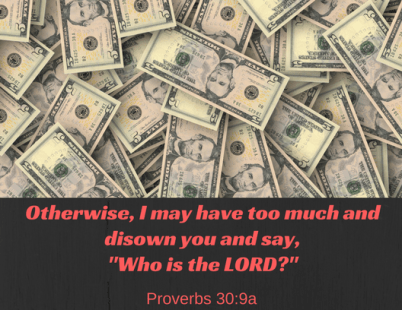
When I read this chapter, however, I did not latch onto those 2 verses like most of the commentaries and devotionals I read.  I was drawn to verse 8.  “Keep falsehood and lies far from me; give me neither poverty nor riches, but give me only my daily bread.”  As a whole, our society is never satisfied.  We are always seeking something more.  I remember talking about marriage in a psychology class, and the professor was explaining how studies have shown that one reason marriages tend to fail more often now than they used to is often because one of the spouses is seeking something more, whether that be a more attractive partner or a partner who makes more money or whatever qualifications are deemed important, rather than being content and wholly loving the current husband/wife.  We are never satisfied, always looking for the next-best thing.  Verse 8 asks the Lord for neither poverty nor riches, only what is needed for the day.  The writer isn’t seeking more.  He’s seeking to be satisfied in the Lord.  We’ve all read that it is easier for a camel to pass through the eye of a needle than for a rich man to enter the Kingdom of God (Mark 10:25), and verse 9 reinforces that someone who is “full” is quick to deny the Lord.

Proverbs 30-9a

Though society tells us that we always need the newest and next-best thing, the newest iPhone, the bigger tv, the prettier woman or more handsome man—the Bible teaches us to be content with what we are given.  Our daily bread is enough.

-Megan Bryant