Three Deep Breaths

PROVERBS 29

Proverbs 29-11

When reading Proverbs 29, I caught onto a theme of how to handle anger and frustration.  Verse 8 says that the wise turn away anger.  Verse 11 reads that the wise bring calm whereas the fool vents his rage.  Verse 20 instructs us not to speak in haste, verse 22 tells us that angry and hot-tempered people stir up conflict and commit many sins, and verse 23 warns against pride, which is often a precursor to anger and argument.

We all encounter trying situations.  We all have tense moments in which we want to scream into a pillow or go for a run or do whatever helps us to cool off.  Proverbs 29 instructs us to keep a cool head and turn away from anger.  I remember a scene from a movie or television show (although for the life of me, I can’t remember the source) in which a character is stressing out.  Another character instructs her to take 3 deep breaths, saying that in the time it takes to complete those 3 breaths, she will stop herself from doing or saying anything she may later regret.

At some point or another, we all get angry.  In these times, it is important to know how God instructs us to handle ourselves.  I had a classmate in college who would pray for the class before every exam.  She always ended her prayers by asking the Lord to keep us calm, cool, and collected during the stress of the exam.  Three deep breaths.  Calm, cool, and collected.  When on the verge of having an outburst, remember to be the wise man and bring calm.  Be wise and turn away anger.  Don’t speak in haste.  Lean on the Lord and His teachings, even in tense moments.  Three deep breaths allows for enough time to reflect back on these verses.

-Megan Bryant

Confession Time

PROVERBS 28

Proverbs 28-18

Verses 13-28 examine the fates of the wicked compared to the righteous.  Verse 13 reads, “Whoever conceals his transgressions will not prosper, but he who confesses and forsakes them will obtain mercy.”  In which camp would you routinely place yourself?  Are there certain parts of our lives that we are quick to share if we sin or fall short, but others that we conceal for the sake of reputation or fear of conflict or avoidance of the consequences?  This verse doesn’t specify between transgressions; whoever conceals his sins will not prosper.  Confessing before the Lord and all other necessary parties brings mercy and an opportunity for growth.  Are there specific wrongs in your life that need to come into the light?  We all have room for growth, and we should ask the Lord to reveal to us our shortcomings.  John 15:2 reads, “Every branch that does not bear fruit he takes away, and every branch that does bear fruit he prunes, that it may bear more fruit.”  Even our fruitful endeavors need pruning.


I would encourage you to pray about your transgressions.  Admit to yourself and the Lord that you have sins, not that you just make mistakes or have oversights.  Ask for help in renouncing and repenting of these shortcomings, and actually try to follow through in walking away from whatever you have been keeping in the dark.  Don’t just make a quick promise, but deliberately seek righteousness.


-Megan Bryant

A True Friend

PROVERBS 27 – Monday

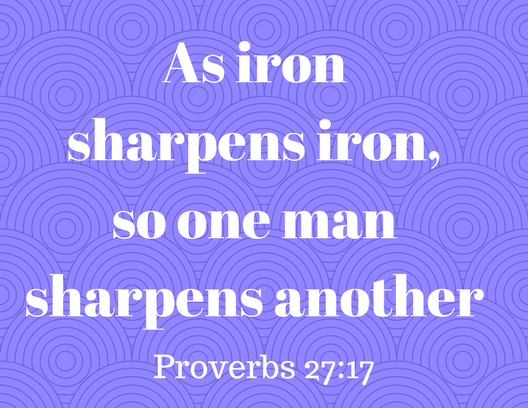
Prov 27 17

Verse 6 reads “faithful are the wounds of a friend…”  In this context, the wounds of a friend appear to be necessary.  Friends who love us enough to be honest with us, even when it hurts, are the best kinds of friends.  I can remember multiple times in my life in which I didn’t enjoy the truth that I was told, but my friends and family loved me enough to tell me anyway.  We often think that allowing people their momentary happiness is a kindness, but if someone is in sin, it is our duty to tell loved ones the painful truth.  Just as iron sharpens iron (verse17) by chipping away the outer bits of metal, honest friends sharpen each other by helping each other to turn away from sin and helping to recognize the things that are keeping us spiritually dull.


Finding a friend or a group of friends who can be open enough with each other to share this kind of love is invaluable.  Someone told me that a friendship that lasts 7 years is a lifelong friendship—if you can make it 7 years, you can make it forever.  I don’t particularly like the idea that a length of time is necessary to determine true friendship; I think that real friendship is proven by friends who can be brutally honest in love.  I was close to a girl in college for 4 years, but I could never tell her hard truths.  It weighed on me when I saw things that needed attention, but I was too scared of upsetting her to be a forthright friend.  “As iron sharpens iron, so one person sharpens another.”  Don’t be afraid to confront your people when you see them in or approaching sin.  We need each other to keep us accountable.

-Megan Bryant

Collection of Timeless Wisdom

Sunday’s Intro

bible light
Hey friends!  This week, we’ll be reviewing the last five chapters of Proverbs.  I would like to reiterate something that Grayson stated last week: when reading these verses, try to approach them as relevant truths rather than dated sayings from hundreds of years ago.  Wisdom does not fade.
I would encourage everyone to understand that while Proverbs can appear to be a stream of consciousness, with one verse seemingly unrelated to the next, this book offers a collection of timeless wisdom relevant to ordinary daily life.  Each verse is relevant.  While these posts won’t analyze each individual proverb, I think it is important for us to pay attention to the verses as a whole.  I will have a theme for each post, but these themes won’t encompass all of the chapter.  I would encourage everyone to read and reflect on each chapter on your own as we go through this week!
Megan Bryant

Converse with the Almighty

bible

Saturday’s Weekly Recap with Graysen Pack

This week we’ve walked through another six chapters of Proverbs and found words that, although written thousands of years ago, still speak to the persistent struggles of human existence.  Answers to guide us seek the wealth that God promises, to join God’s work as he defends the orphaned and poor, to earnestly engage in honest community, to be aware of the emotional strife of ourselves and others, and to use our words to build a church of sincerity.


It can be easy to forget that even when we read the oldest parts of the Bible, the words are still alive and active.  And we don’t really read Scripture, but instead engage in a conversation with it.  It isn’t a professor lecturing at us from the front of a large classroom.  Instead, it is a dialogue that speaks to who, where, and when we are.  The words of God are both alive in the history of Israel and the church as well as our lives today.


As you continue to read through the Word of God this year, remember that you are entering a conversation that will speak to your life and the life of the world today.

Watch Your Words

Proverbs 26 – Friday 

Prov 26-18-19 (1)

18 Like a maniac who shoots deadly firebrands and arrows,

19 so is one who deceives a neighbor

   and says, “I am only joking!”

Proverbs 26:18-19

There’s a popular show on HBO called Game of Thrones.  And whether you’ve ever seen it or not, it has become a meme factory.  And there’s one line that is currently making the rounds on social media: “When enough people make false promises, words stop meaning anything and then there are no more answers.  Only better and better lies.”  

Like the boy who cried wolf, this proverb is a warning that words are powerful.  Although we want to believe that only sticks and stones can break our bones, words can often cripple us in a way that no wound ever could.  I think it is probably fairly rare that we intentionally fire hurtful words at those around us (although when tempers flare I have unfortunately found a sharper tongue than I ever expected in my mouth).  What is really dangerous are the words we throw at someone else veiled in jest.

I learned this from Andy Cisneros, but in every piece of sarcasm there’s a little nugget of truth.  Something real about the thing we’re pretending to say but really meaning.  While we may find them easy to move past at times, sarcastic words erode away at us like water through a canyon.  They’re poison pills wrapped in sweetness and given in bitterness.  

We may not consider ourselves to be con men – deceiving our neighbor intentionally – but we deceive ourselves and shoot arrows at our neighbor when we pretend that the words we say don’t have weight to them.  This proverb encourages us to become people who use our words wisely, to mean what we say, and to engage with each other genuinely so we can build a better community together.

-Graysen Pack

Social Media Warning: Stripping on a Winter’s Day

Proverbs 25 – Thursday

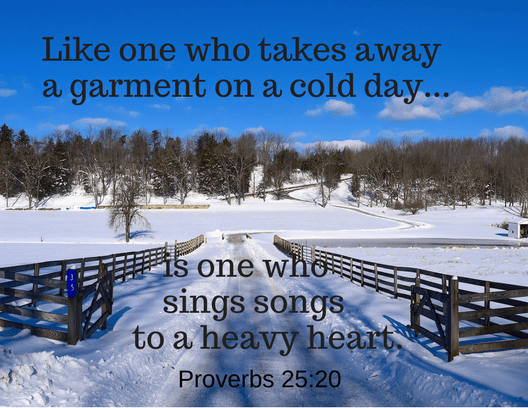
“Like one who takes away a garment on a cold day, or like vinegar poured on a wound, is one who sings songs to a heavy heart.”   Proverbs 25:20
Prov 25-20

Any of us could be forgiven if, by looking at our latest social media feed, we were surrounded by people full of joy living their best life today.  It’s easy to see how perfect our friend’s lives appear when viewed one photo, tweet, or snap at a time.  It’s a perfect and tailored vision of what their lives are.


It isn’t uncommon for me to find myself not refreshed by spending a few (many) minutes on my latest Instagram feed, but actually more tired, weary, and heavy.  In fact, recent studies have shown that spending more time on social media platforms actually increases the likelihood of depression.  I know that I’m not the first one to say this, but holding our own lives – with all its boring, sad, weird bits – against the lives we see portrayed every day in these feeds is a pretty easy way to see yourself into a sadder state.  


The thing is, we have a hard time stopping.  We delete our Facebook, shut down our Twitter, and delete Snapchat from our phone.  But before long, it’s right back again.


I want to talk about this, because I think that this verb from Proverbs speaks as deeply to how we treat ourselves as to how we treat others.


The more obvious way to read this verse is to see it as a directive to treat others and their pain with the respect it deserves.  If someone’s in pain, don’t try to gloss over it.  If they’re hurting, quit trying to just make them laugh.  Quit telling me to smile.


And I can easily point out a ton of examples of how we see this same message echoed throughout scripture. The best thing that Job’s friends do isn’t to try to tell him how to fix it all, but to sit with him in the ashes and mourn with him.  Paul tells us to rejoice with those who rejoice and mourn with those who mourn.  God sent Christ to meet us exactly where we are.  


The Christian message is one of meeting people in their pain and sharing its load with them.  Just like the song says, lean on me when you’re not strong, and I’ll be your friend.  I’ll help you carry on… (you’re welcome for getting that stuck in your head).  


But I want to focus on how we can each steal garments away from ourselves and pour vinegar on our own wounds.  Although we can and do find all sorts of crutches in our life, few of them have the alluring power that social media has inspired over the past decade.  Why?  Because unlike many addictions, social media – when misused – can give us the fleeting sensation of being connected with others without any of the benefits of actually engaging in relationship with them.  


Because social media also has the ability to be a transformative tool for actual social engagement.  It can help us find a community of friends who will help us bear that load (to help us carry on…get it???).  I don’t want you to mistake this as a tirade against social media usage, but rather as a call to reflect on how we should keep it in its proper orientation.  Where digital connections enhance and strengthen the bonds you’ve built IRL (in real life), it can provide a way to stay connected in meaningful ways like never before.  But if it has become an addiction that keeps us from engaging in the richness of the world around us, then we may find ourselves stripping off our own clothing on a winter’s day.


We need to not only treat others emotional trauma with the kind of respect and “sitting-with-ness” it deserves.  But, we need to be attentive to our own emotional needs so that we can feed ourselves with relationships and community that doesn’t just feel engaging, but actually is.  


-Graysen Pack

A Refreshing Answer

Proverbs 24 – Wednesday

Proverbs 24:23-26 

23     These also are sayings of the wise:
Partiality in judging is not good.
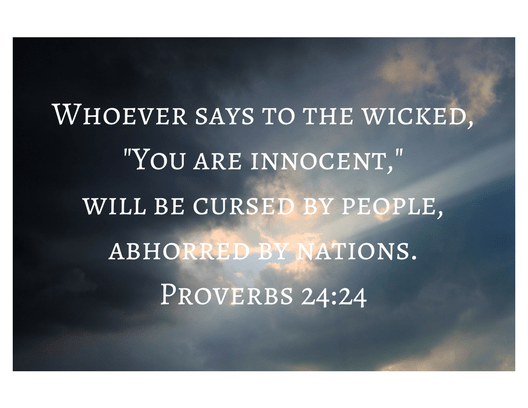
24 Whoever says to the wicked, “You are innocent,”
   will be cursed by peoples, abhorred by nations;
25 but those who rebuke the wicked will have delight,
   and a good blessing will come upon them.
26 One who gives an honest answer
   gives a kiss on the lips.


I grew up with my father telling me “Honesty is always the best policy.”  As I’ve grown, I have to admit that there have been many times in my life when I have tested the wisdom of that saying.  And I’m apparently not alone.  In a study done by the University of Massachusetts, 60% of American adults cannot have 10 minutes of conversation without stepping into some sort of lie.  I find that number both astounding and unfortunately relatable.

Proverbs 24-24

A blatant lie is easy to spot.  Calling those who are clearly wicked and have done evil “innocent” is something that we can uncover with even the smallest pursuit of truth.  But I don’t think 60% of people are taking their conversations that far within 10 minutes.  Instead, I think it has a lot more to do with our desire/need to want to impress those around us (at least I know that it is for me a lot of the time).  So I don’t make up some story whole-cloth.  I pull at the story here a little or there a bit to make it more grandiose or impressive.


Here’s the kicker though, whenever we start to do that our stories actually become less believable and others start to hold us in lower regard than if we were truthful in the first place.  As humans, we have incredibly intuitive brains that can sense when things don’t quite add up.  This is why an honest answer is like a kiss on the lips.  Not romantic, but refreshing and life-giving.


See, I’m married and if I’m exhausted or frustrated, my wife can give me a small kiss (even just a peck) and I can start to feel better.  Not because a kiss is magic but because it reminds me of what is most important in life.  We may experience the same thing when we kiss our family goodbye or give our closest friends an earnest hug.  An honest answer is refreshing and shows us what is really going on – we are engaging in relationship with those around us.

-Graysen Pack

Caring for the Poor

Proverbs 23  (Tuesday)

Prov 23-10-11


There are two strong images that emerge in this proverb.  The first is that of moving a landmark so that it encroaches on “the field of orphans” (Proverbs 23:10).  This is most likely a reference to the Israelite practice of leaving the corners of a field for the poor to glean from (Lev. 19:9-10; Deut. 24:19-21).  This institutionalized care for those in need meant that farmers would always leave part of their field unpicked.


Just like surveyors today, the properties of each person would have been laid out by various markings: large rocks, stakes, or a cairn (pile of rocks).  While there wasn’t a board or city commission the farmers could check against, a greedy farmer could slowly move a marker year after year to make their own plot larger while taking from their neighbor – or in this case, shrinking the portion of their field that is left for the poor.  Human greed to take from those who already have so little is nothing new today.  So, this proverb is a warning that if we try to steal from the orphaned and poor, we have their redeemer to answer to — God.


The second image comes in verse 11 and is connected to the story of Ruth.  It is the role of the “redeemer.”  In the Hebrew, this is the word Gaal or Gaw’al (spellings vary).  We might more accurately translate it as a “kinsman redeemer” like Boaz is in Ruth.  This is the person whose responsibility it is to care for family members who don’t have a means to protect themselves.  And God will not only protect them, but plead their case against us if are the ones threatening the little that they have.


Our God is one who jealously guards His children, even more so those who have no protector themselves.  As the people of God, this Proverb reminds us that God is one who stands as the kinsman redeemer of the poor and that it is our responsibility as part of his family to take up their cause as well.

–Graysen Pack

The Prosperity Gospel vs. Giving Generously

Proverbs 22 – Monday

Prov 22-9

Proverbs 22:4 & 9

The reward for humility and fear of the Lord

   is riches and honor and life…

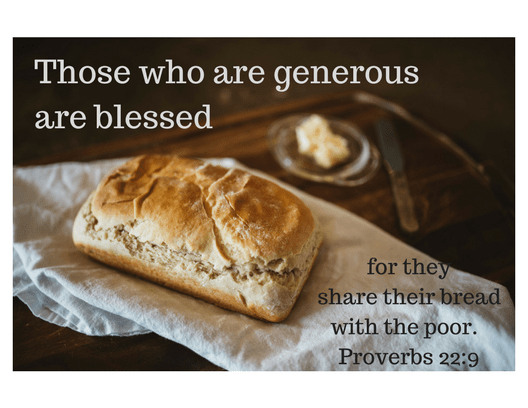
Those who are generous are blessed,

   for they share their bread with the poor.


On any given Sunday morning, I can flip on my television and find a number of ministers promising me riches, wealth, and prosperity if I only have faith.  They usually then want me to practice that faith by making an offering to their ministry – “give us $5 so that God can return it to you one hundred fold.”  These promises do indeed sound promising, but this prosperity gospel is not the message that our Lord came preaching.


Just like we can twist the words of Jeremiah 29:11 and John 10:10 to fit this perspective, we can also turn to Proverbs to try to find a God who rewards those who are faithful with riches, wealth, and health.  But our interpretation of the Proverbs would be just as tortured if we tried to find its truth in the shallow waters of the prosperity gospel.  


Rather, let’s use the Scriptures themselves to better understand the “riches and honor and life” that is promised for those who love the Lord like we find in Proverbs 22:4.  Just a few verses later, we find the clarification that we need.  It is the “generous” who are (hashtag) blessed.


The wealth of the Gospel of Christ lies not in storing up material wealth or riches or fame, but in sharing the material goodness that we have been given with those who don’t have them.  We are blessed with lives of richness, honor, and life abundant when we give away the riches we have so that those with neither riches nor basic needs can be filled as well.


To close with a parable of Jesus, there was a man whose harvest was larger than his barn could store.  He decided to build a larger barn to store his crop.  However, that night he died and all his wealth was lost.  I think that the point of this parable isn’t that we shouldn’t plan ahead or have large barns, but rather that when we have more than we need, we should share it instead of store it up for ourselves.


We can find life, wealth, and riches only when we are generous and give the very things we think we need to hoard.

-Graysen Pack