In God I Trust

Proverbs 3 5 NIV

“Trust in the LORD with all your heart

And lean not on your own understanding;

in all your ways submit to him,

and he will make your paths straight.”

Proverbs 3:5-6


Proverbs 3:5-6 is an often quoted and memorized Bible verse.  However, not surprisingly, it is easier said than done.  It is easy to say the words, without really thinking about what living out these words looks like.

Trust in the LORD.  When I trust in something I can count on it.  The dictionary definition of trust is, “to believe in the reliability, truth, ability, or strength of someone or something; to have confidence in (someone or something); to believe that something is true or correct.”  All of these definitions need to apply to my trust in God.  I must believe that all his promises are reliable and that what he says is true.  I must believe that he had the ability to create the world and that he has the strength to stand against my enemies.  I need have confidence that he cares for me and believe that his word, the Bible, is true and correct.

There are so many things in this life that I can put my trust in.  I can trust my family, my doctor, the government, my pastor, and the list goes one.  But over time, all these people will disappoint and let me down.  There is only one that is totally faithful and trustworthy, and that is my Heavenly Father.  However, if I don’t take the time to get to know God personally, I will never be able to totally trust him.

Trust in the LORD with all your heart.  If I truly trust in God, it must be with ALL my heart.  If I only trust God some of the time, or with only some things, then I am not trusting God at all.  Trust is an all or nothing kind of proposition.

And lean not on your own understanding. I need to let go of what I think I know, and totally rely on God.  I must stop trying to be self-sufficient, but instead depend on my Creator and his infinite wisdom.

In all your ways submit to him.  Trusting in the Lord requires that I submit everything that I have, and everything that I do to him, all the time, every day.  Some versions say, “in all your ways acknowledge him.”  I acknowledge him when I feel his presence with me throughout the day, and turn to him for comfort, companionship and guidance.

And he will make your paths straight.  When I fully trust God, then he can lead me down the correct path.  So often I want to go my own way and do my own thing.  I like to be the boss. However, when I am truly trusting in God then I eagerly follow God’s direction.

When I want to know what God’s will in my life is, I only need to trust in him with all my heart, and lean not on my own understanding, but in all my ways submit to him.  If I am trusting, leaning, and submitting, then I can be confident that I am following God’s plan for my life.

Jill McClain
She Calls Out, But Is Ignored

Proverbs

Proverbs 1 20 a

The wisdom of God is personified as a woman in Proverbs 1:20-33.

20 “Out in the open wisdom calls aloud,
she raises her voice in the public square;
21 on top of the wall she cries out,
at the city gate she makes her speech:”

These verses paint a picture of Lady Wisdom loudly crying out in the middle of the city for people to listen.  She is desperately trying to get everyone’s attention.  The suggestion here is that God wants everyone to hear and respond to his wisdom.  Furthermore, everyone is eventually going to hear the loud calls, and will have to make the decision to either accept or ignore the offer.


Although wisdom is loudly calling out, few are listening to her.  The simple, the mockers and the fools are all ignoring her pleas.

22 “How long will you who are simple love your simple ways?
How long will mockers delight in mockery
and fools hate knowledge?”


Many will ignore the calls for wisdom, but the wisdom of God is available to those who do listen and turn from their sinful ways.

23 “Repent at my rebuke!
Then I will pour out my thoughts to you,
I will make known to you my teachings.”

Nobody likes to be rebuked, to be strongly reprimanded, or have their actions criticized.  However, God will give understanding and wisdom to those that do repent when they have been rebuked.


Next the attention switches back to all those that continually fail to listen to God’s wisdom and are instead pursuing their own desires.

24 “But since you refuse to listen when I call
and no one pays attention when I stretch out my hand,
25 since you disregard all my advice
and do not accept my rebuke,
26 I in turn will laugh when disaster strikes you;
I will mock when calamity overtakes you—
27 when calamity overtakes you like a storm,
when disaster sweeps over you like a whirlwind,
when distress and trouble overwhelm you.”

These verses reiterate that this group of people had the opportunity to listen to wisdom and obey God’s truths, but they instead willingly choose to ignore God.  There are consequences for their choices.  Notice that these verses state when disaster strikes and when calamity overtakes, not if disaster strikes or if calamity overtakes.


The next passage illustrates the need to seek wisdom before we act.  Once we have acted foolishly or sinned, we must face the consequences.  Even if we ask for forgiveness and repent, there are often still consequences that we have to face.

28 “Then they will call to me but I will not answer;
they will look for me but will not find me,
29 since they hated knowledge
and did not choose to fear the Lord.
30 Since they would not accept my advice
and spurned my rebuke,
31 they will eat the fruit of their ways
and be filled with the fruit of their schemes.”

We must wisely choose the correct path so that we can avoid disaster or calamity.  Too often we spend so much energy and time trying to get out of tough spots and wiggle our way out of bad situations that were brought on by our own poor choices. We would be far better off to listen to wisdom and avoid these bad situations and tough spots altogether.


The last two verses in the chapter contrast the foolish and the wise man.

32 For the waywardness of the simple will kill them,
and the complacency of fools will destroy them;
33 but whoever listens to me will live in safety
and be at ease, without fear of harm.”

Failing to follow God’s wisdom has consequences.  Consequences now, but ultimately the greatest consequence will be on the final day of judgement.  Similarly, wisely following God’s plan does not guarantee a problem free life, but it will give you peace and joy in this life, and most importantly it will ensure a perfect and eternal life in the kingdom.

Jill McClain

Dark Ways

October 2 – Proverbs 2 (& surrounding chapters)

Proverbs 2 12 13 NIV

Let’s continue to look at Proverbs 1-4.  Today we are going to focus in on the sections dealing with avoiding sin and living a righteous life.

Proverbs 1:10-19 issues a warning about hanging out with the wrong crowd.  “My son, if sinners entice you, Do not consent.”  (Proverbs 1:10) It is critical to quickly and firmly resist even the smallest temptation.  Immoral people are often not satisfied with just doing bad things on their own, but they will instead often try to persuade others to join in their wrongdoing.  But Proverbs warns, “My son, do not walk in the way with them (sinners).  Keep your feet from their path, For their feet run to evil, And they hasten to shed blood.”  (Proverbs 1:15-16) The wise will not give into negative peer pressure, but they will quickly flee from temptation and those doing wrong.  It is dangerous thinking to believe that you can associate with habitual sinners, but not be affected yourself.  Verses 18 and 19 then explain that those that set out to do evil will ultimately harm themselves.  “But they lie in wait for their own blood; They ambush their own lives.  So are the ways of everyone who gains by violence; It takes away the life of its possessors.”

In chapter two Solomon continues to stress that a wise person will resist evil.

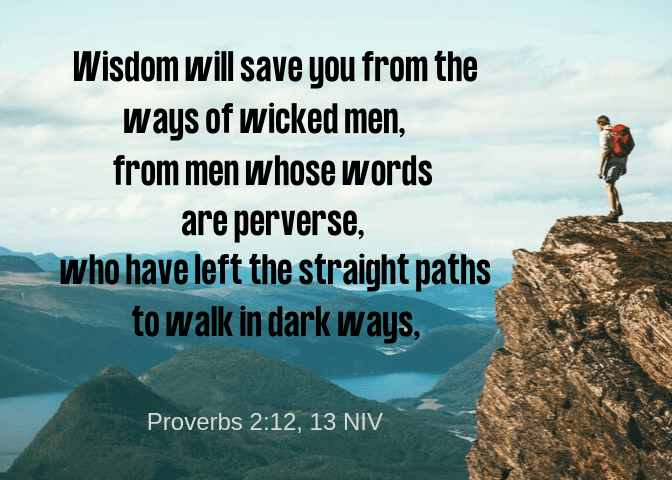
12 Wisdom will save you from the ways of wicked men,
from men whose words are perverse,
13 who have left the straight paths
to walk in dark ways,
14 who delight in doing wrong
and rejoice in the perverseness of evil,
15 whose paths are crooked
and who are devious in their ways.

However, it is not enough to just avoid sin, but it is important to go beyond that, and treat others with goodness and generosity.

27 Do not withhold good from those to whom it is due,
when it is in your power to act.
28 Do not say to your neighbor,
“Come back tomorrow and I’ll give it to you”—
when you already have it with you. (Proverbs 3:27-28)

In chapter four a stark comparison is given between the righteous and the wicked.

18 The path of the righteous is like the morning sun,
shining ever brighter till the full light of day.
19 But the way of the wicked is like deep darkness;
they do not know what makes them stumble. (Proverbs 4:18-19)

How important to realize that with every choice we make, we are choosing to either live in the light or the darkness.

Then Solomon ends chapter four with some straightforward advice about how to keep choosing to live in the light.

20 My son, pay attention to what I say;
turn your ear to my words.
21 Do not let them out of your sight,
keep them within your heart;
22 for they are life to those who find them
and health to one’s whole body.
23 Above all else, guard your heart,
for everything you do flows from it.
24 Keep your mouth free of perversity;
keep corrupt talk far from your lips.
25 Let your eyes look straight ahead;
fix your gaze directly before you.
26 Give careful thought to the paths for your feet
and be steadfast in all your ways.
27 Do not turn to the right or the left;
keep your foot from evil.

We must read the word of God, not only looking on it, but keeping it in our heart, or following through and acting on it.  We have to guard our heart and mind, always being vigilant of our thoughts, actions and priorities. We must be careful of what we say.  We must keep our eyes focused on God and his plans for our lives.  And finally, we must make sure that we are always moving in the right direction, drawing closer to God, and never turning away from him.

Jill McClain


The Source of Wisdom

PROVERBS 1

Proverbs 1 7 NIV

For the rest of the week we will be examining the first five chapters of Proverbs.  The writer of this portion of Proverbs is Solomon, the man who asked God for wisdom.  The book of Proverbs was written as an instruction guide, offering advice, and teaching fundamental truths about life.

Proverbs 1:1-7 introduces the book of Proverbs.  This section implores the reader to study continually, always in search of knowledge and wise instruction so that he may gain wisdom and develop the discernment necessary for righteous living.  Discernment is the ability to judge well, make the right decisions or proper choices.

1The proverbs of Solomon son of David, king of Israel:

for gaining wisdom and instruction;
for understanding words of insight;
for receiving instruction in prudent behavior,
doing what is right and just and fair;
for giving prudence to those who are simple,
knowledge and discretion to the young—
let the wise listen and add to their learning,
and let the discerning get guidance—
for understanding proverbs and parables,
the sayings and riddles of the wise.

                                    (Proverbs 1:1-6)

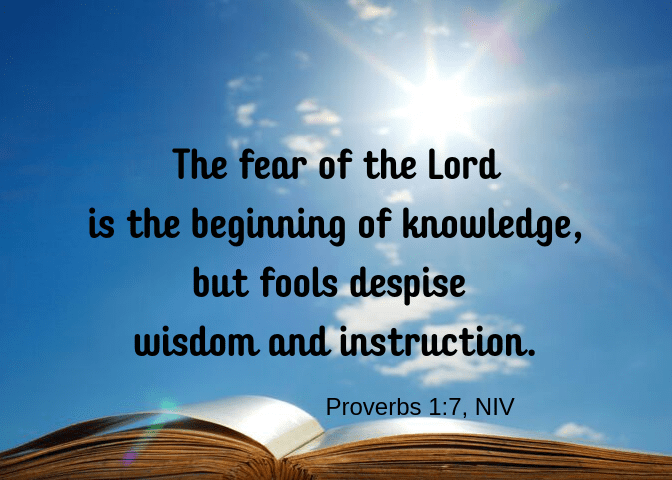
Then in verse seven we have the theme.  “The fear of the LORD is the beginning of knowledge, but fools despise wisdom and instruction.”  All knowledge and wisdom begins with God.  Knowing and obeying God is the foundation for every Christian.  The Creator used wisdom to create the entire world, and wisdom is fundamental to all of life.  “By wisdom the LORD laid the earth’s foundations, by understanding he set the heavens in place; by his knowledge the watery depths were divided, and the clouds let drop the dew.” (Proverbs 3:19-20)  We can know nothing, without it first coming from God.

The proverb of greatest importance is to fear God.  There is nothing more important than to know and obey God.  The next instruction for a successful life is to obey your parents.  In Proverbs 1:8-9 Solomon warns us to honor our parents’ teachings. He says that a parent’s instructions should be seen as treasures, valued and obeyed.  “Listen, my son, to your father’s instructions and do not forsake your mother’s teaching.  They are a garland to grace your head and a chain to adorn your neck.”  (Proverbs 1:8-9)

Skipping ahead a little to the beginning of chapter 2, we hear again the importance of pursuing wisdom.  We are told to purse wisdom, just as we would pursue a hidden treasure.  Then we are told again that God is the source of all wisdom.  And finally that wisdom will lead us to righteousness, justice and protection.

1My son, if you accept my words
and store up my commands within you,
turning your ear to wisdom
and applying your heart to understanding—
indeed, if you call out for insight
and cry aloud for understanding,
and if you look for it as for silver
and search for it as for hidden treasure,
then you will understand the fear of the Lord
and find the knowledge of God.
For the Lord gives wisdom;
from his mouth come knowledge and understanding.
He holds success in store for the upright,
he is a shield to those whose walk is blameless,
for he guards the course of the just
and protects the way of his faithful ones.

Then you will understand what is right and just
and fair—every good path.
10 For wisdom will enter your heart,
and knowledge will be pleasant to your soul.
11 Discretion will protect you,
and understanding will guard you.

(Proverbs 2:1-11)

Just as surely as God gave Solomon wisdom, he can give it to you, too.  “For the LORD gives wisdom; from his mouth comes knowledge and understanding” (Proverbs 2:6). However, it does require a constant searching, as if searching for a hidden treasure.  Actively studying your Bible every day is a great way to search out the treasure of wisdom.
Jill McClain

Wise Enough to Know We are Not Wise Enough on Our Own

1 Kings 3 9

Yesterday, we looked at the relationship between King David and Bathsheba that led to the birth of Solomon.  When King David died, Solomon became king.  “Solomon son of David established himself firmly over his kingdom, for the LORD his God was with him and made him exceedingly great.” (2 Chronicles 1:1)

God appeared to King Solomon in a dream and asked Solomon what he would most like to receive.  Solomon could have asked for remarkable good looks, great bravery in battle, a large loving family, or great riches.  However, Solomon instead asked for wisdom and knowledge.  God replied to Solomon, “Since this is your heart’s desire and you have not asked for wealth, possessions or honor, nor for the death of your enemies, and since you have not asked for a long life but for wisdom and knowledge to govern my people over whom I have made you king, therefore wisdom and knowledge will be given you.”  God was very pleased that Solomon chose wisdom as the gift he most wanted to receive from God.  So, He not only agreed to give Solomon wisdom, but He also said, “I will also give you wealth, possessions and honor, such as no king who was before you ever had and none after you will have.”  (2 Chronicles 1:11-12)   Later in that same chapter we read that Solomon had 1,400 chariots and 12,000 horses and that “he made silver and gold as common in Jerusalem as stones”. God blessed Solomon not only with wisdom, but also with fame, riches and prestige.

Especially during the beginning of King Solomon’s reign, he used his great wisdom and discernment to help govern his people.  One such instance is recorded in 2 Kings 3:16-28.  Two prostitutes came before Solomon asking him to solve a dispute.  Both women claimed to be the mother of the same baby boy.  Solomon said he would cut the baby in two and give each woman half of the baby.  One woman quickly offered that the baby should be given to the other woman.  Solomon determined that the woman who was willing to give the baby up, rather than have him cut in half, must be the true mother for she loved the son too much to have him harmed.

Today you may be contemplating important plans for your future.  Maybe you are struggling with how to deal with a difficult person in your life.  Or possibly you are dealing with a family crisis. When you are faced with difficult choices in your life, how reassuring to know that the Creator of the universe can grant you the wisdom and discernment needed to make sound decisions.  Will you ask Him to? Will you search out the wisdom He has already shared with you in the Bible?

Jill McClain

Never Too Messy for God

INTRODUCTION to PROVERBS

1 Chronicles 22 9

Solomon, who is he and why should I know that name?  First, let’s review the salacious story that led up to the birth of Solomon.  It was Spring, a time when most of the kings in the land would go to battle, due to favorable weather conditions and plentiful food.  However, King David, decided for whatever reason to send his soldiers out to battle, but he himself stayed back in Jerusalem, which certainly went against the warrior king’s typical protocol.  On one of these fine Spring evenings, King David took a walk out on his roof top. As he was strolling around he gazed upon a beautiful woman bathing.  David inquired who the gorgeous bathing beauty was, and was told she was Bathsheba, the wife of Uriah.  King David invited Bathsheba to join him in his bedroom….which lead to…..can you guess?  I’ll give you a hint.  A short time later Bathsheba sent word to David that she was pregnant, with his child.

Upon hearing that Bathsheba was pregnant with his child, King David twice tried to convince Uriah, one of his fiercest warriors, to come home to be with his wife, hoping it would appear that Bathsheba had gotten pregnant by Uriah.  When both of those initial plans failed, David concocted an even more sinister scheme, this time to have Uriah killed.  King David ordered that Uriah be sent to the front line of the fiercest battle, and then instructed that the rest of the soldiers fall back, leaving Uriah alone to face the enemy.  Just as planned, Uriah met his untimely death in the battle that ensued. Following Uriah’s death, Bathsheba moved into David’s home and became his wife.

Not surprisingly, God was very displeased with David for taking Uriah’s wife and then sending him out to die.  David had to face the consequences of his sins.

“This is what the LORD, the God of Israel, says: ‘I anointed you (David) king over Israel, and I delivered you from the hand of Saul.  I gave your master’s house to you, and your master’s wives into your arms.  I gave you all Israel and Judah.  And if all this had been too little, I would have given you even more.  Why did you despise the word of the LORD by doing what is evil in his eyes?  You struck down Uriah the Hittite with the sword and took his wife to be your own.  You killed him with the sword of the Ammonites.  Now, there, the sword will never depart from your house, because you despised me and took the wife of Uriah the Hittite to be your own.’  This is what the LORD says: ‘Out of your own household I am going to bring calamity on you.  Before your very eyes I will take your wives and give them to one who is close to you, and he will sleep with your wives in broad daylight.  You did it in secret, but I will do this thing in broad daylight before all Israel.’” (2 Samuel 12:7-12)

After God delivered this message to David the child born to David and Bathsheba became ill.  David was full of remorse and pleaded with God for forgiveness and for his son’s life.  God forgave David, but his first son with Bathsheba died.

David and Bathsheba had a second son, and they named him Solomon.  Solomon means peaceful.  Solomon went on to become King and his reign was one of peace as foretold in I Chronicles 22:9, “But you will have a son who will be a man of peace and rest, and I will give him rest from all his enemies on every side.  His name will be Solomon, and I will grant Israel peace and quiet during his reign.  He is the one who will build a house for my Name. He will be my son, and I will be his father.  And I will establish the throne of his kingdom over Israel forever.” God loved Solomon and told the prophet Nathan to name him Jedidiah, which means beloved of Jehovah.

There may be consequences to pay for your sins, but if you seek forgiveness God can still work through your “mess” to accomplish great things. After all, from David and Bathsheba came Solomon.

-Jill McClain


(If you’ve been reading with us all year you know we have been working on reading and discussing one chapter of the New Testament everyday – with some FREE THEME days added in to round out the 365 days.  For the month of October we will be reading one chapter of Proverbs a day – the 1st chapter on the 1st of October, 2nd chapter on the 2nd, etc…  It’s a great book to help us all gain a lot of wisdom.  Then, in November we will cover the book of Revelation, and finish off the year with the last gospel we saved for December: Luke.  Keep reading His Word!)

Who are Your Children?

3rd Epistle of John

3 John 4

The letter was written by “the elder”, the same author as 2 John. It is a personal letter to Gaius, who must have been a leader in a congregation. It is not possible to know if this Gaius was the same “Gaius” mentioned in other places in the New Testament (Act. 19:29, 20:4, Rom. 16:23, 1 Cor. 1:14).


No greater joy, 1:4


The author states: “No greater joy can I have than this, than to hear that my children follow the truth”. While it is a great joy for biological parents to know that their children follow the truth concerning God the Father and Jesus the Messiah (John 17:3), here the author is using the world “children” metaphorically to mean those who believe that Jesus is the Messiah (1 John 2:1, 5:1). The author most likely had a personal influence in these “children” coming to and then growing in their faith.  Like a parent who cares for their child, the author expressed his desire to be present with them (3 John 1:10, 13, cf. 2 John 1:12).


Support such men, practice hospitality, 1:5-8


The main purpose for the writing of the letter was to encourage Gaius and the congregation to support traveling Christian teachers. The author knew that these teachers of true doctrine were doing “God’s service”, and as much as Gaius and others could support these men, they would be “fellow workers in truth”. Practicing hospitality is a theme emphasized by other writers of Scripture:


Paul: “Share what you have with God’s people, and practice hospitality” (Romans 12:13).


Author of Hebrews: “Do not neglect to show hospitality to strangers, for thereby some have entertained angels unawares” (Hebrews 13:2).


Peter: “Welcome one another into your homes without grumbling” (1 Peter 4:9).


As believers in the One True God and His Messiah, Jesus, we should be ready to open our homes to others of like-minded faith, especially to those who are ministering “for His sake”.


Diotrephes upbraided, 1:9-10


A certain man named Diotrephes was called out because he refused to practice hospitality to the traveling truth teachers. Diotrephes not only refused to give hospitality, but “stops those who would welcome them and puts them out of the church”. Diotrephes must have been a proud, selfish man.


Bill & Stephanie Schlegel


(Editor’s Note: I am so glad I met Bill and Stephanie Schlegel at FUEL this past summer and had the opportunity to share a meal with them, during which time they agreed to write for this week.  I greatly value their love for and dedication to God’s truth.  The Schlegels lived in Israel for 34 years.  He is the author of the Satellite Bible Atlas: https://www.bibleplaces.com/satellite-bible-atlas-schlegel/ . This spring he will be leading an incredible trip to Israel: https://maranathatours.com/wp-content/uploads/brochure-website.pdf

For more great writing, podcasts, videos and testimonies about the truth in God’s scriptures, we welcome you to check out the website that Bill edits – One God Report: http://www.onegodreport.com/

In the Flesh

2nd Epistle of John

2 John 7

The elect lady and her children, 2 John 1

This short epistle is written to “the elect lady and her children”. Most commentators believe “the elect lady” refers metaphorically to a congregation or church as whole, and “her children” are individual members within the church. Being a “child of God” was a consistent theme of 1 John (see 1 John). The children of God make up a family of those who believe the human Jesus is the Christ, and they are to love one another as brothers and sisters (1 John 5:1). In the last verse of 1 John 2 the author sends “the elect lady” greetings from “the children of your elect sister, i.e., from the believers of another congregation with children (see more comments about the “elect lady” in the REV Bible commentary).

The coming of Jesus Christ in the flesh, 2 John 7

The verse that particularly jumps out at us in this epistle is verse 7:

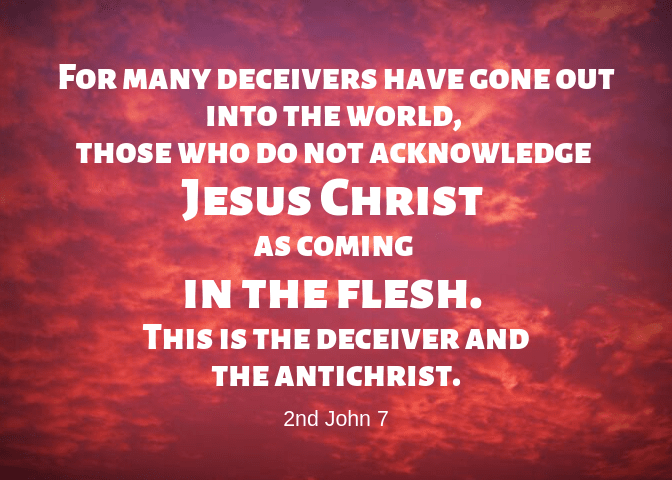
“For many deceivers have gone out into the world, men who will not acknowledge the coming of Jesus Christ in the flesh; such a one is the deceiver and the antichrist.”

We believe that “the coming of Jesus Christ in the flesh” means that the Messiah has come, and that he is the real human being, Jesus.

When John was writing there was already a teaching, today called Docetism, which claimed that Jesus wasn’t a real human being but only “seemed” or “appeared” to be a human. “Docetic” is from a Greek word meaning “an apparition, a phantom” and therefore Jesus only “seemed” to be human. According to this theory Jesus couldn’t be “flesh”, a real human, since the world and flesh are corrupt the “spiritual Christ” couldn’t be directly involved in it.

Traditional Christianity is not entirely docetic but tends toward Docetism since it claims that Jesus only “took on flesh”. If Jesus only “took on flesh” then he is not a real human being, not a real human person. Unfortunately, traditional Christian belief by definition denies that Jesus the Messiah is a real human person. Because, if Jesus is an eternally pre-existent God-person, he can’t be a real human-person, because then he would be two persons (a god-person and a human-person). So traditional Christianity beginning in the centuries after Jesus was on earth began to say that Jesus was a god-person who only “took on flesh”. But a pre-existent god-person who only “took on flesh” is not really a human person. He only “seemed” to be a human person.

John tells us differently. He emphasizes that Jesus is a real human person.

“Jesus” is the name of the child born in Bethlehem, not the name of a pre-existent deity. This Jesus is the Messiah (Christ) who has “come in the flesh”. “Christ, Messiah” is never a title for God himself in the Scriptures. It is a title for the “Anointed” one chosen by God.

Jesus didn’t just seem to have flesh (Docetism), and didn’t just seem to be a human person (Traditional Christianity).

Jesus the Messiah has real human flesh (now raised from the dead, glorified, immortal).

Jesus the Messiah is a real human person, not a god-person just dressed up in human flesh.

See our comments on 1 John 2:22 and 1 John 4:2 earlier this week for more description of what John did NOT say when he said that “Jesus Christ has come in the flesh.”

“Don’t receive him into the house”, 2 John 10

2 John 10 is a verse that can easily be taken out of context and abused. “If any one comes to you and does not bring this doctrine, do not receive him into the house or give him any greeting.” A person can make up any false doctrine, and then say if someone doesn’t agree with it, “don’t receive him into the house”.  This is what Traditional Christianity has done. Traditional Christianity, denying that Jesus is a real human person, made up a false doctrine in the centuries after Jesus, claiming: “Jesus is pre-existent eternal God who took on flesh”. Then once that false doctrine was established, Traditional Christianity said: “Don’t let anyone who doesn’t agree with this doctrine into the house”. See our comments to 1 John 2:19 (this past Sunday) about many anti-christs who have come into the world.

God, and God’s Son, 2 John 3

The beautiful greeting that the author sends God’s children is also a fitting departure blessing.

“Grace, mercy, and peace will be with us, from God the Father and from Jesus Christ the Father’s Son, in truth and love.”  There is only One God, the Father. Jesus the Messiah (Christ) is God’s Son, and we as God’s children are Jesus’ brothers and sisters.


Bill & Stephanie Schlegel

The Son of God

1 John 5

1 John 5 5

This chapter was especially significant for our family about a year and a half ago when I (Bill) was coming to understand that God is One and that Jesus is His human Messiah. My wife points out the irony in the fact that while Trinitarians often go to the Gospel of John and the Epistle of 1 John for presumed evidences of the deity of Jesus, it was these two books that showed us that God is One person, and Jesus is God’s designated human Messiah.

1 John 5:1 “Everyone who believes that Jesus is the Christ (Messiah) has been born of God, and everyone who loves the Father loves whomever has been born of him.”

How tragic that people who believe that Jesus is God condemn those who believe that Jesus is the Messiah. They say that unless you believe that Jesus is God, you are “denying Christ”. What a strange twist of Scripture. The Scripture says that “anyone who believes that Jesus is the Christ (Messiah) is born of God…”

This Scripture does NOT say you are born of God if you believe that Jesus is:

  • A God-Man
  • co-eternal (“pre-existing”) and co-equal to the God the Father
  • of the same substance as the Father.
  • One person of a trinity in a godhead

These are all human inventions.  We should not turn to human inventions (5:21) while abandoning God our Father’s revelation of Himself and His testimony that Jesus is the Christ (Messiah). We don’t want to call God a liar (5:10) by twisting or distorting what God said, or by claiming God said something He didn’t.

“Jesus” is the name of the human person, born in Bethlehem. It is not the name of a pre-existent person of an eternal godhead. This human Jesus is the Christ (Messiah). This same human Jesus is the “Son of God” (5:2) a title which is parallel to and in many ways synonymous with “Messiah/Christ” (2 Sam. 7:14, Psa. 2:1-7). “Son of God” does not mean “God the Son”. There is no “God the Son” in the Bible.

The person who believes that Jesus is the Messiah is a child of God. If you love God, you will love that person, God’s child. If do not love that person, or reject that person, or call that person a heretic, the implication is that you do not love God the Father. Because whoever loves God the Father loves God’s child (5:1).

To love God’s child (the person who believes that Jesus is the Messiah) is a commandment from God (5:2-3; 3:23).

1 John 5:20 is a verse that Trinitarians claim shows “the deity of Christ”. Such a claim shows the weakness of evidence for the “deity of Christ” in the Scriptures. Their claims depend on dubious interpretations of a handful of Scriptures. For instance, from the whole Book of Romans, Paul’s treatise on matters of great theological importance, Paul supposedly told us that Jesus is God in one verse (Romans 9:5)!

I don’t think so.

There is a better way to understand Romans 9:5, just like there is a better way to understand 1 John 5:20. Below is a translation (RSV) that gets it right. I have capitalized “Him” for clarity whenever the pronoun refers to Almighty God:

“And we know that the Son of God has come and has given us understanding, to know Him who is true; and we are in Him who is true, in His Son Jesus Christ. This is the true God and eternal life.”

In short, “This is the true God” does not refer to Jesus Christ, but to the One who is called two times “Him who is true” (cf. John 17:3), who is the Father of Jesus. Jesus the Messiah is His son.

Bill & Stephanie Schlegel

The Love Chapter

1 John 4

i John 4 11

This chapter starts out with an admonition to “test the spirits to see whether they are of God.” Not every teaching or spirit is true. There is a very important test which can be used to know if a spirit is from God, or not. “By this you know the spirit of God: Every spirit that confesses that Jesus Christ has come in the flesh is of God” (4:2).  The test does NOT say:

  • that Jesus Christ has come in the flesh and yet is fully God
  • that God has come in the flesh as Jesus Christ, taking on a human nature
  • that Jesus Christ came from some pre-existent state into the flesh.

We must be very careful to read the text for what it says and not read into it what it doesn’t say! The phrase “come in the flesh” means that Jesus the Christ (Messiah) is a real human being, not just dressed up like one.

1 John 4 is actually the “love chapter” in the Bible as love is mentioned 26 times, almost three times as many times as in 1 Corinthians 13 (9 times). A friend once read this chapter as a devotional thought on Valentine’s Day, and it stuck with me as the “love chapter.” So much so that when I read it last February 14th, I thought that maybe the children’s song could also go “Yes, God loves me, yes, God loves me… the Bible tells me so.”  Ultimately, it’s God’s love that ignites our love for others through His Son, Jesus the Messiah. A key verse that summarizes this chapter of love showing how love is of God is verse 9.  “In this is love, not that we loved God, but that He loved us and sent His Son to be the propitiation for our sins.”

God took the initiative, motivated by love, to remedy our sin problem.

Knowing that “God is love” (4:8,16) should motivate us to love others. But the author is not calling for a hippie kind of “All you need is love, love”. He is admonishing us to a love of other “brothers” who believe that Jesus, the human Jesus, is the Messiah/Christ (5:1). This admonition to love is a call for unity among like-minded believers, because they are family as the children of God. The way we love other like-minded believers whom we can see demonstrates how much we love God, whom we can’t see. And this commandment we have from Him, that the one who loves God should love his brother also (4:21).

Beloved, let us love one another, for love is from God, and whoever loves has been born of God and knows God. (4:7)


Bill & Stephanie Schlegel