Spirit Grown

Old Testament: 2 Samuel 3 & 4

Poetry: Psalm 70

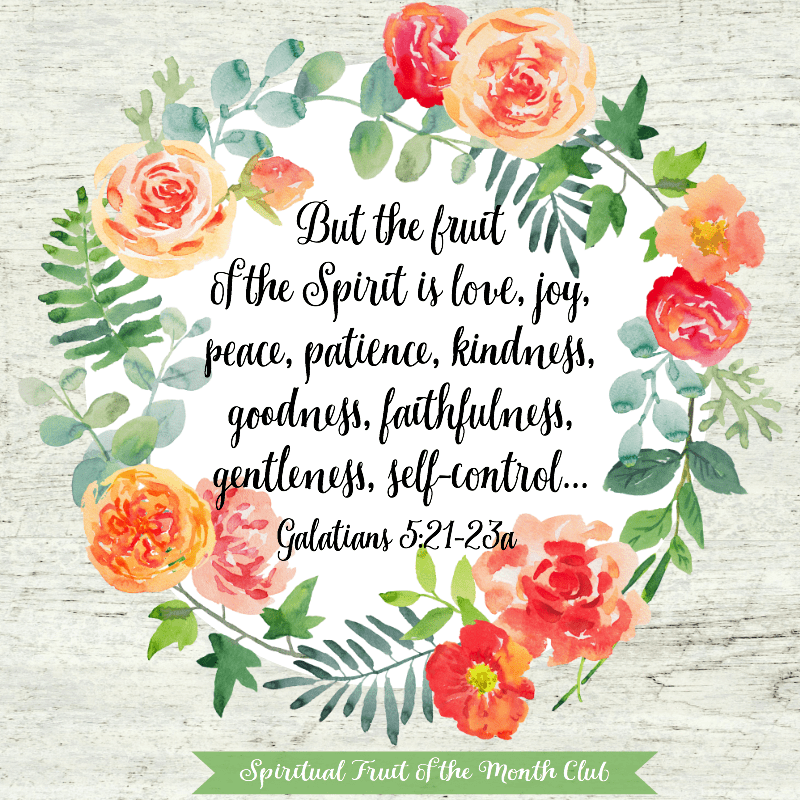
New Testament: Galatians 5:22

My understanding of the fruits of the Spirit has evolved quite a bit over time. I used to think that I needed to strive to demonstrate that fruit in my life and I would get so frustrated every time I would inevitably fall short. I felt like such a disappointment to God. It was actually an egotistical way to approach the matter. John 15:1-8 gives us insight into how we can bear good fruit in our lives:

1 “I am the true vine, and my Father is the gardener. 2 He cuts off every branch in me that bears no fruit, while every branch that does bear fruit he prunes so that it will be even more fruitful. 3 You are already clean because of the word I have spoken to you. 4 Remain in me, as I also remain in you. No branch can bear fruit by itself; it must remain in the vine. Neither can you bear fruit unless you remain in me.

5 “I am the vine; you are the branches. If you remain in me and I in you, you will bear much fruit; apart from me you can do nothing. 6 If you do not remain in me, you are like a branch that is thrown away and withers; such branches are picked up, thrown into the fire and burned. 7 If you remain in me and my words remain in you, ask whatever you wish, and it will be done for you. 8 This is to my Father’s glory, that you bear much fruit, showing yourselves to be my disciples. (NIV)

The critical missing component of my approach was that if it’s a fruit of the Spirit, the fruit produced is a result of the Spirit—not our own efforts. So our effort should not be put into displaying those qualities, but rather drawing closer to the source of that Spirit so that those qualities naturally spring forth. “Apart from me you can do nothing” (verse 5). We are to abide in Jesus since he is the vine and we are the branches. Our Heavenly Father is the gardener and He prunes us in order to increase our fruitfulness.

I find the aforementioned passage to be very encouraging. Our human nature is often inclined to do the very opposite of the fruits of the Spirit, so if we try to master them by our own merit, we are destined to fail. However, God’s word clearly just told us that we cannot bear any fruit apart from Christ. The key is to draw closer to him and to let God prune away the bad stuff in us.

I think David is a great role model in today’s passage in Psalm 70. He is not looking inward and trying to pull from his own strength. In verses 1 and 3 we see where he recognizes his true source of strength.

1 Hasten, O God, to save me;

    come quickly, Lord, to help me.

3 But as for me, I am poor and needy;

    come quickly to me, O God.

You are my help and my deliverer;

    Lord, do not delay.

-Kristy Cisneros

Reflection Questions

  1. Contrast the fruit of the Spirit with human nature? What does each look like and sound like?
  2. Does your life display more human nature (living by the flesh) or evidence/fruit of the Spirit? When do you slip into more human nature characteristics? (when you are worried, stressed, hurried, selfish, etc…)
  3. How can you stay attached to Jesus? How can you make sure his words remain in you? How can you draw closer to the source of this good fruit?
  4. What can you learn from David and apply to your life today?

Good Fruit, Bad Fruit

Old Testament: Genesis 29 & 30

Poetry: Psalm 12

New Testament: Matthew 12

Have you ever eaten a fresh orange straight from a tree? Or maybe an apple from an orchard? Fresh fruit is SO good. I know that some of you are currently in the thick of a snowy, cold winter. For those of us in the Southwest section of the U.S. it’s actually one of our growing seasons, believe it or not! Orange trees are fully loaded with fruit, here in Phoenix, Arizona. Well…most of them….

I have a small little tree right in the middle of my backyard. I did not plant this tree. Whoever planted it didn’t leave any information about what kind of tree it was. I’m a midwest girl and I could not tell you what kind of leaves each fruit tree has. This little dude is small enough that it isn’t growing any fruit yet (although maybe that’s more on us than this tree!). Since I can’t see its fruit, it is hard to tell what kind of tree it is. (For the record, I did google it and I think it is an orange tree.)

In Matthew 12:33, Jesus confronts the Pharisees by using trees as a metaphor for their speech and hearts. He says “Either make the tree good and its fruit good, or make the tree bad and its fruit bad, for the tree is known by its fruit.” He’s calling them out because they were attempting to “speak good” things while their hearts were “evil”. Woah. Now, Jesus was speaking to this group of people, however, I think we can take something away from his instruction. 

The Bible talks A LOT about our tongue (the words we say), and our actions. In fact, our reading in Psalms today mentions this as well! Verses 3-4 talks about those who boast with their tongue. In Ephesians 2, we see that God’s grace is what saves us so that we cannot boast about our own abilities and actions. (Kinda like the Pharisees were trying to do in Matthew 12). It is by His mercy that we can have a relationship with Him. Because of this, our “tree” can be rooted in Him – the ultimate source of life. He is the reason that we must not be conformed to the world but instead, be transformed by the renewal of our minds (Romans 12). THIS is where the good fruit comes from!

Jesus says in Matthew 12:34 that out of the abundance of our hearts, the mouth speaks. Our words are the outward reflection of our hearts. Proverbs 18:21 says that death and life are in the power of the tongue. What we say has an influence on people. I’m sure all of us can attest to this in our personal lives. 

I want to encourage and prompt you with this: we are called to be the salt and light of the world. How do we do those things? By our words and our actions. God has given us a calling to bring His light, love, and goodness to those around us. I pray that our hearts and minds may continually be transformed to be more and more like Jesus. Because of this, we will bear good fruit so that others can see God’s goodness and love.

-Katelyn Salyers

Reflection Questions

  1. How is your fruit looking and tasting? What do others see coming from your life? What does Jesus see? 
  2. What fruit have you produced that you want to create more of? What fruit from your life would you call bad fruit? How can you alter production to produce more of the good fruit and less of the bad fruit?
  3. Jesus goes on to say, “For by your words you will be acquitted, and by your words you will be condemned.” (Matthew 12:37) Do we often forget the power and consequences of our words? Will your words spoken last week acquit or condemn you? How can you better control the words you say?

Happiness vs. Joy

Joy

Joy is the foundation for a positive life.  Our world lacks joy and has way too much fear, worry, discouragement, and depression these days.  We need to fully trust God and have joy even in the hard moments and seasons of life. It we are not fully trusting our Father, then we will never be able to experience pure joy.

Biblical joy, the true joy, comes from filling the spiritual void with good relationships, mostly the intimate relationship with the One who is pure joy.  Jesus put it this way: “I am the vine, you are the branches. He who abides in Me, and I in him, bears much fruit” (John 15:5). That fruit includes much joy!

The Bible speaks much more often of joy than of being happy. “Hap” means chance and is the root of several words— happen, happening, haphazard (dependent on mere chance), hapless, happenstance (a chance circumstance) and happy.

Happiness is a glad feeling that depends on something good happening. God wants you to experience happy times (as long as God approves of what is happening). But His greater desire is that you have unconditional joy. Jesus said His joy would “remain in you” and “your joy no one will take from you” (John 15:11; John 16:22).

Think of joy as a strong foundation that supports a variety of healthy emotions, including happiness. The long-range evidence of joy is general gratitude, contentment, optimism, a sense of freedom and other positive attitudes.

-Katie-Beth Fletcher

A Character Defined by Love

Fruit of the spirit

The Holy Spirit produces these things in our life.  It is important that we know and understand them well, so that we can apply them to our lives.  When the fruit of the spirit is at work in our lives, amazing things happen. Your whole life blossoms and bears fruit.  One of the most wonderful fruits of all is the giving and receiving of love.

The word love can mean many different things, as you can see from the many different dictionary definitions.  We also find different kinds of love throughout the Bible, four of them specifically. Eros is the Greek word for sensual or romantic love.  Even though the term is not found in the Old Testament, Song of Solomon vividly portrays the passion of erotic love.  Storge is a term for love in the Bible that you may not be familiar with. This Greek word describes family love, the affectionate bond that develops naturally between parents and children, and brothers and sisters.  Philia is the type of intimate love in the Bible that most Christians practice toward each other. This Greek term describes the powerful emotional bond seen in deep friendships, this is the most common type of love.  Agape is the highest of the four types of love in the Bible. This term defines God’s immeasurable, incomparable love for humankind. It is the divine love that comes from God. Agape love is perfect, unconditional, sacrificial, and pure.

There are so many people who go through life without feeling human love.  However, God’s plan is for every person to eventually experience His love flowing through them, so that each person can say “my cup runneth over with love.”  The funny thing is that when people are trying to feel love they often forget to read the greatest book ever written about relationships, the Bible. The Bible reveals how we can experience love for God and people that exceeds human capability.  The highest and purest form of God’s love is God’s divine and sublime love that He offers to share with us!  The perfect example of the ultimate nature of God is, “He who does not love does not know God, for God is love” (1 John 4:8).  God wants to transform us so that our character is also defined by love.

-Katie-Beth Fletcher