
Devotion by Jeremy Martin (TN)
What a powerful moment in history. God has redeemed and claimed His chosen people the Israelites, and is laying down a few ground rules for their behavior towards Him and towards each other. The 10 commandments have just been given a few chapters back, and Ex 23 begins with a continuation of some guidelines for interaction. Read through these carefully, do you see a common theme? These rules that God is giving really highlight His character. When I read through these (Ex 23:1-19) what stands out to me isn’t that God wants a bunch of rules followed, but that the character of God is shining through. Look closely.
God is just. God is merciful. God is forgiving. God is loving. God wants us to respect each other, and Him. God will punish the guilty. These characteristics are easily seen by the rules he asks us to follow. When I read these verses, 23:19 really stands out to me: “You shall not boil a young goat in the milk of his mother.”. Why? Because that would be unjust, and not fair. God is so full of love for all of his creation, that he’s concerned with even a baby goat, and is concerned about justice for it. Which makes sense, when you consider that the earth and all that is in it belong to God (Ps 24:1), and you consider the beauty of God’s character.
If we turn ahead a few chapters to Ex 34, God actually tells Moses (1) who He is and (2) what His character is like. This is one of my dad’s favorite verses: “…Yahweh, Yahweh God, compassionate and gracious, slow to anger, and abounding in loving-kindness (or, mercy) and truth; who keeps lovingkindness for thousands, who forgives iniquity, transgression, and sin; yet He will by no means leave the guilty unpunished…” (LSB translation, Ex 34: 6-7). All of the “Children of the Book” agree on the nature of God, because He has revealed it to us. In the Quran 1:3 it describes God as “Most Gracious, Most Merciful.” (a loving nod to some of our Muslim brothers and sisters). I urge us all, let us exhibit God’s characteristics within ourselves, not only to our creator but to our fellow creation.
In Ex 23:20-23 we once again clearly see the concept of “shaliah” demonstrated, and it’s important to note that God actually clearly states “My name is in him”, granting the angel full authority. I suppose the American equivalent would be “active Power of Attorney”, but that doesn’t quite cover the fullness of the concept. We also see Jesus stating clearly in John 17:11 that he has been given this same name, the name of God, so he is acting with the full authority of the God who sent him. If you’d like a more detailed understanding of “shaliah” you can scroll back to the 1/27/2026 devotional, or just ask a jewish person.
In Ex 24, God cuts a covenant with Israel. The phrase “cuts a covenant” was at the time quite literal and involved animal sacrifice and blood, and was considered a binding promise. In this chapter we see a beautiful moment where God speaks to a large number of the priests and elders of Israel and makes a deal with them. In Ex 24:7 it states “Then he took the book of the covenant and read it in the hearing of the people; and they said, “all that Yahweh has spoken we will do, and we will be obedient!”” (LSB translation). Can you just feel the excited vibe amongst these people, who have witnessed an amazing and miraculous covenenat being formed, with the glory of Yahweh “like a consuming fire on the mountain top, in the eyes of the sons of Israel”?
What an amazing event! Never before had something like THIS happened, this was huge! This is what would be described by most folks as a life altering event, something that would change your outlook and destiny, something that would inspire you for a lifetime and change the very fiber of your being for the better. How long do you think something like this would stick in your memory?
40 days, that’s the answer. Moses disappears up the mountain, into the fiery glory of God and is gone for 40 days and nights before it all goes bad. While God and Moses are chatting, the sons of Israel are getting restless. Despite seeing miraculous signs and wonders, if you flip ahead to Ex 32: 1-2 it says “Then the people saw that Moses had delayed to come down from the mountain. So the people assembled about Aaron and said to him, “arise, make us gods who will go before us; as for this Moses, the man who brought us up from the land of Egypt, we do not know what has become of him.” (LSB translation). Forty days. It’s just embarrasing. It’s really a good thing that God is so forgiving and merciful, because that could very easily have been turned into what the scientific minded folk would call an “Extinction Level Event” for the Israelites.
God not only doesn’t wipe them out, but He continues to shelter them, to love them, and to keep them safe and fulfill the promises he’d made both to them and to their ancestors Abraham, Isaac, and Jacob. WHY? Because God always keeps His promises. Because he is the Most Merciful, the Most Gracious.
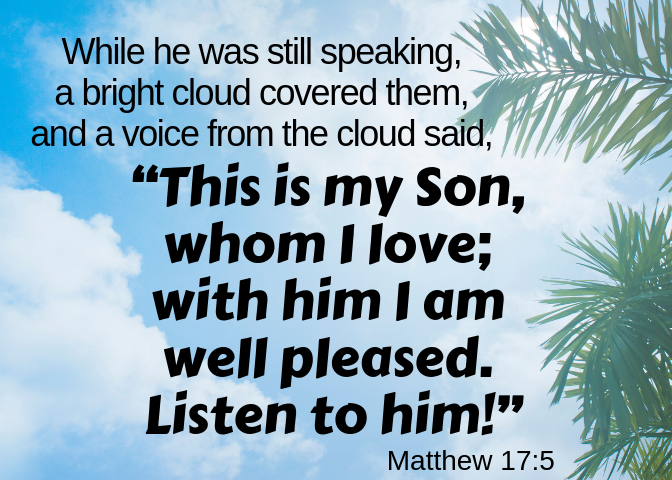
Do you need further proof? Flip over to our NT reading today. In Matt 17:5 God states audibly (for the second time) “This is my beloved son, with whom I am well pleased; listen to him!” (LSB Translation). Then later on, he offers up this man Jesus, His own beloved obedient son, as a sacrifice to grant redemption to humanity and to cut a covenant of salvation. Folks, let me tell you something; I’m a father, and although I absolutely do love a lot of you people out there that I know, if it came to a choice between you and my son…well, let’s just say you would not come out ahead in the equation, I’m sorry. “But God…” (I love that phrase) is the perfection of character, the perfection of love, the highest example of what our own character should be.
What a beautiful God we serve. I know that He is beautiful, because His creation is beautiful. The mist as it gathers at the tops of the mountains is beautiful. The sun arising through the clouds and shedding new light on the world every day is beautiful. YOU are beautiful, as is the entirety of the creation of God, and the voice that spoke all of this creation into being. It should humble and awe you, when you think about the utter depth of the love that God has towards all of His creation. We do not deserve it… “but God…” is the most compassionate, the most merciful, praise His holy name.
REFLECTION QUESTIONS:
- Stop for a moment and think. How many times has God done something amazing and miraculous in your life?
- How long did it take after that amazing and miraculous thing that God did for you before you “moved on” in your mind?
- Why do you think that we, as humans, have this inclination, and what can we do better to hold on to that “awe and wonder” that is rightfully due our God?
- Are WE gracious, compassionate, and merciful to our fellow creation? (Answer for all:) What about people of different denominations? Different cultures? Different faiths? Our “enemies”? Why, or why not? What can we do better?
PRAYER:
Father God, thank you.
You are the Most gracious, the Most merciful. Time and time again we have disappointed and failed You, we’ve broken the covenants that we’ve made with You, but You forgive us over and over. Father, help us to have Your character, to love our neighbor as ourself, and to never forget You who gave us life, breath, and all things. Thank You for Your never ending mercies, which are made new every morning. Help us to humbly seek Your face, to obey Your will, and to be servants who please You. Thank you Yahoveh God, in Jesus name, Amen.
 Seek Grow Love