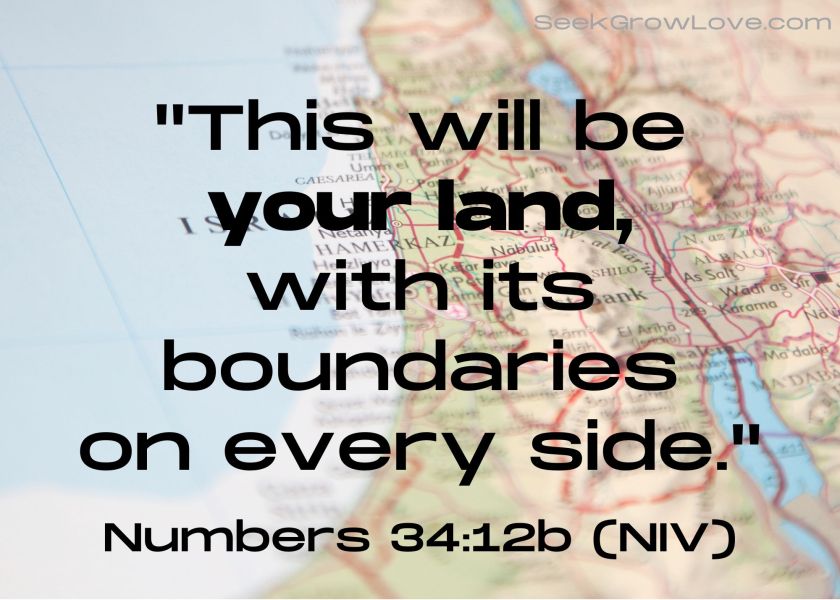
Want to see a map of the borders of the Promised Land?! My husband, Bill Schlegel, wrote the Satellite Bible Atlas (available on Amazon). It’s filled with real photographed maps that he’s added the sites and commentary to. (Sounds like the way I’m doing these devotionals, but he’s much more articulate;). You can go further in depth to your Bible readings with this atlas to help, especially in the upcoming books of the judges and kings. 🙂 He wrote it for the students to use on field trips and classes in Israel.
In the midst of defining the border, God appointed cities for refuge for within. “These six cities shall be for refuge for the people of Israel, and for the stranger and for the sojourner among them, that anyone who kills any person without intent may flee there.” (35:15) Those must’ve been interesting cities with innocent and guilty persons awaiting judgment. Some probably took advantage of them and for others they found refuge they needed .
Nowadays our homes can be a place of refuge. As a mother of five I can testify to that, receiving family members after long days of work, sporting events, school, and other hard tasks. It’s comforting to find refuge in one’s home and provide that for others too looking for peace.
A hammer can build things up and it can tear things down. “The wisest of women builds her house, but folly with her own hands tears it down.” Proverbs 14:1 It’s important we use our tools to build and help others rather than tear them down.
Another place we can greatly find refuge is in God. “The name of the LORD is a strong tower; the righteous man runs into it and is safe.” Proverbs 18:10 Especially after coming to the one God faith this verse means so much more to me. His personal name YHVH/LORD is strong and stable, mentioned some 6,828x in the Old Testament. That’s one out of every four verses making it 25% of the time. It’s powerful just seeing it so many times. Reading the Bible on a regular basis helps one to refocus and gain strength and peace. We can take refuge in God and His Word.
-Stephanie Schlegel
REFLECTION QUESTIONS
1. Where do you find refuge on a daily basis? How has it brought you relief?
2. Is your home a place of refuge for others? Maybe there’s a hurting person you can invite over this weekend to share a meal or coffee with?
3. Is the name of the LORD/YHVH a strong tower for you? What’s a way that could improve that even more?
So things are not going well for the Israelites. In yesterday’s reading, we see that distrust in God led to the destruction of many and the curse of roaming around the desert – which would eventually lead to the death of everyone over 20 years old when they grumbled against the Lord. In today’s reading, God first curses the people by demanding offerings brought in fractions. Frankly, I would have found this worse than being stuck in the desert. 2/10, ⅓, 3/10, ¼ , WOW! This would definitely be a sacrifice of praise for me!
Now you would think that having seen God’s miracles and blessings, people would accept Moses as their human leader and do what was required of them. But in Numbers 16, a man named Korah, a Levite, decides he’s had enough. I don’t know if he blames Moses for the things that have gone wrong on this journey or he just liked picking fights with those in leadership. But long story short, God decides He’s not even going to mess around and swallows Korah, along with his cronies who sided with him and all their households and all that they owned.
In Numbers 17 God uses the familiar rod (the same rod He turned into a snake, sent a few plagues and split the Red Sea) to prove that Moses and Aaron are the leaders He anointed. God had Moses collect a rod from each of the 12 tribes of Israel, and write the name of each tribe on the rods, Aaron representing the Levites. He would then cause one to bloom and the one that blooms was the rightful leader. I don’t think it’s a spoiler to tell you which one bloomed… to the point of producing almonds! I would think that seeing the ground opening up and swallowing a lot of people who had been complaining against Moses and Aaron would have been enough for me to keep my thoughts to myself. However, apparently, there was still some complaining but after the budding of the rod, no one questioned Aaron’s position after that, Yeah…I kind of think that’s weird too!
Today’s reading ends with, “Behold, we parish, we are dying, we are all dying! Everyone who comes near the tabernacle of the LORD, must die. Are we to perish completely?” Cheery. Even cheerier… WE are all dying. The people of Israel (at that moment) finally realized they were one mistake away from death. They needed a savior. WE need a savior. I am so grateful this is not the end of the story.
-Maria Knowlton
Reflection Questions
What was Korah’s (and those who aligned with him) sin, or sins?
How did Moses handle this rebellion?
How do you tell who God has chosen as Christian leaders?
Some of you may be old enough to remember the old Sunday School song, “12 Men Went to Canaan Land” and you held up your ten fingers and then gave the double thumbs down when you sang “10 were bad.” Then you held up two fingers and gave two thumbs up while you sang “and 2 were good!”
In today’s reading we see the stark difference between fear and faith and why 10 were bad and two were good.
In chapter 13, twelve spies, one from each tribe in Israel, came to scope out the land of Canaan, the land flowing with milk and honey, the land God had promised.
In his commentary, David Guzik, reminds readers that there was no need for this reconnaissance mission. According to Ezekiel 20:6, God had already searched this land and promised it to them. So some people were already distrusting God from the beginning.
“Some saw giants big and strong,” 10 of the Israelite spies came back with scary accounts of many giants in the land that made the spy’s look like grasshoppers. One theologian stated that “fear performed the miracle of adding a cubit to the stature.” 😉 and on top of that, the city is heavily guarded! Obviously, there was NO way to defeat them!
“Some saw grapes in clusters long.” All of the spies agreed that the land was made of fertile soil and it would be easy to grow wonderful food there. This was definitely the place God had promised them!
“Some saw God was in it all,” But only two spies, Joshua and Caleb, had unshakable faith that God would deliver what He had promised and bring them into this land.
I love how F.B. Meyer put it, “ They saw the same spectacles in their survey of the land; but the result in one case was panic, in the other confidence and peace. What made the difference? It lay in this, that the 10 spies compared themselves with the giants, whilst the two compared the giants with God.” WOW! Did that statement convict you?!? It sure convicted me!
It’s easy for us to figure out who was good and bad back in the Old Testament. Hindsight from over 3000 years ago is 20/20. But what about you? When troubles come your way, which spy describes your response? Are you comparing you to your troubles, or your troubles to God?
“10 Were Bad and 2 Were Good!” Which one are you?
-Maria Knowlton
Reflection Questions
How is Caleb described in Numbers 14:24? is there anyone you know today who could also wear that description well?
“10 Were Bad and 2 Were Good!” Which one are you? Do you generally compare yourself to your troubles and experience fear and panic? Or, do you more often compare your troubles to your God and rest in faith and peace?
What was the reward for Caleb and Joshua? What was the punishment for the 10 spies? What was the punishment for all those who listened to and trusted the report of the spies? Who are you listening to today? How does who you listen to today determine whether you will receive a reward or punishment?
Throughout history God has lead his people many ways. To a few he spoke audibly, others in dreams but he used the tabernacle to lead the Israelites. They set up the tabernacle to the very detail as God requested. After it was complete, 40:34 says
Then the cloud covered the tent of meeting, and the glory of the Lord filled the tabernacle.
God made his presence known and clearly began to lead the people on their travels. Whenever the cloud left the people knew it was time to get up and go. Whenever the cloud would stop the people would also stop.
Sometimes I wish that God led us today in such an obvious manner. I need fool proof directions just to get across town let alone the race we are called to run as followers of Christ.
Although it is not as obvious, God still leads his people. He still tells us when and where to go and also when and where to stay.
The tabernacle was a dedicated place for God in the lives of the Israelites. They gave of their time, energy and resources to have a spot for God in their lives. Many often claim that they want direction from God but have not made space for his leading in their lives. They have not made time or space for God.
After the ascension of Christ, the believers were blessed with God’s presence in an even better way than the tabernacle. God’s power, his presence, his spirit can dwell in YOU!
Will you make time and space in your life – for the glory of God to lead you where he would have you go? And further, are you willing to follow that lead?
John Wincapaw
(originally posted for SeekGrowLove on February 12, 2020)
Reflection Questions
Can you give some examples of God’s leading in your life – in big or small ways?
What types of preparation and space making would God like to see you involved in before He reveals where He wants you to go next? Unlike Moses, are there any directions you haven’t completed yet that might be a helpful pre-cursor to the big journey God wants to lead you on next?
“Will you make time and space in your life – for the glory of God to lead you where he would have you go? And further, are you willing to follow that lead?” What does it look like to make time and space for God?
I’ve been a pastor for 35 years (actually, 40 now, as this was written in 2020). I’ve pastored local congregations. I’ve served on the mission field in a different country. I’ve served as a hospice chaplain with people who have been diagnosed with life ending diseases and as a hospital chaplain with people who are very sick, or having surgery, or recovering from surgery or recovering from pneumonia, or have attempted suicide or are struggling with mental health issues and need extra support. I preach each week to people in the nursing home and those who are suffering from Alzheimers and other forms of dementia. I’ve stood at the bedside and prayed with families whose loved one is about to die or who has already died. I’ve prayed blessings over newborn babies and people over 100 and everywhere in between.
The one common need I find over and over again is the need of the person going through crisis to know that God is with them. Everyone goes through challenges and difficulties, losses and pains in life. It’s not a question of, “Will bad things happen?” or even, “Why do bad things happen?”, it’s more a case of, “When bad things happen what resources do you have to draw from to help you get through it?”
As God’s people, Israel was being transformed from slaves to the people of God who were to be a light to all nations, they were going to face many challenges on that journey of transformation. They had a desert to cross. They had numerous enemies to face who all wanted to prevent them from reaching the promised land, and once they arrived in the land, there were enemies who wanted to take the land away from them and turn their hearts away from undivided loyalty to God.
To get through these challenges Israel needed regular assurance that God knew them and that God was with them. If you’ve been a Christian for most of your life, it is likely that you know these things already. You know that God knows you by name, that before He formed you in your mother’s womb he knew you. You know Jesus’ promise that he will be with you always, to the end of the age, right? There’s no way you would ever forget that God knows you and that Jesus is with you, right? (More about that in a minute).
The people of Israel were spiritual babies. They were just starting to learn about who this God is and to get used to the idea that God would stay with them and not abandon them. They needed a lot of reminders. So, in addition to having a tent of meeting constructed in their midst (see yesterday’s devotion) they needed to know that they had representatives who would go before God regularly on their behalf. So God set aside a group of men who would serve as priests. They had a special calling and were set apart or consecrated to do the work of a priest.
Today’s reading describes the various pieces of clothing that the priests wore and the purpose of each item- ephod, breast piece, robe, tunic, turban, urim and thummin, gold plate, sashes etc… of all of these descriptions in Exodus 28 one in particular stands out: “Engrave the names of the sons of Israel on the two stones the way a gem cutter engraves a seal. Then mount the stones in gold filigree settings and fasten them on the shoulder pieces of the ephod as memorial stones for the sons of Israel. Aaron is to bear the names on his shoulders as a memorial before the Lord.” (11-12). So when the priest went before God, he went bearing the names of the sons or tribes of Israel. This was a reminder that they were there on behalf of the entire people of God. The message for the people was that the priests would bear on their bodies a constant reminder to God of His beloved people.
We might ask the question,” if God is perfect and all knowing, why would he need such a reminder? ” I would say that the reminder wasn’t for God as much as it was for the people to have the assurance that they were being constantly brought before God. Prayer works the same way for us. When someone prays to God on our behalf, they aren’t exactly bringing new information to God’s attention. God knows our needs before we ask. One of the benefits of intercessory prayer is to remind us that we are not alone in the midst of our needs. When I was first diagnosed with cancer and underwent surgery and radiation lots of people were praying for me. It brought me great comfort and encouragement to be reminded regularly that people were remembering me before God’s throne.
In Exodus 29 it provides a description of the rituals that were used to consecrate or set apart the priests for their duties of bringing the people before God. Notice how the consecration involved sacrifices and blood. In order for the priests to go before God on behalf of the people, their sin and guilt had to be covered over by blood. In fact, every day, morning and night, a lamb was to be sacrificed to God. “For the generations to come this burnt offering is to be made regularly at the entrance to the tent of meeting, before the Lord. There I will meet you and speak to you; there also I will meet with the Israelites, and the place will be consecrated by my glory.” (42-43)
This served as a constant reminder that God was holy and sinless, and that human beings are sinful and needed to be cleansed and forgiven of their guilt in order to come near to God’s presence. As a result: “Then I will dwell among the Israelites and be their God. They will know that I am the Lord their God, who brought them out of Egypt so that I might dwell among them. I am the Lord their God.” (45-46) These daily sacrifices served as a constant assurance to God’s people that He was their God and that He was with them.
As Christians, we are not required to sacrifice a lamb day and night in order to be assured that God is with us. Jesus is the lamb of God who takes away the sins of the world. He, as the high priest and the sacrificial lamb, went into the most holy place with his own blood and offered a sacrifice that covers over all of our sins once and for all. (Once you read the book of Exodus, the book of Hebrews in the New Testament is much easier to understand… check it out). When Jesus was first prophesied in Isaiah 7 it was said that he would be a sign that God is with us (Immanuel means God is with us). In the name of Jesus we can be assured that God is with us – not because we are perfect or sinless, we are no more sinless than the nation of Israel was, but we have been made holy by the blood of Jesus.
Earlier I asked the question: “There’s no way you would ever forget that God knows you and that Jesus is with you, right?” The fact is, we all have times when we forget that God knows us and that Jesus is with us. This is a danger when everything is going well in our lives- when we are busy enjoying the blessings that God gives us and are on a roll, we can get so caught up in enjoying the gifts that we forget to worship the one who gives them to us, God. It is also a danger when things are tough and we are hurting and feel all alone or worry that God isn’t answering our prayers. When we go through spiritual depression or the dark night of the soul we can forget that the Lord promised never to leave us. We need constant reminders, in the good times and the bad times. That’s why we need to gather regularly with other believers to find encouragement and strength, so we don’t forget. That’s why we need to regularly break bread and drink the cup at communion, to help us remember. You and I need ongoing reminders that God is with us, that God remembers us. We need to know others are bringing our names before God in difficult times, and we need to remember to bring others before God during their difficult times. We may not have to wear ephods and robes and rub lamb’s blood on us, but as Christians we are all priests and we all need to go before God regularly on behalf of each other and on behalf of people in the world, in the name of Jesus. Don’t forget to remember, God is with us and God will never forget you.
A number of years ago I led one of my churches through the 21 day Complaint Free Challenge. The challenge was to go for 21 days in a row without complaining. We each were given a purple wristband to wear throughout the challenge. You were to wear the wristband on the same wrist for 21 straight days. If you caught yourself complaining, then you had to switch your wristband to the opposite hand and start your 21 day challenge again. Some of the studies I read said that it takes most people about a year to go 21 consecutive days without complaining. I forget how many months it took me to get to that point.
What was the purpose? To help people break the habit of complaining. For many people complaining is simply a bad habit. Will Bowen, who invented the 21 Day No Complaining Challenge says that most people complain for one of 5 reasons using the acronym G.R.I.P.E.
Get Attention
Remove Responsibility
Inspire Envy
Power
Excuse Poor Performance
When we habitually complain to get attention, to remove responsibility (shift the blame), inspire envy, exert power or excuse our poor performance, we dig a behavioral rut and complaining becomes our default response to just about any situation. That’s a sinful habit from which we need to repent.
In order to break the bad habit, like any bad habit, one must counter the undesired behavior with more desirable behavior. The goal of the complaint free world experiment was to improve the world by reducing the amount of complaining that goes on. During that process I became aware of just how often I did complain. I don’t like hearing other people complain all of the time, I don’t think anyone does. Parents don’t like to hear their kids complain all of the time. Spouses don’t like to hear their husbands/wives complain all of the time. Children don’t like to hear their parents complain all of the time. Students don’t like to hear their teachers complain, and teachers, I’m sure don’t like to listen to their students complain. Churches don’t enjoy hearing their pastor complain all of the time and pastors don’t like hearing church members complain a lot the time. And guess what…even God gets fed up with human beings complaining all of the time.
In today’s reading, God has been busy taking care of Israel. He led them out of slavery to the Egyptians by performing ten amazing signs. When Israel was being chased down by Pharaoh’s army and looked like they were doomed for destruction, God miraculously parted the waters and brought them through on dry land. God led them by cloud during the day and fire during the night. God was taking them on a journey to a land that he was going to give them. God was doing nothing but good for them.
And how did God’s people respond to all of this goodness? They complained. We’re thirsty… we’re hungry. They sounded like a bunch of whiney kids on a long trip. If you’ve gone on a long trip, the experience is very different for the parents up front and the children in the back. Think about a family going on vacation. The parents are the ones preparing for the trip. Mom’s doing the laundry, packing everyone’s clothes, preparing snacks, arranging for neighbors to come and feed the animals and water the plants. Dad is making sure the car is running well, changing the oil, getting the mail stopped, gassing up the car, checking the route to make sure there are no road closures. The parents buy the tickets for wherever they are going, pay for the meals along the way, pay for the hotel rooms, make sure the kids have stuff to do in the car/van/suv. And what do the kids do? They complain: I’m hot… I’m bored… I’m hungry…I’m thirsty… I have to pee… sister’s looking… brother hit me… and are we there yet? I had 11 children and I know what I’m talking about here.
Imagine Moses… and God. They are moving roughly 2 million men, women and children across the wilderness toward the promise land. There are no McDonalds on the journey. There are no Holiday Inns with an indoor pool. There are no air conditioned SUVs with built in blue ray players and no iPhones or Nintendo Switches to keep them occupied. They are tired, they are hot, they are thirsty and hungry, and they are complaining… a lot!
If I’d been Moses or the Lord I would have been tempted to say “Ya’ll be quiet or we’re turning around and going back!” Fortunately the Lord, and Moses, have more patience and grace than I ever had:
Exodus 16:6 So Moses and Aaron said to all the Israelites, “In the evening you will know that it was the Lord who brought you out of Egypt, 7 and in the morning you will see the glory of the Lord, because he has heard your grumbling against him. Who are we, that you should grumble against us?” 8 Moses also said, “You will know that it was the Lord when he gives you meat to eat in the evening and all the bread you want in the morning, because he has heard your grumbling against him. Who are we? You are not grumbling against us, but against the Lord.” 9 Then Moses told Aaron, “Say to the entire Israelite community, ‘Come before the Lord, for he has heard your grumbling.’” 10 While Aaron was speaking to the whole Israelite community, they looked toward the desert, and there was the glory of the Lord appearing in the cloud. 11 The Lord said to Moses, 12 “I have heard the grumbling of the Israelites. Tell them, ‘At twilight you will eat meat, and in the morning you will be filled with bread. Then you will know that I am the Lord your God.’”
God heard their grumbling and he gave them quail and manna to eat. There it was, as much as they wanted. They were able to eat their fill. And after that they never complained again. Well, that’s not true…. before long they were complaining about being thirsty too.
What God should have done was give each of them a purpose wristband to remind them not to complain. It would take them a few more lessons before they quit complaining.
I’m sure God does get tired of hearing our complaining… but he still loves us and he even gives us ways to complain in the Bible. Many of the Psalms are called Psalms of complaint and/or Psalms of lament. Jesus himself, while he was on the cross prayed one of those Psalms of complaint/lament, Psalm 22 which begins: “My God, my God why have you forsaken me?” When we are suffering real pain, real sorrow, real trials, God wants us to turn those into heart felt prayer and we should. God is able to handle our complaints and do something about them. At the same time, too often our complaining comes from a place of ingratitude. The ungrateful complaining that fails to acknowledge and appreciate God’s blessings needs to stop; legitimate complaining for true hurt in faith is something God is ready and able to hear and respond to for his glory and our blessing.
Jeff Fletcher
(originally posted on February 4, 2020 for SeekGrowLove.com)
Reflection Questions
What could the Israelites have said instead?
What happens when you are around people who are complaining? What positive message could you share with a complainer?
Try it out just for today – how long can you go without complaining and grumbling? What could you say instead every time you catch yourself (almost) complaining? How long do you think it would take you to go 21 days without complaining? Will you take the 21 Day Challenge?
In our devotion yesterday Jeff Fletcher was describing the Dark Night of the Soul when it seems like God is distant. Certainly being enslaved for 400 years in a foreign land could have that effect. I wonder if even through all those years of painful toil if many or some Hebrew parents were still faithfully telling their children of the God of Abraham, Isaac and Jacob who had promised Abraham that his descendants would come out of that land of slavery after 400 years with great possessions and God’s judgment upon their former masters (Genesis 15:13). Was anyone still counting the years in anticipation? Were they talking to God about how He would show up? Were they watching to see how God might be acting on their behalf day after day while in slavery? I don’t know. But I hope so. In our reading today, there can be no doubt, God is at work and He shows up in some major ways – and also in some small surprising ways, too – but always faithful.
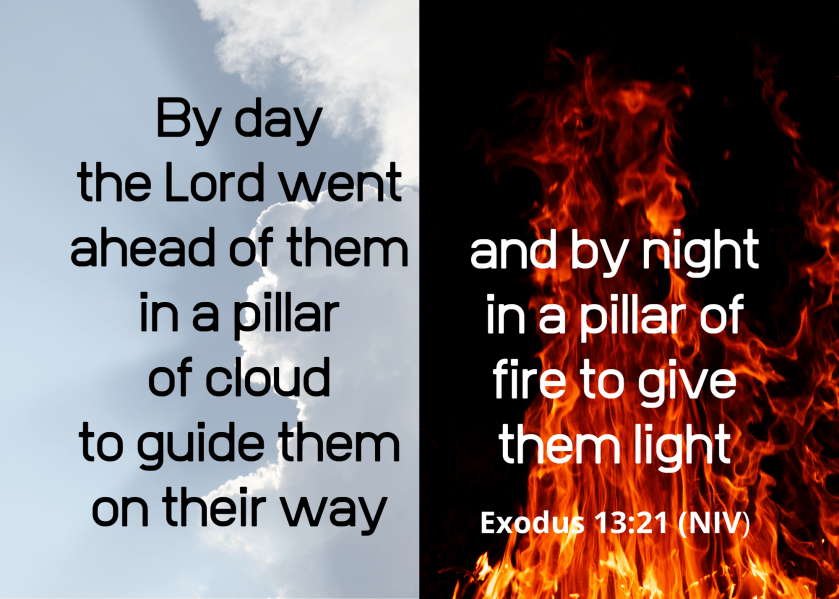
I will assume that you already have some knowledge of these events from Exodus 13-15. So, you already know of the amazing way God chose to lead the Israelites on their journey out of Egypt – with a pillar of cloud by day and a pillar of fire by night – spectacular! And you already know of God’s strong east wind that split the Red Sea with a wall of water on their right and a wall of water on their left as His cherished people crossed on dry land – astounding!
So, today I will focus on two of the smaller things – wheels and logs.
I don’t know about you – but I take great delight (maybe a little too much) in the picture of God at work in Exodus 14:25. Here the great God of the universe who has been directing the winds to create great mountains of water is watching from the pillar of fire/cloud which He specifically moved from in front of the Israelites where it had been guiding to the rear where it was protecting. So this great all-powerful God of the universe reaches down from on high to clog the chariot wheels of the advancing Egyptians who want to take back their slaves. Is there an adversary chasing you who wants to make you or someone you know a slave again? God is good at protecting His children, sometimes in ways I wouldn’t even think of. In big and small ways. God so loved the world. But we know everyone is not going to listen and play on His side. Some will play the role of adversary, but do not fear, our God knows how to clog their chariot wheels. Oh, and, make sure you are playing on the right team because the God who clogged their wheels also sent the mountainous walls of water crashing down on the Egpytians and none survived. His judgment is right and sure and coming at God’s perfect time not ours. And the whole world will know He is the Lord.
The second little example of God at work even in small ways in His big plans comes at the end of our reading today. The Egyptians are no longer a problem. Now, thirst is. They have traveled three days and have not found water. And when they finally reach water at Marah, they find the water is bitter, not just unpleasant to drink but likely unhealthy and perhaps deadly as well. The people grumble, Moses cries out to the Lord, and the Lord answers by showing Moses a log.
Thanks, God. This will help – if we want a campfire or need to start building a log cabin. But we really need water now. The Bible doesn’t record that Moses questioned God, but I might have. I love the partnership between Moses and God. God could’ve fixed the problem any way He wanted to. And if He wanted to sweeten the water with a log He could have easily picked up the right log and thrown it in himself – after all we just saw Him displace how many gallons of water and clog chariot wheels without any help from human hands. But more to His “normal” working – He shows Moses which log – and Moses simply steps up, pitches it in the water and God makes the waters sweet and healthy and life-giving.
Today, whether God is displacing the sea for you to walk through on dry land or clogging some chariot wheels to protect you, or showing you which log He wants you to pick up to sweeten your bitter surroundings – follow Him. He is at work, in big and small ways, guiding and protecting and sustaining.
-Marcia Railton
Reflection Questions
What inspiring words did Moses have for the people at the edge of the Red Sea in Exodus 14:13 & 14? Which phrase do you need to hear today? What words does the Lord God have for Moses in Exodus 14:15? Where do you think God is calling you to go forward?
Exodus 15 includes the first recorded hymn of the Hebrew people. If you were to create a hymn or worship song praising God for who He is and what He has done for you what would you include?
Where do you see God at work – in big and small ways? Like Moses picking up the log God showed him – what might God be showing you to do to change bitter to sweet and help sustain the weary, thirsty children of God?
As we go through life, there are times when it seems like God is very active and involved in our day to day lives and we sense God’s love, nearness and active interest in our lives. However, if we are honest, there are other times when life seems to just move along and God doesn’t seem to be saying much or doing much on our behalf. The technical term for this awareness of God’s absence is called “the dark night of the soul.” Many growing Christians have and do experience times of God’s apparent absence in our lives.
As we read through the Bible it becomes apparent that there are times when God gets actively involved with His people. God was there in creation, making the earth, making the plants and trees, making the animals, making Adam from dirt and Eve from Adam’s rib. God was there in Eden talking openly and directly with Adam and Eve. God was there asking Cain about his brother Abel. But then we don’t hear much from God. We know that people like Enoch “walked with God”, but we’re told very little about what God is up to for hundreds of years, as the population of earth increases and also the sin of humanity increases. There is a long period of God’s apparent absence from history until the days of Noah when God appears to Noah and tells him to build the Ark because a flood is coming.
After the flood there appears to be more years of silence, until the Tower of Babel gets built and God comes down and confuses people’s language. Then there is more silence from God until he calls Abraham. And so on and so on…There are intermittent times where God is active and involved and times when God seems silent throughout the book of Genesis.
At the end of Genesis God saves Abraham’s family from famine by bringing them down to Egypt. At first, all is well as Joseph, Abraham’s great grandson is the second most powerful man in all of Egypt. But Joseph eventually dies, and he is no longer able to protect his family from the powerful Pharaoh, and eventually the descendants of Abraham are enslaved by the Egyptians. This lasts for a period of roughly 400 years. During that 400 years it seems that God is once again silent.
During that time Israel is growing from a few hundred people, to millions of people. Millions of men, woman and children living in bondage in a foreign land. Perhaps stories about God and their ancestors Abraham, Isaac and Jacob were passed along by word of mouth, but we might imagine that so many years of silence may have left the nation of Israel in a permanent Dark Night of the Soul. But then… out of the darkness and silence, Moses is born and becomes a member of the Egyptian royal family. God is at work, but he’s not quite ready to make himself fully known to Israel. Moses kills an Egyptian and flees to the wilderness and it seems that the darkness continues and the voice of God remains silent…until God appears to Moses in the burning bush and tells him to go back to Egypt.
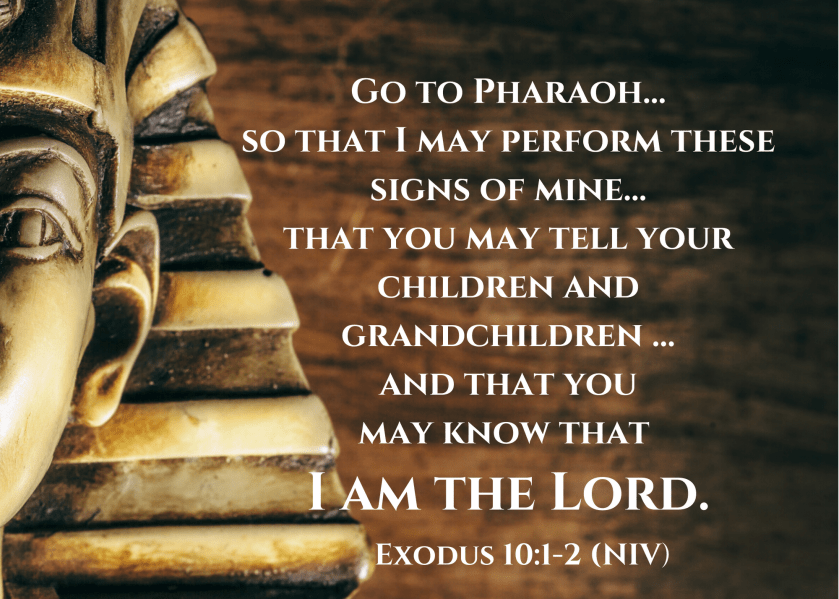
In Exodus 10-12 the time has come for God to make himself known to His people… and to Egypt. Exodus 10:1-2 – “Then the Lord said to Moses, “Go to Pharaoh, for I have hardened his heart and the hearts of his officials so that I may perform these signs of mine among them that you may tell your children and grandchildren how I dealt harshly with the Egyptians and how I performed my signs among them, and that you may know that I am the Lord.”
Here, God tells Moses that He’s about to make his presence known in a powerful way. God’s about to show up, the darkness is ending, the silence is over. And show up He does! God shows up in a profound and powerful display of his power and might. Bear in mind, Egypt was, at the time, the most powerful empire in the whole world. Pharaoh was the most powerful person in the whole world. Pharaoh had been exerting his power in a ruthless way over God’s chosen people for hundreds of years. Lord Acton once said “Absolute power corrupts absolutely.” In the United States we live under a Constitutional system that intentionally balances power among three different branches of government- Executive, Legislative and Judicial. This is to prevent any one person from having too much or absolute power. These lessons were learned after observing thousands of years of kingdoms. Pharaohs and other absolute monarchs have historically used their power in destructive and unjust ways. And with such unmatched power comes hubris.
The Poet Percy Bysshe Shelly captures the hubris in his powerful poem Ozymandias:
I met a traveller from an antique land,
Who said—“Two vast and trunkless legs of stone
Stand in the desert. . . . Near them, on the sand,
Half sunk a shattered visage lies, whose frown,
And wrinkled lip, and sneer of cold command,
Tell that its sculptor well those passions read
Which yet survive, stamped on these lifeless things,
The hand that mocked them, and the heart that fed;
And on the pedestal, these words appear:
My name is Ozymandias, King of Kings;
Look on my Works, ye Mighty, and despair!
Nothing beside remains. Round the decay
Of that colossal Wreck, boundless and bare
The lone and level sands stretch far away.”
Pharaoh, like Ozymandias in the poem, was filled with hubris over his unmatched power. He believed himself to be king of kings. He needed to be taught a lesson in humility by the true King of Kings. God showed up. Ten plagues later and all of Egypt was brought to their knees. Meanwhile, the people of God began to see first hand just how great and powerful their King, the true God, YHWH really was. That story has been told for thousands of years, and today, the people of Israel continue to sit down and eat bread without yeast and drink wine and remember the Passover and how powerful their God really is.
Sometimes, God seems to be silent, but make no mistake, God is still there and God is still powerful and in the end, God will show himself to be greater than all human opposition. May you know the true God.
Jeff Fletcher
(originally posted for SeekGrowLove on February 2, 2020 – Thank you, Jeff!)
Reflection Questions
Have you ever felt like you were in a dark night of the soul? How would you describe this time? How might God describe this time? Is there anything you found helpful during this time?
How do you think the Israelites were feeling as they: made bricks without straw, encountered the first 9 plagues, asked their Egyptian neighbors for jewelry – and received, selected a lamb, killed it, put the lamb’s blood on their doorframe, experienced the distinction God made between Israel and Egypt?
What lesson was Pharaoh learning in Exodus 10-12? What were the Israelites learning? What are you learning about man and about God?
Moses does not believe that he can speak adequately, so what does God say? He does not tell Moses, “I am sorry. I picked the wrong man.” No. Instead He says, “I picked you for a reason. If you can not speak, then delegate that duty to Aaron.” God still says that He is going to speak through Moses, not Aaron. Once Aaron has received the words from Moses, then Aaron can speak them to Pharaoh. In fact, this is the way that religion is going to work for the rest of human history. God will pick a prophet, whether that prophet thinks he is capable or not, and will speak to the rest of humanity through that single person. God is also able to set up leadership through this prophet and the prophet can lead others and coordinate with them in order to achieve more and reach more people. This is what is established in the Levitical priesthood.
I recently heard an interesting interpretation on the hardening of Pharaoh’s heart. I have usually not been able to define the phrase “hardened heart” when I read it. This interpretation however, defines the hardening of a heart as making a man brave. Under this interpretation, God did not force Pharaoh to refuse to listen. Pharaoh first chose to ignore the words of God. Then, when he became fearful because of the plagues, he was willing to let the Israelites go. It is at this point that God makes Pharaoh brave, allowing the Pharaoh to hold to his original decision not to let them go. I think this interpretation has some merit and is interesting at least.
Why did God choose the plagues that he chose? Why did he turn the Nile to blood? He could have turned it to mud or dried it up or anything. Why did he send a plague of frogs? Why not crocodiles or giant river snakes or something a little more intimidating? Why gnats? Gnats are just tiny little things, a nuisance at worst. Well God is the mastermind behind all of this, so He must have known what he was doing. Let’s try to think about all of these plagues in the context of Egypt. We know that Egypt is full of sorcerers who have a handful of tricks. We also know that the Egyptians were polytheistic and had many zoomorphic gods. Finally, we know that the Pharaoh had been oppressing the Egyptians with hard work and even worse, had slaughtered all of their baby boys.
God could have just dried up all of the water in the Nile and it would have had the same effect. All the fish would die and begin to rot and stink. There would be no water to drink. Yet God chose blood. This relates to what I said yesterday about turning people by degrees. God is starting with a plague that the Egyptians think is mere magic. The same thing occurs for the frogs, but the magicians can not create gnats. There is definitely some symbolism to blood in the Nile, possibly referring to the Pharaoh’s slaughter of the newborns. I also think it has to do with the significance of the river to Egypt. That river was a large part of the economy for them, they relied on it. So God took it away. Man should rely on God because he is the source of life. Even at this point in history, people knew that blood is an essential part of life and thought that a person’s life was in their blood. Thus, by turning the river to blood, God is saying, “I give life and I take away life.”
The plague of frogs is a weird one for me. The way it is described makes it sound like an inconvenience; they are just everywhere. One commentator I read said that this was poking fun at the Egyptians gods Hapi and Heqt. God was directly challenging the gods of Egypt.
The gnats are particularly nasty. Have you ever been out on a run in the summer when all of a sudden your mouth is full of gnats? Maybe that is just me. It is one of the most unpleasant experiences. Now have you ever been in a dry, dusty field running around and kicking up dirt? That is also quite unpleasant. It gets tough to breath. One time I was in a situation like this and I had to keep blowing my nose until it stopped coming out black. Now replace the dust in this field with gnats. That is a nightmare.
I am going to stop there and ask that you ask yourself these questions and see if you can come up with an answer. Why flies? Why livestock? Why boils? Why hail? God has every tool imaginable at his disposal, yet He deems these to be the best plagues for this situation. Why is that?
Thanks everyone for starting this plan and sticking to it! If you started from the beginning, great job making it this far and if you are just joining, I hope that you are able to find a routine of your own or hop in with this one. There is nothing better for the mind than to focus on God’s word daily.
Thanks for reading,
Nathaniel Johnson
(originally posted for SeekGrowLove on February 1, 2020)
Reflection Questions
Why do you think God chose the plagues that he did? At which plaque would you have let the Israelites go?
How might you describe a hard/hardened heart? Where have you seen one before? Have you ever experienced one? When is there a downside to being brave?
What were some of the truly miraculous things about the plagues – including the timing, the location, the extent of each? What were the Egyptians learning? What were the Israelites learning? What are you learning? Who can you pass this knowledge on to?
Oh Dear Lord, please be with my mouth and teach me what I shall speak! Because my mouth is not eloquent.
Sometimes it is downright rude. Sometimes it lies. Sometimes it gets angry. Sometimes it hurts people.
Oh Dear Lord, please be with my mouth and teach me what I shall speak! Sometimes it stays shut when it should open to speak your words. Sometimes it forgets to give you praise. Sometimes it prefers to be grouchy or selfish instead of thankful.
Oh Dear Lord, please be with my mouth and teach me what I shall speak! Sometimes it doesn’t speak up for the oppressed. Sometimes it misses opportunities to spread joy and hope and your love. Sometimes…
Oh Dear Lord, please be with my mouth and teach me what I shall speak!
In Exodus 3 & 4 Moses is giving God lots of reasons (excuses) why He should pick someone else for the job of delivering God’s first-born child (the Israelites) out of slavery in Egypt.
I am nobody special
I don’t even know your name
The elders won’t believe me
I am not eloquent
Somebody else can do it better
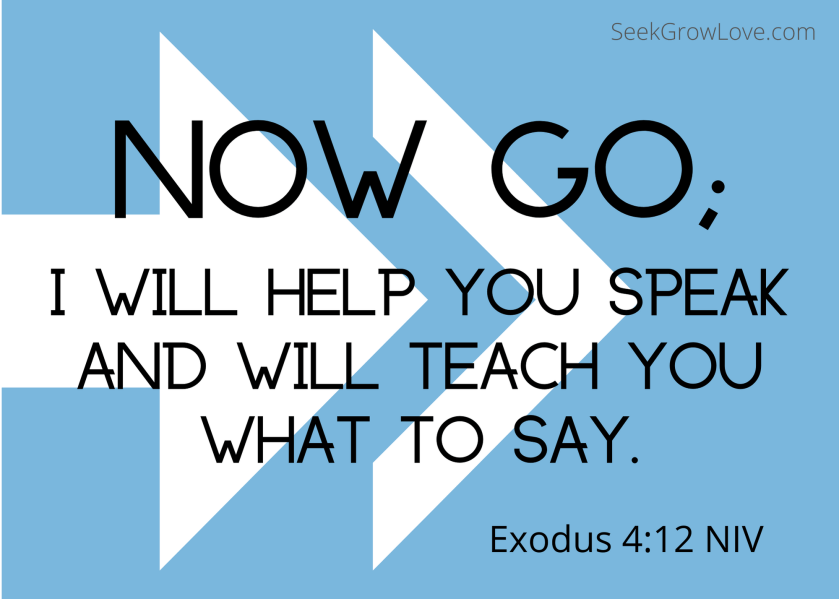
God has answers for it all. I love the Lord’s words in Exodus 4:12 (ESV): “Now therefore go, and I will be with your mouth and teach you what you shall speak.” What a beautiful promise! Yet, Moses still pleaded with Him to just send someone else! God got angry at that one. How many times does this child of God need to be reassured that his God is bigger than any fear that comes with doing His Work. The maker of your mouth can teach you how to use it – when you step up and GO where He wants you to GO! Did you notice that little two letter word at the start of God’s promise to be with Moses’ mouth and to teach him what to say? You’ll never know what words God is waiting to teach you to say if you say no and don’t go.
God graciously compromised with Moses and rather than sending someone else instead of Moses, He sent someone else to go along with Moses, his brother Aaron who was not ‘coincidentally’ coming out to the wilderness to meet Moses.
Maybe it’s time I spend less time on my excuses and instead say YES, step out and GO and trust God to do what He says He will do – be with my mouth and teach me what I shall speak!
-Marcia Railton
Reflection Questions
What excuses have you tried giving God for not stepping out to do a job He wants you to do? How do they stand up to your GREAT BIG GOD?
How can you be someone’s Aaron and come alongside him/her to do a job for God that perhaps neither of you would feel you could do “on your own”? Though, you are of course never “on your own” when you are doing the Lord’s work!? What are some other instances that God used the buddy system and what were some advantages to having a partner?
So – the big question is – where does God want you to go? If you aren’t sure yet, be praying. And then, thank Him for being with your mouth and teaching you what you shall speak.




 Seek Grow Love