Seek, God Sees and a No-Brainer

Psalm 7, 27, 31, 34, 52

This week we are choosing past devotions to repost, but I had a hard time choosing just one – so here are 3 for you! SeekGrowLove today!

ON PSALM 27 –

(from 2021) You may have noticed that the SeekGrowLove blog features a key verse: “You will seek me and find me when you seek me with all your heart” from Jeremiah 29:13. The LORD confirms that our seeking is worth it, because ultimately, we will find Him. However, there is an important requirement; we need to seek with all our heart. What does this phrase “with all our heart” really look like? How can we seek “with all our heart”? Perhaps “with all our heart” seeking is completely and sincerely devoted. Maybe determined and enthusiastic. This type of seeking is relentless, full of passion for what is right. It can’t be stopped. Psalm 27:4 states, “The one thing I ask from the Lord, this only do I seek: that I may dwell in the house of the Lord all the days of my life, to gaze on the beauty of the Lord and to seek him in his temple.” Verse 8 continues, “My heart says of you, ‘Seek His face!’ Your face, Lord, I will seek.’” You can hear the determination in that statement. The writer wants to be in the presence of the LORD. They are completely and sincerely devoted. Enthusiastic for the presence of the LORD. They are pursuing him ‘with all their heart.’

This is what the LORD desires for us. “The Lord looks down from heaven on all mankind to see if there are any who understand, any who seek God.” (Psalm 14:2) He wants us to seek him wholeheartedly. Passionately. Relentlessly. In life, we can be distracted with many pursuits, desires, and distractions. However, we can choose to refocus on the one who matters. We can choose to seek “with all our heart.” The benefits of this type of “with all our heart” seeking is great. Matthew 6:33 says, “Seek first the kingdom of God and His righteousness.” This desire to be close to God will be rewarded.  We are rewarded today with our close loving relationship with God and later when we see Him face to face. So, if you start to feel discouraged or distracted, remember who our seeking will lead to: “Look! God’s dwelling place is now among the people, and he will dwell with them. They will be his people, and God himself will be with them and be their God. He will wipe every tear from their eyes. There will be no more death or mourning or crying or pain, for the old order of things has passed away.” (Revelation 21:3,4)

-Rebecca Dauksas (originally posted February 25, 2021 for SeekGrowLove)

ON PSALM 34 –

In yesterday’s lesson, I neglected to point out a story from 1 Samuel 21 that is relevant to today’s reading.  When David ran away from Saul, he escaped to Gath (enemy territory) so Saul wouldn’t keep chasing him. The king’s servants pointed out that David was the man about which they sang, “Saul has slain his thousands, and David his tens of thousands.”

David took these words to heart and was very much afraid, so he pretended he was insane –  scratching on the doors, and letting his saliva run down his beard. When the king saw this, he thought David was crazy, and sent him away.

David wrote Psalm 34 after this experience.  Here are some verses that stand out to me.

V 3, “Glorify the Lord with me; let us exalt his name together.”

V 4, “I sought the Lord, and he answered me; he delivered me from all my fears.”

V 6, “This poor man called, and the Lord heard him; he saved him out of all his troubles.”

V 7, “The angel of the Lord encamps around those who fear him, and he delivers them.”

V 8, “Taste and see that the Lord is good; blessed is the man who takes refuge in him.”

V 12-14, “Whoever of you loves life and desires to see many good days, keep your tongue from evil and your lips from speaking lies.  Turn from evil and do good; seek peace and pursue it.”

V 15, “The eyes of the Lord are on the righteous and his ears are attentive to their cry;”

V 19, “A righteous man may have many troubles, but the Lord delivers him from them all’

We need to be quick to praise God for whatever he does for us, just like David did.  It’s easy to cry out to God when times are tough, but sometimes it’s harder to remember to praise Him and let others know what He has done for us.  This is important too.

What I really like about this chapter are the multiple times that David points out that we will experience difficult times, but God sees us through those times.  I like the image conveyed by verse 7. When I’m going through a hard time, it’s comforting to imagine God sending an angel to protect me. This doesn’t mean I won’t have difficulties, but God sees me through.  God is attentive to the righteous.

In verse 8, I picture David saying, “I’ve been through some hard times, but I’ve remained faithful to God, and God has pulled me through.  I want to encourage you to develop a close relationship with the Lord. Once you experience that relationship and experience His helping you through those difficulties, then you too can understand how good God is.”

I have to echo David’s words, because I’ve been there.  So I encourage you too, “Taste and see that the Lord is good; blessed is the man who takes refuge in him.”

–Steve Mattison (originally posted April 14, 2020 for SeekGrowLove)

ON PSALM 52 –

For the Christian it is considered a “no brainer” that our trust is supposed to be found in God. But so often the stresses and worries of the world come against us, and we may forget that we serve a mighty God who cares deeply for us. 

Here in Psalm 52 we are shown a great contrast between David here and his enemy. David wrote this Psalm during the time when he was constantly on the run from Saul, who was chasing him down to kill him, out of jealousy. David lost many years of his life running from Saul but he never lost his trust in God. At this time David had amassed a group of strong men who were ready to fight for him, but Saul, having the armies of Israel behind him, had the greater strength. David had support from people who gave him food and supplies as he ran from place to place, but Saul had all the riches of Israel behind him. But the important thing is that David had God with him, and God had promised him the throne of Israel that Saul currently sat on. 

David was able to stay strong in his faith because he had seen God help him against overwhelming odds again and again, the most notable time was when he took on the nine foot tall giant, Goliath all on his own. There were actually two times during David’s years of running, that we are told about, where David had the chance to rely on his own strength to defeat Saul. Once was when Saul went to relieve himself in a cave, not knowing that David was hiding in the cave. The other time, the Bible says that God caused the entire army that was with Saul to go into a deep sleep and David was able to sneak right up next to Saul. Both times the man who was with David encouraged him to kill Saul and take the throne. But each time David refused, saying that he would not harm the Lord’s anointed. It would have been so easy for David to trust in his own strength in that moment, and no longer have to keep running for his life, but just like when David faced Goliath, David put his trust in God and not in himself. And because David did trust God, he never had to draw his sword against Saul or anyone in his family. In one single battle, Saul and all of his sons were taken out by the Philistines. God provided David the throne without David having to shed blood. David’s faith in what probably seemed like the hopeless situation of being relentlessly chased down by King Saul, paid off in the end. Years later after David had become king, he penned another Psalm, in which he said, “Some trust in chariots and some in horses but we trust in the name of the Lord our God.” I hope and pray each day to have the kind of faith and trust in God like David had, and I hope you do as well.

-Jonny Smith (originally posted February 22, 2023 for SeekGrowLove)

Reflection Questions

  1. Is there a time you have trusted in God through a tough situation? What was the result? Who have you seen trust God through a tough situation and emerge with an even stronger faith in God?
  2. What do you sometimes put your trust in instead? How does that work? Why?
  3. What has God shown about Himself in your reading today?

“Flowers Grow in the Valley”

Ruth 1-4

In my life, I’ve seen many people deal with troubling times and grief in various ways. Most of them initially take the path of least resistance, which often leads them further from God, but those with a strong support system are guided on pathways that lead them closer to God than they’ve ever been. I’ve had my fair share of troubles, and without the help of my school teachers, professors, friends, and family, I wouldn’t have been as close to God as I am today. I heard a song recently called Flowers by Samantha Ebert that contained the lyrics, “I’m a good God and I have a good plan, so trust that I’m holding a watering can, and someday you’ll see, that flowers grow in the valley.” Ruth’s story is a fantastic illustration of the beauty that God can bring to fruition in life’s valleys. 

The book of Ruth takes place during a time of trouble and famine. Naomi lost her husband Elimelek and her two sons Mahlon and Kilion. Ruth and Orpah became widows. However, a glimmer of hope came to Naomi as she heard what the LORD had done for His people (aiding and providing for them in this tough time). She urges her daughters-in-law to return to their mother’s house (because it would be a much easier route for them), but the unexpected happens. Instead of going home, Ruth decides to go with her, stay with her, make Naomi’s people her own, and remain alongside her in death/burial (1:16-17). Naomi tried to “talk some sense” into Ruth but failed to convince her to choose a different path. This resulted in an interesting and intriguing turn of events.

Shortly after arriving in Bethlehem, Naomi and Ruth’s tragic story spreads around town, and the overseer of Boaz’s harvesters and Boaz (who “just so happens” to be one of their kinsman-redeemers) hears of it. Boaz blesses Ruth with protection, provides her with the opportunity to earn an abundance of food, works diligently to ensure she is cared for, and continues the line of David through Obed. This information makes me believe that the “coincidences” along the way were more of a God thing than a perchance thing. As a result, Ruth and Naomi went from two widowed women in one of the biggest valleys of life put in their way to two well-off women blessed with the beauty of God’s providence.

Pain, suffering, and troubled times often bring forth heightened emotions, illogical judgments, and tough decisions. If we’re not careful to keep ourselves in check, we can go down a dangerous path towards death and destruction. In Matthew 7:13-14 we find Jesus urging others in his sermon on the mount to, “Enter through the narrow gate. For wide is the gate and broad is the road that leads to destruction, and many enter through it. But small is the gate and narrow the road that leads to life, and only a few find it.” We are presented with a choice, take the easy route and go back to what’s familiar, or choose the path with a few more hills and valleys that God can use to show us more than we could ever hope for.

-Jeffrey Seiders

REFLECTION Q’s

  1. Ruth took the harder path, went with Naomi, and God provided for her. What paths in your life have you taken that were difficult but God blessed you through them?
  2. Naomi tried to convince Ruth and Orpah to take the easier route, and only Orpah went. When did you take the easy route and how did God work through your decision? 
  3. What valleys are you going through now, and how can you see God’s beauty in them?

Safe Cities

Joshua 19-21

After studying the Underground Railroad, my family and I toured a local church that played a major role in helping escaped slaves reach freedom. Though the dismal, subterranean tunnel boasted no modern amenities, its hidden passage beneath the church’s sanctuary had served as a refuge for countless escapees on their way to freedom. How I wished the walls could talk! There are no written records of the tunnel’s guests from that time period, probably to protect the identities of the escaped slaves (and besides, most local records were destroyed in the 1913 flood that ravaged this region), but shards of pottery and discarded animal bones from choice cuts of meat provide evidence of the meals that were smuggled in to nourish the “fugitives.” I was speechless while envisioning the grueling journey a desperate, sweet soul must have endured to arrive this far north – more than 60 miles beyond the Ohio River – weighed down by the well-preserved foot chains that had been found in that very tunnel. 

The escaped slaves were hungry for safety. “Safety” is a concept that we often take for granted in this twenty-first century, first-world country; in many countries, simply proclaiming Christianity could cost one’s life. I find it interesting that God designated several cities of safety for his people in the Promised Land. These were cities to which anyone could escape who had accidentally killed someone, in which they would safely await trial without threat of the victim’s family avenging the (potentially innocent) murderer. 

Though we no longer have similar cities of refuge, this concept is a foreshadowing of sorts to Jesus: in him, we sinners find refuge from our enemy. “We run to Christ to escape the danger we are in from the curse and condemnation of the law, from the wrath of God, and from an eternity in hell. Only Christ provides refuge from these things, and it is to Him alone that we must run. Just as the cities were open to all who fled to them for safety, it is Christ who provides safety to all who come to Him for refuge from sin and its punishment.” (quote source). 

“He is our refuge and strength, an ever-present help in trouble.” Psalm 46:1

“Therefore, we who have fled to him for refuge can have great confidence as we hold to the hope that lies before us. This hope is a strong and trustworthy anchor for our souls.” (Hebrews 6:18, NLT)

I am so grateful for the hope that lies before us! Aren’t you?!

-Rachel Cain

Reflection: 

Look up synonyms for the word “refuge.” Which one stands out most to you in your journey of faith? 

“He kept every promise he had made to the Israelites; each one came true.” (Joshua 21:45) What a powerful verse! God is always faithful. Reflect on his faithfulness in your life by writing a memoir or journal about how he has moved in your life, and share it with those close to you. 

Burn the Ships

Hesitant Hebrews

Joshua 16-18

It was so close they could almost taste the milk and honey on their lips – their Promised Land! After centuries of oppression and slavery under Pharaoh followed by 40 more years wandering free in the wilderness, the Israelites finally possessed the metaphorical keys to their inheritance. Many of the tribes ventured out right away for their assigned territories, ready to explore, conquer, and settle at last, but several tribes remained behind. Why wouldn’t they ropedrop this momentous occasion and charge with abandon straight to their inheritance?

Though I cannot speak for all the Israelites since I have not walked in their sandals, this is my speculation based on what I’ve read: they desired the path of least resistance. Though they were promised that the land would be theirs, they had to go in and take it. There were still other people living on those properties; it would require a lot of effort to drive them out. Yes, God had guaranteed that this land would be theirs, but that didn’t mean their possession of it would be effortless. In the beginning of their nomadic desert life, remember how they had longed to return to the familiarity of slavery and oppression in Egypt? Now, well accustomed to desert dwelling, they didn’t want to expend the energy to settle into the cities, which would still require them (albeit with the promise of success!) to conquer it. It was more comfortable to stay in their crummy environment than to embrace the best land that God had for them.

I am reminded of Spanish conquistador Hernan Cortes who was determined to conquer the interior of Mexico, including the Aztec empire and a vast swath of land from the Caribbean to the Pacific. This fierce leader and fighter, frustrated that his men were too focused on the possibility of going home and too scared to invade this new territory, took away their temptation to retreat by doing what any extreme leader would do: he burnt the ships. Now, there was no turning back, no reason to not forge ahead and claim this land. 

Perhaps the seven tribes had become so lazy or complacent in their faith that they didn’t even care that God had something infinitely better in store for them. As C.S. Lewis said, “It would seem that Our Lord finds our desires not too strong, but too weak. We are half-hearted creatures, fooling about with drink and sex and ambition when infinite joy is offered us, like an ignorant child who wants to go on making mud pies in a slum because he cannot imagine what is meant by the offer of a holiday at the sea. We are far too easily pleased.”

Ultimately, in part because the Israelites did not fully drive out the inhabitants of their Promised Land, God’s people became immersed in the culture, false gods, child sacrifice, and overall moral corruption of the people around them, which perpetuated the spiral of falling away from God and then begging Him to save them. Though written much later, Romans 12:2 would have been good advice for the Israelites (who were called to be set apart for God), and it is still wise for us as present-day believers to heed its wisdom: “Don’t become so well-adjusted to your culture that you fit into it without even thinking. Instead, fix your attention on God. You’ll be changed from the inside out. Readily recognize what he wants from you, and quickly respond to it. Unlike the culture around you, always dragging you down to its level of immaturity, God brings the best out of you, develops well-formed maturity in you.”

So, what ships are holding you back? What comfort, familiarity, or apathy is keeping you from fully following God? Sometimes I am a lot like the 7 tribes and Cortes’ crew. While I claim to desire God’s calling on my life, I often let the comforts of the present and anxieties about the future hold me back from fully embracing His plan for my life. Let us pray for God’s strength to follow wherever He may lead us. 

-Rachel Cain

Reflection: 

Watch this powerful music video about “burning the ships” and charging ahead into God’s will for our lives. 

Priestly Portion

Joshua 12-15

I’ve heard sad stories of siblings living hostilely toward one another for decades because of arguments regarding the inheritance from a late parent. I wonder if the Israelites assumed God picked favorites as he doled out their assigned territories in the Promised Land. 

Remember Caleb? At eighty-five years old, Caleb finally realized his dream of inheriting Hebron four decades after he had first explored it. He and Joshua were the only two of the dozen spies who had encouraged the nation to take their Promised Land; the ten other agents involved in the espionage had invoked great fear in their people. As a result of their collective lack of faith, the Israelite nation would wander for 40 more years in the wilderness while most of that unfaithful generation died off. Caleb, now an octogenarian, was very eager to finally claim the territory that had been promised to him two scores ago. He and Joshua had kept the faith, remained true to God, and waited patiently to receive their inheritance, just like we must wait patiently for our Promised Land, the Kingdom (Romans 8:25). 

Perhaps the Levites, the tribe designated to serve as priests, initially felt slighted when they learned that they would inherit no land at all; rather, God promised to be their portion and take care of their needs as they served as religious leaders for His people. Though it might seem like they had received nothing tangible, they actually received the best gift: a closeness with and dependence on God that most would never experience. 

We, too, are beneficiaries of a similar priestly portion:  “But you are a chosen people, a royal priesthood, a holy nation, God’s special possession, that you may declare the praises of him who called you out of darkness into his wonderful light.” 1 Peter 2:9 

Unfortunately, we tend to chase temporary things in this life, like fortune and fame, rather than keeping our eyes on the eternal prize. None of this truly satisfies, and we can’t take it with us when we die – you’ll never see a hearse pulling a U-Haul, after all! Jesus reminds us to “store up treasures in heaven… for where your treasure is, there your heart will be also” (Matthew 6:20-21). As followers of Jesus, we have a much greater inheritance promised to us, far better than all the riches of this world. 

I leave you with the priestly blessing from Numbers 6:24-26: 

The Lord bless you and keep you;

the Lord make his face shine on you and be gracious to you;

the Lord turn his face toward you and give you peace.

-Rachel Cain

Reflection: 


What does it mean personally to you that God is your portion? How does that impact your soul?

Meditate on these scriptures as you thank God for being your portion! 

  • My flesh and my heart may fail,but God is the strength of my heart and my portion forever. Psalm 73:26
  • Because of the Lord’s great love we are not consumed, for his compassions never fail. They are new every morning; great is your faithfulness. I say to myself, “The Lord is my portion; therefore I will wait for him.” Lamentations 3:22-24
  • And this is God’s plan: Both Gentiles and Jews who believe the Good News share equally in the riches inherited by God’s children. Both are part of the same body, and both enjoy the promise of blessings because they belong to Christ Jesus. Ephesians 3:6

Power in Song

Deuteronomy 32-34 & Psalm 91

When Moses had finished reciting all these words to all Israel, he said to them: “Take to heart all the words that I am giving in witness against you today; give them as a command to your children, so that they may diligently observe all the words of this law”. Deuteronomy 32:45-46 (NRSV)

I’m a music lover.  My memory of “contemporary” music goes back about 30 years. 1995-1996 is when I first remember getting into music on the radio. It’s not just the music of my era… I grew up listening to the classic rock format as well as ‘90s rock and pop. If I were to anonymously give you a top 20 list of my favorite albums or songs (which I’d probably never be able to narrow down), you might be left scratching your head, wondering who this person is and when they were born. Powerful is the art of song and music. I love music for the notation, the way that notes and chords are put together to create melody and harmony, even dissonance, but also for the lyrics… The way that someone can convey emotion or conviction in a way that hits hard, that makes you think and feel.

Great songs come in many forms. There is much to be gleaned from a simple lyric – Jesus loves me, this I know, for the Bible tells me so; and there is much to contemplate from an imaginative and thoughtfully written gem that paints an image in the mind: “Could we with ink the ocean fill, and were the skies of parchment made; were every stalk on earth a quill, and everyone a scribe by trade; to write the love of God above would drain the ocean dry; nor could the scroll contain the whole, though stretched from sky to sky”.

The Beatles were a smash with their early simplistic songs, but also with more thought-provoking tunes toward the end of their run. Leonard Cohen’s “Hallelujah” (Jeff Buckley did it better) is one of the most gut-wrenching (in a good way) songs that I can think of. It carries the listener through peaks and valleys of emotion as it describes tensions in the human experience of love. Perhaps I have digressed too much, but I can get distracted when I get into the minutiae of music.

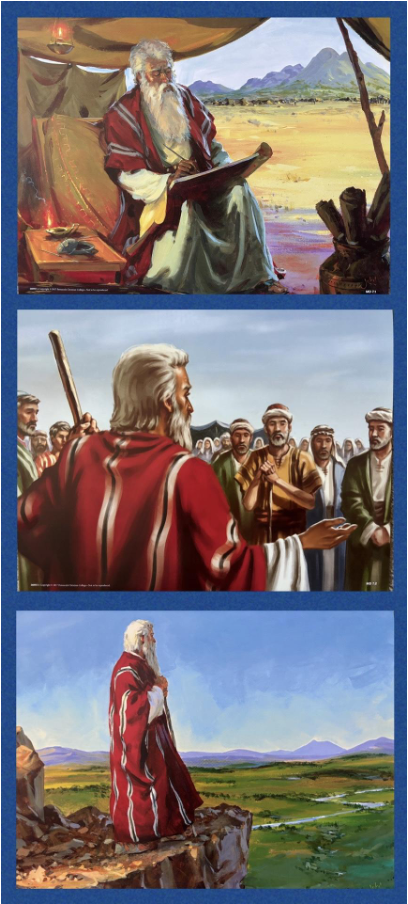
In Deuteronomy 32, we have recorded a song that Moses recited to the Israelites shortly before he went up to Mount Nebo to get a distant view of the promised land and then die. In this song, we see a variety of things addressed. Moses glorifies Yahweh, his God, but takes the people on a journey to envision their future failure and rejection of God’s ways that they are on a path toward. Challenges, encouragement, and perspective.

While Moses covers some pretty negative territory regarding the Israelites in his words, he also gives assurance that Yahweh is a God of mercy and redemption and that his people will be cleansed. Despite impending failure, there is forgiveness and mercy on the docket, and there will ultimately be protection for the people of God against their adversaries.

I find it a little curious that Moses addresses the people in song, diverging from the status quo of God’s revelation to his people up to this point, but song can be a powerful way to commit things to memory. In contrast to the ten commandments and the subsequent revelation of the full law, this presentation perhaps was remembered and recited in a way that was engaging and complementary. 

-JJ Fletcher

Reflection Questions:

  1. How has music impacted your relationship with God and Jesus?
  2. Do you find it easier to remember lyrics and scripture put to song than simply memorizing bible verses?
  3. How do we balance the desire that we might have for catchy and relatable tunes with the directive to glorify and worship God with music?
  4. What impact do you think Moses’s addressing the people in this manner had on them? (might be helpful to look back at Deuteronomy 31:19-22)

True Holiness

Deuteronomy 21-23

When reading chapters such as the ones we read today, I find it’s sometimes easy to just glide through these laws that initially seem irrelevant to us today. Within these ancient statutes, however, two timeless themes particularly stood out to me: God’s call for His people to be set apart in holiness, and His heart for the most vulnerable in society.

1. A Call to Holiness

As we’ve read previously, God set Israel apart from the surrounding nations to be a people that reflected His righteousness. These laws we observed today emphasize moral purity, integrity, and responsibility within the community. For example, laws regarding sexual immorality (Deut. 22:13-30) were meant to protect family structures and promote faithfulness. 

While we no longer live under these specific laws, the principle of holiness remains. Something beautiful happens in the New Testament—though it caused an outrage at the time. Jesus shifted the focus from outward regulations to inward transformation. 

Blessed are the pure in heart, for they will see God. – Matthew 5:8

Holiness today, while still requiring abiding by a list of rules (the handy little updated one provided by Jesus), is ultimately about living in a way that honors God, demonstrating His love and goodness in our daily actions. Even though we don’t face the consequence of being stoned to death if we fall into temptation, these passages point out just how important it is in the eyes of God that we choose to walk in His light. 

2. Justice and Care for the Vulnerable

These chapters also reveal our Father’s deep concern for justice and protection of the weak; many of the laws were designed to guard against exploitation:

  • Captive women were given dignity and rights, rather than being killed or treated as property, as they would if their home had been conquered by other nations at the time (Deut. 21:10-14).
  • Neighbors were expected to care for one another—returning lost property and offering help when needed (Deut. 22:1-4).
  • Fair treatment of runaway slaves—they were not to return an escaped slave to their master but to let them settle freely in their land. (Deuteronomy 23:15-16)

We see Jesus continue this mission throughout his ministry on earth, declaring, “The Spirit of the Lord is on me, because he has anointed me to proclaim good news to the poor… to set the oppressed free” (Luke 4:18-19). He demonstrated through both his life and death that true holiness heeds more than personal purity, but also constantly considers how best we can treat those around us, especially those in need.  

-Isabella Osborn

Reflection Questions:

  • How do we maintain spiritual purity in a world full of distractions? What are some ways you can guard your heart, mind, and actions?
  • Even though we are no longer called to live according to the Old Law, we still are called to holiness in the New Testament. What are some of Jesus’ commandments that you find it difficult to abide by?
  • What are some practical ways we can reflect God’s heart for the weak and vulnerable in our modern world?

Remember His Faithfulness

Deuteronomy 14-16

Celebrate the Festival of Tabernacles for seven days after you have gathered the produce of your threshing floor and your winepress. Be joyful at your festival—you, your sons and daughters, your male and female servants, and the Levites, the foreigners, the fatherless and the widows who live in your towns.” – Deuteronomy 16:13-14

Today we read God’s commands to begin observing three major feasts: Passover, the Feast of Weeks, and the Feast of Tabernacles. Each of these festivals was meant to be an intentional time set aside for remembrance (a recurring theme in Deuteronomy). The Israelites had witnessed God’s power and provision in so many ways… like so many. They were delivered from Egypt, provided for in the wilderness, and were finally being brought into the Promised Land—all of which included various miracles and supernatural occurrences. These celebrations were more than legalistic rituals—they were acts of worship and gratitude intended to continually remind God’s children of His unending goodness.

While most Christians today don’t keep these feasts in their traditional form, their purpose no doubt remains deeply relevant. We are still called to remember God’s goodness, rejoice in His provision, and keep His Kingdom promise forefront in our minds. Jesus, our Passover Lamb, has secured our ultimate deliverance, and we live in the hope of the final harvest when God will gather His people into His eternal presence. Not only must we live in hope, but in daily remembrance. Our hope is not a baseless one. We have a book full of stories and people and places that display our Father’s faithfulness. We live in a world uniquely and precisely designed for human life in ways that defy mere chance. We see glimpses of the Kingdom in small moments every day. These are the things that we must recognize and reflect upon on a daily basis. 

Whether through communion, worship, prayer, or perhaps even partaking in some feasts or holidays, we are called to consistantly honor the God who has redeemed us, sustains us, and promises us a future. I pray today that we cultivate hearts of gratitude and remembrance, celebrating our Father’s steadfast love and infinite goodness in every season of our lives. 

-Isabella Osborn

Reflection Questions:

  1. God established specific times for Israel to remember His faithfulness. How can setting aside time for remembrance strengthen our faith? How might neglecting remembrance weaken faith?
  2. How can you intentionally set aside time to remember and celebrate God’s goodness?
  3. What are some specific ways God has delivered you in your life? Have you taken time to truly reflect on and thank Him for those moments?

Listen – and Act Accordingly

Deuteronomy 5-7

These 3 chapters continue to reiterate the importance of REMEMBERING. Moses is addressing the new generation of Israel, preparing their hearts to enter the long-awaited Promised Land. We read in chapter 5 the repeated Ten Commandments, and Moses’ encouragement to follow these laws that bring life and blessing, “that you may live long in the land that you shall possess.” The Israelites are repeatedly reminded throughout these chapters that these laws are meant to serve them for generations to come; Moses emphasizes over and over again the cruciality of ensuring that their children and their children’s children not forget the foundation provided to their ancestors via these laws. 

Chapter 6 is home to one of the most well-known prayers in the Bible, the Shema Yisrael, which has remained embedded in Jewish culture to this day. Ancient Jews combined Deuteronomy 6:4-5 with other Torah passages (Deut. 11:13-21; Num. 15:37-41), reciting the words every morning and every evening. This prayer became ingrained in Jewish tradition, and was widely practiced in the Second Temple Period. Jesus declared it the greatest commandment in the Torah in Mark 12:29-31. 

“The most important one,” answered Jesus, “is this: ‘Hear, O Israel: The Lord our God, the Lord is one. Love the Lord your God with all your heart and with all your soul and with all your mind and with all your strength.’ The second is this: ‘Love your neighbor as yourself.’ There is no commandment greater than these.” – Mark 12:29-31

Many of us memorized these verses at a young age. What gives this prayer such immense significance? Well, to the Jews at the time (and through history), it is a pledge of allegiance to God, emphasizing three main ideas:

  • Monotheism: The Shema asserts that there is only one true God, distinguishing Israelite faith from the surrounding polytheistic religions of the ancient world. (Deut 6:4)
  • Covenantal Relationship: The Shema affirms Israel’s special relationship with God, requiring wholehearted love and devotion. (Deut 6:5)
  • Daily + Generational Remembrance: It is recited morning and evening, reinforcing a life centered on God’s commandments, and ensuring that it is passed down to future generations. (Deut 6:6-9)

These truths remain relevant to us today, and this prayer is a beautiful, concise way to remind ourselves what Moses stressed throughout these passages. 

Something interesting about the opening line of the Shema, “Hear, O Israel,” is that in Hebrew, “hear,” or “shema,” does not only mean to listen. It means to listen and then act accordingly. It is directly tied to action. And the word “love,” or “ahavah,” similarly means to act in love. It’s more than just a feeling; it’s active obedience and loyalty. It’s a call for the Israelites to be faithful to their covenant with Yahweh. We, too, have a covenant with Yahweh, a renewed covenant with new laws and a new Promised Land. But as Jesus clarified, this command remains true, and we must make the active decision to live out the Shema each and every day. 

-Isabella Osborn

Reflection Questions:

  1. What are some practical ways you can incorporate Scripture into your daily life to ensure that you keep them on your heart, as to better remember and live by God’s Word?
  2. The Shema calls us to love God with everything we are. How can you intentionally cultivate a deeper love for Him in your daily life?
  3. Just as Israel was called to pass down God’s truths, we are called to disciple others. Who are you investing in spiritually? How can you be intentional about sharing your faith—whether with your family, friends, or community?

Looking Back and Looking Ahead

Deuteronomy 1-2

A time of reflection and recap of events as the Israelites prepare to enter the Promised Land. “For the LORD your God has blessed you in all the work of your hands. He knows your going through this great wilderness. These forty years the LORD your God has been with you. You have lacked nothing. (2:7) They’ve LACKED NOTHING?! They probably didn’t agree with that, but it shows how God provided for them the basics, which is ample for a person. He literally gave them their daily bread.

Moses reminded them, “The LORD your God who goes before you will Himself fight for you, just as He did for you in Egypt before your eyes,and in the wilderness, where you have seen how the LORD your God carried you, as a man carries his son, all the way that you went until you came to this place. Yet in spite of this word you did not believe the LORD your God.” (1:30-32)

It’s amazing that we can do the same thing like the Israelites at times, cry out to get out of a difficult situation (Egypt), then afterwards when we’re out we complain again. But if they would’ve trusted that God would fight for them they could’ve been spared the long difficult 40 years. The wilderness was the ONLY way to get to the Promised Land, and their lack of trust made it even harder (and longer).

Not one of these men of this evil generation shall see the good land that I swore to give to your fathers, except Caleband Joshua who wholly followed the LORD.” (1:35) Even Moses wasn’t allowed to enter as the LORD was angry with him too (or, had been angry and was following through with consequences).

Despite failures and difficulties Moses pressed on with the people until his departure. This reminds me of parenting! It’s difficult and rewarding! One of my main parenting verses that encouraged me over the years, besides Deut. 6:4-7, is 1 Peter 4:12,

Above all, keep loving one another earnestly, since love covers a multitude of sins.

– Shalom y’all, Stephanie Schlegel 🙂

            (From Israel and Tennessee:)

REFLECTION QUESTIONS

1. Have you had to endure a difficult situation for years? How did God sustain you through it?

2. Is there an issue you’re dealing with that if you’d wholly trust God, the situation would be better? Are you taking matters into your own hands or trusting God with it?

3. Reflect over this last month how God’s provided for you and thank Him for it!

4. How does looking back better prepare the Israelites for looking ahead? How can it benefit you?