When my son was little, we spent a lot of time watching Thomas the Tank Engine and Friends. One of Thomas’s friends was an engine named Percy. Percy was good at his job, but sometimes he just felt he was given way too much work and it was unfair. “I feel put upon!” Percy would declare at various times. While reading today’s chapters, I think Jeremiah was saying the same thing (but in Hebrew 😀).
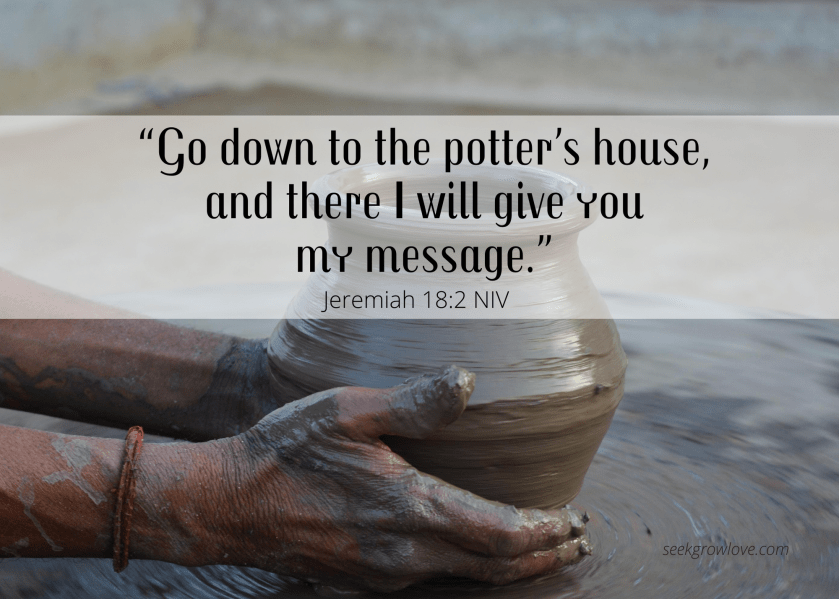
And really, I don’t blame him. God had him observe a potter creating and destroying vessels at his pleasure to demonstrate what God will do with His people. Then He had Jeremiah buy a clay jar and smash it in front of the leaders of Judah to demonstrate what God will do to Judah. And what does Jeremiah get for his obedience? Beaten and mocked. Not only that, but Jeremiah saw that nothing was happening to the evil people, in fact, they seemed to be doing quite well. He was frustrated and felt defeated. I think I would have, too. Any half-way mature person knows that life isn’t fair, but sometimes it’s hard not to be frustrated when you always seem to be on the unfair end of things and that’s where Jeremiah is here. But despite his anger and frustration, he still acknowledges that no matter what, Jeremiah would praise Him and continue to prophesy in His name. Which is probably a good thing because after years of warnings, God begins moving His hand against Judah.
In chapter 21, we see that the warning of destruction of kings was no longer a vague, general mourning. People are being named. King Zedekiah was told he would be captured by the Babylonians, King Josiah’s eldest had been exiled, and his next son, Jehoiakim’s death was predicted to be un- mourned and dishonorable. Then it’s Jeremiah’s job to try to convince the people to surrender to Babylon so they will go “easy” on them and not kill them. No wonder this guy wasn’t very popular. I hadn’t really given it much thought before but in verse 20:18, Jeremiah mentions his friends. They certainly aren’t good friends as they are plotting to kill him. But unlike Jonah who was commanded to go and preach to a far off nation, Jeremiah was preaching to the people he grew up with and lived around. The people he traded goods with, the people he talked to while on the way to the temple, people who had been a part of his everyday life. Between being scorned for delivering these messages and knowing what was in store for his community, no wonder Jeremiah was down and depressed. He WAS put upon.
We’ll have to keep reading to find out what happens to Judah and Jeremiah. But in the meantime, think about the times you’ve felt “put upon” by the Lord. What happened? Did He stay with you? Like Jeremiah, did you praise Him anyway?
Prayer:
Dear Lord,
There are times in life when You have given us a burden and we feel “put upon”. Help us to have an attitude of peace and contentment at these times because You have chosen us to carry that burden. Please give us the strength to do it with pleasure.
In Christ’s Name,
Amen
-Maria Knowlton
Reflection Questions
“Think about the times you’ve felt ‘put upon’ by the Lord. What happened? Did He stay with you? Like Jeremiah, did you praise Him anyway?”
Have you ever delivered warnings from God to someone you know? What was the hardest part? What did this person think of you? What do you think God thought of you? What happens when no one warns?
Isaiah 20 is an incredibly short though (at least for me) difficult chapter to read. And it is one I definitely don’t remember learning in Sunday School class growing up. We learned about Isaiah, the faithful servant of God who had a powerful calling from God. When he saw a vision of God’s majesty he crumbled in unworthiness and guilt, but then God cleansed him with a burning coal to his lips and Isaiah boldly declared, “Here am I. Send me!” (Isaiah 6:8). We knew Isaiah wrote lots of chapters with many warnings and some beautiful passages of the promised Messiah. But, we didn’t know about the humiliation of chapter 20.
Today we read, “At that time the Lord spoke through Isaiah son of Amoz. He said to him, ‘Take off the sackcloth from your body and the sandals from your feet.’ And he did so, going around stripped and barefoot.” (Isaiah 20:2 NIV). No, argument is recorded. Just obedience. “And he did so.” And, it wouldn’t just be for the day or even a week – but for three years! Commentaries kindly mention he would still have had a loin cloth (a.k.a – underwear). But that’s not too reassuring to Isaiah, his family, or his readers today.
It is natural to ask WHY, God? There has to be a reason why a loving God would ask His faithful servant to go through this embarrassing and painful object lesson for three long years. In this case I believe God was having Isaiah dramatically get the people’s attention to remind them just how degrading and dehumanizing their lives would be as prisoners of war (who were often marched around in such fashion). And, that is what they will become if they choose to forsake the Lord and put their trust instead in foreign ungodly allies like Egypt and Cush.
It makes me wonder – what am I willing to do for God? What amount of personal pain, sorrow, and humiliation am I willing to endure in order to be doing what God has asked of me? Am I more concerned about what men will think of my service to God, or what God would say? Certainly Isaiah would have never lasted for three nearly naked years if he held in greater regard the approval, understanding or encouragement of his peers over pleasing God.
Could I have done what Isaiah did? I think when faced with God’s awesome majesty I could say, “Here am I. Send me!”. After all, it sounds like pretty good resume material to be a messenger for God – I bet it’s a job that comes with some great benefits, too. I would even name my baby boy Maher-Shalal-Hash-Baz (meaning quick to the plunder, swift to the spoils) just as Isaiah did for God. That is an object lesson I feel I would willingly participate in, even though others might laugh and ridicule my choice. But, is there a cut off line where my loyalty and devotion to God would end? Is there a job He could ask of me that I would say ‘no’ to? I hope not.
Too often when we sign on for a position working for the Almighty, we try to choose what it will look like. “I will go here for God and do this for God.” And everyone will be amazed. But, sometimes, God has different plans. Bigger plans. Sometimes, more confusing plans. Sometimes, plans that will take you far out of your comfort zone and even into the midst of personal pain, loss, turmoil, and ridicule.
While the apostle Paul never faced the exact same jobs Isaiah endured, he also gained a lot of experience facing trials and difficulties, misunderstanding and persecution while following God, and His Son Jesus. He wrote in Colossians 3:17 “And whatever you do, whether in word or deed, do it all in the name of the Lord Jesus, giving thanks to God the Father through him.” We can learn a thing or two from both Paul and Isaiah about serving the Lord.
What would you do for God?
-Marcia Railton
(Originally posted for SeekGrowLove Sept 12, 2021. I apologize the devotion wasn’t emailed out earlier today.)
Reflection Questions
What do you think God wanted the people of Isaiah’s day to know about Him and His plans?
What do you think God wants people today to know about Him and His plans?
About 60 years after the first Babylonian exiles returned to Jerusalem, Ezra, appointed by King Artaxerxes, returned to Jerusalem with a new wave of exiles. His mission was to renew Israel’s commitment to following God’s Law.
For Ezra had set his heart to study the Law of the Lord, and to do it and to teach his statutes and rules in Israel. (Ezra 7:10)
For Ezra had set his heart…
At the time this passage was written, there was no Hebrew word for brain and no concept of its role in the body. Instead, biblical authors used the word heart (lev or levav) to describe both our emotions and thoughts. Here, when Ezra says he “sets his heart” on studying the Law, he means dedicating his entire being to knowing and following God’s Word.
You will seek me and find me, when you seek me with all your heart. (Jeremiah 29:13 ESV)
…To study the Law of the LORD…
The Law, or Torah, refers to the first five books of the Old Testament. It contains 613 laws that establish a covenant between Israel and God. God promises that following His way will lead to blessing.
This Book of the Law shall not depart from your mouth, but you shall meditate on it day and night, so that you may be careful to do according to all that is written in it. For then you will make your way prosperous, and then you will have good success. (Joshua 1:8 ESV)
…And to do it…
While being able to recite all 613 laws would be impressive, knowledge without application is futile. It’s significant that not only does Ezra know the Law, but he also commits himself to following it.
But be doers of the word, and not hearers only, deceiving yourselves. For if anyone is a hearer of the word and not a doer, he is like a man who looks intently at his natural face in a mirror. For he looks at himself and goes away and at once forgets what he was like. But the one who looks into the perfect law, the law of liberty, and perseveres, being no hearer who forgets but a doer who acts, he will be blessed in his doing. (James 1:22-25 ESV)
…And to teach his statutes and rules in Israel.
This is where Ezra’s preparation meets his ministry. As a “scribe skilled in the Law of Moses” (Ezra 7:6), his knowledge of the Torah is complete. His mission is to teach the Torah to restore Yahweh’s rule and reign in Jerusalem.
And these words that I command you today shall be on your heart.You shall teach them diligently to your children, and shall talk of them when you sit in your house, and when you walk by the way, and when you lie down, and when you rise.You shall bind them as a sign on your hand, and they shall be as frontlets between your eyes.You shall write them on the doorposts of your house and on your gates. (Deuteronomy 6:6-9 ESV)
May we be like Ezra. May we set our hearts to study God’s Word, to live it out, and to teach its message to a world in need of revival.
-Mackenzie McClain
Reflection Questions
What have you set your heart on? What is your entire being dedicated to? How is this displayed in your life?
What is the value of setting your heart on studying the law of the Lord (and now the whole word of the Lord made available throughout the 66 books not just the first 5 Ezra had the privilege of knowing)?
Do you find it easier to study God’s law or to do it? Can you have one without the other?
What ministry has God called you to? Who do you know that you can teach what you know about God and His Word?
Have you ever thought that it was too hard to stand for God in the middle of this dark world? Have you ever feared ridicule that kept you from sharing your faith with someone? I know that I have thought both of these things at times in my life.
One example in Scripture that serves to encourage us in this category is Jeremiah. Jeremiah served as a prophet in one of the darkest days for the people of God, beginning his ministry right before the exile into Babylon. Jeremiah 1 chronicles the “call” of Jeremiah to serve God.
Jeremiah 1:4-5 (ESV)
4 Now the word of the LORD came to me, saying,
5 “Before I formed you in the womb I knew you, and before you were born I consecrated you; I appointed you a prophet to the nations.”
God tells Jeremiah that He knew him before he was born! Not only that, God called Jeremiah to be a prophet before he was born. What an incredible calling! And Jeremiah would need this kind of encouragement and consolation, because the people of God at this point in history were not inclined to listen to the Lord’s instruction. In fact, Jeremiah’s whole life would be filled with heartache and sorrow as he fulfilled his role as a prophet to the people of Judah in this time before and during the exile.
Jeremiah, just like Moses and many throughout the Bible (and perhaps some of us, too!), argued with God’s choice. God responds with the only words that Jeremiah needed to hear (and the only words that we often need to hear):
“Do not be afraid of them, for I am with you to deliver you.”
They continue talking — God shows Jeremiah some visions. At the end of the chapter, God reiterates this simple word to Jeremiah:
“They will fight against you, but they shall not prevail against you, for I am with you, declares the LORD, to deliver you.”
Jeremiah faced many challenges in his life. He was tempted to be discouraged at every turn. And yet, in his darkest moments, he could remember the simple words that God told him the day that he was called:
“I am with you.”
Today, you can rest knowing that God is with you, just like He was with Jeremiah. We may face different types of battles than Jeremiah did, but the same God that was with Jeremiah is with us. He will deliver us.
-Will Barlow
Reflection Questions
What do you notice in your mind and body when you face opposition? Do you tense up, get angry, feel intimidated? How can you acknowledge and hold space for these feelings while also living your faith out the way that you desire to?
What can you do to be more intentional to stand for God bravely as Jeremiah did?
Have you ever argued with God when He has asked you to do something? What did you do? What can you learn from that experience?
Once again, we have come across another section of Numbers with a number of sacrifices, laws, and other things that the ancient Israelites were expected to fulfill. Unfortunately for us, those laws are not as relevant to us today and can seem boring. To them though, these were essentially important to living in communion with their God. But what lesson can we Christians who are no longer bound by the Old Covenant take from this section?
I believe that 27:15-23 has very great insight for all people of all ages. This passage explains that Moses will not be leading the people into the Promised Land because of his disobedience back in 20:8-12. However, Moses is commanded to install Joshua as his successor as leader of the Israelites. Up to this point, Joshua was likely studying underneath Moses and worked with him.
The point of this lesson is two-fold: Those that are older need to prepare someone younger to take their place eventually, and those that are younger need to learn from those that are older. Unfortunately today, people have a mindset that their generation is the only one that is correct, while the truth is that there is much that can be learned from all generations, both older and younger.
To those that are older: Look for the potential in those that are younger in your church and start training them up to eventually enter ministries that you will be leaving eventually
To those that are younger: Learn from those older than you, be willing to do ministry work in your church, and develop a passion for the Lord.
-Talon Paul
(originally posted September 8, 2016)
Reflection Questions
What was Moses’ concern when the Lord told him he would not be entering the Promised Land?
If you are on the older end of ministry – who are you mentoring and teaching to do the ministry you are doing? Who else can you get involved?
If you are on the younger end of ministry – who will you ask to teach you how to serve and minister?
Have you ever felt like or heard the expression as you are trying to navigate through life, “Oh boy! I sure wish there was a manual for life!” Or perhaps, “Couldn’t someone write a manual for life for dummies?” After reading the book of Leviticus, it’s impossible to return to this way of thinking because there it is, plain as day, rules to live by. Not just rules though, specific instructions on how to live life without sin and how to please the Most Holy, One and Only God whose name is Jehovah! Even though these valuable instructions were written long ago, there they stand, perfectly applicable to the here and now and somehow perfectly suited to our day and age. What a God to create and not leave us without instruction!
Leviticus 18:1-5:”And Jehovah spoke to Moses, saying, Speak to the children of Israel, and say to them, I am Jehovah your God. After the doings of the land of Egypt (America, Russia, China, insert your land here and it’ll apply), where in you dwell, shall you not do: and after the doings of the land of Canaan, whither I bring you, shall you not do: neither shall you walk in their ordinances. You shall do my judgments, and keep mine ordinances, to walk therein: I am Jehovah your God. You shall therefore keep my statutes, and my judgments: which if a man does, he shall live by them: I am Jehovah.”
Next Jehovah God gives specifics about avoiding sexual sins and how to deal with our nakedness. A very specific and thorough list, so we make no mistake and do not give ourselves permission to sin in this way. In chapter 18 verse 22, “You shall not lie (to have sexual relations) with mankind, as with womankind: it is abomination.” Verses 24-25: “Defile not you yourselves in any of these things (again long list in previous verses-read for yourselves): for in all these the nations are defiled which I cast out before you: and the land is defiled: therefore I do visit the iniquity thereof upon it, and the land itself vomits out her inhabitants.” There are quite a few more verses that warn the children of Israel (which children you are, if you believe in Jesus Christ-because you are then Abraham’s seed and grafted into the family tree. See Galatians 3:29 and Romans 11:11-32).
Leviticus 19 continues on to describe the conduct and expectations of the people of God. Much of this section reiterates the 10 commandments. I had a Christian friend say to me last year that she was teaching the children’s fellowship that they no longer have to fulfill the 10 commandments of the law, because she believed we are no longer under the law. My insides were set on alarm and my eyes widened. Then her own son replied, “But, we should, right mom?” When Christ fulfilled the law and commandments, the law was not abolished; but rather, we were set free from sin so that we could fulfill the law! It gladdens our Father God’s heart for us to love him with our everything and to demonstrate our love for God by loving one another. How can we know what love is without instructions? God declares of himself that he is love (1 John 4:16). He ought to know what love is and how to be holy and without sin. An exhortation to live by is in Leviticus 19:2b: “You shall be holy: for I Jehovah your God am holy.” Following God’s instruction manual will liberate you to be holy and to love more.
Psalm 40:
“I waited patiently for Jehovah: and he inclined unto me and heard my cry. He brought me up also out of a horrible pit, out of the miry clay and set my foot upon a rock, and established my goings. And he has put a new song in my mouth, even praise unto our God: many shall see it, and fear, and shall trust in Jehovah. Blessed is that man that makes Jehovah his trust, and respects not the proud, nor such as turn aside to lies. Many, O Jehovah my God, are your wonderful works which you have done and your thoughts which are to us-ward: they cannot be recounted in order to you: if I would declare and speak of them, they are more than can be numbered. Sacrifice and offering you did not desire; mine ears have you opened; burnt offering and sin offering have you not required. Then said I, Lo, I come; in the volume of the book it is written of me. I delight to do your will, o my God: yes, your law is within my heart. I have preached righteousness in the great congregation: lo, I have not refrained my lips, O Jehovah, you know. I have not hid your righteousness within my heart: I have declared your faithfulness and your salvation: I have not concealed your lovingkindness and your truth from the great congregation…”
Oh to have the heart of David and of Jesus Christ, our forerunner! Let us not conceal the word! Let us not hide what is righteous! Let us do what is right and show others what God has done by delivering us out of the miry clay of our sins! We will be happy if we trust in Jehovah and do what is right.
Acts 13:
The gift ministries of a prophets and teachers:
Acts 13:1-3: “Now there were in the church that was at Antioch certain prophets and teachers; as Barnabas, and Simeon that was called Niger, and Lucius of Cyrene, and Manaen, which had been brought up with Herod the tetrarch, and Saul.” (Right here there were 6 prophets and teachers recorded). “As they ministered to the Lord, and fasted, the Holy Spirit said, Separate me Barnabas and Saul for the work whereunto I have called them. And when they had fasted and prayed, and laid their hands on them, they sent them away.”
A prophet is one who speaks for God or receives information from God for the people. They speak on God’s behalf to the people. A teacher is one who expounds and conveys what God has said and what has been written in God’s word. Both gift ministries are gifts to the church to build up the people and to keep the people of God growing and on God’s track. They are gifts to the body of Christ until we all come into the full measure of the fullness of Christ.
People may not always like a prophet or a teacher; but nevertheless, they are God’s gift to the church until Christ comes in his kingdom.
In chapter 13 we have Barnabas and Saul separated unto specific work for them to do. Each prophet/teacher prayed and fasted asking God’s direction and afterwards received word from God and sent these two men on their way to do what God would have them do.
On his way, Paul first addresses a false prophet (someone not sent from God, who is not doing God’s will) and Paul being filled (filled to overflowing in the Greek text) with the holy spirit, set his eyes on the false prophet, rebukes him and blinds him! Paul made full proof of his ministry right there! Next Paul preaches on the first Sabbath and in essence rebukes the Israelites for not seeing the Christ coming and how Jesus fulfilled just what was prophesied that he would fulfill. Then Paul preached to them the forgiveness of sins through believing Jesus Christ and that they can be justified from all things. Paul warned the Israelites not to miss the boat and then comforted the proselytes (Gentiles who believed). Paul continued to preach there until “the word of the Lord was published throughout all the region.”
There are still prophets/teachers in the body of Christ today. You may see them doing these specific things as seen here. Being filled to overflowing and performing the works of God, rebuking, preaching, warning, comforting and continuing. If you are a prophet, keep doing it! If you see a prophet/teacher, thank God for them and heed them! If you feel you want to serve in this capacity, pray and ask God for the gift that can benefit the body and meet with other prophets/teachers so you can learn and grow and fulfill God’s will for your generation.
-Cindy Abbott
Reflection Questions
Is there someone in your life or at work or school who would benefit from learning the instructions in Leviticus 18 and 19?
Can you sit and appreciate all the thoughts that God is having about you this very minute? Thoughts of peace, thoughts of love, thoughts of longing for your fellowship?
Can you tell someone who is suffering and in a horrible pit how God delivered your soul and can deliver them as well?
In what ways have you seen God demonstrate his love for the body in your area through the men and women who chose to serve as prophets and teachers?
Has God called you to this gift ministry? Will you answer the call?
I love that right after Luke wrote about Cornelius and Peter’s God-orchestrated visit (in yesterday’s reading of Acts 10) he spends the bulk of the next chapter telling all the events again. This time Peter is explaining his actions to the circumcised believers in Jerusalem who were criticizing him for going into the home of an uncircumcised man and and even eating with them. This story is obviously near and dear to the writer’s heart. In Luke’s gospel and his sequel book of Acts how many times did Luke write of the events of the birth of Jesus? Once. How many times did Luke recount the events of Jesus’ death and resurrection? Once. But Luke, the Gentile doctor, perhaps the only Gentile writer of the New Testament (depending on who wrote Hebrews), takes the opportunity to tell this story twice.
For this story – this true factual account complete with times and locations – opened up a new way for Jews and Gentiles. This story had the power to change ministry, to change lives, to save lives – a lot of lives. Now God’s overwhelming love, forgiveness, salvation through the blood of his Son – the Jewish Messiah – and the newly poured out gifts of the Spirit were not just for the circumcised Jews who believed but for anyone in the whole world who would listen and accept and do what is right. God in His mercy and grace can and will and has cleaned up what was thought could never be clean. This is BIG NEWS worthy of retelling.
Did you catch what Luke reports the Gentile named Cornelius was doing when God’s angel appeared to him with a message, that when followed, had the potential to change his life and the lives of his family and the lives of all Gentiles to come? If you aren’t sure, check out Acts 10:30. Did you catch what Luke reports the Jew named Peter was doing when he received the vision (3 times, because once wasn’t enough) that would completely change the brand new life of the early church and Christian movement? If you aren’t sure, it’s recorded in Acts 11:5. I don’t think it is mere coincidence that both of these devout men were praying AT THE TIME when God gave them directions that would change their world.
“Draw near to God and He will draw near to you” (James 4:8).
What might have happened if Cornelius and Peter had been too busy to pray? I don’t doubt that God’s amazing plan would have proceeded, but perhaps through the actions of someone else. What would have happened if either of these men had not followed the directions given to them when they prayed? What if they had just come to God in prayer to quickly deliver their most recent “God Please Do” list and then get on with their day as they had planned? What if Peter had continued with his, “Surely not, Lord” protests because the directions he was receiving weren’t what he expected?
Might there be times we have missed out on God’s life-altering blessings and messages because we didn’t take the time to pray to draw near to God? Are there times when we steal Peter’s line and tell the Almighty, “Surely not, Lord”? Are there people and situations we doubt God can clean? Have you ever tried to stand in God’s way? Are there times we haven’t followed the Lord’s direction because it doesn’t line up with what we were expecting? Maybe we need to hear this story again?
-Marcia Railton
Reflection Questions
What does this account in Acts 10 and 11 mean to you? What do you find amazing about it?
Is your prayer time drawing near to God, not just turning in your most recent “God please do” list? When you pray are you ready to really receive direction from God?
Have you tried telling God, “Surely not, Lord”? Have you tried to stand in His way? Do you more often stand in His way or follow His way?
Have you ever been given a huge gift of money, equal to say, 20, 40 or even 100 years of wages? I am going to guess your answer, like mine is “No!” So instead I will ask, what would you do if you were given a huge gift of money like that? Houses, cars, boats, RV’s, college, investments, and even some donations. I can dream up a few things and I am sure you can, too.
But what would you do if you were entrusted with a huge amount of money worth 20, 40 or 100 years of wages? It’s a totally different question. The money isn’t yours. But you are responsible for it. The owner has put it in your care (whether you wanted it or not). And he is going to be returning (sometime) to see what you have done with it.
You have some options. You could totally screw up and spend it all as yours and have nothing for the master when he returns. But that would be totally unwise because of what the master would do when he returns. You could hide it under your mattress and just keep it safe so you can return it when the master comes. This option is ruled by fear: fear of losing, fear of the master, fear of things not turning out right, fear of trying. Only trouble is, the master has a few different words for the fearful afraid servant who hid his alloted resources: wicked, lazy and worthless. Well, that’s not really the only trouble because the LARGER trouble is what becomes of that fearful, afraid, wicked, worthless and lazy servant: the master orders him to be thrown, “into the outer darkness; in that place there will be weeping and gnashing of teeth.” (Matthew 25:30). His eternal destination is decided because he was too afraid to try to use what the master entrusted to him.
In order to please the master, everyone needs a ministry in which they are putting to work what God has entrusted to him or her. Your ministry doesn’t have to look like your neighbors or pastors or parents. God has given each one of us different resources, bags of gold and talents and spiritual gifts and skill sets. But he didn’t give them to us for us to foolishly squander on ourselves or fearfully hide away. In fact, he didn’t give them to us for us to keep. But he entrusted them to us for us to put them to work for him. He expects us to grow them. And when we do, he welcomes us to come share in his happiness and even gives us more.
Which words will you hear from the master? It depends on what you have done with what he has entrusted to you.
-Marcia Railton
Reflection Questions
What resources, talents, gifts, skills and passions has God entrusted to you? How are you putting them to work for him?
Are there times when you have allowed fear to keep you from investing God’s talents He’s given you?
When I moved away from my home in Illinois to Atlanta Bible College (12 hours away), I was equally excited and nervous. I longed for adventure and to see the world outside of my hometown, especially since there were only about 1200 people in the town I graduated from. However, I gained much more from having stepped outside my comfortable realm of family and friends: I gained eternal life in Jesus Christ. I had to get away from my comfortability to see my need for Jesus, for I wasn’t even a Christian at that point (a non-believer going to a Bible college still sounds silly to me, but it is what happened). However, I always had the intention of returning home one day with my newfound knowledge, and hopefully reaching the troubled friends that I used to run around with… but I still haven’t made it back yet…
I believe God has been deliberately keeping me from returning back to my old stomping grounds because of Jesus’ statement in our passage today: “A prophet is not without honor except in his hometown and in his own household.” See, I’ve had the opportunity offered to return home and even pastor my home church: TWICE. And yet, both times that I’ve been offered, there was something going on that prevented it from happening. Having to say no both times was a definite challenge, complete with tears and pain, especially having our son being a distance from his grandparents, but there was definitely divine protection involved.
Ask yourself this: if Jesus couldn’t do it, do you think you can? I used to reason in my head that Jesus didn’t really mean what he said: but I was wrong. If Jesus was even rejected by his own people, why would I assume that I would be any different? Would the friends and family that saw me partying in high school automatically start listening to me about eternal life and morality? Would my parents and grandparents automatically start listening to me about how to live? Would they be convinced that my life had changed, or would they only remember what I used to be like? As painful as it is to admit, sometimes the last people who we can convince are family and former friends, like Jesus… and yet, we’ve gained so much more by choosing his path. We have new friends and family all throughout the world, all those who have made the same decision we have: choosing Jesus. He is fulfilling his promise in our lives that he made to Peter in Matthew 19:29, granting us a hundred times as much in this life and in the age to come.
My encouragement to you today is to consider exploring what options are out there that Jesus is drawing you towards. It is scary and challenging some days, but the benefits far outweigh the negatives. There is a large world out there that needs you and what Jesus has instilled in your heart: don’t be afraid to leave home and pursue the kingdom of God.
Talon Paul
Reflection Questions
Are there times when you have already stepped out of your comfort zone and beyond your hometown circle of family and friends to pursue the kingdom of God and share with others? If so, what was the hardest part for you? And, what blessings have you received from doing so?
Are there some people you can practice giving more honor to, perhaps from your own town or family?
Where might Jesus be calling you to go with the message of the kingdom? What are the challenges and the advantages to going beyond your current hometown and family?







 Seek Grow Love