“for God is not a God of confusion, but of peace. As in all the churches of the saints,” 1 Corinthians 14:33 NASB
In our house, we narrate the dog’s thoughts. Somebody will see Zippers make a funny expression and they’ll say “She’s like: “Umm guys I’d like to go to the park too. Is that okay? Or if not, I guess I’ll just stay here.” Then somebody else will chime in… “No, Zippers is like I really like to ride in the car…” and it goes on like that for a while. Then somebody will miss-hear what one of the previous dog interpreters said and will ask “Did you just say, ‘She said she wants to use a fork too?’” And everyone will bust out laughing. It’s not quite the same as speaking in tongues or sharing a revelation of prophecy, but it helps me imagine what it may be like to be in a church where more than one person is trying to do those things at once. With a family of six people plus a big dog, when everybody wants to talk at once, it gets a little overwhelming.
We have grown accustomed to our kids’ speech patterns and can usually understand what they are saying. For quite a while EmmaGrace could only say “ahhhhhh” with subtly different inflections to indicate if she was asking a question or affirming that she wanted milk to drink. As she got a little older she would tell you her favorite color was “lello”- which most people can probably figure out by context. But if she was just pointing out something that was yellow, you might need an interpreter.
When Weston was smaller he drooled more than our English Mastiff. So much so that he earned the nick names “Puddles” and “Weston the wet one”. When he spoke with a mouth full of slobber he sounded a lot like Sylvester from the Bugs Bunny Cartoons. When we make smoothies, they are “poovees” to him. When he had a little tummy bug, he told my mom that he had “buffered in the hall way.” That needed a little interpretation. (It’s the word that rhymes with scarf and when kids did it in school the janitor had to get those funny smelling wood chips).
Carter is all about airplanes. So he loves to talk in acronyms that he learned in his ground school for pilot training. From time to time he talks about MSL, VNO or VNE. I went to most of the classes with him but my 40 year old brain has less RAM (Random Access Memory) than his does. So I can get MSL- Mean Sea Level. I can remember that VNE is one that varies from plane to plane but basically it is the speed at which your wings will probably fall off if you continue to accelerate or hit any kind of turbulence. It is the Velocity to Never Exceed. Sometimes I have to ask him though “What does VNO stand for again? Oh yeah, velocity of normal operation.”
Communication is a two way street. When speaking we have to use words that the audience can understand. We also have to listen to the person that is speaking. I fear I am developing the multigenerational genetic gift of hearing loss, so sometimes I wish life had closed captioning.
1 Corinthians 14 tells us that these unique abilities to receive and deliver messages from God are pretty cool but they really only work if we have some order in the church. We can’t have everybody talking at once.
-Brian Froehlich
Application questions:
Paul seems to assume that the Corinthian church will have more than one person at a time that wants to speak in a tongue or deliver a prophetic word. It is almost like how he assumed they would be practicing communion. Are these gifts practiced in your church today?
If not, should they be?
If so, are they practiced as directed by Paul in this chapter?
“Now these three remain: faith, hope and love. But the greatest of these is love.”
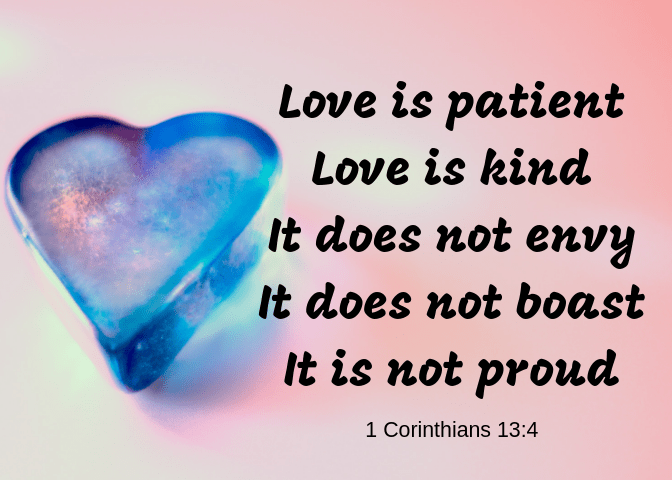
“They” call 1 Corinthians 13 “the love chapter”. It’s quoted from at most weddings. So what is it talking about? I don’t think it is a coincidence that Paul discusses love and speaking in tongues (a gift involving the ability to speak unique languages), in the same chapter. Love is difficult to put into words.
In my work as a Funeral Director and Deputy Coroner, I am often at a loss for words. I frequently have opportunity to speak with families when there is nothing to say. Nothing that should be said, anyway. That certainly doesn’t stop some people from trying. I’ve heard people say all kinds of stuff to try to comfort the grieving. Most of it, frankly, has no basis in scripture or reality. Sometimes I wish I had a platitude and cliché bingo card I could pull out of my pocket and shout “BINGO!”. About the only right thing to do in that situation is nothing at all.
My father-in-law is a pastor and has served as Chaplain for a local fire department for a number of years and he recently commented during a sermon about how in most situations when the fire department is needed, if the crew showed up and just stood there people would say “Don’t just stand there, DO SOMETHING!” But when it comes to the work of a fire chaplain, the best approach is “Don’t do something, JUST STAND THERE!” I liked that line. I have stolen it and shared it with coworkers several times. When a person has lost everything they don’t need a preacher, they need a presence. To be able to just be present, is a gift. (Do you see what I did there?).
As Christians, being confronted with a sudden and unexpected death is like being the pilot in charge of an airplane when the engines stall. All that is really left at that point is faith, hope and love. What words of comfort can you give when you know that a person did not have faith in Jesus Christ? What chapter of systematic theology will you turn to for the family who has no hope in The coming Kingdom?
I said before, our dog is named Zippers due to her urge to chew on our coat zippers. If we named our children using that method, one of my sons might have been named “Whacko”. He has always liked to “whack” things with sticks. When he was two years old we bought him a Sesame Street drum set for Christmas.
It was a pretty cool toy. It came with a little stool to sit on. It had a pedal for the bass drum. It is hard to see in this picture, but there was even a tiny metal cymbal. Man, did he love to whack that thing!
I honestly don’t know what ever happened to that drum set but I have a feeling it found its way to “a better place”. The place where all the noisy toys end up. You know the toys I’m talking about- the Jack in the boxes, the little microphones with the spring inside that toddlers yell…I mean sing into, the Fisher Price Pop “Corn Poppers” that aunts and uncles buy for their nephews as revenge for the year you wrapped up too many candy canes… We’ve all had noisy toys like that.
Those noisy toys are exactly what I picture when I read 1 Corinthians Chapter 13. To paraphrase, Paul says all of those gifts of the spirit we just talked about in the last chapter are great. I’d really like for you to have ‘em, but in the end all that really matters is faith, hope and love. Of those three qualities, if you only have room for one, choose love because when the rubber hits the road, what people need to know is that God loves them more than anyone has ever loved them. All the rest is just noise.
-Brian Froehlich
Application questions:
What is the noisiest toy you had as a child?
What is the “noisiest” thing in your life right now?
Have you ever had a friend who was just silently present with you when you needed them?
The luxury automotive company, Lexus, advertises the “December to Remember” event every year. The commercials show someone waking up on Christmas morning and looking out in the driveway to see a brand new car with a huge bow on top. What a gift that would be! I don’t personally know anyone in the tax bracket that could afford to buy a brand new car and surprise their spouse with it for Christmas. It would certainly be a December to remember. Ironically, I had to google which car company did the “December to Remember” campaign because I couldn’t remember.
My birthday is in January, it is less than 30 days after Christmas. Growing up, the majority of the gifts I received for the year tended to be within a month of each other. During the winter of 1988-1989 a lot was going on in my world (that’s the topic for another time). It was in many ways a winter to remember. I distinctly remember some of the gifts I received that year. My dad made me a really neat wooden puppet stage with real working stage curtains and lights I could turn on with a switch. I received a magic set, an Alphie the robot toy and I received a savings bond. Yeah, a savings bond.
I can still perform some of the tricks from the magic set. The puppet stage went through a couple “revamps” as my dad called them over the years, but I still have it. I think my kids might still play with that Alphie robot when we are over at my parents’ house sometimes. Who knows what happened to that savings bond? I’m probably a millionaire and don’t even know it. If I ever find that thing, it will certainly be a December to remember when Hannah finds that new Lexus in the Driveway.
I started “dating” Hannah when I was 16 and she was 15. On her 16th birthday she told me that her grandparents, in Arizona, bought her a new, blue, Volkswagen Beetle. I kinda believed her. She kept adding details to the story over the next few days. The more she went on about it, the more I actually believed she had received a real car for her birthday. I was more than a little disappointed when the truth came out, the car she had received was a toy the size of a matchbox car.
My brother, Evan, is 13 years younger than me. When I was in college in Atlanta and came home for Christmas I had the opportunity to be a really cool big brother. I went to a hobby shop and bought an “Air Hogs” brand remote controlled airplane. I thought he would love it. If not, I kinda wanted it myself. In an attempt to be funny, I also bought him several boxes of candy canes at the dollar store and wrapped them up for him as a gag gift. I also wrapped up the airplane but hid it. It was just the 20 boxes or so of candy canes under the tree. When it was Evan’s turn to open presents he was excited to see what he got from me. He tore into the paper and saw the candy canes. He started crying. Through his tears he loudly asked “What am I going to do with 100 candy canes?!” That’s the part we all remember at family get togethers now. Nobody even remembers the airplane.
Around Valentine’s Day, when my son Carter was 5 years old he asked me to help him make a heart out of Crayola Model Magic (a substance similar to play dough, except it drys into a soft foam rubber kind of material). Knowing full well that he was talking about the simple geometric heart shape like chocolates come in, I carefully sculpted my best replica of an anatomically correct heart and handed it to him. I took a picture of his disapproving scowl. When I showed my wife, she reminded me that the Bible teaches fathers should not exasperate their children.
The first part of 1 Corinthians Chapter 12 talks about “gifts of the Spirit”. Paul writes:
“There are different kinds of gifts, but the same Spirit distributes them. There are different kinds of service, but the same Lord. There are different kinds of working, but in all of them and in everyone it is the same God at work. Now to each one the manifestation of the Spirit is given for the common good. To one there is given through the Spirit a message of wisdom, to another a message of knowledge by means of the same Spirit, to another faith by the same Spirit, to another gifts of healing by that one Spirit, to another miraculous powers, to another prophecy, to another distinguishing between spirits, to another speaking in different kinds of tongues, and to still another the interpretation of tongues. All these are the work of one and the same Spirit, and he distributes them to each one, just as he determines.”
I have known some people that have said they had the gift of speaking in tongues but I certainly couldn’t understand or appreciate what they were saying. I have known people who desperately wanted or maybe even thought they would receive the gift of healing when someone they loved was very sick, but despite fervent prayers the healing did not come. It would be awesome to have “miraculous powers”. I would love to be able to raise the dead or cause the sun to stand still in the sky. (I do have questions about the physics about how all that worked.). So far I don’t think I have been given those gifts. Even my ability to deliver a message of wisdom or knowledge are iffy at best. There are certainly far better preachers and teachers than me. So where does that leave me? Do I even have any spiritual gifts? Is have a “gift of the spirit” as important as exhibiting the fruit of the spirit? Is this the complete list of gifts?
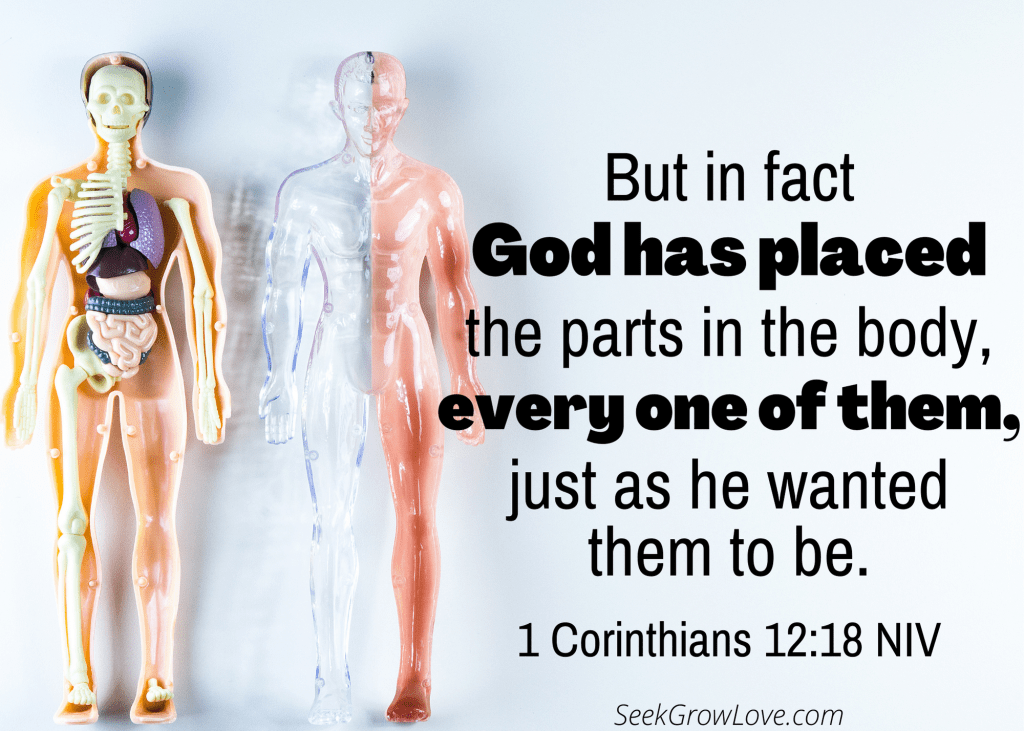
Paul addresses some of those questions in the second part of 1 Corinthians Chapter 12. He compares the church to a human body. He says “Just as a body, though one, has many parts, but all its many parts form one body, so it is with Christ. For we were all baptized by one Spirit so as to form one body—whether Jews or Gentiles, slave or free—and we were all given the one Spirit to drink. Even so the body is not made up of one part but of many. Now if the foot should say, “Because I am not a hand, I do not belong to the body,” it would not for that reason stop being part of the body. And if the ear should say, “Because I am not an eye, I do not belong to the body,” it would not for that reason stop being part of the body. If the whole body were an eye, where would the sense of hearing be? If the whole body were an ear, where would the sense of smell be? But in fact God has placed the parts in the body, every one of them, just as he wanted them to be. If they were all one part, where would the body be? As it is, there are many parts, but one body. The eye cannot say to the hand, “I don’t need you!” And the head cannot say to the feet, “I don’t need you!” On the contrary, those parts of the body that seem to be weaker are indispensable, and the parts that we think are less honorable we treat with special honor. And the parts that are unpresentable are treated with special modesty, while our presentable parts need no special treatment. But God has put the body together, giving greater honor to the parts that lacked it, so that there should be no division in the body, but that its parts should have equal concern for each other. If one part suffers, every part suffers with it; if one part is honored, every part rejoices with it. Now you are the body of Christ, and each one of you is a part of it. And God has placed in the church first of all apostles, second prophets, third teachers, then miracles, then gifts of healing, of helping, of guidance, and of different kinds of tongues. Are all apostles? Are all prophets? Are all teachers? Do all work miracles? Do all have gifts of healing? Do all speak in tongues? Do all interpret? Now eagerly desire the greater gifts. And yet I will show you the most excellent way.”
-Brian Froehlich
Application questions:
1. What is the first gift you remember receiving?
2. How about the most unusual gift you have ever received?
3. Was there ever a gift you had on your wish list that you asked for or hoped to receive, maybe even thought you would get but did not?
4. Have you ever received a gift that the giver thought you would like but you totally did not have any desire to use?
5. Have you ever received a gift without knowing its value till much later in life?
6. What gift(s) of the spirit have you been given.
7. When thinking of Paul’s imagery of us all being parts of the body, what body part do you think you are? An eye? An ear? Maybe an appendix or a tonsil?
I graduated from Atlanta Bible College in 2003. I worked with a couple small churches after that, but found my “calling” in helping people through grief. Next month, my wife, Hannah, and I will celebrate our 18th wedding anniversary. Our marriage is almost old enough to vote. We have four children ranging in age from 12 to 3. In November 2021, we bought a purebred english mastiff puppy. We call her “Zippers” for her propensity to chew on jacket closures. This is the lens through which I see things, my source for some great sermon illustrations and the perspective from which I write today.
I am my parent’s oldest child. I was the first grandchild on both sides of the family. I had three whole years of life experience before my sister was born. I felt like I was practically an adult at age 13 when my youngest brother was born. When I went through grade school in DeKalb, Illinois, each student attended kindergarten through 4th grade at the elementary school closest to his or her home. Then “the whole city” converged on Clinton Rosette Middle School for 5th and 6th grade. Then, everyone transferred to Huntley Middle School for 7th and 8th grade. Finally, everyone went on to the last building of the journey, DeKalb High School. That means when I was a big 7th grader, my 4th grade little sister was still “two whole buildings behind me” in “baby school”, at Carl Littlejohn Elementary. I didn’t let her forget it. I mean it had “Little”, right there in the name. My sister and I would fight like cats and dogs growing up but if anyone else tried to mess with her, they’d better look out. Being “the big brother” or “the oldest” was a big part of my identity growing up. As adults, the three year chasm between my sister and I, does not seem so important. She’s about to finish her master’s degree and will probably make more money than me. My brother can definitely grow better facial hair than me. When we are together people have mistakenly thought he was my older brother. I’ll admit I don’t love having my sense of identity challenged. I think some of the early Christians in Corinth might have felt the same.
In 1998, I “officially” started dating the preacher’s kid, a “PK”, as they say. I quickly learned that people (including myself) make certain assumptions about how a pastor’s family members ought to behave. Sometimes there are unrealistic expectations. When you date a preacher’s daughter, people have some expectations for you too. Some are unspoken. Most of them should be. A lot of them aren’t. Churches are funny that way. People feel safe saying things they shouldn’t, or wouldn’t say elsewhere. If someone perceives you as too perfect, or not perfect enough, they might feel the need to take you down a notch, or give themselves a little ego boost by comparison. It’s kind of like social media.
Sometimes the point of what people are trying to say is correct, but it is lost because of the way they say it. If we aren’t careful, even discussing certain topics can ignite a public opinion forest fire. Polarizing material is pumped into our televisions and handheld devices every day. Maybe that’s why they call them devices; because they are so divisive. Lifelong friendships have been destroyed over which “side of the aisle” a person stands on certain topics. Gender equality is one of these “hot button topics”. At first glance it might look like 1 Corinthians 11 is “too hot for TV”. I suggest that it is not, but reader discretion is advised.
What is Paul talking about with all this head covering business in the first part of this chapter? Is he suggesting that women are somehow less important than men? Not at all.
As I understand it, the tradition of the time was for women to cover her head (and in some cases, her face too) while in public as a symbol of faithfulness to her husband. She was saving her beauty “for his eyes only”. An online Bible commentary on the subject explained that it was not completely unlike the message that would be conveyed by a woman wearing a big diamond engagement ring in today’s American culture. It said she is taken. It said, don’t event try to flirt with her. Prostitutes on the other hand, would not have covered their head in public. They wanted to draw attention to themselves. To do that in church, when the focus was supposed to be on worship, would have been quite provocative. Can you imagine if a woman came into church wearing “barely there beach attire” nowadays? It would be distracting for both men and women alike as was the case in the time Paul wrote this letter to the church in Corinth.
In case there was any question as to where Paul stood in regards to the value of women. He clears it up in 1 Corinthians 11:12 when he says: “For as woman came from man, so also man is born of woman. But everything comes from God.” So in the first part of 1 Corinthians chapter 11 Paul tries to build unity in the church by asking people to be modest.
The second half of 1 Corinthians chapter 11 is less controversial. Paul admonishes the Corinthians for abusing the opportunity for unity through communion. People in that time were eating without waiting for each other and totally missing the point of the exercise. It reminds me of obedient mastiffs and “Boy’s night waffles”.
My wife, Hannah, is a nurse. When my oldest son, Carter was little, Hannah would usually work the evening shift at the hospital. So when she worked, Carter and I had “‘Boy’s night!” Sometimes, I would make waffles and sausage for supper and we would load them all up with all the toppings we both liked: Chocolate chips, blueberries, strawberries, whipped cream, etc. Hannah would never buy all that stuff. So we called them “Boy’s Night Waffles”. As we had more kids, Carter still wanted Boy’s Night Waffles. But it became increasingly difficult with four children. It was like conducting an uncooperative orchestra to have all the waffles warm and the toppings cold and help the kids cut their food into reasonable bites so we could all eat at the same time. Now on the rare occasion that we have Boy’s Night Waffles, I just have the kids start eating as their food is handed to them. We don’t even try to eat at the same time on waffle night.
English mastiffs like our dog, are sometimes called gentle giants. They are known for their size. They are one of the largest breeds there is. A female, like ours, can easily be around 150 pounds. They can be intimidating looking, but they are generally very calm and don’t need a ton of vigorous exercise. These qualities match our family pretty well. I hope to use our dog Zippers as a therapy dog, so I have been going to obedience classes with her one or two times per week ever since she was small. A large part of what we do in class is walk in circles reminding her to watch me and not ahead of me or behind me. When we get to a doorway we practice having her wait and not allowing her to just run right in or out. When we put food in front of her she has to leave it until we say a release word. Zippers is pretty good at the waiting part. She’s not so good at the release word part. We have tried “OK” and “Free” and “Eat”. A lot of times she will not start eating unless one of us sits beside her. Paul would probably like this dog.
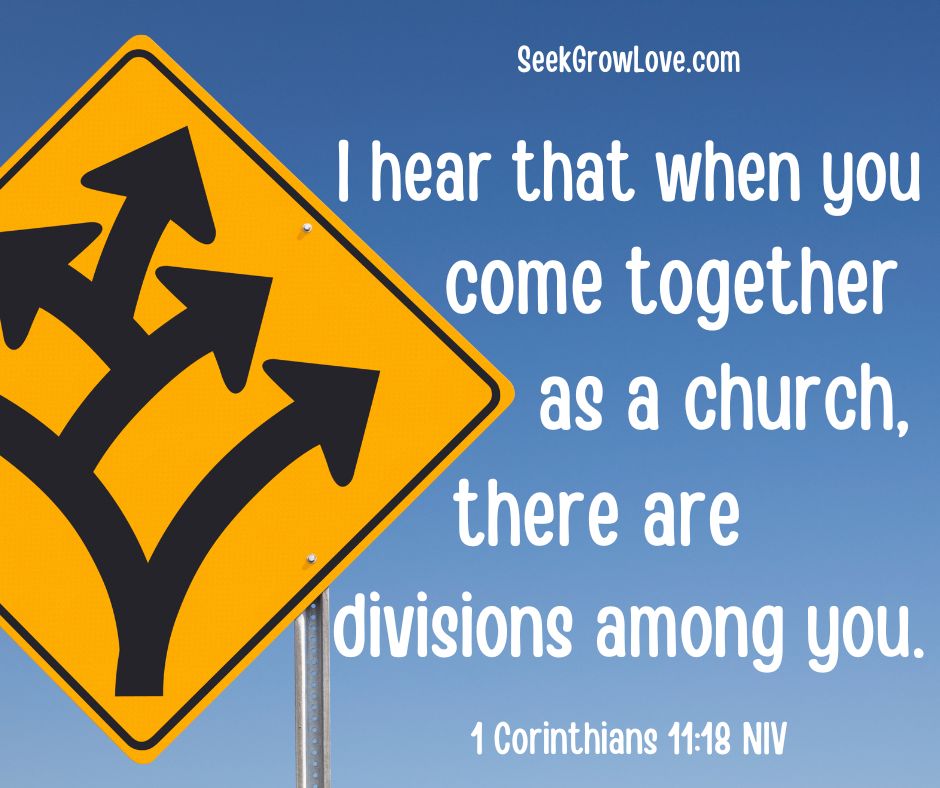
As I see it, 1 Corinthians Chapter 11 is meant to remind the reader, (originally, Christians at the church of Corinth in about 55 AD), about the importance of unity. Paul says he is glad that the Corinthians are following his teaching and traditions but, he wants to remind them that it is more important to follow Christ than following himself. He encourages the church to be modest and build unity over division.
-Brian Froehlich
Application Questions:
What traditions in your church have become a part of its identity?
What are some behavioral differences you notice when you visit another congregation?
What are two or three attitude adjustments your church should consider for the sake of unity?
How does the Corinthian Communion service compare to those you have participated in?
Idolatry has been going on for all of human history. It is as old as sin, because when we stop worshiping God we naturally start to worship something else that is not God, and when we do this we give it an importance and a prominent position in our life that it should not have.
The ancient Israelites dealt with the idols and sacrifices to Baal and Ashera, the early Christians in Corinth lived in a culture that worshiped Apollo, Athena, and the Emperor.
The worship of these idols defined the culture of the day and helped to form a part of the social life of many people. For many, accepting Christ and walking away from the worship of Apollo meant losing all of their friends and community, and a part of their identity. So many of them tried to keep a foot in both worlds. They would go to Christian services and be a part of that community, and they would offer meat to idols and try to maintain their position in society. They would argue that eating meat and talking with friends was not bad, but they missed the point.
18 Look at the Jews. They ate the animals that were brought to God as gifts in worship and put on the altar. Did this not show they were sharing with God? 19 What do I mean? Am I saying that a false god or the food brought to it in worship is worth anything? 20 No, not at all! I am saying that the people who do not know God bring gifts of animals in worship. But they have given them to demons, not to God. You do not want to have any share with demons. 21 You cannot drink from the cup of the Lord and from the cup of demons. You cannot eat at the Lord’s table and at the demon’s table. 22 Are we trying to make the Lord jealous? Do we think we are stronger than the Lord?
It is not the meat they are eating that is bad, but the context, the community and the mindset. If they accidentally happened to eat some of the meat that was offered at a pagan altar, they would get some tasty protein and that is about it, but if they seek out a community of people that are offering sacrifices to, and worshiping something other than God in order to maintain their social standing and public image, then that is sin. They have elevated their pride and their image and have put that ahead of God’s will, and when they join in with the idol worship they show the non-believers that God means less to them than the idols.
27 If a person who is not a Christian wants you to eat with him, and you want to go, eat anything that is on the table. Ask no questions about the food. Then your heart will not say it is wrong. 28 But if someone says, “This meat has been given as a gift to false gods in worship,” do not eat it. In that way, it will not hurt the faith of the one who told you and his heart will have peace. 29 How the other person feels is important. We are not free to do things that will hurt another person. 30 If I can give thanks to God for my food, why should anyone say that I am wrong about eating food I can give thanks for? 31 So if you eat or drink or whatever you do, do everything to honor God
In every context our mindset should be to honor God. Because we are Christians all of our actions send a message to others about who God is, and when we are hypocritical or give in to social pressures, that hurts the faith of all who see it.
-Chris Mattison
Application Questions:
Do you have anything that you are trying to keep in your life that could be an idol? Maybe a group of friends that party a bit too hard, but you don’t want to lose them as friends? Or an unhealthy obsession with social media and how others view you, instead of how God sees you?
The early part of this chapter looks back at the Old Testament times and how angry God gets at idolatry, why do you think God gets jealous and angry when his people turn to idols instead of to him?
Do you need to be more aware of the struggles of those around you and give up some of your freedoms so that you can honor God and help grow their faith?
Do you not know that in a race all the runners run, but only one gets the prize? Run in such a way as to get the prize. (1 Corinthians 9: 24)
Being competitive is sometimes presented in a negative light. Probably because competition can bring out the ‘jerk’ in people. That’s too bad, because in his letter to the Corinthians, Paul is telling them (and us) to lean into that competitive spirit.
Paul is using this as an analogy, by the way, he’s not telling us that we are in competition with other believers. He uses two phrases that I hope will inspire you as you run your race.
“strict training”
Athletes preparing for a big competition don’t eat whatever they want and binge Netflix all day. What do they do instead? They do things that will help them succeed in their goal. (Winning!) Paul’s goal, and ours, is “a crown that will last forever.”
How do we train for eternal life?
The word obey comes to mind. In order to obey we need to really know Scripture. If we want to hear the words “Well done, good and faithful servant,” we need to know what the Master expects of us. And we need to do it, even when it’s hard. Just like the athlete in training gets off the couch and goes to practice, even when he’s tired, we need to obey even when it doesn’t make sense to our human sensibilities.
“do not run aimlessly”
If you’ve ever been to a kid’s sporting event, you know that there are players that do not have their head in the game. They are wandering around the field, chatting with friends, maybe even picking flowers in the grass. Adorable.
Not so adorable when it’s adults in an Olympic competition and not cute when we’re talking about forever.
So many of us say that we are sharing our faith by the way that we live our lives. But how much of that is a cop-out because we’re not comfortable evangelizing? If we are actively sharing our faith through our life, we will be intentional in planning ways to do it. We won’t just be going about our life, wandering aimlessly along.
I encourage you today to make a training plan. How are you getting ready for Christ’s return? I also encourage you to make a game plan. How are you looking for ways to share your faith with those around you?
-Susan Landry
(Editor’s Note: Sorry this was sent out later today. It’s been fun hearing from a variety of writers this week, but today’s scheduled writer ran into a health issue and was unable to write. So, we went back in time and found this great devotion from 2019 – thank you, Susan – definitely good enough to read again. God bless you as you Seek, Grow and Love!)
Questions for Reflection and Discussion
How often do you remember that you are training for a crown that will last forever? If we remembered this more often how might it change our hearts, our schedules, our free time, our priorities, our training routine? What could you do differently this week, remembering the goal of your training and perhaps making it a little more “strict” than it has been lately?
Are there any ways in which God may say you have been running aimlessly? What adjustments do you think Paul would suggest? Are you willing to do them?
1st Corinthians chapter 7 presents us with Paul explaining to the church the importance of Christian liberty in marital relations. This chapter is all about the importance of the Christian concept of marriage and how it needed to be established in the early church.
In Paul’s letter he writes about the principles of marriage, but he also writes about singleness, in 1st Corinthians 7:4 Paul says,
“A wife does not have the right over her own body, but her husband does. In the same way, a husband does not have the right over his own body, but his wife does.”
In a marital relationship, the husband and wife belong to one another, just as we belong to God in our relationship with him. We can also see this in how Elihu speaks to Job in Job 33:6.
“Look, you and I both belong to God. I, too, was formed from clay.”
We all belong to God in everything we do. We are to trust God in his decisions for our lives and the places we are to go, just as our spouse is to rely on us in our relationships.
Paul also speaks of singleness in chapter 7. Paul says in 1st Corinthians 7:8-9, and verses 32-35.
“I say to the unmarried and to the widows: It is good for them if they remain as I am. But if they do not have self-control, they should marry, since it is better to marry than to burn with desire.”
“I want you to be without concerns. The unmarried man is concerned about the things of the Lord. How he may please the Lord. But the married man is concerned with the things of the world, how he may please his wife, and his interests are divided. The unmarried woman is concerned about the things of the Lord, so that she may be holy both in body and in spirit. But the married woman is concerned with the things of the world, and how she may please her husband. I am saying this for your own benefit, not to put a restraint on you, but to promote what is proper and so that you may be devoted to the Lord without distraction.”
Paul isn’t saying we shouldn’t be married or have relationships, but he is saying, that when we are in them it is important to not lose sight of your faith, and to devote yourself to God first. Sometimes our seasons of singleness are God’s way of pulling us closer to him, and that is one of the most important periods in our life. We have an opportunity to be devoted to only God and spend time learning who he wants us to be.
This is where I have been in my life lately. I’m realizing that my relationship with God must come first before I am able to have a relationship with someone else, so that we can strengthen each other through our faith in Christ. God wants a relationship with us, and for us to trust in him first and foremost.
-Hannah Eldred
Questions for Reflection and Discussion
Whether you are single or married, how can you deepen your devotion to God?
What is the person to do who is married to an unbeliever? Why?
If you will be choosing a spouse, what does Paul say he/she has to be? Why?
If you are married, how can you work (ideally, together, with your mate) at keeping God first?
Paul is full of questions. Should you go to court against your neighbor? Is it possible that you are capable of judging in even a small court? Can you not as brothers in Christ decide your own lawsuits against one another? Is it not better to be cheated or wronged? These are just a few questions you will discover in this chapter. Paul was just getting started when he asked: (9) “Or do you not know that the unrighteous will not inherit the kingdom of God?” Now, unrighteous covers a lot of territory. Self-examination is encouraged for each of us. Are you ready? Fornicators, idolaters, adulterers, homosexuals, and those who are effeminate will not inherit the kingdom of God. But wait there’s more behaviors that are pointed out. Thievery, or covetous, that’s a given already covered in the 10 Commandments. Should I keep going? Drunkards, revilers, or swindlers are excluded from the kingdom too. I had to look revilers up in the dictionary. I am sure I used to know its meaning, but my memory failed me today. A reviler is someone who is verbally abusive, criticizing in anger.
Here comes the good part. Paul reminds them that some have turned away from evil and have been washed, sanctified and justified in the name of Jesus and in the Spirit of God. How wonderful to be redeemed!
There are several other important points that Paul goes on to make in chapter 6 and they shouldn’t be missed. For instance, you can eat whatever you want, but is it healthy for you. A carton of ice cream (butter pecan) is legal to eat in one sitting, but it would not be the right thing for anyone. Paul goes on to say that the same is true in other aspects of an individual’s life. As Christians, we are to flee immorality. Joining with a prostitute makes you one with her. We are to be in one spirit with the Lord. Your body is a temple of the Holy Spirit who is in you. Remember, in Christ we have been bought with a price and we are to glorify God in our body.
-Bob Collier
Questions for Reflection and Discussion
What were some of the questions Paul asked the church at Corinth?
Can you think of some life actions unacceptable to God that are not mentioned in this chapter?
What will you pray about today?
Knowing what you read today, what needs changing in your life?
As we continue past the previous chapters of 1 Corinthians, that of leadership in the church and the nature of true apostleship, we enter a new section that is initially and seemingly unrelated to the current mood of Paul’s letter. It feels kind of awkward to talk about certain sins and topics, today’s being incest, because it is so obviously horrendous that it almost feels like a waste of breath to talk about. However, this negligence is precisely why we need to discuss such things, so that they do not become the normative culture. (As is seen with a plethora of “hot-button” issues the modern church has just accepted due to ignorant doctrine.) Additionally, as we’ll see with what Paul wrote, these topics are also excellent gateways for further understanding other applications of the word: true faith in action.
Paul begins by calling out the sin of incest between two members of the Corinthian church, fixating the blame on the man responsible, and seems to be most uproarious about how proud the offenders are in their sin. Verse 2 reads, “And you are proud! Shouldn’t you rather have gone into mourning and have put out of your fellowship the man who has been doing this?” It appears as though, while the act of incest itself is an egregious sin, being boastful in it simply exacerbates its severity. This claim is supported by the next six verses and subsequent pseudo-parable. Verses 6-7 read, “Your boasting is not good. Don’t you know that a little yeast leavens the whole batch of dough? Get rid of the old yeast, so that you may be a new unleavened batch – as you really are. For Christ, our Passover lamb, has been sacrificed.” A little yeast, the parabolic equivalence of humility (i.e., the absence of excessive boasting), is sufficient to make useful bread. Old yeast is to be thrown out, as it makes bad bread and is useful for nothing; just as we need not boast at all, Jesus is our supplement for humility. We are called not to boast in our accomplishment or our sins, but to attribute all that we have done that is good to God.
Returning to Paul’s initial command to extradite the man from the church, does that not seem antithetical to the accepting nature of faith? Perhaps upon an initial reading it may, but Paul acknowledges this and says in verses 9-11, “I wrote to you in my letter not to associate with sexually immoral people – not at all meaning the people of this world who are immoral, or the greedy and swindlers, or idolaters. In that case you would have to leave this world. But now I am writing to you that you must not associate with anyone who claims to be a brother or sister but is sexually immoral or greedy, an idolator or slanderer, a drunkard or swindler. Do not even eat with such people.” Paul is entirely aware that man is a sinful being, and that there was only one man to walk the earth who was blameless: Christ. Instead, in this passage, he makes the clarification that the people we are to not associate ourselves with are those who claim to be brothers and sisters in the faith, and STILL are boastful in their sin, unapologetic about their openly sinful life, perhaps even going as far as claiming that their actions are biblically justifiable. These are the people we are to lovingly rebuke, as they claim to live by the word and yet blatantly do not. So often, Christians are seen as judgmental toward outsiders. Unfortunately, this is not wholly unreasonable. Our issue is that we judge those who do not live by the law for not living by the law, while simultaneously turning a blind eye to those who CLAIM to live by the law and openly do not. Paul writes in verses 12 and 13, “What business is it of mine to judge those outside the church? Are you not to judge those inside? God will judge those outside. ‘Expel the wicked person from among you’.” Our responsibility is to spread the good news to those who do not have it, and to lovingly keep ourselves accountable.
-Mason Kiel
Questions for Reflection and Discussion
Sin is sin. Why is there a difference between how we view, judge or treat various sinners?
Are you personally more apt to spread more judgment to those outside the church or load on the mercy to those inside than Paul would recommend? What is the danger in each of these?
What is the purpose of expelling a brother in sin?
The life story of Paul is always a fascinating read. Bad guy turned good. And it even has a cool name change from Saul to Paul. But more importantly it’s a story about how God used our brokenness and yet found a beautiful way to restore us and give us a purpose through Him. And throughout his letters it is evident that God was working through him. There is nothing that Paul did to deserve being “put in charge of explaining God’s mysteries.” (1 Corinthians 4:1) The important part is that he answered the call and gave God all the glory – as He deserves.
Paul makes it clear that his desire is to visit Corinth again. But he tells them that when he gets there they will inevitably receive praise or discipline from him. Because while he was away they were either following God or they weren’t. In the same way, everything we do either brings us closer to God or pushes us away. The Corinthians were given a chance to turn from their sin and follow God. Paul warns them to change before they have to face the consequences of their choices. We may never have Paul sending us emails or posting his wisdom on Instagram but we still have the same choice as the Corinthians 2000 years later. And thankfully God still has other ways to communicate with us and warn us when we find ourselves going down a slippery slope. Whether through our conscience, a godly mentor, or even a timeless letter from good ol’ Paul. Thankfully we can read the same words that Paul wrote to the Corinthians and we have a chance to learn from them.
God is love. But we often forget this attribute is still being displayed when it’s time to be disciplined. He loves us enough to warn us countless times when we choose to walk down the wrong path. His justice and love compliment each other in ways that we cannot understand. But we can know for certain that God loves us and has our eternal interest in mind. He wants us to be in His Kingdom, but we ultimately have to make the decision to accept God’s gift of eternal life.
The concept of Paul sending Timothy whom he refers to as his beloved and faithful child in the Lord is strikingly similar to God sending His only begotten Son Jesus, on behalf of Him. The connection between Paul and his mentee Timothy makes me think about the nature of the relationship between God and Jesus. Since Paul was preaching the message to other cities he sent Timothy ahead of him to Corinth to continue his ministry. In a similar way, since God is not able to be in the presence of sinful humans (aka the earth) he sent a man, His Son, Jesus to represent God. Jesus’ mission from his father was to proclaim the gospel (the name of Jesus and the message of the Kingdom of God) and die on the cross for the sins of the world. This ultimately will eventually allow God to come to the earth after the earth has been judged from its sin. The big picture shows the importance of being on the right side, God’s side. So learn from God’s discipline now before the world is judged for not following God.
-Makayla Railton
Questions for Reflection and Discussion
How is discipline an important part of God’s love? Where have you seen or witnessed his discipline and justice at work for good?
Who has God sent to reveal/explain His mysteries to you? To whom can you share what you have learned and how you live?
If Paul were to be writing to you and your church, or even stopping in to visit this Sunday morning – what words do you think he would bring?