“But he was pierced because of our transgressions,
crushed because of our iniquities;
the chastisement for our peace was upon him,
and by his wounds we were healed.
All of us have wandered about like sheep;
we each have turned to his own way,
and Yahweh let fall on him the iniquity of us all.”
Psalm 108:1 (LEB):
“My heart is steadfast, O God;
I will sing and give praise, even with my glory.”
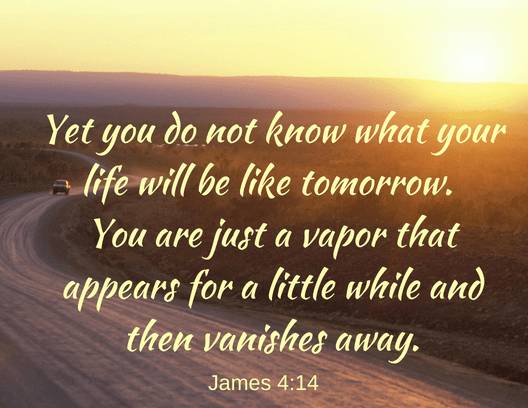
James 4:14-15 (LEB):
“Yet you do not know what tomorrow will bring. What is your life? For you are a mist that appears for a little time and then vanishes. Instead you ought to say, ‘If the Lord wills, we will live and do this or that.'”
Isaiah 53 paints a vivid picture of the suffering Servant, Jesus Christ, who bore our sins and took the punishment we deserved. It reminds us that God’s plan for salvation was in place long before we understood it. We were like wandering sheep, yet God sent His Son to rescue us and reconcile us to Himself. Isaiah 53 reminds us that God’s plan for our salvation was set in motion long before we even understood our need for it. We can trust His plans for our lives because He has proven His love through the sacrifice of Jesus.
Isaiah 54 shifts from the suffering of the Servant to the hope and restoration that follows. God promises to expand the tents of His people, signifying the growth and blessing that come through Christ’s sacrifice. This passage is a reminder of the immense love God has for us, His plan to redeem, and the restoration we experience in Him. In moments of doubt or difficulty, we can trust that God’s plans for us are rooted in His unfailing love and perfect wisdom.
Psalm 108 calls us to have a steadfast heart before God. The psalmist’s heart is fixed on praising God regardless of the circumstances, declaring God’s greatness in the morning and in the midst of battle. Just as Isaiah speaks of the suffering and victory of the Servant, Psalm 108 reminds us that our response to God’s sovereignty should be steadfast praise. Even when we face trials or uncertainty, our hearts can be firm, trusting in His ultimate plan and offering Him our highest worship. Psalm 108 challenges us to maintain a steadfast heart of praise, even when life is uncertain. In every season, our hearts can be anchored in worship of God’s goodness.
James reminds us of the uncertainty of life and the importance of acknowledging God’s control over every aspect of our future. We often make plans assuming we are in control, but James challenges us to live with a heart of surrender, saying, “If the Lord wills.” This humility reflects a life that trusts God’s sovereignty in all things. James 4 reminds us to live with humble dependence on God, acknowledging that our lives are brief and that God’s will is sovereign. Our plans should always be made in light of His greater purpose.
As we consider the sacrifice of Jesus in Isaiah 53 and the promises of restoration in Isaiah 54, we should be moved to submit every part of our lives to God. Our days are like a mist, and we don’t know what tomorrow holds, but we can trust the One who holds tomorrow. Living with humility and dependence on God’s will is an act of worship and surrender.
This week, let the truths of Isaiah 53-54, Psalm 108, and James 4 inspire you to trust God’s sovereign plan for your life. Reflect on His immense love shown through Christ, cultivate a heart of steadfast worship, and live in humble surrender to His will.
-Jeff Ransom
Reflection Questions:
How does reflecting on Christ’s sacrifice in Isaiah 53 deepen your trust in God’s plan for your life?
In what areas of your life do you need to have a more steadfast heart of worship, as seen in Psalm 108?
How can you practice the humility and surrender James speaks about in your daily decisions and plans?
Are there areas in your life where you struggle to trust God’s sovereignty? How can you take steps to surrender those areas to Him?
Life is uncertain. That seems to be the theme that Solomon focuses on in this chapter. His first statement seems quite enigmatic, “Cast your bread on the waters; for you may find it after many days.” “Casting one’s bread on the waters” may be a metaphor for maritime trade, and what one might “find after many days” could refer to the revenue that comes back to the person after the goods are sold. The numerical proverb in verse 2 could suggest the wisdom in diversification of cargo on different ships, so that if something happened to one ship, the entire shipment won’t be lost. The reasoning for this is that a person cannot know “what evil may happen on the earth,” referring to unforeseen disasters and circumstances in the future.
Another imagery that is used is that of clouds that are full of rain (v. 3). The imagery is meant to depict the randomness of life and the unpredictability of events. The implicit idea that the imagery represents is the uncertainty of disasters or bad things that will negatively impact one’s life. We have no control over where a cloud will drop its rain. We know that clouds bring moisture, but the definitiveness of when and where that will take place is outside the ability of a person to know. We are simply subject to the randomness of weather patterns. Now, ultimately we know that weather is not truly random, but it is impossible for us to know all the factors that play into the weather and the behavior of clouds.
A modern expression that captures this same idea is: “That’s the way the cookie crumbles.” No one can predict how it is going to happen. But when it does, then that is how it happens.
Next an agricultural illustration is used describing farmers and how the inevitable randomness can cause one to be paralyzed by the inability to know the future. If a farmer tries to predict when the wind will be favorable for planting, they will never sow their seed because the wind might change at any moment. In addition, the farmer who stares at the clouds in order to predict when it will be dry to harvest will never gather the crops because it might rain before the harvest can be completed.
As one scholar summarizes the point of v. 4, “…one cannot use the possibility of misfortune as an excuse for inactivity. Someone who is forever afraid of storms will never get around to working his field. The Teacher in effect says, ‘Just face the fact that things may go wrong, but get out there and do your work anyway.’” (Duane A. Garrett, Proverbs, Ecclesiastes, Song of Songs, [Vol. 14, The New American Commentary], 338)
We humans are vastly ignorant about the inner workings of life and of God. In this verse, Solomon is stressing that fact but using the developing fetus in a womb as a clear example of something we know nothing about. One of the great mysteries of human existence is how life comes together in a fetus as it forms in the womb. We have no idea how “spirit” (i.e., life) enters the bones of a baby.
This example of human ignorance is being used to make the point that even though we don’t understand how many things in life really work, we should not let a lack of knowledge paralyze us into inactivity.
Thus, while trying to figure out what is going to come in the future is not profitable, we should still act wisely and take reasonable chances in life, unlike the skeptic and fearful who will not move forward in life even if the opportunity is there.
This illustration is compared then to the “work of God” in the world. Solomon describes God as the one who “makes everything.” The reference is to the operations of creation (e.g., gestation). God causes the sun to rise and the rain to fall, just as he gives life to the fetus and causes it to grow in the womb. And so, in the same way that we don’t understand how certain things happen, like a pregnant woman who is trusting God that the baby will develop as God designed, so also all future plans must likewise be put in the hands of God. We ultimately cannot control success or failure. We must simply do our best and trust God with the rest (i.e., the outcome).
In light of the general ignorance about life and the work of God, Solomon encourages the reader to work hard in the face of uncertainty, even if we don’t understand what is going to happen. He instructs farmers to “sow your seed,” meaning go out and plant the crops, and “do not withhold your hand,” meaning don’t refrain from working. Finish the job!
We have no idea whether something will turn out good or bad. We have to wait and see. Maybe one thing will work, and another will fail, or perhaps both will work, or both will fail. But one thing we can be sure of, if we don’t do anything, then nothing will ever happen.
“Light is sweet” appears as a mismatched metaphor. How can “light” be tasted. Here “light” is likely a metonymy of association referring to the perception of light by the senses of one who is alive. Thus, it refers figuratively to “life” and represents a living person (cf. Job 3:20; 33:30; Ps 56:14). This is the opposite of “darkness” which represents “death.” And “sweet” is a metaphor of taste referring to a pleasurable experience, not actual tasting with one’s mouth. This figuratively represents something that is good and delightful. Furthermore, “to see the sun” refers to being alive and able to work and do something “under the sun.” The idea is that being alive is “good” and something to be enjoyed.
Verse 8 provides the reader with encouragement to rejoice in life no matter what age a person might be. But that rejoicing is to be accompanied by an awareness that life is filled with “darkness” and that everything that happens cannot be explained or give ultimate meaning to life. Sometimes bad things happen, and no explanation can be offered to explain them. Thus, attempting to know the reason why everything happens is not possible, and therefore, it is “pointless.”
Solomon is advancing the premise that joy should accompany a person throughout their life, but life is not solely one of bliss and ease, it is also filled with hardship, pain, and various evils. And this is why he returns to the idea of “joy,” and now in more forceful terms, he flat out instructs the reader to “Rejoice!” The instruction is not meant exclusively to be directed or applied exclusively to young people. What is meant by the expression is for “joy” to become a set pattern early on in one’s life.
The phrase “let your heart cheer you…walk in the ways of your heart…in the sight of your eyes” uses the terms “heart” and “eyes” as organs of desire, and they refer to one’s inner yearnings and inclinations. The exhortation is not to follow whatever impulses one has regardless if they are immoral or reckless. Rather, one is to pursue desires and the joy they bring into life with the awareness of God’s impending judgment over everything you do.
Lastly, with God’s judgment in mind, a person should not allow the frustrations of life to incumber their pursuit of joy. We must not let the enigma of life and the unexplainable and uncontrollable realities weigh down our rejoicing in life. On the other hand, a person must not let their desires draw them into evil either. Pursuing one’s desires often can lead to wickedness and sin. Thus, one must be diligent about avoiding temptations that arise from the desires in our flesh. So, despite the human condition, we are to overcome the troubles that the “pointlessness” in life brings and focus on the joy that we can experience in the midst of it.
-Jerry Wierwille
Reflection Questions
Have you ever used the possibility of misfortune as an excuse for your inactivity? If so, what might Solomon say to you?
“Pursuing one’s desires often can lead to wickedness and sin.” How have you seen this in your own life? What desires? What wickedness and sin? How can you protect against this? Should some desires be changed? How? Should you go about pursuing some desires in different ways?
Even with the unknowns and the difficulties in life, how can you still pursue and show joy?
Chapter 3 of Ecclesiastes begins with a long poetic structure on the nature of time. Verse 1 gives the overall premise and theme of the poem, “For everything there is a season, and a time for every matter under heaven.”
There are SEVEN double pairs in the poem (FOURTEEN pairs total), which likely is meant to represent completeness for all the possible human activities and experiences in life. All the pairings are all polar-merisms, where the two extremes of an activity are mentioned to represent all the various combinations and degrees that can exist between them.
The appropriateness of timing is a major theme in wisdom literature. Timing is everything in life. Wisdom promotes knowing how fitting the timing is for a particular activity. The idea that there is a proper time for everything stems from the premise in wisdom literature that God has created the cosmos in such a way that everything follows an orderly path and timing. So, if creation exhibits orderliness and appropriate timing of events, then wisdom would see that intention as being applied to human decisions and life experience as well.
While God has ordered the cosmos in such a way that it follows distinct patterns and activities, Solomon is not saying that such a mechanistic view of the world is meant to be replicated exactly in human life. The various circumstances described in the poem are not pre-determined to happen in the course of life like a formula or preset timeline.
Interestingly, outside of being born and dying, every other circumstance that is described in the poem is one which a person can respond to when they find themselves encountering that occasion. Throughout the poem, it is difficult to pin down exactly what some of the references actually mean. They are mostly generic and therefore can be applied to a wide range of human situations. Furthermore, it cannot be determined if they are meant to be understood concretely (i.e., literally) or figuratively.
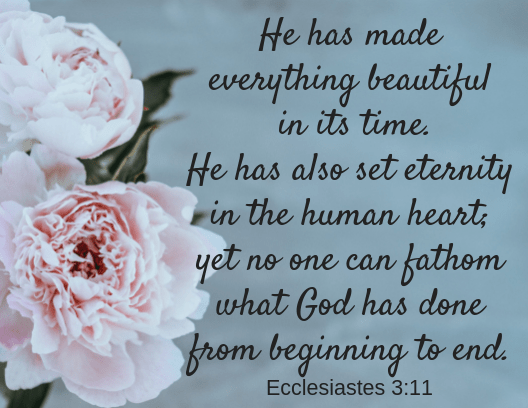
Verse 11 says that God makes “everything appropriate in its time”—what does it mean to be “made appropriate in its time”? This is perhaps one of the most difficult verses in the entire book of Ecclesiastes. It seems that the best way to understand this phrase is to begin with Solomon’s framework of the world in mind where he sees God as the one ultimately in charge in ordering the world. And so, in Solomon’s view, God has structured the world so that everything has its proper time in which everything happens, but the how and when of the appropriateness of the timing is elusive to the human mind. Only God can comprehend how he has made everything to have its own appropriate time.
Along with this complex statement, Solomon says next that God has also “set eternity” in people’s hearts, but not in such a way that they “can find out the work that God has done from the beginning to the end.” What does it mean to “set eternity” in the human heart? The phrase can be taken a couple of different ways, but it seems that the best way to take the phrase is referring to how God has placed a sense of time in the human heart where they are aware of past, present, and future and the duration of events. In a world that is ordered by time, humans can understand “that” there is a time and place in which all events happen, but to grasp the larger picture, to be able to see the whole, escapes the comprehension of humankind.
However, another way to understand this phrase could be that God has placed “a deep-seated desire, a compulsive drive…to know the character, composition, and meaning of the world…and to discern its purpose and destiny.”[1] In essence, God has placed an endless curiosity for understanding and acquiring answers in the human heart. Humans want to know, we crave to know, the answers to the questions we ask. Human beings desire to understand the “beginning” all the way to the “end” in order to control and manipulate it, thereby being able to obtain some profit or gain from their efforts.
But none can be collected. We are not able to discern the plan or pattern that God has set in motion in the world. The intricacies of God’s “work” (why he does what he does) are outside the realm of human investigation (i.e., we can’t find out no matter how hard we search), and therefore, it is beyond human comprehension, and by extension then, human control. And so, while we have “eternity” in our hearts, we are left in a state of bewilderment regarding the mystery of time by which all events happen in life.
What I think we can learn from this is that life is filled with a diversity of experiences and is not something that can be micromanaged. While we can choose how we respond to various circumstances in life, our lives are filled with events that are outside our control. God has ordered the world and life in general in such a way, and we experience life according to that ordering but not in a way that we can understand why everything happens the way it does, when it does. We must trust our lives to God who has infinite wisdom and sees all things. Only he has the “big picture” and knows the end from the beginning. To him be all the glory and praise. Amen.
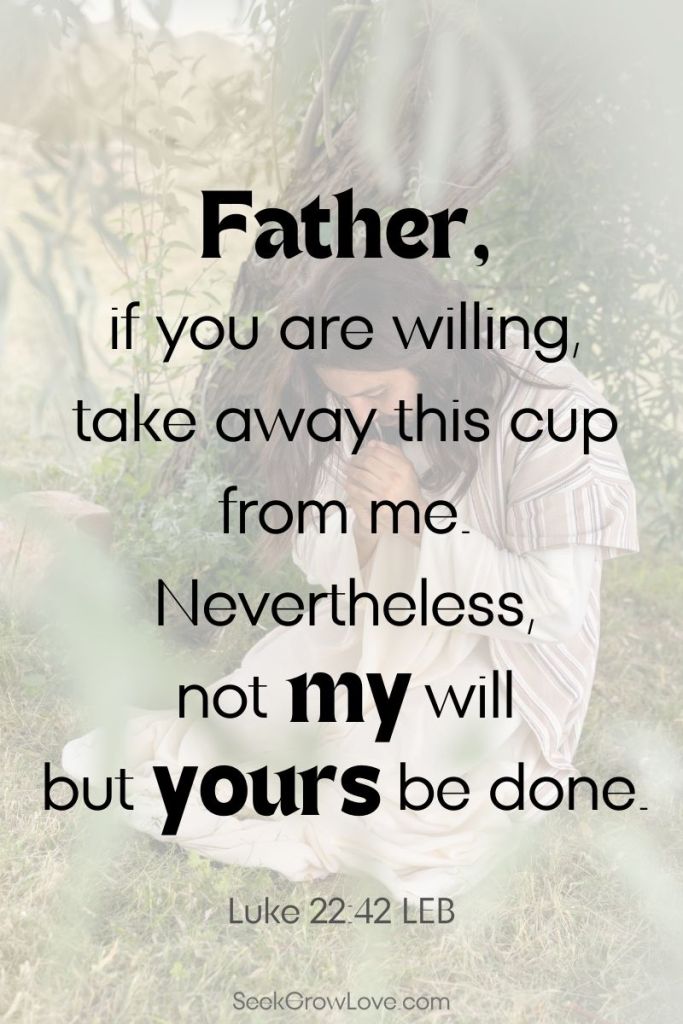
Scripture: “Return, and say to Hezekiah the leader of my people, ‘Thus says Yahweh, the God of David your ancestor: “I have heard your prayer; I have seen your tears. Look, I am about to heal you. On the third day you shall go up to the temple of Yahweh.”’” — 2 Kings 20:5 (LEB) “Listen, Yahweh, to my prayer, and attend to the voice of my supplications.” — Psalm 86:6 (LEB) “Father, if you are willing, take away this cup from me. Nevertheless, not my will but yours be done.” — Luke 22:42 (LEB)
In 2 Kings 20, King Hezekiah is faced with a life-threatening illness. His immediate reaction is to pray earnestly to God, and God responds with compassion, healing, and an extension of his life. This powerful story of prayer and divine intervention resonates deeply with themes found in Psalm 86 and Luke 22, reminding us of the importance of prayer, God’s compassion, and surrendering to His will.
When the prophet Isaiah tells Hezekiah to prepare for his imminent death, Hezekiah turns to God in earnest prayer and weeping. God hears his prayer and responds with a message of healing and an additional fifteen years of life. This account underscores the power of heartfelt prayer and God’s readiness to respond to His people’s cries.
Psalm 86:6 echoes the sentiment of Hezekiah’s plea: “Listen, Yahweh, to my prayer, and attend to the voice of my supplications.” This verse highlights the assurance that God listens to our prayers and attends to our supplications. Hezekiah’s experience validates this promise, showing us that God is attentive to our deepest needs and concerns.
In Luke 22:42, Jesus prays in the Garden of Gethsemane, expressing His desire to avoid suffering but ultimately surrendering to God’s will. This prayer, “Nevertheless, not my will but yours be done,” mirrors Hezekiah’s trust in God’s plan. Even in our most desperate moments, we are called to trust God’s sovereignty and submit to His will, just as Hezekiah and Jesus did.
Hezekiah’s sincere prayer, Psalm 86’s plea, and Jesus’ prayer in Gethsemane all highlight the importance of coming to God with our deepest concerns. God listens and responds with compassion and grace. God’s response to Hezekiah’s prayer and Jesus’ submission to the Father’s will reveal His compassionate nature and sovereign authority. He understands our struggles and holds ultimate control over our lives. Hezekiah’s trust in God’s healing power and Jesus’ surrender to the Father’s will teach us to trust God fully and submit to His plans, even when we face difficult circumstances.
-Jeff Ransom
Reflection Questions:
How do you typically respond to difficult news or situations? How can you make prayer your first response?
In what areas of your life do you need to trust more fully in God’s sovereignty and compassion? How can Hezekiah’s and Jesus’ examples encourage you to pray more earnestly and surrender to God’s plan for your life?
This week, reflect on these questions and consider how you can deepen your prayer life and trust in God’s compassion and sovereignty. Turn to Him with your concerns, knowing that He hears and cares for you.
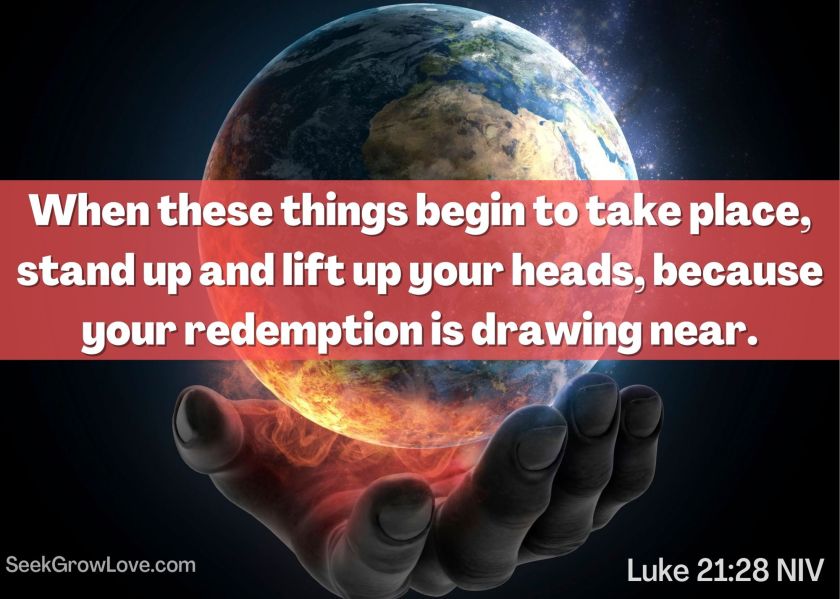
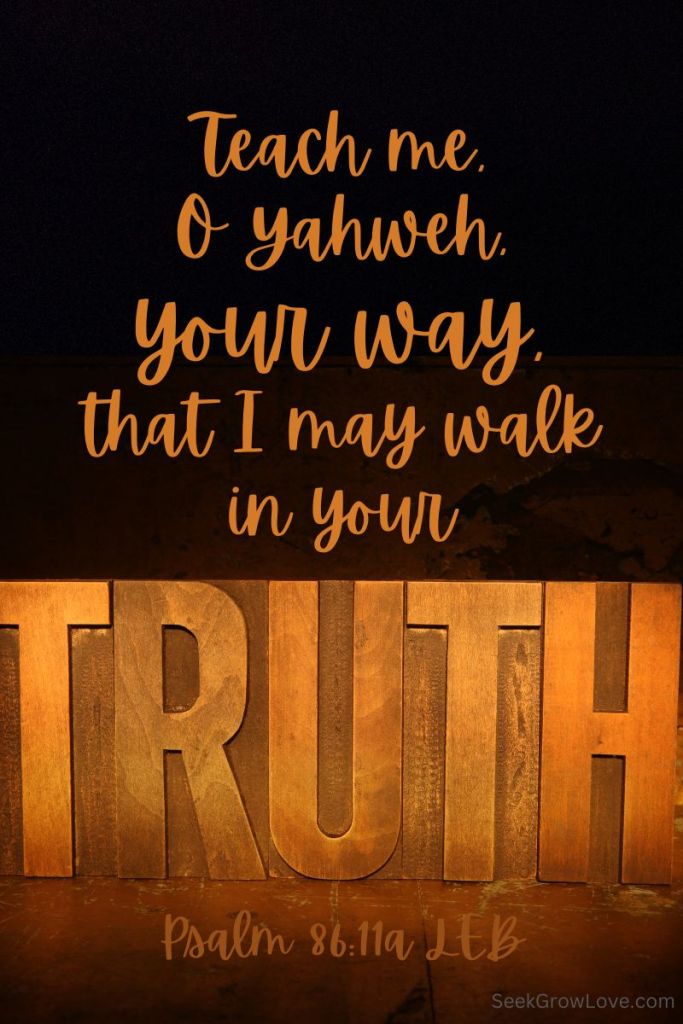
Scripture: “So now, Yahweh our God, save us, please, from his hand, so that all the kingdoms of the earth may know that you, Yahweh, you alone, are God.” — 2 Kings 19:19 (LEB) “Teach me, O Yahweh, your way, that I may walk in your truth; unite my heart to fear your name.” — Psalm 86:11 (LEB) “Now when these things begin to happen, stand up straight and raise your heads, because your redemption is drawing near!” — Luke 21:28 (LEB)
In 2 Kings 19, King Hezekiah faces a seemingly insurmountable threat from the Assyrian king, Sennacherib. Instead of succumbing to fear or relying on his own strength, Hezekiah turns to God in prayer, seeking divine intervention and deliverance. This theme of seeking God in times of distress is echoed in Psalm 86 and Luke 21, offering us a comprehensive understanding of faith, humility, and hope.
When confronted with Sennacherib’s threats, Hezekiah’s first response is to seek God. He spreads the threatening letter before God in the temple and prays for deliverance, not only for the sake of Judah but also for God’s glory to be known among all nations. Hezekiah’s prayer exemplifies humble dependence on God and a desire for His name to be exalted.
Psalm 86 reflects a similar heart of dependence and trust in God. David’s prayer, asking God to teach him His way and unite his heart to fear God’s name, mirrors Hezekiah’s desire for God’s guidance and intervention. Both prayers highlight a deep reliance on God’s wisdom and sovereignty in navigating life’s challenges.
In Luke 21, Jesus speaks about the end times and encourages His followers to stand firm and look up, for their redemption is near. This message of hope and anticipation ties into Hezekiah’s situation, where trust in God’s deliverance leads to ultimate salvation. It reminds us that, no matter how dire our circumstances, God’s redemption and intervention are always near.
Hezekiah’s immediate response to crisis is to turn to God in prayer. This act of faith underscores the importance of seeking God first in our times of need, trusting in His power and sovereignty. By spreading out the letter before God, Hezekiah shows his complete dependence on God. Similarly, Psalm 86 calls us to seek God’s guidance and unite our hearts to fear His name. Jesus’ words in Luke 21 encourage us to stand firm and look up, for our redemption is near. Hezekiah’s trust in God’s deliverance and the anticipation of God’s intervention are powerful reminders of God’s faithfulness and sovereignty.
-Jeff Ransom
Reflection Questions:
When faced with a crisis, what is your first response? How can you make seeking God in prayer your immediate reaction?
In what areas of your life do you need to humble yourself and depend more fully on God’s strength rather than your own?
How can you live in a way that brings glory to God, showing others that He alone is sovereign and that His redemption is near?
This week, reflect on these questions and consider how you can seek God more earnestly in your times of need. Trust in His power and sovereignty, and live in a way that brings glory to His name.
Scriptures: “He trusted in Yahweh the God of Israel, so that after him there was none like him among all the kings of Judah, nor among those who were before him.” — 2 Kings 18:5 (LEB) Psalm 86: “Teach me, O Yahweh, your way, that I may walk in your truth; unite my heart to fear your name.” — Psalm 86:11 (LEB) Luke 20: “And Jesus said to them, ‘Render to Caesar the things that are Caesar’s, and to God the things that are God’s.'” — Luke 20:25 (LEB)
In 2 Kings 18, Hezekiah’s trust in God stands as a powerful example of faith and commitment to God. By removing idols and leading Judah back to true worship, Hezekiah’s actions reflect a heart fully devoted to God. This theme of wholehearted devotion is echoed in Psalm 86 and Luke 20, tying together a comprehensive understanding of what it means to trust and honor God. Hezekiah’s reforms in Judah were driven by his deep trust in God. He actively sought to purify his kingdom from idolatry, demonstrating his dedication to God’s ways. His trust was not merely a passive belief but a driving force that led to decisive action and comprehensive reform.
Psalm 86 is a prayer of David, asking God to teach him His way so that he might walk in truth. David’s plea to unite his heart to fear God’s name resonates with Hezekiah’s life. Both show a desire to align their hearts and actions with God’s will, seeking His guidance and truth in all things.
In Luke 20, Jesus teaches about giving to Caesar what belongs to Caesar and to God what belongs to God. This teaching emphasizes the importance of recognizing our ultimate allegiance to God. Just as Hezekiah dedicated his reign to purging Judah of idolatry and leading the people back to God, we are called to dedicate our lives to honoring God above all else.
Hezekiah, David, and Jesus all highlight the importance of wholehearted devotion to God. This involves seeking His ways, trusting Him fully, and ensuring that our lives reflect His truth. Hezekiah’s actions in Judah show that true faith leads to action. Similarly, Psalm 86 and Luke 20 call us to live out our faith in practical ways, aligning our lives with God’s will and giving Him our full allegiance. Seeking God’s guidance, as David does in Psalm 86, and understanding our duty to God, as taught by Jesus in Luke 20, are essential aspects of living a life that honors Him. We are to learn His ways, walk in His truth, and render our lives to Him.
– Jeff Ransom
Reflection Questions:
Are there any areas in your life where you need to seek God’s guidance to walk more fully in His truth? How can you actively demonstrate your trust in God through your actions, like Hezekiah did? What does it mean to you to render to God what is God’s, and how can you live this out in your daily life? This week, reflect on these questions and take steps to deepen your devotion to God. Seek His guidance, trust in His ways, and ensure that your actions align with His truth.
We have had a particularly rough week with our four year old son. He has been pushing hard on the boundaries of our well-established routines. One more episode. One more toy. One more minute. One more game. One more snack. One more destination. Seemingly an infinite amount of times my wife and I have offered correction in punitive, redirective, and rehabilitative forms. In particular, these insistences led to an implosion at bedtime a few days ago. In that moment, his unrelenting barrage was a challenge to my authority as a parent, and down swung the hammer. I know this is only the beginning. Each of the remaining years of my life as his father, both his will and his physical strength will increase, and it will be well within his power to usurp me when there is more at stake than a night of rest.
This is where David finds himself with his son, Absalom. This prince wanted just one more thing, the kingship for himself. He was skipped in favor of Solomon, leading him down a path of familial betrayal, worthy of a primetime drama. Furthermore, this act of mutiny runs even deeper. Absalom was pitting himself against God’s anointed. This leads to deep emotional turmoil for David. A king who wishes to remain in power should squash any hint of rebellion; however, David submits to his role as a father and more importantly, trusting God to provide him with an answer and response which can be found in 2 Samuel 15:25: “Carry the ark of God back into the city. If I find favor in the eyes of the Lord, He will bring me back and let me see both it and His dwelling place. But if he says, ‘I have no pleasure in you,’ behold, here I am, let Him do to me what seems good to Him.’”
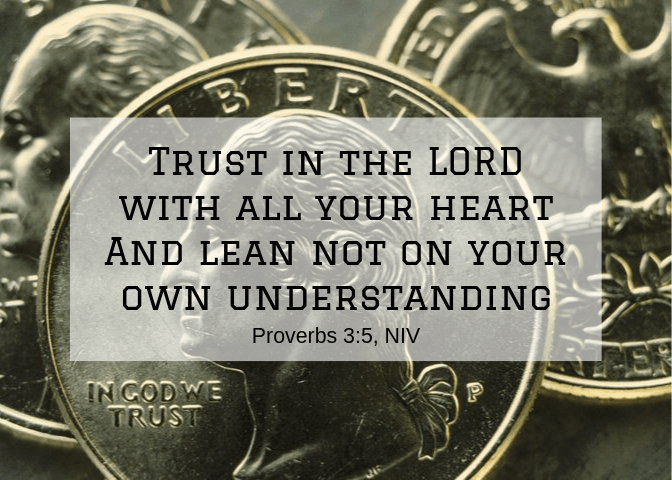
When faced with betrayal David did not respond with bitterness nor retaliation. He tested his methods in the fires of the Heavenly Father, trusting in the sovereignty of God over the product of pride. Did this put David in a strategically weak position? Absolutely, but David’s goal was not to snuff out an insurrection, but to ultimately realign himself with Absalom and restore him back into his presence. When I see David in this moment, I see a father I want to be, but I also see the actions of someone who mimics the attributes of God. Proverbs 3:5-6 beckons our battle with betrayal with this well-known wisdom “Trust in the Lord with all your heart, and do not lean on your own understanding. In all your ways acknowledge Him, and He will make straight your paths.” While we cannot test with the presence of God existing in an ark, we do have the Holy Spirit living in us. We don’t bring the hammer first, but are merciful, gracious, compassionate, faithful, slow to anger, and abounding in love and forgiveness (Psa. 86:15)
Let us never forget that we are, first, the ones that have trespassed against God and have spilled the blood of Christ. Yet those in Ephesus in the first century and those across the world today who put their trust in Jesus have the same greeting:“[God] has blessed us in Christ with every spiritual blessing in the heavenly places, even as He chose us in Him before the foundation of the world, that we should be holy and blameless before Him.” (Eph. 1:3b-4) In our betrayal there is a sovereign and loving plan that brings restoration, so that none might perish but all may have everlasting life (John 3:17). Stephen, whose stoning is attributed to the action of Ephesians’s author, might tell you to trust the process, taking action and direction from God and choosing his goodness over vengeance.
From time to time, a good Father will bring down the hammer, and in fact, Our Sovereign God’s final attribute is not leaving the guilty unpunished. Nevertheless, when feeling there is a knife in our back or heart, our first and foremost reaction should be to lean on the Heavenly Father not on our hubris. In this way, we go beyond obedience and restoration to an earthly parent or monarch. We become an example of our Creator, bringing obedience and restoration to Him that provides an eternal answer to utter betrayal, restoring us to His family line and an enduring rest.
-Aaron Winner
Reflection Questions
What is your experience with betrayal? Were you the betrayer or the betrayed? Was bitterness and/or retaliation involved? What can you learn from David in 2 Samuel 15?
If you are a parent or you know a parent, how can parents mirror God’s mercy, grace, compassion, faithfulness, slowness to anger, and abounding in love and forgiveness ? Why are those attributes important to establish? What role does the hammer, justice and judgment play?
When did you trust in God by not following what human nature says is right? How can this be helpful in a situation that you face today?
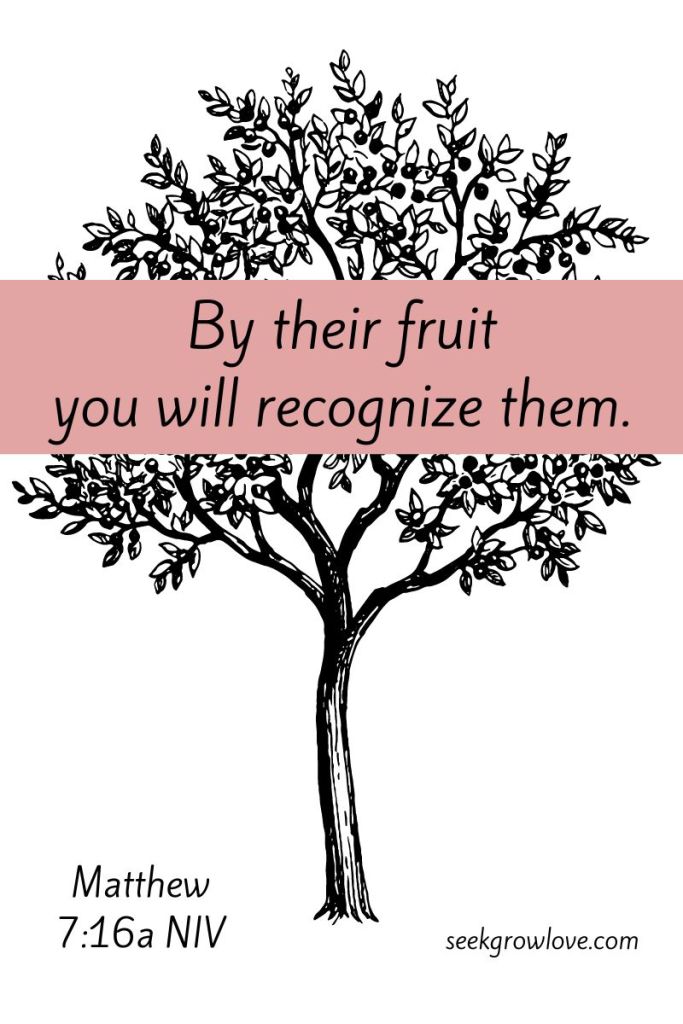
15 “Watch out for false prophets. They come to you in sheep’s clothing, but inwardly they are ferocious wolves. 16 By their fruit you will recognize them. Do people pick grapes from thornbushes, or figs from thistles? 17 Likewise, every good tree bears good fruit, but a bad tree bears bad fruit. 18 A good tree cannot bear bad fruit, and a bad tree cannot bear good fruit. 19 Every tree that does not bear good fruit is cut down and thrown into the fire. 20 Thus, by their fruit you will recognize them. (NIV)
“By their fruit, you will recognize them.” The fruit we bear in our lives is a litmus test for our spiritual health and the strength of our relationship with our Heavenly Father and His son Jesus Christ. We just read yesterday how apart from Christ we can do nothing. So our ability to bear good fruit depends on our willingness to abide in Christ. Take an inventory of your life. Do you see evidence of love, joy, peace, patience, kindness, goodness, faithfulness, gentleness and self-control? Taking this inventory of my life highlights areas where I need to repent of sin and abide more deeply in Christ. It is also important not to just take a cursory, shallow glance at that list of fruits, but to dig deeper and investigate more in depth what the scriptures have to say about the various fruits. For example, with the fruit of love, Jesus tells us in Matthew 5:44, “But I tell you, love your enemies and pray for those who persecute you.” Does my life show evidence of loving my enemies? Whew, I’m going to be real here, that is a tough one! To actually pray for someone who might be actively working against you or for your demise seems so counterintuitive to our human nature and our survival instinct. God, you want me to give my enemy a salt shaker so that they can rub it into my raw wound even more? Doesn’t that leave me vulnerable and unprotected? Do the scriptures support that God leaves us vulnerable and unprotected? In a couple of weeks you will be reading in Ephesians 6:10-17 about the spiritual suit of armor that God provides us. I won’t go too in depth with it since there are devotions coming that week, but that passage shows us that God protects us from head to toe. Also, remember we are talking about the fruit of the Spirit and John 15 reminds us that we are not alone in this battle.
John 15
26 “When the Helper comes, whom I will send to you from the Father, that is the Spirit of truth who proceeds from the Father, He will testify about Me, 27 and you will testify also, because you have been with Me from the beginning. (NASB 1995)
The scriptures also have something to say about who fights our battles. Let’s take a close look at Romans 12:19-21:
19 Do not take revenge, my dear friends, but leave room for God’s wrath, for it is written: “It is mine to avenge; I will repay,” says the Lord. 20 On the contrary:
“If your enemy is hungry, feed him; if he is thirsty, give him something to drink. In doing this, you will heap burning coals on his head.”
21 Do not be overcome by evil, but overcome evil with good. (NIV)
Did you catch that part about putting that love of our enemies into action by feeding them if they are hungry, giving them something to drink if they are thirsty? That’s taking that command to love your enemies to the next level, isn’t it?!?! Are you prepared to do that? Am I? It’s time for a heart check.
It really boils down to trusting God, doesn’t it? Do we believe Him when He says that He’s got it handled? If we find our faith lacking in this area, this is something we can pray about. It brings to mind the passage in Mark 9:
17 A man in the crowd answered, “Teacher, I brought you my son, who is possessed by a spirit that has robbed him of speech. 18 Whenever it seizes him, it throws him to the ground. He foams at the mouth, gnashes his teeth and becomes rigid. I asked your disciples to drive out the spirit, but they could not.” (NIV)
Later we read in verses 21-24:
21 Jesus asked the boy’s father, “How long has he been like this?”
“From childhood,” he answered. 22 “It has often thrown him into fire or water to kill him. But if you can do anything, take pity on us and help us.”
23 “‘If you can’?” said Jesus. “Everything is possible for one who believes.”
24 Immediately the boy’s father exclaimed, “I do believe; help me overcome my unbelief!” (NIV)
That verse always touches my heart because I can relate to it so well. I know what the scriptures tell us, but sometimes my trust and faith are lacking. Sometimes my prayers sound something like this, “Father, I know that Your word tells me that I am to love my enemies, but it’s so hard, God. It hurts so much. I need Your strength to show them the love Your word says I should show them. Father, I know that Your word says that You will work all things together for the good of those who love Him. Help me to love You more deeply and fully and to trust that promise so that my fear does not hold me back from being obedient to Your word to love my enemies. Help my lack of faith in this area. Help my unbelief.”
In today’s passage in Psalm 71 we read how God handled David’s enemies:
24 My tongue will tell of your righteous acts
all day long,
for those who wanted to harm me
have been put to shame and confusion. (NIV)
Our only job in regards to our enemies is to love them and to follow through with loving action that helps meet their needs. God’s got the rest of it.
-Kristy Cisneros
Reflection Questions
If a stranger watched you for an hour yesterday, would they have seen good fruit or bad? Would they guess that you abide in Christ? Do you? How can you do so more and more?
Who might you consider as your enemy? How do you typically treat them? What is Jesus asking you to do for them? Will you? When and how?
Romulus, the “first king” of Rome, supposedly built Rome with his followers and then asked for the consent of the people who lived in the city. I guess being raised by wolves is helpful in courtly duties.
Arthur Pendragon pulls a sword from a stone, whether his horse was simply two halves of a coconut or Merlin’s owl spoke.
T’Challa took a heart-shaped herb and fought a Panther I think? I don’t quite remember that movie.
“Charles the Third, by the Grace of God of the United Kingdom of Great Britain and Northern Ireland and of His other Realms and Territories, King, Head of the Commonwealth, Defender of the Faith”, boringly, inherited it from his mother.
At least one of those kings is fake, the historicity of two others are greatly debated, and personally, I still have my doubts about Charles.
How does someone become king?
In 1 Samuel 8:19-20, the people cried out for a king.
In 1 Samuel 9, Saul is chosen by Samuel.
In 1 Samuel 10:20-24, Saul is chosen by lot.
In 1 Samuel 11:14-15, *Saul* is chosen by the people.
So, how did he become King?
People’s choice award?
Pulling the short straw?
One old guy’s decision?
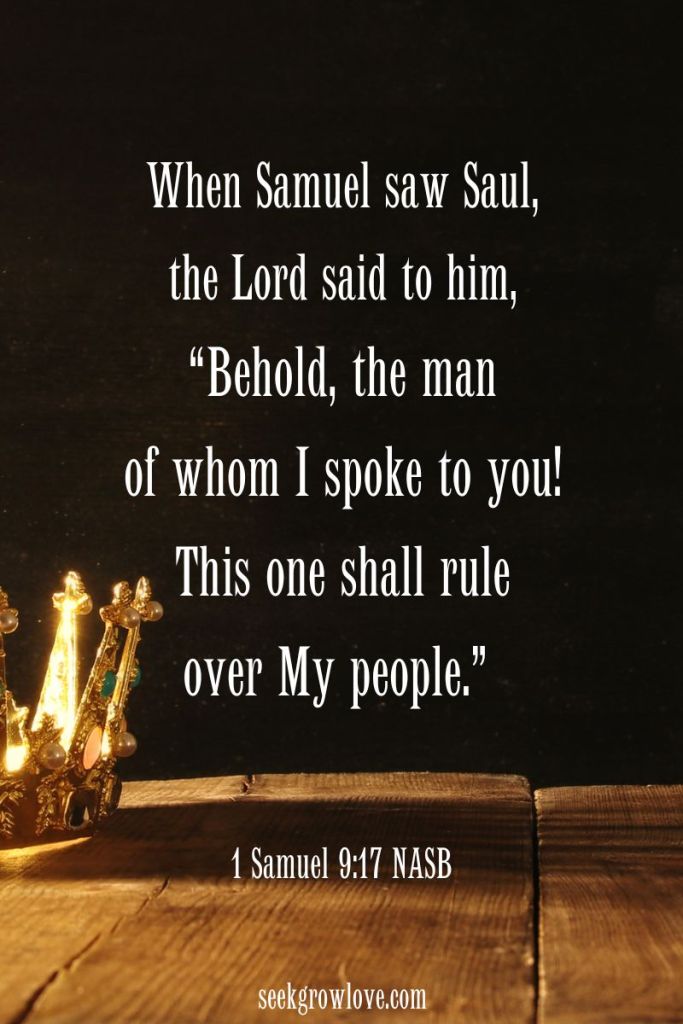
Saul’s reign is not because the people demanded it, or because Saul got lucky at dice (or pot shards). God is involved in the process. In 1 Samuel 9:17 is was not Samuel but GOD who chose Saul.
In every authority, in every government, this is true. “Let every person be subject to the governing authorities. For there is no authority except from God, and those that exist have been instituted by God.” (Rom. 13:1) It is clear that God does not approve of every leader and certainly not of their actions. God lets humans make their bad and destructive choices (including, in democracies, choosing bad leaders). Then he works with, and in spite of, those choices. God works to bring about glory for himself; he works toward the coming of the Messiah and his Kingdom.
Saul was given an opportunity by God to be a person who would bring God’s plan into fruition. God took Saul from chasing donkeys to ruling a nation. God gave Saul every opportunity to be a ruler “after God’s own heart” and yet Saul chose to disobey.
Kings, rulers, presidents, emperors are only ruling because God has given them the opportunity; the opportunity to obey or disobey, to listen to his voice and to his commands. The same choice he gives to each of us.
Remember, no matter who sits upon any throne, any seat, or behind any desk…
God is on his throne and in control.
-Jake Ballard
Reflection Questions
Preempting “Godwin’s Law”: “What about Hitler?” “What about Mao?” “What about Pol Pot?” Yes those leaders were truly awful. Still, Paul wrote Roman’s to the people who were in the heart of one of the most powerful, most militaristic empires the world has ever known. Paul died by beheading in Rome, and yet he still was inspired by God to write Romans. What is the Christian response to wicked leaders? How much should we obey leaders who are acting against our values? (Maybe check Acts 5:27-32 to compare to Romans 13)
The Lion from Benjamin?: From prophecy in Genesis (Gen. 49:10), it seems like a Benjaminite should never have been king. We see God chose Saul. Now a question for you to chew on for a long time, why Saul? David was a man after God’s own heart and a descendant of Judah. Was Saul always destined to failure? Why THIS choice? (There is not a clear cut reason in scripture, but having read through this chapter, what do you make of it?)
I want to be very clear from the outset: YHWH, the God who created everything, who spoke the universe into existence, who watches the explosions of supernovas and the random dance of each of the electrons in the subatomic particles, THIS God is *on your side*. YHWH (usually written as LORD in the Bible) is a *someone* who has relationships, not just a power or a force; he loves you and wants to be with you in the Kingdom, the eternal life after death on the Earth made new. To that end, God gave us his son Jesus of Nazareth, to die in our place and for our sins so that we could be forgiven and live eternally. God did not have to do that but he did because he is on our side, even when we haven’t been on his.
BUT…
God is not “on call”.
Have you ever wondered why witchcraft was banned in Israel? (Ex. 22:17, Lev. 19:26) Part of it is that God wanted the Israelites to have a clean break with everything that was in the land of Canaan before them. But there was an ancient belief that by practicing witchcraft, humans could control the supernatural. When God revealed that he is the only God, then witchcraft was a presumption that humans can control God, that we can make demands on the Almighty. This was still the assumption of the culture all the way to the time of the early church (see Simon the Sorcerer in Acts 8:9-24).
Read 1 Samuel 4:2-4 again. The Israelites are defeated by the Philistines. At that point, they probably should have prayed to know the will of the Lord. They could have sacrificed and cast the urim and thummim to discern the wise solution. But what they actually did was to try and control God. “Let’s take the Ark, and it will deliver us!” Or, said another way, “God certainly won’t let us lose if we carry his Ark into battle; he’ll have to let us win!” They don’t look to the God who would deliver them; they were looking to the tools that were used to remind them of God.
We don’t have the Ark today; maybe it was melted down by the Babylonians, or maybe it was taken to Ethiopia, or maybe it’s on Oak Island. No one knows, and it doesn’t really matter. We don’t want to fall into the same trap that the Israelites did. We shouldn’t presume that God will do what we desire, even though he is on our side.
Today, we don’t march with the ark, but we think of God in wrong ways. Some of the WRONG ways to think about God are:
God is a loving grandfather, who dotes upon his grandkids and makes sure to sneak them candy or a crisp $5 bill when mom and dad aren’t looking. The grandkids may not ask, but they do expect.
God is a genie, who will grant our wishes when we believe hard enough and pray long enough.
God is a vending machine; we put in the “belief” and “prayer” coins and God spits out the requested deliverance. At this point, God has lost all personality.
What happens to those who presume to demand God show up when and how they desire? Death, destruction, pain, and despair. (1 Samuel 4 is a depressing chapter!)
But there is a better word for you. God is on your side, and you approach him as a father that has the best plans for you, even though that may be painful work to make you full and complete. You must approach him as God, believing that he will work all things for good and knowing that the ultimate good of the universe is His glory and our worship, not our happiness or comfort. You must approach him as God, that hears and responds to the prayers of his people, but not beholden to us to work like a machine at his request.
May we honor the God who is not controlled by us, but is on our side!
Questions
If you do not know the saving power and love of God, seek that out today. God REALLY is on your side. He loves you deeply, he wants the best for you, and he knows what you need better than even you do. Will you trust in him to bring you to life and salvation?
How have you treated God in ways other than God deserves to be treated? Have you thought of God as your grandfather, or your genie, or your vending machine? Maybe some other way that you make demands of God? If you have, how can you repent, and trust in God without demanding anything of him?
“God’s ultimate goal is his glory, not your happiness.” This is one of the hardest truths to accept when pride and the flesh is still being worked out of us. How can we give God the glory and worship he deserves, and not get hung up on our own desires, preferences, and pleasures?



 Seek Grow Love