Loving the One Lord our God

Theme Week: 1 God, 1 Messiah – Deuteronomy 6

Old Testament Reading: Deuteronomy 1 & 2

Psalms Reading: Psalm 77

(Our SeekGrowLove 2023 Bible reading plan includes 7 theme weeks spread throughout the year. This week is the first and will focus on 1 God, 1 Messiah. The OT and Psalms readings will continue and the third reading will be a chapter that lends itself to the theme. At the bottom of each devotion is a link to the yearly schedule you may download and print if you would like to keep track of where we are going next. Thanks for reading along! Let’s keep Seeking God in His Word, Growing our Faith and Loving Him More and More!)

     Deuteronomy 6 is seen as a foundational chapter for discussing the “oneness” of God. People sometimes divide the teachings of Christianity into orthodoxy (right teaching) and orthopraxy (right action). On that basis the idea of there being only one God generally gets put under the heading of a teaching. But I think God may see our faith as a more active part of our lives than that description brings to mind.

     When Moses says, at the start of Deuteronomy 6, that he is relaying “the commandments, the statutes and the judgments which the Lord your God has commanded me to teach you” (NASB) he is continuing a thought from Deuteronomy 5 (see v. 31). Moses had described how it made the Hebrews afraid when they heard God’s voice at Horeb (Sinai) almost 40 years earlier. They had asked God not to speak aloud to them anymore, but to speak to them through Moses. The people gathered at that mountain knew that God was their God. God had already proven His faithfulness (He brought them safely from Egypt, after all), but God had also shown His judgment. They believed that to keep hearing that voice would mean their deaths. And God didn’t object to what they said. Maybe God even agreed that they risked death from being exposed so closely to God’s holiness, if only because they wouldn’t always respond to it properly. “Oh that they had such a heart in them, that they would fear Me and keep all my commandments always, that it may be well with them and with their sons forever!” (5:29).

     Moses says he is going to tell us “the commandments, the statutes and the judgments,” and what he starts with is that the Lord is God and is singular, which feels close to the core of the matter. This chapter opposed the nations in the land the Hebrews were about to enter. But the message is deeper than a warning against the idols that would all too often distract coming generations of Hebrews. This is about commitment and devotion in living for God. To love with your whole heart, your whole soul/life, and all your might – that is not something you can just fall into, it is something you choose, and which you need to keep on choosing.

     Moses was about to die, this speech was his farewell address, and he offered a plan that could steer the course of the history ahead of him. The generation that was being told these things was able to remember the miracles of the desert; many of them still could recall the Exodus and crossing the Red Sea. The idea was for that knowledge, that certainty about God, to be presented to each generation so it could take hold of faith for itself. But things did not go that way.

     Lord, please allow me to love you with my whole heart, soul and might. I know this is not the first time I have pledged this, and that I have not maintained that focus. But you, Lord, are a great God. You are worth turning back to, I will not give up on you because I am imperfect. And you are a merciful Lord who is willing to receive those who turn back. You will not give up on me because I am imperfect. Please help me to be renewed in what is appropriate for your glory, and to do service for your name and the name of your son, Jesus. Thank you, Lord. Amen

-Daniel Smead

Daniel Smead is a father of two, former pastor of the Eden Valley Church of God, former editor of the Church of God Adult Quarterly and sometime teacher at Atlanta Bible College. He lives in Minnesota with his family and attends the Pine Grove Bible Church. In his free time he is working on creating a board game centered around early Christian heresies.

reflection Questions:

  1.  The text says to bind these words on your hands and your foreheads. Some see this as a metaphor, saying to let the scripture affect what you do with your hands, and how you think. What are some ways you could do that?
  2. Verse 24 says that we are to “fear the Lord our God for our good always”. Is it difficult to remember that God does not want anything for us that is bad for us? How do you remind yourself of that?
  3. It sometimes seems impossible that the Hebrews were denying God’s existence, rather they failed to worship their God by choosing to describe God to themselves as something other than what God is. At Sinai they pictured God as a golden calf, wanting to see the unseeable God, making God more understandable for themselves. Perhaps at Jericho Achan – who had been present for Moses’ speech – managed to mistake God for someone who cared about human wealth and advancement more than purity. Perhaps you can think of some other applications of this principle. How clearly do you think you understand what God is like? How does that understanding help you?

Choices

Old Testament: Deuteronomy Intro below

Psalms Reading: Psalm 76

New Testament Reading: 2 Corinthians 13

Today we have three readings before us that seem very different from one another. They are different in many ways; approach, style, etc. but contain a similar message throughout.

The book of Deuteronomy details many hardships and troubles that God’s people faced. It also contains promises and hope. It reminds us that we have an active role in our faith. Our Heavenly Father did not create us with a certainty that we would listen and obey, that we would automatically choose Him. He created us with free will and allows us, each and every one of us, to make these life and death decisions on our own. He gives us all of the information we need and places the choice in our hands. To have life is to be with God. This book is about having an ongoing relationship with our loving God.

Psalm 76 is a song of victory of Israel over the enemies of God. Often times we see the rejoicing of the people and focus only upon the battle God won that led them to this point. He had delivered victory – that is evident to Israelite and Gentile both. There is more to it though, more here than a casual glance will reveal. The psalmist sings of weapons of war at rest. The Lexham English Bible says, the stouthearted sleep, both rider and horse slumber. Death is implied here but, in that death, God has brought peace. The slain, the peace of death, and for those who yet live peace through knowing Him, revering Him, “From heaven you pronounced judgement, and the land feared and was quiet.” Like with our overview of Deuteronomy, we see our need for a relationship with God, that life comes from Him.

And then we get to our final section of reading for today, as we finish 2 Corinthians with chapter 13 – which brings to mind 1 Corinthians 13 – the chapter all about love. From verse four through the beginning of verse eight, it details what real love is and what it is not. The first three verses are quite plain to say that what we do or say in this life matters little if it does not come from the type of love that God, and Jesus displayed for us.

We are merely messengers of the Gospel, the Good News. We are to ensure that others know of salvation through Jesus by our words and actions. It is not for us to judge one another or force a change. We are to faithfully bring the truth of God’s word to our family, friends, and acquaintances. It is that truth that will reveal both sin and the need for salvation, but it is still up to the individual to make that choice. If that choice is not to come to God through Jesus, then we are to still love them. We are limited to our knowledge of now, this moment, and even that is severely lacking. We do not know their future choices, so we love them. They are created in God’s image, so we love them.

Each of these sections of Scripture present the hardships that come with the choice we each face, to know and love God or deny Him. It is not just our choices though, but also those of everyone around us. We have this amazing knowledge of God, Jesus, and salvation. We, who have a relationship with Him through Jesus, have a hope beyond the troubles of this life. Loving God, and knowing His love, can comfort us in our most desperate moments.

We want that for others and sometimes get frustrated, angry, or hurt that they refuse to open themselves to this relationship. That is probably similar to how God felt about you and I before we made that choice. I believe that a huge part of our commission to go into the world to spread the Gospel is to love the sinner as God loves us who still sin. Be patient. Speak and live God’s word. That is what love is!

-Jeff Ransom

Deuteronomy Introduction

I love the book of Deuteronomy.  Even though it retells many of the highlights of Exodus through Numbers, the tone of Deuteronomy is much different.  Instead of just laying out the law as God had given it, and instead of just relaying historical facts, Moses was now encouraging the people to love and follow God- for their own good.  

Moses wrote the book of Deuteronomy just before his death.  This was his last opportunity to encourage the Israelites to obey God wholeheartedly.  When he wrote it, almost everyone was dead who had been an adult when the Israelites had left Egypt.  As a result, Moses was trying to remind the new generation of all that God had done for them (and their parents), and was trying to encourage them to follow God – and not just obey Him, but to love Him.

Deuteronomy 10: 12-13 is an example of this, “And now, Israel, what does the Lord your God ask of you but to fear the Lord your God, to walk in obedience to him, to love him, to serve the Lord your God with all your heart and with all your soul, and to observe the Lord’s commands and decrees that I am giving you today for your own good?”

The book of Deuteronomy ends with Moses climbing a mountain, and looking out over the Promised Land – which he wasn’t allowed to enter because of one act of disobedience against God.  And then Moses died.  Can you imagine how disappointed Moses must have been, seeing the promised land, but not being able to enter?  He had longed for this his whole life, and was finally denied entry.

This should be a warning to us. It reminds me of Luke 13:28, which says, “There will be weeping there, and gnashing of teeth, when you see Abraham, Isaac and Jacob and all the prophets in the kingdom of God, but you yourselves thrown out.”

I’ll close with Deuteronomy 30: 15-20, “See, I set before you today life and prosperity, death and destruction. For I command you today to love the Lord your God, to walk in obedience to him, and to keep his commands, decrees and laws; then you will live and increase, and the Lord your God will bless you in the land you are entering to possess.  But if your heart turns away and you are not obedient, and if you are drawn away to bow down to other gods and worship them, I declare to you this day that you will certainly be destroyed. You will not live long in the land you are crossing the Jordan to enter and possess. This day I call the heavens and the earth as witnesses against you that I have set before you life and death, blessings and curses. Now choose life, so that you and your children may live and that you may love the Lord your God, listen to his voice, and hold fast to him. For the Lord is your life, and he will give you many years in the land he swore to give to your fathers, Abraham, Isaac and Jacob.”

-Steve Mattison

Reflection Questions

  1. What do we learn from Moses and Paul about how to speak and live God’s word? How can you speak and live God’s word better than you have previously?
  2. We all have choices to make. What choices have you made that have brought you closer to a relationship with God and the salvation he extends through His son? What choices have you made that have taken you further from God? What will you choose today?
  3. What do you learn about God and His character in today’s Bible reading? Who needs to hear that and how will you share?

Promise Keeper

Old Testament Reading: Numbers 34-36

Psalms Reading: Psalm 75

New Testament Reading: 2 Corinthians 12

Looking here at the last three chapters of the book of Numbers, it can often be easy to gloss over it, and miss the bigger picture of what is happening. It is easy to look at this as just some boring passages about land being divided between the tribes of Israel. But when we look at the Pentateuch (first five books of the Bible) we are supposed to look at it all together as a whole. Really we are supposed to look at the whole Bible that way, as one continuous story that leads to Jesus, and the work that God did through him on the cross.

When we look at the Pentateuch we see that the land of Canaan is referred to as the Promised Land. The reason for that is because way back in Genesis, God promised Abraham that this land would belong to his descendants: “The whole land of Canaan, where you now reside as a foreigner, I will give as an everlasting possession to you and your descendants after you; and I will be their God.” (Genesis 17:8) And so as we look at the end of Numbers what we are seeing is the fulfillment of God’s promise to Abraham. This passage even goes so far as to show that God is providing a place in the land of Canaan for those who are guilty of accidental murder, and for a family of sisters, whose dad had died without any male heirs.

Nowadays we look at that last chapter and say, “Well of course those ladies should inherit their father’s land,” but in those days that was unheard of. In the days of the Israelite conquest of Canaan, the only people who could legally inherit land from their fathers were men. But God had promised to Abraham that all of his descendants would be part of that inheritance. And God keeps His promises.

I think that is a big takeaway for us out of this passage. We can be sure that God keeps His promises no matter what. In II Corinthians (which we will also finish tomorrow) Paul wrote “For no matter how many promises God has made, they are ‘Yes’ in Christ. And so through him the ‘Amen’ is spoken by us to the glory of God.” (1:20) Just like it was surely difficult for God’s people when they were trapped in slavery for a few hundred years to hold on to the promise of freedom and a land of their own. And like it was most likely hard for the Israelites who were exiled in Babylon for seventy years to hold onto the promise of being returned to their home in Israel. In the same way it may have been difficult for Simeon to hold onto the promise that his eyes would see the Messiah before he died. In the same way, it is difficult for us today to hold onto the promises that God may have given us. But just like in all these stories and so many others in the Bible, God fulfilled all of His promises.

When we read passages like this, we shouldn’t just gloss over them, but instead celebrate with the people that God’s promises were fulfilled in their lives. And we should also remember that just as He fulfilled his promises for them, He will do the same for us. So if you are struggling with fear and doubt about whether something God promised you will happen and take place, take heart because God will never ever ever break a single promise that He makes.

-Jonny Smith

Reflection Questions

  1. What promises of God have already been fulfilled, both in Scripture and in your own life?
  2. What promises of God are you still expecting to be fulfilled? How sure are you that they will indeed happen? What should we do while waiting for them?
  3. Using what you have read in His Scriptures, how would you describe God?

God’s Restoration

Old Testament: Numbers 31-33

Psalms Reading: Psalms 74

New Testament: 2 Corinthians 11

My Bible notes explain that Psalm 74 is from the time of the exile, after the nation of Israel had been destroyed and the temple left in ruins and the promised land completely ravished. The first half of the Psalm is a recounting of how the sanctuary of the Almighty was decimated by the enemy. The second half of the Psalm is a cry out to God to do something about it. Verse 12 is the pivot point between the two halves. 

As I read Psalm 74, my inner first-born older-sister voice says something like, “Well, what do you expect? Your insolent behavior was basically an invitation to the enemy to come and wreak havoc. You opened the door to the temple wide open with your disobedience. And now you realize your mistake and want God to fix it???”

As if I never did anything foolish. Not once have I been disobedient. And I never have had to deal with the consequences of my poor choices. Nor have I ever asked God to come to my rescue and defend me when I got in over my head. Nope, not at all. Not me.

Maybe this Psalm hits a little too close to home. Because there have been so many times when my disobedience has left me on my knees. I said something that shouldn’t have been said; I ignored God’s voice telling me to walk the other way; I refused to forgive; I thought too highly of myself. And when I realized what I got myself into, the only thing I could think of doing was crying out to God for help.

While God fully desires us to be obedient, he knows our human nature and capability to mess things up from time to time. He wants us to call out to Him. He longs for us to recognize our need for Him. So even when we open the door of our hearts to something less than God’s best and our lives are turned inside out and upside down, He will come and restore us to who we are meant to be.

Thank you God, for being full of mercy and grace and hearing me when I call out. Thank you God, for not turning your back on me when my mess is a result of my foolishness. Thank you God, for loving me unconditionally, that even though I may have to suffer the consequences of my actions, you redeem me.

-Bethany Ligon

Reflection Questions

  1. When has your disobedience caused the need for restoration?
  2. Is there an area of your life that you have already experienced God’s restoration? What did it look like when it was in ruins? What does restoration look/feel like?
  3. What has God revealed about Himself in today’s Bible reading?

To Be Near God

Old Testament Reading: Numbers 28-30

Psalms Reading: Psalm 73

New Testament Reading: 2 Corinthians 10

What is the longest that you have prayed for something? A couple of days? A few weeks? Multiple months? Several years? Maybe a decade or two? 

For me, I prayed for something for over ten years. The words may not have been on my lips each day or recorded in my journal on a regular basis, but it was in my heart for a very long time. There were times when I looked around and wondered why God wasn’t answering this prayer. Why did he seem to be responding to others before me? Why did it appear that even nonbelievers were ‘living their best life’ and here I was, trudging along, waiting for God to do something.

Eventually, I saw an answer to my prayer. It didn’t come in a way that I anticipated, but God answered. Hallelujah! 

I find myself in another long-term praying situation. Every once in a while I see a glimpse of what I hope for, but it doesn’t last for long. It’s frustrating. At times I feel powerless because nothing I seem to do makes any difference. At other times, I am jealous of others who have what appears to be what I am asking God for. 

As I read Psalm 73, I identify some with the author in his observations that life just doesn’t seem fair. But I have come to realize that when I am looking at ANYTHING other than God, my perspective, my attitude, my desires, become skewed.

When I am intentionally seeking after God, my confidence in His plan and timing grows; my heart’s desires change, my thoughts are transformed. I become spiritually stronger and sustained when I stop comparing my life to the world and start trusting that God has bigger and greater plans in store for my future. 

So for now, I will lift up my hands and reach out to my Father who will take hold and provide all that is needed while I wait for an answer. And even if that answer doesn’t make sense, doesn’t seem fair or doesn’t match my timeline, I can trust that His way is better than my way and He alone is enough.

-Bethany Ligon

Reflection Questions

  1. What is the Psalmist’s attitude and focus in the first half of Psalm 73? What is his attitude and focus in the second half? What is the turning point? What are your favorite verses in this Psalm?
  2. When does life seem unfair to you? What is your typical response? Even when the situation remains the same, how can your attitude and focus change?
  3. What do you learn of God and His characteristics in today’s Bible reading?

Giving is Like a Garden

Old Testament Reading: Numbers 26 & 27

Psalms Reading: Psalm 72

*New Testament Reading: 2 Corinthians 9

Giving generously is like sowing seeds in a garden. Just as a farmer must plant a plentiful amount of seeds to reap a bountiful harvest, Christians must give generously to receive God’s blessings. In 2nd Corinthians 9, Paul emphasizes the importance of giving with a willing heart, not out of compulsion or obligation. When we give with a cheerful heart, it is like planting our seeds in rich soil, knowing that they will grow into a plentiful harvest.


Furthermore, just as a garden requires consistent care and attention, our giving requires consistent effort and a dedication to meeting the needs of others. Paul reminds us that our giving is not only an act of obedience to God but also a way to meet the needs of others. When we give generously, we are like gardeners tending to our plants, making sure they have enough water, sunlight, and nutrients to thrive. Our giving provides the necessary resources for those in need to grow and flourish.


Like a garden, our giving should also be done with a spirit of thanksgiving and praise. When we give with a joyful heart, we are like flowers blooming in the sun, displaying their vibrant colors and beauty. Giving generously not only blesses those in need but also brings glory and honor to God. It is like a garden bursting with life and color, a testament to the abundance of God’s grace and provision.


Finally, just as a garden produces a bountiful harvest, our giving produces a harvest of righteousness. When we give generously and joyfully, we are like farmers reaping a plentiful harvest, knowing that God’s blessings will overflow in our lives. Our giving is a tangible way to demonstrate our faith and commitment to following Christ’s example of selflessness and generosity.


In conclusion, 2nd Corinthians 9 teaches us that giving generously is like sowing seeds in a garden. Just as a garden requires consistent care and attention, our giving requires consistent effort and a dedication to meeting the needs of others. When we give with a cheerful heart, it is like planting our seeds in rich soil, knowing that they will grow into a plentiful harvest. May we be inspired by the simile of the garden to give generously and joyfully, trusting in God’s abundant provision and blessings.


-Austin Kizer

Questions for Reflection

  1. How can you cultivate a heart of generosity and joy in your giving?
  2. In what ways have you seen God bless your giving, whether it be in material provision or in the transformation of lives?
  3. What steps can you take to consistently care for and tend to the needs of those around you?
  4. What has God revealed about Himself in your Bible reading today?

My Mouth is Filled with Your Praise

Old Testament Reading: Numbers 24 & 25

*Psalms Reading: Psalm 71

New Testament Reading: 2 Corinthians 8

As I began reading Psalm 71 I immediately took to heart the first sentence, “In you, LORD, I have taken refuge.” How many times do we have troubles and look to things other then God? We look to our friends, our families, sometimes video games, sugar, so many things when our first response should be to look to God. Our writer goes on to ask God to be his rock of refuge, to which I can always go. We can go to Him anytime day or night. Sometimes I wake up in the middle of the night because something is bothering me. While I know my husband would not get upset if I woke him, it is not something I want to do. But guess what, God is there! He is always with us.

The Psalm goes on to ask about not casting him away when he is old, not forsaking him when his strength is gone. He asks God for help. He says he will always have hope and he will praise God more and more. He will tell of his saving acts all day long. He will praise Him with the harp, the lyre, his lips and his tongue. The writer of this Psalm really knew that God is AMAZING!

All of this made me think of a few things. First, as I said earlier, God is aways with us. I have a great support system and God has put wonderful people in my life to help me navigate the craziness of this world but do I put God aside and try everything else first and then go to Him? I know I do sometimes, then I realize I should have gone to Him first. Many times when I go to him first, he puts the right help in front of me to navigate my problem and sometimes he tells me I just need to wait on it.

Second, when he is talking about his enemies, I think of the enemies that are trying to take us away from God. They will stop at nothing to tear us from the love of God. Verse 4 says “Deliver me, my God from the hand of the wicked, from the grasp of those who are evil and cruel.”  We need to stand firm in our faith, seek God, spend time in His word, and be careful that we don’t get pulled away. It is so easy to walk away, to spend time away from God. We need to be purposeful in our walk with Him so we are not tempted to walk away.

Lastly, he is praising God. We need to praise God for all he has given us. My husband says he is part of the joyful noise club. I am too, I don’t have a beautiful voice but the Bible doesn’t say we have to have a beautiful voice, it says to make a joyful noise. It also doesn’t say we need to be Bible scholars to speak his word or tell others of the great things He does. Verse 17 says, “I declare your marvelous deeds.”  Go out and declare His marvelous deeds in your life.

-Jeani Ransom

Questions for reflection:

  1. How do you take refuge in God? Do you seek others first or God first?
  2. How can you show your praise to Him today?
  3. What marvelous deeds has He done for you? Who can you share them with?

What God Puts in My Mouth

Old Testament Reading: Numbers 22 & 23

Psalms Reading: Psalm 70

New Testament Reading: 2 Corinthians 7

Balaam is an interesting character – as is of course his famous articulate donkey. He must have been a very well-known and successful diviner – or pagan prophet – for Balak, the king of Moab, to send delegations twice to bring Balaam to curse the Israelites.

Balaam is not an Israelite. He does not serve the Lord Almighty. However, in these two chapter (Numbers 21 & 22) it appears he does a better job of listening to the Lord God and following his directions than most of the Israelites whom God had rescued from Egypt. From the Israelites who had experienced God’s mighty saving hand at work we have heard a whole lot of grumbling, complaining, and belly-aching as well as questioning God’s power and intent, His love and His faithfulness and His chosen leaders. In contrast, here we have the pagan prophet Balaam who (currently) seems to be following God’s every directive: Stay, Go, Speak. And Balaam does it. Perhaps Balaam has heard some of the stories coming out of the Israelite camp: the ground opening up to swallow the rebellious, the plagues of sickness and death, the water from the rock, the quail three feet deep, the sons of the priest burned to death by fire from heaven. As a sorcerer/diviner/soothsayer he has got to be more than a little curious about this God and all He can do. We do know Balaam heard his donkey speak to him (God truly can give His words to anyone, or anything) and God opened Balaam’s eyes. In response, Balaam speaks. And at this time, he speaks for God. It is as if he has no choice, just as his talking donkey had no choice. And so Balaam delivers God’s words:

“Even if Balak gave me all the silver and gold in his palace, I could not do anything great or small to go beyond the command of the Lord my God.” (22:18)

“But I can’t say whatever I please. I must speak only what God puts in my mouth.” (22:38)

“Did I not tell you I must do whatever the Lord says?” (23:26)

How silent the world would be if we erased all the words spoken that were NOT what God put in our mouths. This thought has been going through my mind the past couple of days (perhaps making it harder to write this devotion). Who of us can say (for very long), “I must speak (type) only what God puts in my mouth”? How would my house and marriage and work and church be improved if every word from my mouth first was reviewed to see if it was worthy of God’s seal of approval – “These words were brought to you by God”? I have said some pretty stupid, wrong, hurtful words that were definitely NOT from God. And, they get me into trouble and further from where He wants me to be. I know there are also many times I have failed to say what God HAS wanted me to speak.

Unfortunately for Balaam, his story doesn’t end there. Unfortunately for Balaam, his heart and motives and ethics were not in line with his words from the Lord. It is not enough to speak what is right while doing what is wrong. As we continue reading in Numbers we will learn more about Balaam. In the meantime, you might be interested in also checking out what some New Testament writers had to say about Balaam: 2 Peter 2:15, Jude 11, Revelation 2:14.

Dear God, please open my eyes and give me the words you want me to say. THOSE are the words I want to speak. Help me live your words and show You to the world.

-Marcia Railton

Reflection Questions

  1. Re-read carefully the words that God put into Balaam’s mouth (23:7-10 & 18-24). What does God want to be made known about Him and His people? What do you think God wants you to tell others about Him? How? Where? When?
  2. How can you guard against saying the right thing but doing the wrong thing?
  3. What does God reveal about Himself in your Bible reading today? Why is that important?

Generations

* Old Testament Reading: Numbers 20 & 21

Psalms Reading: Psalm 69

New Testament Reading: 2 Corinthians 6

In Numbers 20-21 we encounter the Israelites at the end of their journey as they wrap up their years in the wilderness and prepare to enter the promised land of Canaan. Unfortunately, before they do that, we see a purging of a generation of people who had rebelled, distrusted, and quarreled with themselves and with the LORD. In Chapter 14 God had instructed them that only Joshua and Caleb would enter the promised land, and now we see God was serious. In Numbers 20:1 Miriam dies, in verse 12 Moses is told he will not be entering the promised land, and by the end of the chapter Aaron is dead. No special privileges here for being a priest, a leader, or related to a special someone who “was a really good person most of the time”.

In recent years I’ve heard more and more talk about generations.  Terms like X, Y, Z’s, Millennials, Zillennials, Baby Boomers. All have their strengths and weaknesses, and since I fall right in-between two, depending where I am or what is being said, I might want to associate with one more than another. That is because there are stereotypes of generations, but none are always accurate nor are they particularly important or beneficial. No matter what, as a body of Christ, we are an intergenerational people, and research continues to show the benefits of multigenerational worship and education. The year of your birth simply does not have anything to do with who we are in Christ. What does matter is our faith in Jesus and being a follower of him. In today’s reading, we see a generation dying out who knew God, yet had managed to waste the better part of 40 years not doing much to please Him, but doing a great job finding things to fight and complain about. We are currently living in a world where fights and complaints are the norm, and also one where our life expectancy is dropping. Many people born in recent generations have a lower life expectancy than their parents did. We are on this earth for a finite time, and unless we live until Jesus returns, we will “rest with our fathers” the same way people have been doing since the days of Numbers.

But, the story of Numbers doesn’t just end with death and burials, and ours doesn’t have to either. Joshua and Caleb (and crew) did get to the Promised Land. And we see more symbolism again in this idea since Yeshua can be translated as Joshua in Hebrew (our OT character leading them to the promised land) and when translated into Greek/from Greek can be translated as Jesus (our NT character through whom we have hope of our promised land in the kingdom). There is lots more out there to learn about as far as name studies if that interests you which I’ve learned a bit more about through a friend who has “Yeshua is my king” stickered across his back window. I couldn’t help ask about that one the first time I met him!

Another thing I found interesting as I read Numbers 20-21 is that a lot of the pagan enemies they are fighting on their way to the promised land are their “relatives”. The Edomites come from Esau (who was later named Edom), the Moabites and Ammonites come through incestuous relationships through Lot, and for that matter, all of them go back to Noah’s three sons! But, it didn’t matter if you were a descendant of Abraham or a relative of someone who once believed in the one true God. The people who entered the promised land were those who trusted and relied on Him, humbling themselves to allow Him to lead. Everyone else who didn’t worship the one true God as he instructed them to, set apart and holy according to his expectations. . . they were enemies. It didn’t matter if they had heard YHWH, the God of Israel, was powerful and real and they were a little scared of him. It mattered if they honored and obeyed him, and they certainly did not. While family trees can be interesting, that is about all they are good for when it comes to things of eternal perspective. The fact that your great grandpa was an elder who walked 10 miles uphill to go to church every Sunday doesn’t matter, and whether or not your relatives called themselves Christians or you attended church as a kid does not matter for your future. What matters is that in your present, regardless of which generation you are from or how much longer you may have left on this earth, you humble yourself before God and let Him lead.  The wilderness surrounds us, but the promised land to come is real.

Yesterday I ended with a verse I really liked about Jesus being the sacrifice for sins for all of us, for the whole world for all time. No more sacrifices required, and we are cleansed and forgiven. That is beautiful and true. But, the verse immediately following is too. It tells us how God expects us to respond to that gift and is a good way to wrap up our studies in Numbers this week I think.

“And by this we know that we have come to know him, if we keep his commandments.” (I John 2:3, ESV)

-Jennifer Hall

Reflection Questions

  1. What did this Israelite generation have going for them? What were strikes against them? What most important thing did they keep forgetting?
  2. Right now, this week, have you been more like Joshua and Caleb – intent on trusting a great big God who saves and will lead you into the Promised Land – or the generation that will not survive the wilderness – losing sight of God’s greatness as you focus instead on complaining, arguing, living in fear and negativity and quarreling with the Lord? Are there any changes that need to be made starting today?
  3. What does God reveal about Himself in the passages we have read from His Holy Word today?

The Red Heifer

*OLD Testament Reading: Numbers 18-19

Psalms Reading: Psalm 68

New Testament Reading: 2 Corinthians 5

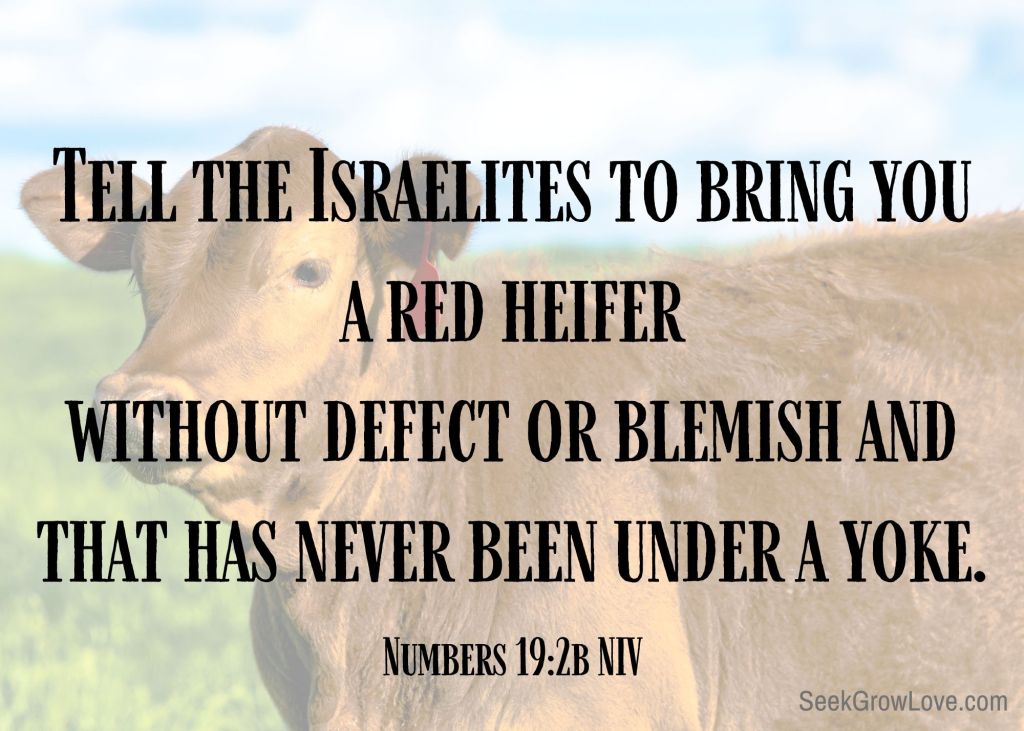
Numbers 18-19 continue laying out God’s specifics for his tabernacle with things like priestly duties, purification procedures, and one topic covered in detail in Chapter 19 is the sacrifice of the red heifer. This sacrifice is unique from others, and worth taking the time to look at a bit. The sacrifice of the red heifer was different than other animal sacrifices laid out in the law of Moses.

For one, this was a female animal instead of male. Also, this one was to be slaughtered outside the camp, burned in all of its flesh and blood (and dung!) with a few specific additions to the fire including cedar, hyssop, and scarlet wool. (Interestingly, I realized that I now have some hyssop popping up that I planted last year, and I added cedar shavings to the garden this past week. But, no scarlet wool and no red heifers around here!).  It seems this sacrifice was extremely specific and unique, and definitely similar to some things we see in Jesus’s sacrifice for us. If you want to read more about the symbolism and foreshadowing from the red heifer to Jesus, it is certainly out there. And, without looking too hard, we can definitely see connections including Jesus being killed in all of his flesh/blood outside of the temple, being perfectly flawless, being offered hyssop on the cross, being a sacrifice for our sins the way the red heifer was for the Israelites, etc., etc.

Evidencing that Old Testament stories are still relevant for us today, according to the Temple Institute, five blemish-free red heifers from Texas arrived in Israel in September 2022. Some view this acquisition as a step forward to the functioning of the new temple and related to Bible prophecy. No matter what, it is interesting to see how this reading from Numbers is still related to current events, and humbling to think what Jesus was willing to sacrifice for all of us.

“My little children, I am writing these things to you so that you may not sin. And if anyone sins, we have an Advocate with the Father, Jesus Christ the righteous;  and he himself is the propitiation for our sins; and not for ours only, but also for those of the whole world.” (I John 2:1-2, NASB)

-Jennifer Hall

Reflection Questions

  1. How was Jesus’ sacrifice different from the red heifer sacrifice – and different from all the other Old Testament sacrifices? What do all these sacrifices have in common?
  2. What can we learn about God through our Bible reading today?