The Path to Life

Tuesday – May 25, 2021

1 Kings 1-2, Acts 22

1 Kings opens up with David’s final moments. His health begins to decline as turmoil grows in his kingdom. David’s sons had a history of defiance and wrongdoing, culminating in the story of Absalom’s revolt described in 2 Samuel 15. Absalom dies, and David mourns for him. In 1 Kings, we meet another of David’s sons, the next in line after Absalom – Adonijah. Adonijah is the heir apparent, the oldest surviving son. He begins to exalt himself in 1 Kings 1:5, saying “I will be king!” This Lion King-esque refrain has a darker tone to it. Adonijah was never truly promised the throne, and at the time he was saying this, his father was still alive. Instead of waiting for a peaceful transition of power, Adonijah seizes the moment of David’s weak health and begins amassing forces to take the kingdom by force. Adonijah’s greed for power leads to sin and death, as the revolt eventually spirals into his own demise. 

Adonijah walked down the path of foolishness. His rash actions were compounded by sinfulness and a total disregard for the law. He had to pay for all of his actions. But, in verse 6, there is an interesting statement: “But his father had never once reprimanded him by saying “Why do you act this way?” Adonijah did not commit these actions in a vacuum; he had a family, court, and religious leaders surrounding him. Who was speaking wisdom into Adonijah’s life? Encouraging him to make wise choices and reminding him of Absalom’s life – and what might happen if he doesn’t show patience in his potential ascension to the throne? David ‘never once reprimanded’ Adonijah, calling into question his wrong behavior. Instead, he allowed Adonijah to do what was right in his eyes. In doing so, Adonijah eventually walked towards his own death. David needed to provide guidance and discipline for Adonijah, and because of his refusal to do so, Adonijah caused turmoil and pain to himself and others. 

Discipline can seem like a scary thing. It’s definitely one of my least favorite parts of being a teacher. It’s complicated and sometimes painful to discipline others and be disciplined ourselves. But, discipline is a crucial part of being a disciple of Jesus. Hebrews 12:10-11 says, “10 [Our parents] disciplined us for a little while as they thought best; but God disciplines us for our good, in order that we may share in his holiness. 11 No discipline seems pleasant at the time, but painful. Later on, however, it produces a harvest of righteousness and peace for those who have been trained by it.” Discipline is such an important part of our sanctification. Essentially, discipline is the way that we call each other back to the way of righteousness and holiness. And, it’s the way that God calls us back to him. 

How have you experienced God’s discipline in your life – through his hand or those of your parents or church leaders? Remember, discipline can keep us from becoming an Adonijah, someone with no guardrails or guidelines for the right, wise way to live. Let’s pursue a righteous life together. 

~ Cayce Fletcher

Read or listen to today’s Bible reading at Biblegateway.com: Job 1-2 and 2 Corinthians 2 .

Victorious

May 24, 2021 – 2 Samuel 23-24, Acts 21

When David came to power, he had his work cut out for him. Part of his legacy was fulfilling the calling that God gave to the Israelites when they first came to the Promised Land. He was charged with taking the land. He was supposed to be strong and courageous, and over his lifetime, he proved to be a man of strong military prowess who doubled the size of the kingdom of Israel. 2 Samuel 23 describes the men who helped David make that happen. These are his mighty men, the elite warriors who single handedly won battles against the Philistines with God’s help. One warrior killed 800 men at one time with a spear. Another group broke into an enemy stronghold just to get a cup of water for David. Repeatedly, these men are described as strong, fearless. They ‘stood their ground’ against their enemies. When they faced them this way, ‘the Lord brought about a great victory’ against their enemies. 

In Acts 21, Paul is facing strong and terrifying enemies. In fact, he is told what would happen to him by a prophet in verses 11-12 when the prophet describes how he would be tied up and delivered to the Romans in Jerusalem. The people are begging him not to go to Jerusalem, weeping for the bitter end that they knew would come to Paul if he decided to go to the city. Paul shows his determination and willingness to follow Jesus no matter what when he replies: “What are you doing, weeping and breaking my heart? For I am ready not only to be bound but also to die in Jerusalem for the name of the Lord Jesus.” What a mighty and fearless response! Paul may have not been marching into a war with spears and swords, but he knew the spiritual battle he was facing that would have real – and very dire – implications for his health and well-being. But, it didn’t matter – he would do anything for the name of Jesus. 

We need to face our everyday battles with the same determination and strength, resting in the knowledge that God will bring about the victory if we stand our ground. We need to be strong and courageous, because God is right there with us in our battles. We will emerge victorious!

~ Cayce Fletcher

Read or listen to today’s Bible reading at Biblegateway.com: Job 1-2 and 2 Corinthians 2 .

Sunday – May 23, 2021

2 Samuel 21-22, Acts 20

In today’s Old Testament reading, 2 Samuel 21-22, we see David, a victorious king and man broken by sin, dealing with the legacies of previous leaders of Israel and the political unrest they left behind. In addition to this, we see fall out with the Canaanite peoples, who had remained in the promised land for a thousand years after Joshua and the Israelites were told to conquer it. The last few chapters of 2 Samuel function as an appendix; they list stories that occurred during David’s reign, in non-chronological order. 

In 2 Samuel 21, we find a brutal story that involves betrayal, sacrifice, and tragedy.  Earlier in David’s reign, there was a famine that lasted 3 years. David responds to this famine, recognizing it as discipline from God, by going to God in prayer. The reason God gave for the famine is because of Saul’s, the previous king, slaying of the Gibeonites – a people the Israelites had made a treaty with (Josh. 9:15-20). David goes to rectify the situation, and so the Gibeonites ask for seven of Saul’s male descendents to punish for Saul’s decisions. 

The seven descendents were handed over and killed. Heartbreakingly, Rizpah, the mother of two of the sons, goes to the place where her sons were killed and protected their bodies from the elements and birds from April to October. four months of a day-in-day-out vigil, through heat, cold, rain, and sun. Finally, David heard about what Rizpah had done, her love and dedication to her sons, and because of her actions, he decided to honor the memories of Saul and Jonathan – and Rizpah’s sons – by burying them in their family’s tomb. After all of this, the famine stops in the land. 

This story is hard to read, but it shows an important truth: Our legacy is determined by the small, everyday actions of our lives. Those small everyday actions build up into something that can make a profound impact on the lives of those that come after us. 

Because of Saul’s actions and his failure to consistently follow the law, he devastated the lives of both the Gibeonites and his own family. His legacy left a ripple effect of destruction that led to a famine in the entire land of Israel. That legacy of destruction was only stopped when another woman consistently showed love instead of violence, for both her sons and for God. Because of her actions, God answered the prayer for the land. 

What type of legacy are you building? How are you daily and consistently building up a legacy that honors God and provides hope and help to those around you?

~ Cayce Fletcher

Read or listen to today’s Bible reading at Biblegateway.com: Job 1-2 and 2 Corinthians 2 .

The Money Trail

Acts 19

There is a saying with some truth to it that if you want to know about a matter – ‘follow the money’. This means if you look at the funding sources of a matter then you get a picture of who is pushing what (aka agenda) and who has financial gain or interest or conflict of interest in the matter. This is not a new concept, but rather, an old one. It is even present in Biblical times. The incident with Demetrius in Acts 19 is the perfect example.

Demetrius is a silversmith idol maker and has a good business going making a lot of money in Ephesus. He is afraid that the message that Paul is sharing that there is only one true God and that Jesus Christ is His son will plummet his sales in idols of Diana. Ephesus was known for its worship of the goddess Diana and the god Zeus. So he incited his fellow idol makers towards anger and malice towards Paul and the disciples in Ephesus. This snowballed into a riot where half the people didn’t even know what the issue was and just joined in rioting just because. (Sound familiar?) The authorities of the city knew that Paul and the disciples had done nothing wrong and had not stirred up this great rioting mob by anything they had done so they refused to bring them to court to try them. Ultimately Paul and the disciples decided to leave town and go somewhere else where they could share the gospel.

All of this is due to Demetrius and his fellow silversmiths being concerned that they would lose their livelihoods making shrines that they made a great profit from selling to the people. They were not interested in hearing or considering the truth – they were only concerned with the almighty dollar as we might say today. It is sad that the truth of the gospel couldn’t be openly shared in Ephesus because of a handful of greedy men. Does this happen today? In our time? You bet. The names and the livelihoods may be different but the situation still rears its ugly head. So …if you want to know about a matter ‘follow the money’ and you will find out a lot. More importantly follow Jesus and gain discernment about situations that arise. One will never go wrong when truly following Jesus.

-Pastor Merry Peterson

Today’s Bible reading passages can be read or listened to at BibleGateway here – 2 Samuel 19-20 and Acts 19

Going with the Gospel

Around the World or Across the Street

Acts 18

It is interesting how some people basically stay in one place all their lives and others seem to travel about quite frequently. No one can accuse the apostle Paul of being a homebody! In Acts 18 we notice that Paul travels quite extensively staying in one place for a little while, and then traveling to another place. Sometimes the places he traveled to received the gospel message with readiness and welcomed him, and at other times he received more hostile treatment. Everywhere he went he shared the gospel message. About the first thing he would do each place he went was to go to the synagogue and teach there about Jesus being the promised Messiah and way to salvation.

Among his travels he met Priscilla and Aquila and they were strengthened in the faith. So much so that later when Paul travelled on to a new location without them they were able to teach another man named Apollos more clearly about the gospel. It seems whether near to home or far away these early Christians were ready and willing to share the message with whoever would listen and believe. They were truly ready to give an answer in season for the hope they held within them.

We should be ready and willing just as they were to give an answer for the hope that we hold within us. Whether God gives us the opportunity to travel from place to place, or whether He asks us to be the light within our own community. Our willingness should always be present, just as it was with the early Christians, to share the hope we have in Christ.

-Pastor Merry Peterson

Today’s Bible reading passages can be read or listened to at BibleGateway here – 2 Samuel 17-18 and Acts 18

Do Your Homework

Eagerly Examine Every Day

Acts 17

Do you do your homework? This may seem like an odd question to be asking but that’s exactly what the people in Acts 17 were commended for doing. When Paul and Silas went to a place called Berea they were teaching the word of God to people in the synagogues. The people had never seen the scriptures in the light that Paul and Silas were teaching it to them, they had never recognized the truths that were being shared. So rather than just believe what they heard they went ahead and studied it in the scriptures for themselves to see if what Paul and Silas were saying was true. Essentially they were ‘doing their homework’. They found that what was being taught was true and so came to salvation. We refer to them as the Bereans. The term may sound familiar to you as many church youth groups have held the name Berean in their names. This is a reference to that noble group that studied the scriptures for themselves to see if what they were being taught was true.

In our society today there do not seem to be enough people who display Berean like qualities of ‘doing their homework’. Why were the Bereans noble – because they searched for the truth and they found it! Truth is important to us, but today the truth seems more, and more difficult to unearth. There are many newscasters, commentators, teachers, and yes preachers too who would all benefit from doing a little more homework before presenting information to the public. This would prevent a whole host of misinformation from circulating about. Many people would be better able to discern the truth if they did their homework. If you know the truth of a matter then you will less likely fall for anything false. We should all strive to be like the Bereans and desire to know the truth for ourselves, through diligent research especially when it comes to the word of God!

-Pastor Merry Peterson

Today’s Bible reading passages can be read or listened to at BibleGateway here – 2 Samuel 15-16 and Acts 17

God Focused Response

Acts 16

There are so many things that I find interesting in Acts 16. Paul has a vision of a man from Macedonia asking for him to come share the gospel with him. When they get to Macedonia to the region of Philippi they meet a woman who comes to belief along with her whole household. But what unfolds next is really fascinating. Paul and Silas get into a situation and end up being severely beaten and thrown into the inner holding rooms of the prison. But what I want us to notice is their reaction – they aren’t crying, they aren’t in there feeling sorry for themselves or busy being angry or muttering threats – they are Praying and Singing Hymns to God! What a contrary reaction to what everyone would expect!

If we were in that situation, sore, and bleeding, in a dark, inner, dingy room with criminals around us would we be that confident and flat out bold? We would more likely be in there feeling sorry for ourselves, scared out of our wits, and wanting desperately to call our lawyer or mom or anybody that could help us get out of there! But Paul & Silas’ response was God focused. By praying and singing hymns to God they were communicating with the one who has all power and authority to change and alter any and every situation. Who needs a lawyer when you have God on your side? God used the situation to open the hearts of the Philippian jailer and his household to hear and accept the gospel message. Paul and Silas were also released to go free from the prison where they were being held. When Paul and Silas exhibited the right response to their unfair situation God turned their situation around for His glory.

If we were to be bold and confident in the Lord and say within ourselves as the Psalmist did in Psalm 121:2 “My help comes from the LORD, who made heaven and earth.” And keep an attitude of worship, praise, and open communication with God in our trials; maybe we would stand in the same place of victory as Paul and Silas did. One of the biggest challenges that we face in our Christian walk is keeping the right attitudes when things don’t go our way or get difficult for us. I hope we are inspired by the actions of Paul and Silas and remember to communicate with the author of life and outcomes when we face our next difficult situation.

-Pastor Merry Peterson

Today’s Bible reading passages can be read or listened to at BibleGateway here – 2 Samuel 13-14 and Acts 16

Differences

From a Pure Heart

Acts 15

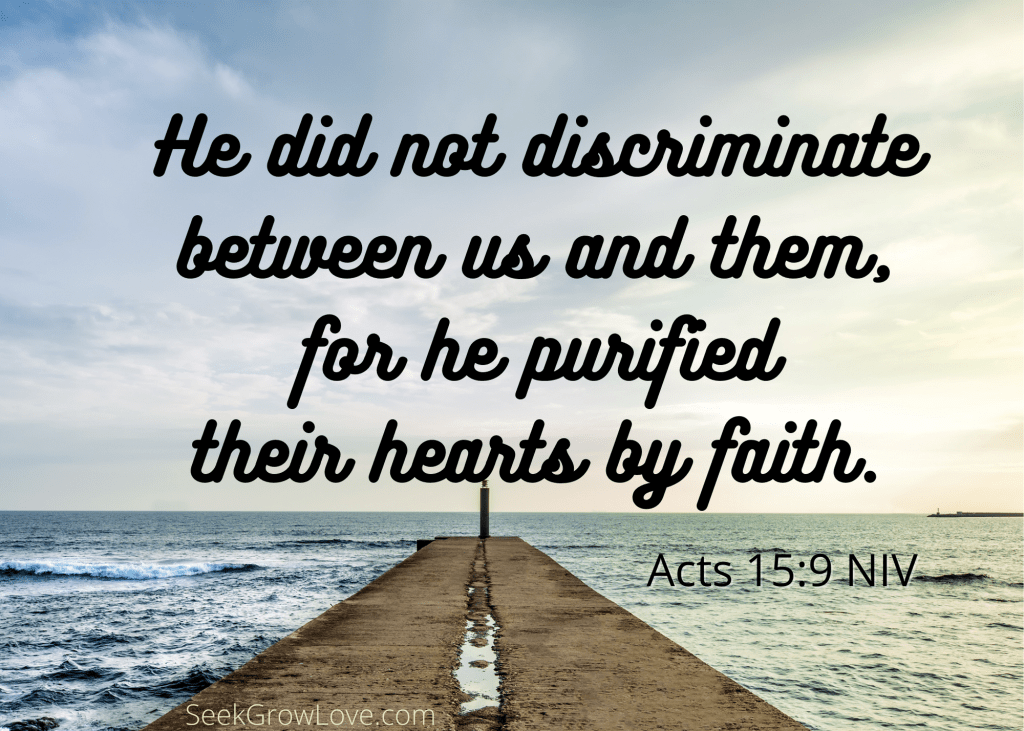
How many different churches have you visited? Have you noticed that each church does things just a little bit differently? The way we generally worship in North America is very different than in Africa. In Africa the people dance in the worship service in praise to the Lord – that is something that we generally don’t see here in North American worship services. The way churches conduct their services or the way they sing and praise may be different but there is one thing in common – their hearts are directed to the Lord. The issue of differences is what the apostles were dealing with in Acts chapter 15. Christianity began in the Jewish community; and in their religious tradition was the practice of circumcision for males. Although circumcision had nothing to do with the gospel of Jesus Christ they still felt that it was necessary for anyone who was to believe in Christ. Afterall Jesus was Jewish and went through the rite of circumcision himself.

The problem arose when the Jewish heritage Christians began to insist that the Gentile heritage Christians had to honor the rite of circumcision. The Gentile Christians didn’t have any religious practice that was like that. It was not part of their religious culture to do that and it didn’t have anything to do with the acceptance of the gospel message. So here we have two groups of Christians, both with hearts surrendered to the Lord but with very different religious practices. The apostles concluded through discussion and prayer that it is really a matter of the heart and not the practice of religious traditions that matter. Their directives to abstain from things offered to idols was to make sure that the Lord had first place in the heart. That they abstain from blood and from things strangled was a practical application directive to keep everyone healthy as consuming blood and saturated bloody products often led to unnecessary disease and illness. Lastly, abstaining from sexual immorality was the mark of living a righteous life that pleases God. All three of these directives were a sure mark of Christianity as the pagan practices of the day focused on sexual encounters, doing strange things with blood, all in the worship of idols. Ultimately in this case the two groups of Christians even though different in their practices had the same thing in common – that their hearts were in the right place before the Lord.

In our experience today with so many different churches we must honor each other as Christians. Some churches sing hymns, others sing more modern music. Some observe communion every week, some have communion once a month. Some have youth group or Bible study on Wednesdays, others have it on some other day of the week. Their practices may be different from one another but they all have one thing in common – their hearts are directed toward the Lord. Hopefully we will not be blinded by practices or traditions so much that we fail to honor the hearts of fellow Christians.

-Pastor Merry Peterson

Today’s Bible reading passages can be read or listened to at BibleGateway here – 2 Samuel 11-12 and Acts 15

When the Good News is Misunderstood

Acts 14

There’s nothing quite like being misunderstood! Have you ever felt that way – misunderstood? It happens to all of us and usually things sort themselves out one way or another but being misunderstood really put the apostles in danger in Acts 14. Along with the gospel message that they were to share, God had given them a portion of His holy spirit to be able to work miracles in those who would believe. Innocently enough the apostles began to share the message and then a lame man was healed and made strong again in the presence of all the people. This could have resulted in many more coming to belief in Jesus but instead the miracle resulted in the people thinking that their false gods were responsible and that they were manifesting themselves in Barnabas and Paul.

Talk about misunderstanding! Barnabas and Paul were mortified that the people were attributing greatness to them and thought that their false gods had done the miracle instead of the Almighty God of heaven and Earth. It became such a terrible situation that they even dragged Paul out and stoned him! What a terrible misunderstanding.

Have we ever tried to share the gospel with someone or a group of people and it went terribly wrong – with people ending up with wrong ideas or wrong impressions of what you said or did? Just remember you are not alone – the disciples had the same experience. Thankfully in our day and age stoning has gone out of fashion but tabloid lies and rumors abound. Social media can quickly make or break people’s opinions and ideas whether they get the right idea or the wrong one! Speaking from experience I had something I said unfortunately taken in the wrong way on social media due to how I phrased my response – oh the backlash! Live and learn. We must season our lives with prayer and ask God to direct our words and actions so that they will be taken in the correct manner. My prayer is that we would always be understood clearly whenever it comes to the gospel so that the work of the Lord may abound.

-Merry Peterson

Today’s Bible reading passages can be read or listened at BibleGateway here – 2 Samuel 9-10 and Acts 14

Gaining God’s Guidance

Acts 13

I am continually amazed at the way God directed the steps of the apostles through the direction of His Holy Spirit in the days of the formation of the early church. The apostles had the message to share that through Jesus there was forgiveness of sin and reconciliation to the Father. They were given the opportunity to share this message in very public places and many came to believe in Jesus. Can you imagine speaking in one place and then being asked to speak again the following week and almost the whole town shows up?

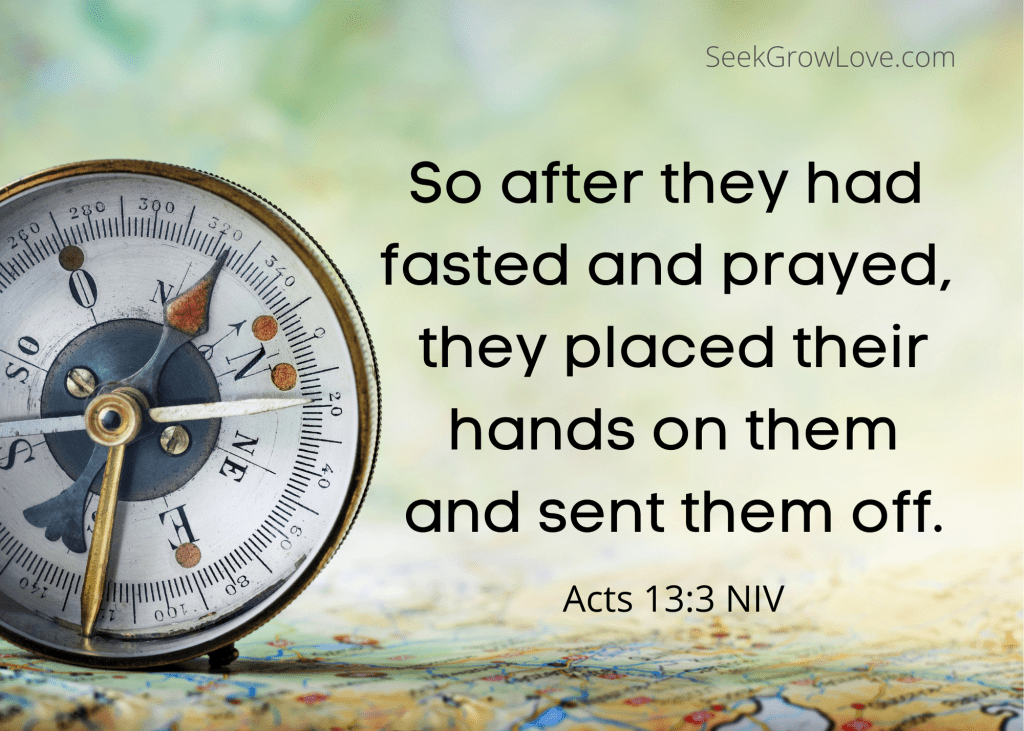
We as Christians have been given the same message to share – that there is forgiveness for sin through Jesus Christ resulting in reconciliation with our heavenly Father God. This is the greatest message of hope there is. Do we share it as often as we can? Wouldn’t it be awesome if we were asked to share and a whole town full of people showed up and came to believe! We realize that the apostles were filled and empowered by the Holy Spirit to do amazing things, and make amazing inroads in the gentile world for the gospel of Christ to be shared and accepted. If we want to be successful like they were notice what they did at the very beginning of Acts chapter 13 – the men fasted and prayed for direction and it was given to them.

As we attempt to share the gospel of Jesus Christ with the world do we go about it in our own way or in God’s way. Do we remember to pray for God to lead us by His Holy Spirit to know where and when we are to share the message? Do we ask for the opportunity to share and do we ask for the correct words to say as the opportunity presents itself. The apostles were successful in their mission to share the gospel in Antioch because they had prepared the way ahead with prayer, and diligence to listen to where, and when God was directing them to speak. All of this leaves me wondering – would we be much more successful in our sharing of the Gospel if we spent more time in preparation with prayer and listening for God’s directives? Give it a try and see what happens!

-Pastor Merry Peterson

Pastor Merry Peterson lives in Ontario, Canada and pastors at Freedom In Christ Church.

Today’s Bible reading passages can be read or listened to at BibleGateway here – 2 Samuel 7-8 and Acts 13