Be on the Alert!

Mark 13 & 14 (Thursday)

Mark 13 33

The thirteenth chapter of Mark finds Jesus teaching his disciples on the Mount of Olives outside of Jerusalem.  Jesus is teaching his disciples about the tribulations that are to come and his second coming.  He ends with this admonition in 13:35-37…

“Therefore, be on the alert – for you do not know when the master of the house is coming, whether in the evening, at midnight, or when the rooster crows, or in the morning – in case he should come suddenly and find you asleep.  What I say to you I say to all, ‘Be on the alert!’”

Jesus begins and ends his command with “be on the alert.”  In fact, Jesus says “be on the alert” in verses 33, 34, 35, and 37.  For Mark’s audience, this is like shining the spotlight on the words while fading everything else to black.  Like we covered earlier this week, the gospel was meant to be heard and hearing the same phrase back to back like this is a sign that it should be held onto.

Now, let’s jump just ahead a bit to Mark 14:32.  We’ve been through the Last Supper and Jesus has taken his disciples to Gethsemane.  He picks his three favorites (Peter, James, & John) and takes them a bit further than the rest.  He says to them, “My soul is deeply grieved to the point of death; remain here and keep watch.”

You ready for this?  Jesus is using the exact same word as he did back in chapter 13.  It’s even in the same tense!  The word is gregoreo by the way (like gregarious).  It’s a command directed directly at his listener.  Jesus was asking his disciples to do something much more than just stay awake.  He was pointing them back to what they had heard the night before: to be alert because the end is approaching.

In fact, when Jesus returns to find his disciples sleeping the first and second time, he repeats this same command to them, gregoreo!  Stay alert!  But upon his third visit he says it is enough, the time is now here.  In Mark 13, Jesus commands his disciples to be alert so that they may be prepared for the (ultimate) end, but in Mark 14, when the (immediate) end comes, they are asleep at their post and ultimately all leave him and flee (14:50).

This is not just a word by Jesus for his disciples but a word for us today as well.  Like the chorus in a Greek play, Mark’s words in 13:37, “What I say to you I say to all…” is a clear calling out to us here today.  Be on the alert for the end is coming and we must be prepared.  We must be prepared to face our own crucifixion – to die each day as a living sacrifice – as our own immediate ends in service, love, and sacrifice for others.  It is the cup we are called to bear as followers of the one who showed us the way.

OK – tomorrow is the big finale!  Mark’s last words to the earliest followers of Christ.  It’s a shocking, amazing, inspiring vision of Jesus’ ministry.

-Graysen Pack

A Den of Robbers

Mark 11 & 12 (Wednesday)

Mark 11 17

Once Jesus enters Jerusalem, the timeline for Mark slows down significantly.  While the first half of the book takes place over almost a year, the second half occurs in about a week.  Mark is letting us know that this is what his gospel and Jesus have been preparing for.  Mark 11 and 12 takes a closer look at the first 3 days Jesus is in Jerusalem.

While there’s a lot that we could cover here, I’d like to focus on Jesus’s experience in the Temple and how we can better understand a well known story that we may misinterpret.

On Jesus’s first day in Jerusalem, after the triumphal entry, he enters the Temple and “looks around at everything.” (11:11).  He leaves for Bethany outside of Jerusalem – using it as a kind of safe spot – instead of staying the nights in the city.  On the second day, he goes back to the city with his disciples and enters the Temple again.  However, instead of just observing, he begins to cause a scene.  Mark tells us that he starts “to drive out those who were buying and selling in the temple, and over-turned tables of the money changers and the seats of those selling doves; and he would not permit anyone to carry merchandise through the temple.”

Whoa.  That’s a pretty radical departure from the Jesus who didn’t want anyone to talk about the miracles he was performing.  It’s as if the shy kid from the back of the class suddenly started burning textbooks in the auditorium screaming “You won’t do any more homework while I’m around! Ha ha ha!”  It’s a little weird.  And, the principals would be rightly concerned about what was going on (like the chief priests and scribes).

So, what is going on?  First, let’s clear up some misconceptions about what the Temple looked like.  We may think that Jesus was clearing out the Temple area because the vendors were causing problems for the act of worship.  That doesn’t really fit with what we know about the Temple.  First, the area where Jesus is clearing house is HUGE.  I mean really big.  It’s approximately the size of 11 soccer fields.  That’s massive (about 704,000 square feet).  There weren’t enough vendors in all of Israel to fill that space.

Another idea is that Jesus was fed up with the temple system completely and was overturning the model that the temple existed on.  This tends to emerge when we think that Jesus is somehow trying to move beyond Judaism and create his own new thing.  Well, Jesus isn’t.  He was and is a Jew.  Mark’s gospel itself undermines this idea in chapter 12.  On the third day, Jesus returns to the Temple (where he wrecked it the day before) and sits across from the treasury.  A widow comes and puts in her 2 pennies.  Notice, Jesus doesn’t say that she is being scammed out of her pennies, that she should do something better with her money, that it isn’t right for her to give to the current system, or that she’s being robbed by the temple.  No – he says that what she’s done is more than everyone else AND it seems to be a great thing!  Even today, this widow is meant to be a role model for us.

So, what is Jesus trying to do?   Let’s look at the text.  After he drives out the merchants, he says that the temple had “become a robber’s den.” (11:17)  Was the temple robbing people?  No – a robber’s den isn’t where robbers actually rob people.  It’s a place where robbers can go and be safe.  It’s a hideout where they don’t have to worry about the law coming after them.  I don’t think that Jesus was calling out the merchants or the temple system, but rather the leadership in the Temple for their willful blindness to injustice and sheltering those who do injustice in their midst.  His criticism of the Temple isn’t for how it works or what it does, but rather for what it isn’t doing.  I think that Jesus is taking up the call of Isaiah, “Learn to do right; seek justice. Defend the oppressed.  Take up the cause of the fatherless; plead the case of the widow.” (Isa. 1:17)

This is where I think we can find a message for our lives and churches today.  Would Jesus level the same criticism against us today?  Not that we have vendors in the church, but that we allow ourselves to become a den for those who rob others?  Jesus’s problem with the temple wasn’t directed at the merchants or vendors but at those who were complacent in the face of wrong-doing, injustice, and evil.  Standing against injustice – especially when we find it in our own house, community, and ideals can be scary and seem life-threatening.  But, I think, like the widow, we are called to give what we have – “all that [we] have to live on” – to offer hope and justice to those starving for it.

-Graysen Pack

News Too Good to Keep Silent

Mark 10 52a

As we continue to work our way through Mark, we approach the end of one of Mark’s most intriguing themes: Jesus’ emphasis on keeping his identity secret.  So far in the gospel, whenever Jesus has acted in a way that would point out that he is the messiah, he has quickly followed his action with a command for those in-the-know to be silent.

Biblical scholars call this the “Messianic Secret” of Mark.  And honestly, it’s still largely a mystery as to why Jesus does this and why Mark records it as a prevalent theme throughout his gospel.  In fact, Luke was so uncomfortable with this idea that it was explained as an attempt by Jesus to not be overwhelmed by large crowds (Luke 5:15-16).  Remember, Luke and Matthew based their gospels off of Mark’s framework.  So the healing of the leper in Mark 1 shows up in Luke 5 and Matthew 8 from their perspective.

I say all of this to point out that Mark 10 marks (ha!) the end of the Messianic Secret.  In verses 46-52 we have the story of the healing of Bartimaeus.  In the final verse, Jesus says, “Go; your faith has made you well.”  That’s it!  Before this, we would have expected Jesus to say something like “Be healed, but shush!”  No, instead Jesus heals him and that’s it.  The missing admonition is emphasized even more because in the opening of the scene, it is all of Jesus’s followers who were telling him to be quiet…very interesting… But, Jesus himself says nothing.  While Jesus may be the first example of being emo (‘I liked being quiet before it was a thing.  Now that it’s a thing, don’t.’), I don’t think that’s what Jesus or Mark had in mind.

If we look back at chapter 1 of Mark, Jesus’ first miracle happens in the synagogue (church).  He casts an unclean spirit from a man (Mark 1:23-28) telling the spirit to “Be quiet, and come out of him!”  Whoa!  The first thing Jesus says is shut it!  Now, in Mark 10, Jesus’ final miracle is the healing of Bartimaeus and he doesn’t say anything about silence.  And, it’s a miracle where a man’s sight is restored!  If Jesus is trying to hide his messiah-ship, then the restoration of sight (seeing that Jesus is the messiah) is the perfect way to emphasize it’s end.

So, what happens next?  The triumphant entry into Jerusalem where EVERYONE sees and claims the messianic nature of Jesus.  Whoa!  Mark is doing some crazy, mind-blowing stuff here that would work on even the best dramatic television shows today.

As we continue to explore Mark, we’ll get to see how this theme becomes a critical foundation for what is to come and for Mark’s final message to his reader.  So, stick around and we’ll keep digging through this amazing text together.

-Graysen Pack

What to Do with Doubt

Mark 9:14-32 (Monday)

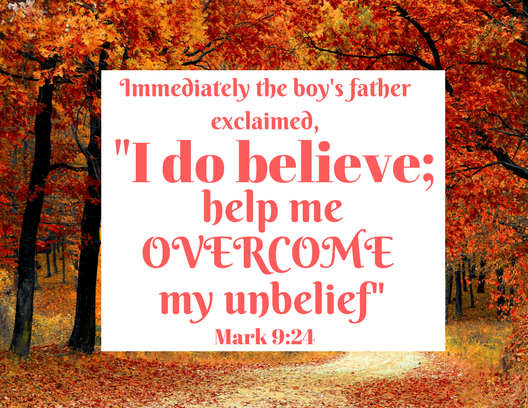
Mark 9 24

None of Scripture was intended to be read.  Although that may seem strange to us today, the ability to read was incredibly rare.  For today, it’d be like having a doctorate.  There are a number of professor’s out there, but you don’t run into them every day.  Reading just wasn’t something most people needed to be able to do to get through their day.  The agricultural and craftsman lifestyles didn’t need to keep many notes themselves.  As a result, the writings, when they were used, were usually read aloud in a collective setting – and this is key.  Because Scripture is meant to be heard – not read!  All those with EARS, let them HEAR.

Because of this, there weren’t any of the nifty little headings that we find in our Bibles today.  It was just one long story without breaks or chapters.  So, the nice breaks that we often get around stories didn’t exist except for the past few hundred years.  For today’s reading, both of these things are really important.

These two vignettes in Mark 9:14-32 (the healing of the child and the misunderstanding of the disciples) come back to back and would have been heard that way by Mark’s original audience.  So, what I’d like you to do is try it.  Take just a second to read these verses out loud. If you’re somewhere public, just try whispering if you want.  But read it out loud and see what sticks out to you.  I’ll wait here and I’ll do it too…

[waiting]

So, how was it?  Awkward? Weird?  Probably a little.  But when I did it something new really stood out to me about this passage.  In the first story, a man comes to Jesus asking for healing for his son. Jesus responds ‘oh you faithless people…how much longer do I have to put up with you.  Bring me the boy.’  The father, distraught over Jesus’ seemingly kinda cruel response, cries out – ‘I want to believe! Please help my unbelief!’  He wants to save his son and will do whatever it takes to save him.

The next story is between Jesus and his disciples.  He’s teaching them about what’s going to happen to him when he reaches Jerusalem.  But they don’t get it.  They don’t have belief/faith, just like the dad in the previous story.  However, instead of putting aside their pride and asking for Jesus to help their unbelief (lack of understanding), they stay silent.

Here, in these few verses, a man from “this faithless generation” reaches out, pleads, and finds Jesus meeting him in his unbelief while the ones who are part of Jesus’ own inner-circle remain unmoved in their faithlessness.  And this at a time when Jesus’s time with them was literally drawing short.

The problem with this is never unbelief.  The problem is how we respond to it.  We won’t have all the answers.  We will doubt and question.  Jesus doesn’t lament our struggle – it is one that he himself walked through (for he shared in all things but without sin).  Embrace the places where you are unsure.  Lean into the spots where the struggle is the most real and you are shaken like the son in the story.  Push forward and call out for a help, a grace that will fill us in our uncertainty and bring healing.

-Graysen Pack

Graysen’s Favorite Gospel

Mark 1-1


Hey everyone!  I’m excited to be back 😀  Bethany helped us move this past week from the Old Testament into the New Testament with the gospel of Mark (thanks Bethany!).  This week, we’ll be exploring the second half of the gospel of Mark and see some of the themes that Mark has been setting up come to their close.

Before we get into looking at the text itself, here’s just a bit about Mark that will be helpful for us as we read.

First, Mark is the oldest of the gospels and it sets the stage for the synoptic gospels (Matthew, Mark, & Luke).  As the church grew in the years after Jesus’ resurrection, there wasn’t any need to write down stories about his life – the people who were there and saw it were still alive and present.  It was only around the end of the first century CE that people who were followers of Jesus began to write down what they knew about his life and teachings.  Why?  Because all the witnesses were dying!  They needed to keep a more permanent record of Jesus’s words that didn’t rely on having witnesses of the events nearby.  That first written story came to be known as the Gospel of Mark.  The writers of the Gospel of Luke and Matthew would later use Mark as the skeleton for their gospels.

It’s because of this that the gospel of Mark is my favorite of the gospels.  It’s the pre-cursor and contains the most concise collected narrative of Jesus’ life and teachings.  And – the end is just great (but we’ll get there soon enough)!

So, I hope that you’ll join me as we explore what one of the earliest authors of the life of Jesus had to say about “the good news of Jesus Christ, the Son of God.” (Mark 1:1)

-Graysen Pack

Fishing Reflection Questions

Saturday – Recap with Bethany Ligon


Our week together reading, meditating, and studying Mark 1-5 has come to an end. Thank you for reading along.


The focus for most of the week has been on becoming fishers of men. I’ve found some reflection questions that I will leave you with. Feel free to share your thinking here on the blog or post a comment on the FUEL Facebook page.


  1. What strikes you most about Jesus in Mark’s picture of him at the beginning of his ministry?
  2. Of what truths was Jesus most concerned to make people aware? In other words, what is the essence of ‘the gospel of God’ that he preached?
  3. What different kinds of reaction and result did the activity of Jesus provoke?
  4. To which class of people was Jesus prepared to give most? What must I be prepared to do to belong to this class? What can I then expect him to give me?

These questions came from: Stibbs, Alan M. Search the Scriptures: The Study Guide to the Bible. Downers Grove, IL: InterVarsity, 2004. Print.


Desperate to Meet Jesus: At His Feet

Mark 5

Mark 5 22b

Have you ever had the opportunity to go see, and possibly meet, a celebrity (actor, musician, athlete) in person? Ten years ago, the New York Giants and the New England Patriots were in Arizona to play in Super Bowl XLII. You may be thinking that I tried to get to see either Eli Manning (the Giants quarterback) or Tom Brady (the Patriots quarterback). But my interest wasn’t in either of them. No, I knew that Eli’s brother, Peyton, would be in town to attend some parties before the game. I had a friend of a friend of a friend who had tickets to one of those parties and I daydreamed hard about getting to meet the future NFL Hall of Famer.


A few years before that I was in Monaco and my tour guide had heard that George Clooney, Brad Pitt and Matt Damen were supposed to be filming a scene in the movie Ocean’s 12 at the famous Monte Carlo Casino. The group of students that I was traveling with and I stood with a crowd of people for almost an hour hoping to get a glimpse of the three actors. Well that never happened. But we did get to witness two extras walk down the steps of the casino and that scene is in the movie, so it wasn’t a complete waste of our time. Kinda.


When I read Mark chapter 5 I imagine that the crowds that followed Jesus around were a bit like the superfans of a celebrity. Wherever He went, masses of people would go and seek Him out. Not because He was rich and famous, but because they had heard He could perform some pretty crazy healing miracles. In this chapter we read about three people who were not just highly interested in meeting Jesus, they were desperate to meet Jesus. And so they did what they had to do, to get near Him. The demon-possessed man saw Jesus at a distance and ran and fell on his knees at Jesus’ feet (verse 6). The father of a dying young girl worked his way through the crowd and fell at Jesus’ feet (verse 22). The sick woman reached through the swarm of people to touch his cloak and then fell at His feet (verses 28, 33).


Desperation brings you to a place of complete abandonment of pride and social decorum and a complete surrender to experience an ounce of relief. Imagine being so in need of healing that you fight your way through a crowd of strangers to fall onto your knees at the feet of Jesus. The wonderful thing is that Jesus had compassion on each and every one of those people and He will have compassion on you too.


But Jesus doesn’t want you to humble yourself just when you’re desperate for healing. He wants you to be desperate to spend time with Him every day, even when things are going well for you. His desire is for us to sit at His feet and enjoy His presence no matter what is going on in our lives. Remember Mary, Martha’s sister, who sat at her Lord’s feet and she was praised for doing what was right (Luke 10:38-42)? Mary had the right idea. It’s during these times that we learn how to follow Him and to love Him. It’s during these times that we understand what it means to love others and become a fisher of men.


Psalm 16:11 says, “You have made known to me the path of life; you will fill me with joy in your presence, with eternal pleasures at your right hand.” When we find ourselves at the feet of Jesus, life, in all of its complexities, will begin to make a little bit of sense because we no longer view things at face value, but we get glimpses of how our life experiences fit into God’s eternal plan. Yes, we will still know sorrow and grief, but we will also have an eternal hope, a peace that surpasses understanding, and overflowing joy.


So let’s take a few minutes to fall on our knees at the feet of our Savior and Lord.   


-Bethany Ligon


The Storms of Life

Mark 4

Mark 4 41b

As I write this, masses are evacuating Florida in the anticipation of Hurricane Irma. By the time you read this, I hope that the storm has passed and that the loss will be minimal. I pray for the recovery teams who will be in the areas doing their best to help families begin to put lives back together.


In Mark 4 we read about another storm. One that scared the disciples beyond anything that they had ever experienced before. This huge squall was both a test and a teachable moment. Jesus was testing the men’s faith and trust in the Son of God. Jesus also used this time to teach the men the extent of His great power. If these men had any doubts before about who Jesus was and what He was able to do, His calming the winds and the waves certainly would have clarified any misconceptions, don’t you think?


I think that we all have to experience a storm or two in our relationship with Jesus in order to find out what our faith is made of. I can think of several of you who I personally know and the storms that Jesus has lead you through and how it has reinforced your faith. I too have been tossed about in a violent storm and the only thing I knew to do was to call out to Jesus. I’ve had my share of nights where the only thing that brought my mind enough peace was to sleep with an open Bible on my bed and my hand literally resting on God’s promises. I’ve had days when anxiety was so great within me that the only thing that could keep the negative thinking at bay was to read Scripture out loud for hours on end.


If you are not currently experiencing a storm, then now is the time to make sure that you are in the Word daily and living out your faith while the waters are calm. 2 Timothy 1:14 says, “Guard the good deposit that was entrusted to you – guard it with the help of the Holy Spirit who lives in us.”


If you are living through a storm right now, hang on tight. Hebrews 4:14 encourages us with this: “Therefore, since we have a great High Priest who has gone through the heavens, Jesus the Son of God, let us hold firmly to the faith that we profess.”


I many not know the details of your personal storm, but I do know the One who is powerful enough to keep our boats from overturning. And He certainly will bring you through to the other side. Believe. Trust. Love. Obey.


-Bethany Ligon


Answer the Call

Mark 3

Mark 3-13

About seven years ago, one of my very closest friends was pregnant. She and her husband already had one daughter who was birthed at home and they had decided that their second child would also be born at home. She asked if I would babysit the older daughter during the delivery. Of course, I said yes.


I got a call one morning from my friend and she explained that she was experiencing contractions and that I should be ready to come over in a few hours when the contractions got closer together. Ok, no big deal, I thought. I’ll run a few errands, take care of some other stuff and I’ll simply wait for the call. About four or five hours later, she calls and says, it’s time to come over. Sweet! I was excited!


I got to her home and her husband wasn’t there yet, he was still at work. The midwives weren’t there yet, they were stuck in traffic. Oh boy! What had I gotten myself into???


I helped her prepare the bed for the delivery and get some other things situated. Thankfully, her husband eventually arrived and the two of them went up the stairs while I stayed downstairs with their little girl. Finally, the midwives busted through the front door and I told them where to go. I decided to take the little girl outside to her playset and within 20 minutes, their second daughter was born.


After a bit of time, my friend’s husband, came down stairs and invited me upstairs to introduce me to the newest member of their family.


It was only after I had left to go to my own home that I realized what I could have ended up doing if the husband and midwives hadn’t shown up in time. And so, I was so incredibly honored that my friend had asked me to be part of her delivery day. But I never would have been asked to be there in the first place if I hadn’t developed the close relationship with my friend a few years before.


In Mark 3, we read about Jesus inviting his closest followers to become His apostles. Simon, James and John, Andrew, Philip, Bartholomew, Matthew, Thomas, James son of Alphaeus, Thaddaeus, Simon the Zealot, and Judas had all first responded to Jesus’ call of becoming His disciples. They learned from Jesus. They witnessed miracles being performed. They left all that they had to be obedient.


Now Jesus was asking for more. He was getting ready to send them out and become fishers of men. A task that wasn’t asked of everyone. This was an important task, one that demanded, not just knowledge and readiness, but a dedication to persist through great trials and tribulations. These men probably had no idea what they were getting themselves into when they said “yes”. But to them, because of the relationship that they had developed with Jesus, the promotion He was offering was the natural thing to agree to.


Here’s the thing. Jesus wants our relationship with Him to be so close, so intimate, so natural, that when He asks us to do something, to go somewhere, to minister to some person, that we don’t have a second thought about it. In fact, when we realize His desire for us to do something, it’s an honor and privilege to serve Him in whatever task He’s given us.


I was not prepared to deliver a child into this world, but I would have been willing if the need arose. Likewise, I may not know exactly what Jesus is going to ask of me today, tomorrow or the next, but I am willing to do whatever He asks of me. Are you?


-Bethany Ligon


The Strength of Christian Friends

Mark 2

paralytic top

Many years ago, a precious lady in our church was coming to the end of her battle with cancer. One of her closest friends, also from our church, was sharing that she had been to her bedside to visit. While she was there our friend said that she could no longer pray for herself. The visiting friend reassured her that she had fought the good fight, she had finished the race and she had kept the faith, but it was time for her to rest and others would be praying on her behalf.


I’m not sure why this has stuck with me for probably longer than 20 years. Maybe it’s because I know that the bond of friendship between these two Godly women had endured a great many of life’s other trials as well as celebrations.


In Mark chapter 2 we see another wonderful example of friendship. Four friends going to extreme measures to bring another man to the Great Physician. Because of their faith, the man with the physical disability was healed and the five of them walked out of the room together. Can you imagine the celebration that took place among them and their families?


I realize that many lessons from Mark 2:1-5 have been taught about faith and the healing powers that Jesus demonstrated on that day. But to me, my attention always gets drawn to the message of how important friendships are.


We are not meant to walk our faith out in isolation. Faith is meant to be experienced in community. I know I said this in yesterday’s post, but we need others of like-minded faith, by our sides. This is so, so important. Our friends in the faith are who keep us on track, who support us when life gets tough, and who help us cheer when life is spectacular. And just as importantly, we do the same for them.


My prayer for you is that you have a network of people with whom you can do life together.  


-Bethany Ligon