It’s hunting season here in Ohio! All around the countryside, hunters are sneaking though the fields, climbing tree stands, and checking their trail cams. The deer are careful and on alert, listening and sniffing the air for the sign of trouble. Failure to sniff out the enemy can have deadly results for the hunted.
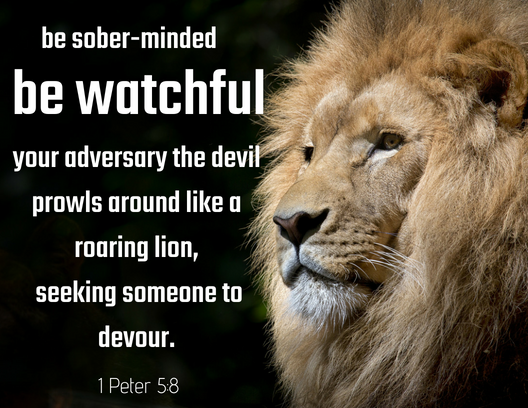
As Christians, we have to be on guard against temptations and situations that can cause us to fall away from the Lord God. 1 Peter 5:8 warns us to “Be alert and of sober mind. Your enemy the devil prowls around like a roaring lion looking for someone to devour”. Peter, in his letter to the Christians across Asia Minor (modern Turkey), has tried to encourage the believers to stand firm in the face of persecution. Instead of getting revenge or lashing out against people who have hurt us, Peter encourages us to rejoice in our sufferings and be thankful for the opportunity to do good to those who hurt us (1 Peter 3:8-12).
It is easy to want to strike back, to say something hurtful, or to defend ourselves. But God has a higher purpose in mind behind our suffering. He wants to shape and mold us into mature Christians. Sometimes, we have to endure hard times to allow that change towards maturity to occur. It is tempting to want to respond in kind to those who hurt us. We have to stand firm and resist the urge to take the bait!
Peter reminds the Christians that this is a sneaky trap, set by our enemy, the devil. We have to be on the alert, and watchful to avoid falling into the traps set by the enemy. Like deer trying to avoid the hunter, we avoid the traps of temptation by seeking to do God’s will. Peter asks us to be alert and sober minded. Resisting the temptation to lash out at our enemies or to hurt other people is not easy. But the more we resist, the easier it is to stand firm against the schemes of the devil. God wants us to trust Him. As we obey Him, He will “restore you and make you strong, firm and steadfast” (1 Peter 5:10).
What is the best way to lead others in the church? What is the best way to follow church leadership?
At the end of 1 Peter, Peter gives some exhortations to leaders in the church and then to the general assembly. His exhortation to leadership, while brief, is powerfully meaningful:
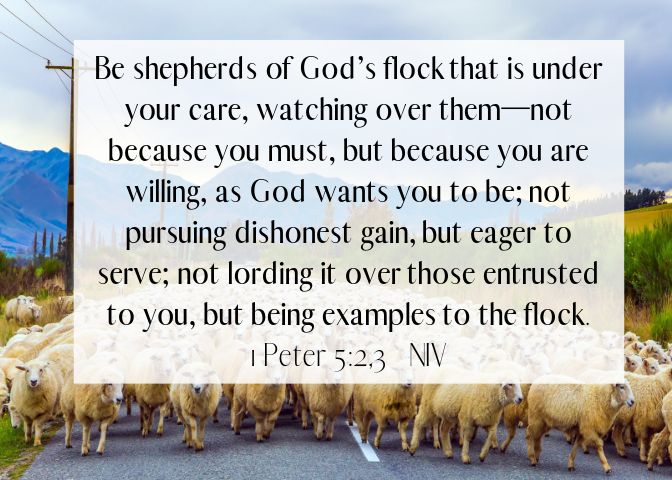
1 Peter 5:2-3 (ESV)
2 shepherd the flock of God that is among you, exercising oversight, not under compulsion, but willingly, as God would have you; not for shameful gain, but eagerly;
3 not domineering over those in your charge, but being examples to the flock.
Leaders in the church are commanded to shepherd the flock not by abusing authority but by being examples. Peter is repeating what Jesus taught him years before (see Matthew 20:25-28). Jesus served others in love, showing everyone how to live a godly life. He did not collect taxes, lead an army, start a big corporation, or run for President (or Caesar, not that it was a democracy!), but even if he held a prominent worldly position, he would not have led through fear or domination.
How many times has this gone wrong in the history of the Christian church? How often are leaders tempted to lead this way? As a pastor, knowing how common this problem is leads me to greater personal reflection and humility. My job is to serve willingly and eagerly and to be a good example to the people in our congregation. That sounds simple and straightforward, but the other way is tempting. Leaders, we must keep the servant’s towel wrapped around our waist at all times!
Peter goes on to admonish the whole assembly to be humble, to cast anxieties to God, and to be watchful. Each of these dispositions is important. First, humility is a foundational Christian attribute. It’s like the key to the door of growth. Humility says, “I don’t know everything yet. I can still learn more.” Everyone in the church should be humble before God and before the Scriptures. There is always more to learn. There is always more to live.
Second, we are to cast our anxieties to God. This world is full of trouble and brokenness. All of us experience anxiety from time to time. We must remember that God cares about every aspect of our lives. What a crazy thing to believe, but it is true — the Creator of the Universe wants a relationship with you! God cares for you!
Finally, we are to be watchful. There are influences of darkness in the world around us (see: anxieties above). The powers of darkness, led by the adversary/devil, have built systems to damage our faith and lead us into temptation. Just as our Lord Jesus taught, we seek God instead. He will deliver us from evil, and the promise is, that as we resist, the devil will flee (see also James 4:7).
-Will Barlow
Reflection Questions:
(Leaders) How do you stay humble and focused on serving the people around you?
(Non-leaders) What can you do if you are concerned about your leaders and how they are behaving?
Are there things in your life that need more watchfulness or resisting the powers of darkness? What can you do to strengthen your resolve in those categories?
Chapter 4 ends with verse 19: Therefore, let those who suffer according to God’s will entrust their souls to a faithful Creator while doing good (ESV).
The suffering in the New Testament is related to living a life set apart from worldliness, which is opposed to God’s will. It is not God’s will that we should suffer, but when we follow in the ways that he has prescribed for us we will undoubtedly face opposition and ultimately suffer for the sake of the Gospel. We need to trust that our creator will ultimately use that suffering for good. There’s a popular song that we sing at my church that has the line “you take what the enemy meant for evil, and you turn it for good” (drawing on Genesis 50 for inspiration).
Chapter 5 then begins with Peter addressing the leaders of the church, specifically calling to mind the sufferings of Christ. Pastors/elders are to function in the role of shepherds for the congregations that have been entrusted to them in leadership. The verb that is translated as “shepherd” also can be translated as “feed” – does this directive remind you of any instructions that Peter himself received from Jesus?
In John 21 three times Jesus asks Peter if he loves him (notice a correlation between Peter’s three denials of Jesus and the three affirmations that Jesus receives from him?) and three times tells him to feed his sheep (this is a different Greek word in John, but it means essentially the same thing). As the primary leader of the church Peter was to feed Jesus’ sheep, meaning Christians. The impetus for this spiritual leadership is not to be out of self-importance or in Peter’s case even that Jesus chose him to lead, but out of love for his master and savior (and friend!). When we see Peter lead, he is following in obedience to the one who called him out of the boat and invested in him and entrusted him to feed his sheep. Peter certainly was not doing this for gain or for an easy life, I imagine his life would have been much easier had he simply decided to go back to fishing full time, but he faced many trials and much opposition in his preaching the word and leading the church.
In the same way, those of us who are called to be pastors and elders (who are specifically addressed here, but anyone who holds an office in the church should take heed of this) should be using their love of Jesus as their motivation for leading. Presumably most church leaders start off this way, but it can easily go to one’s head. There are many public instances of pastors who have become controlling, power hungry, and abusive (quite often we see this in large churches with lucrative opportunities for pastors) – but even in small churches the desire to control can infiltrate the hearts of those who are called to lead or “run” the church. Elders (I’ll include pastors in this title from here on out) are to be willing and eager to carry out the work that they have been called to. With a calling to leadership comes responsibility – a significant thing to note is that we who are in authority (and who teach) are held to a higher level of accountability (James 3:1). Those who are in authority are to be an example to those who they oversee spiritually, and humility is one way in which we should be an example. Jesus stated that he was gentle and humble (Matthew 11:29), and we see in Philippians 2 that humility was essential in Jesus salvific work as God’s anointed one.
As Jesus was humble and as we who are elders (overseers) are to be humble (following Christ’s example), so then are the members of the body to exercise humility and submit to those who are in authority over them. If leaders are humble and operating as Jesus would expect them to, then humble Christians submitting to the godly authority that has been placed over them will thrive in their submission. We’re never going to agree on everything and that is why the decisions of local congregations are to be subject to the elders and not left up to the democratic will of a large collective. Elders absolutely can delegate responsibilities and set up clear roles for the body (Acts 6), but the authority over the church should lie with them.
We just added two new elders at my church yesterday. The process was not a short one… Myself and our other elders had many discussions on who we thought would be a good fit to assume these offices and eventually recommended that these two individuals be confirmed as elders. We don’t accept nominations for elders, but rather we look for men who meet the requirements of elders as listed in Titus 1, and then we have a confirmation vote. Other churches do things differently and may have boards structured in different ways or may be more egalitarian in the way that they define elders, I don’t condemn that, but we need to take seriously the guidelines that are listed in scripture and not be too quick to structure things in a way that is more reflective of the nation/society we live in than how the early church did things. Regardless of our views on church leadership one thing we need to be able to do is disagree with grace and love.
We need to make sure that whatever disagreements we have are dealt with in love and we need to not let them distract from what God would have us do and we need to make sure that we keep our minds clear (5:8, reaffirming 4:7), be on the lookout, and refrain from being anxious (cast those anxieties on God, see also Matthew 6), because the enemy prowls like a lion looking for someone to devour. When we allow conflict to take root or we allow anxiety to be prevalent in our churches, bad things will happen. We may often think about the enemy being on the prowl for individuals, but he’d also love to devour a local church and render it ineffective at making disciples or worse, cause it to die out (is that really worse?). I bet we could all think of examples of things we can (or do) divide over, one such argument could be what Peter means by “our enemy the devil”, but we need to take seriously the words of the author of Hebrews when he/she says: “Strive for peace with everyone, and for the holiness without which no one will see the Lord. See to it that no one fails to obtain the grace of God; that no “root of bitterness” springs up and causes trouble, and by it many become defiled;” (Hebrews 12:14–15 ESV).
-J.J. Fletcher
Reflection Questions:
1. For those of you in authority: do you do it willingly? Eagerly? Without being domineering? Sometimes we do have to be forceful and make unpopular decisions, but that can still be done in a graceful and kind way. Do you need to be humbler, or do you think you have that well under control? Do you have an individual in mind that has authority problems with whom you can practice extra grace?
2. For those of you under authority: Do you respect those who have been placed in authority over you? Do you easily submit to that authority? Do you gossip about the leaders of your church and cause problems that way? Do you stop attending church when changes occur, or decisions are made that you disagree with? Do you go church hopping and just stick around till someone ticks you off and move on to the next place (which might just be going back to a former church until the vicious cycle starts over again?
Podcast Recommendation: The Rise and Fall of Mars Hill (from Christianity Today). It can be difficult to listen at times, but it has lots of examples on how to do leadership wrong, which we can benefit from.
There is an old Amish proverb that goes something like this: There are two kinds of leaders: those who are interested in the flock, and those who are interested in the fleece. In the first part of I Peter 5 there is an admonition given to pastors but it is applicable to all those who hold leadership roles anywhere. Leaders are to lead by example. They are not to be dictators with an accompanying attitude but rather directors who are always directing people in the case of pastors toward Christ, and for other leaders directing people toward the greater vision with a humble attitude.
Peter encourages us and the early believers to honor one another and treat each other respectfully. Have you ever been around someone who frequently ‘tooted their own horn’? How annoying is that? Does it make you want to follow that person’s lead or make you like that person very much? Think about social media posts you have seen like this, or maybe even posted yourself. One Christian leader appropriately called out some posts as the ‘humble brag’ and targeted how annoying and self-serving they are. As Christian brothers and sisters no one should toot their own horn but rather let others give them any due recognition. Peter reminds us in verse 5 that God hates pride but appreciates true humility.
In serving God with a humble attitude and living a righteous life we can expect to have some opposition. Opposition can have two effects: either failure, or strength and growth. In the end of the chapter Peter points out that our adversary the devil would like to see us fail, and is just waiting to help us to our demise – but by staying the course God will give us victory. The admonition for us is to stand firm in our faith and righteousness so that we may glorify God in this life and thus overcome the evil one.



 Seek Grow Love