Finding Common Ground

Acts 17:1-18:18

Devotion by Emilee (Ross) Christian

Today’s reading contains one of my favorite stories about Paul’s travels – his time in Athens. I love this story because it teaches us to approach others of varying beliefs with kindness and respect. In Acts 17:22-30 Paul demonstrates how to speak the truth in love.

            Paul begins his discussion with the Athens people by complimenting them. It isn’t false flattery either. While the lifestyle of idol worship is appalling, Paul looks at the heart behind the lifestyle and establishes common ground with the people. He makes the observation that they are “very religious in every way” (v. 22 NLT). He reminds them of their own “‘unknown God’” to whom they have dedicated an altar. Instead of coming to them with radically new ideas, he expounds on one of their own. Instead of creating division between his religion and theirs, Paul seeks unity.

            In his following statements, Paul shows his knowledge of their customs, further establishing his credibility. He isn’t ignorant of their ways of life. He notes how the Greeks put special significance over temples, believing it to be where their gods reside and have power. He explains how the Hebrew God “since he is Lord of heaven and earth, he doesn’t live in manmade temples” (v. 24 NLT). He discusses their custom to offer sacrifices and argues that the true God does not require sacrifices from man in order to survive. Finally, Paul quotes some of Athens own poets to prove the existence of God as creator of man. To make all these arguments, Paul needed to have a baseline understanding of the Athens religious beliefs. This means he took the time to understand the people he sought to evangelize.

            It’s also worth noting that Paul initially approaches them with an I statement. I looked it up in the original Greek and sure enough the verb used for seeing/noticing is conjugated first person singular. In relational communication, I statements are key. I statements help the speaker convey ideas without seeming to attack the recipient. I think it is brilliant that Paul does that here with the Athens people.

            The way Paul speaks to the Athens people reminds me of how he explained his teaching style in I Corinthians when he wrote “I have become all things to all people” (9:22 NIV).  Paul humbles himself in sharing the gospel. Rather than teach a doctrine, Paul sought to teach good news. I think today we can learn from Paul. If there is someone in your life who’s lifestyle seems counter to yours or your beliefs, I encourage you to search for common ground like Paul. Find that common ground. Address it, using an I statement. Then, expound on their beliefs by guiding them to the truth. It takes finesse, of course, but it is important to not ostracize people. In a world full of so much division, look for the similarities. Ask God to give you humility. I wonder just how many people we could reach if we paused and looked for our similarities. Despite the many ways we can differ, at the end of the day, we are all a part of God’s creation, groaning and longing for a day free from death and decay. We are more alike than we are different. 

Reflection Questions

  1. Have you worked on using “I statements”? What results have you seen? Have you tried them before when sharing the good news?
  2. How was the good news shared with you? Are there bad ways to share the good news? What might that look like? With what results?
  3. Think of someone different from you who does not currently have the hope of eternal life. What do you have in common? What do you know about them? What “I statements” could you use to start a conversation with them about God?


Sharing the Message

– So it will be Received

Old Testament: Leviticus 26 & 27

Poetry: Job 3

New Testament: Acts 17

Acts 17 is very inspiring to me. Paul and his companions are traveling talking to others about God and our savior Jesus. They persuaded some Jews as well as God-fearing Greeks and prominent women. This made others jealous, causing them to make trouble for Paul and the believers. Paul did not stop talking, they went on to another city.

The people in the next city received the message with great eagerness and examined the Scriptures every day to see if what Paul said was true (vs 11). I pray that we have the the same eagerness that I imagine they had. I envision them diving into the Scripture and asking questions, strengthening their relationship with God. Can you guess what happens next? Yep, more trouble and they move on to another city.

In Athens Paul was greatly distressed to find the city filled with idols. I wonder how distressed he would be if he were to see the world as it is now. I know the Bible says there is nothing new under the sun and I don’t doubt that, but it seems that we have more to direct our attention away from God. We have more “things” to distract us from Him. I think that God had a plan with our reading today because Acts warns us about idols and so does Leviticus. Chapter 26:1 says “Do not make idols or set up an image or a sacred stone for yourselves, and do not place a carved stone in your land to bow down before it. I am the Lord your God.” We need to be very careful of what we worship and keep God at the center of it. 

Going back to Paul’s journey, he spoke about the Messiah all over the city. Some people became followers and believed. We need to continue to speak out to others about our faith. I am not saying that we need stand on the rooftops and scream at the top of our lungs, but I am saying that we need to live each day with God in our hearts. People should be able to tell that we are followers of Christ by the way we act. If someone comes to us with something, do not hide our faith but share our love of God with others so they can have a relationship with Him as well. Who knows, you may inspire them to speak out as well.

-Jeani Ransom

Reflection Questions:

Do you have eagerness to learn and study the Scriptures?

Do you have any idols in your life?

If so, how can you remove them?

How can you share your faith with others?

God Did All This

Acts 17

May 5

Paul starts out in Acts chapter 17 arriving in Thessalonica and speaking in the synagogues for 3 Sabbaths. He proclaims that Jesus needed to suffer and be raised from the dead. The Jews corner Paul and he is forced to leave the city after paying the officials. Paul and Silas depart for Berea. The Berean Jews listen to him and study to see if what he is saying is true and many of them believed. The Jews from Thessalonica find out Paul is in Berea and come after him there.

Paul is immediately sent away by the brothers in Berea and Paul arrives in Athens. Paul doesn’t take a break while in Athens. Paul seeing the city full of idols almost can’t help himself. Paul starts going into the marketplace and reasoning with the Jews in the synagogue and preaching to them about Jesus resurrected. They bring Paul to the Areopagus, a court of philosophy, and Paul launches into one of the most cultured speeches or sermons in the New Testament.

Paul starts out with the general declaration that God has made everything in v.24. God doesn’t live in a temple, made of human hands. He instead dwells within all of us. This is in abstraction to all the gods of Athens who needed a temple, a place for them to dwell. Our God when a house is built for him it was only supposed to represent God’s presence with his nation, Israel. It was a symbol for his people.

Paul makes his third statement about God’s sovereignty in v. 25. He doesn’t need us to serve him. For there is nothing that he needs from us that he can’t do for himself.  He instead involves us and allows us to serve him for our own good. Our service to God is a matter of grace from God to us. It is letting us love him back. We are like children using the money mommy gave us to buy something for daddy.

Paul then makes a statement about the whole world’s dependence on God. He says that God gives to us life, breath and everything. Life: many of you may think of this as coming from your mom and dad; but as at least some of you may know, pregnancy is a miracle in and of itself. Either way God gave you your life. Have you had any enjoyment in it? Praise God because he gave it to you. Breath: God has provided you the air in your lungs right now and all the air you have ever used. He gave you the air you used to praise him and the air you used to sin against him. Everything: Everything you have ever interacted with – like that piece of cake or your mama. He made all that as well.

Verse 26 says that God providentially gave to each a time and a place. Verse 27 Tells us exactly why he did this. He gave us our time, place, life, breath, and everything that we have and everyone we love that we would SEEK Him and FIND Him. This statement is so significant if we look at it from Paul’s audience’s perspective. God made everything and gave everything, that we would find Him. He did it, so it would point us to Him.

The good things that he gives to non-Christians and the good things he gave to us, when we didn’t love him, were all done for us that we would seek and find Him.

We are going to skip down to verse 30. Paul tells us he has overlooked our ignorance and is telling them to repent and that he will judge the world by a righteous man. Paul then says that we have assurance of this because Christ was raised from the dead.

This is the third time in this chapter Paul talks about Christ’s resurrection. Christ’s resurrection is paramount to the Christian faith. If Christ isn’t raised we have nothing. His resurrection gives us Christ in us and God in Christ and therefore God in all of us. By his resurrection, not just his death, we are justified (Romans 4.25).

-Daniel Wall

Questions for Reflection and Discussion

  1. How can you be more mindful of all that God has made and done for you today?
  2. How will you seek Him?
  3. Who do you know who still needs to hear about and know the “unknown God”? How can you introduce them?
  4. What does Christ’s resurrection mean to you?

Do Your Homework

Eagerly Examine Every Day

Acts 17

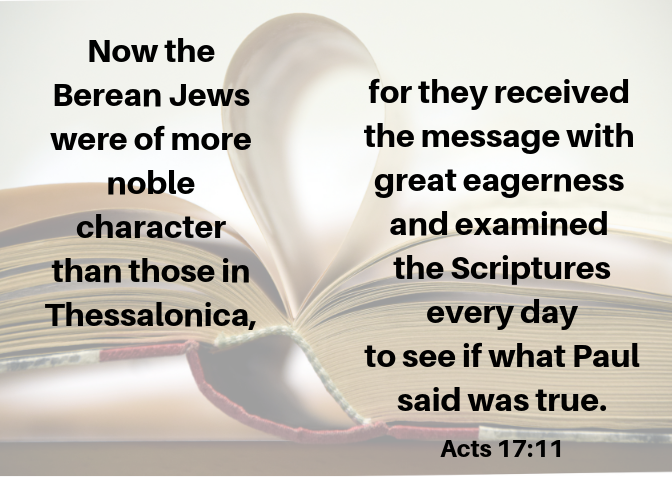
Do you do your homework? This may seem like an odd question to be asking but that’s exactly what the people in Acts 17 were commended for doing. When Paul and Silas went to a place called Berea they were teaching the word of God to people in the synagogues. The people had never seen the scriptures in the light that Paul and Silas were teaching it to them, they had never recognized the truths that were being shared. So rather than just believe what they heard they went ahead and studied it in the scriptures for themselves to see if what Paul and Silas were saying was true. Essentially they were ‘doing their homework’. They found that what was being taught was true and so came to salvation. We refer to them as the Bereans. The term may sound familiar to you as many church youth groups have held the name Berean in their names. This is a reference to that noble group that studied the scriptures for themselves to see if what they were being taught was true.

In our society today there do not seem to be enough people who display Berean like qualities of ‘doing their homework’. Why were the Bereans noble – because they searched for the truth and they found it! Truth is important to us, but today the truth seems more, and more difficult to unearth. There are many newscasters, commentators, teachers, and yes preachers too who would all benefit from doing a little more homework before presenting information to the public. This would prevent a whole host of misinformation from circulating about. Many people would be better able to discern the truth if they did their homework. If you know the truth of a matter then you will less likely fall for anything false. We should all strive to be like the Bereans and desire to know the truth for ourselves, through diligent research especially when it comes to the word of God!

-Pastor Merry Peterson

Today’s Bible reading passages can be read or listened to at BibleGateway here – 2 Samuel 15-16 and Acts 17

Be a Berean

ACTS 17

acts 17 11

In Acts 17 we see three very different cities and their different responses to the Gospel.

Thessalonica hears the word and some Jews and a lot of Greeks believed.  But other Jews did not like how Christianity changed their culture. They liked the status quo and therefore used their influence to stir up trouble for Paul and got him kicked out of the city.  Similar to the rich young ruler there are some people that are very happy with life as it is and just cannot accept the changes required to follow Christ and will fight it tooth and nail to hold on to their old lives.  We cannot hesitate and look back when we follow Christ.


Berea is very different.  The Jews there hesitated when they heard Paul’s message, but they studied the scriptures and saw that Jesus did indeed fulfill the prophecies and they believed.  It is very important that we seek out truth and question things that we hear and compare them to scripture. There are too many people in the world today that hold a certain belief just because their pastor or their denomination told them so.  Those people might be right and might have a lot of wisdom and knowledge to pass on, but at the end of the day I am the one that is responsible for my own salvation and I need to know that what I believe is the truth. Deep study is a great way to make your faith your own.


Lastly there was Athens, which had been a hub of culture and ideas for hundreds of years and had idols of many different gods from many different cultures.  The Athenians knew that God was out there, but they were searching for him in all the wrong places. There are many people around us today that similarly feel a need for something more in their lives, but instead of finding the one true God they fill that void with idols.  Those idols come in many different forms such as jobs, significant others, money, or belongings. Even though the Athenians were searching in all the wrong places at least they were searching and were therefore open to listening to Paul’s message. I think that Athenian culture is one of the most similar cultures from Bible times to our culture today, and I think that God is likely similarly unhappy at the number of idols that we have placed in our lives.


So, to conclude, I would encourage you to let go of your old life, study the scriptures and make them your own, and remove the idols from your life.  If we can do these things then we can consider ourselves to be of noble character like the Bereans.

-Chris Mattison