Giving the Good Stuff

Acts 20:35 NASB

Old Testament: Numbers 5 & 6

Poetry: Job 6

New Testament: Acts 20

I would like to start off this post with a short introduction.  My name is Ruth Finnegan and I am married to Sean Finnegan and we have four sons, who range from age 11 to 1 month old.  It is my joy and pleasure to be a stay-at-home mom!  When Sean and I first got married we had a lot of discussion about “how are we going to be.” We decided to set a few tenets or standards for our life together.  These were:  seek righteousness; don’t be cheap, tip generously, only use good toilet paper, and be given to hospitality.  Recently, I went to the store to stock up on toilet paper and they were out of our usual brand.  I bought a cheap package to tide us over until I could go to the store again.  Oh man! Mistake!!  Sean started declaring, “Have we lost all of our principles?? What is this, sandpaper?! Should we stop tipping too?” I burst out laughing when he said this because I was instantly brought back to that conversation early on in our marriage.  I went out and bought good toilet paper for the house and got rid of the cheap stuff.

Sean and I have been married for almost 14 years and we have always been passionate about being given to hospitality (Romans 12:10).  Over the years, we have had many people come stay with us.  Some come for just a night and some for many months.  We feel that God has given us much and blessed us abundantly and that it is our joy to bless others with our home (and with our good toilet paper).   I have found that you discover a lot about people when they stay with you in your home.  I thought about this as I read Acts 20:17-38.

When Paul was in Ephesus, his mission was certain.  He served and lived among the people, he kept back nothing, teaching them “repentance toward God and faith toward our Lord Jesus Christ” (Acts 20:21).  Paul was a true shepherd who cared for his flock and was very clear about his purpose.  He made sure that he was not a burden.  He took care of himself and those with him and he used every opportunity to teach and shepherd the flock there.  He truly cared for people and genuinely wanted the believers to be protected from the wolves that were sure to come.  Paul knew he had to leave and wouldn’t see them again.  He implored them with these final words:

35 In everything I showed you that by working hard in this manner you must help the weak and remember the words of the Lord Jesus, that He Himself said, ‘It is more blessed to give than to receive.’”

And with that, he knelt down with them and prayed for them.  When Paul left, they did not breathe a sigh of relief because he had inconvenienced them.  No, they had deep sorrow in their heart because he had been a blessing to them.

We have had people stay with us that were all about what they needed or being served so when their time of departure came, we were thankful!   We have also had the pleasure of having guests that infused our home with light and eternal blessings!  They had eyes to see and wanted to be a blessing and help.  When we go about our lives and come into contact with others, let’s strive to be like Paul.  He was all about teaching the eternal things of life like the Kingdom of God.  He was not a burden but a blessing to the believers and sincerely cared for them.  He didn’t complain about his lot as a missionary, he was driven by the holy spirit even when it came to his own discomfort and sacrifice.  Let’s strive to encourage others and remember it is more blessed to give than to receive!

-Ruth Finnegan

(Originally posted for SeekGrowLove on June 10, 2017 – today, Ruth and Sean’s boys are much older and taller. But I bet the whole family still enjoys using, and giving, the good toilet paper.)

Reflection Questions

  1. How would you describe how Paul gave? What was he giving?
  2. When have you found it to be true that, “It is more blessed to give than to receive?” What has been your favorite thing to give?
  3. Where are you challenged to give more freely? What will you give this week? How?

Make it Spread and Grow

xr:d:DAF-jOL4x5w:6,j:901140544355471458,t:24030412

Old Testament: Numbers 3 & 4

Poetry: Job 5

New Testament: Acts 19

What stands in the way of you living completely committed to God?  Time management problems, a secret (or not-so secret) sin, a preoccupation with _______, a friend taking you in the wrong direction? Many in the early church in Acts were living out a completely committed relationship with God and His Son, Jesus. And the results are exciting to watch as we read through the book.  Their faith was living and active and daily – and tested regularly.

I wonder if today too many people who carry the label ‘Christian’ use their faith as a once-a-week booster shot, if they can make it to church that week.  But then are quite content to spend the week surrounded by (and sometimes covered in) the germs and sicknesses of worldly living and priorities.

When you read Acts 19 search for all the sold-out characteristics and examples; and while you’re at it – spot the imitations as well (those exist today, too).  I particularly like the passage in verses 18-20 where the believers were confessing their practices and bringing their (expensive) magic books to be burned.  They had heard about Jesus and they believed and they were excited and ready to change!  It’s not that they had heard about Jesus and kind of believed and were sort of interested and wanted to add in some Jesus/church/faith to their already full lives.  See the huge difference?  They were radically changing their lives because they wanted to follow Jesus well.

Do you have anything in your life to add to the bonfire?  Anything that is keeping you from being totally committed to God and His Coming Kingdom?  Anything that doesn’t mix well with Jesus’ message that you need to give up?

The believers burned 50,000 drachmas worth of obstacles to living sold-out lives (a drachma was a silver coin worth about one day’s wages) – that’s a lot of obstacles they eliminated!  The very next thing Luke wrote was: “In this way the word of the Lord spread widely and grew in power” (Acts 19:20).  Sacrifice and true change brought growth. Are you ready to grow?

-Marcia Railton

(Original devotion posted for SeekGrowLove on April 19, 2018)

Reflection Questions

  1. In your reading of Acts what do you find impressive about the early church?
  2. What in your life is keeping you from living totally committed to God and His Coming Kingdom? What do you have to confess? What do you have to add to the bonfire?
  3. What changes can you make in your life that would help the word of the Lord to spread and grow in power?
  4. What does your church already do that is similar to the actions of the early church? How can you help your church look more like the early church?

Saying Goodbye

Theme Week: Paul in Review: Acts 20

Old Testament: Job 40-42

Poetry: Psalm 48

            Goodbyes are hard.  This week I gathered with a lot of people that I love.  First at General Conference in Oregon, IL.  I was gathered for 3 days with people that I love.  Some are my biological family- My Mother, sisters, brother-in-law, uncle, cousins, sons and daughters, and sons and daughters-in-law and grandchildren. My wife was also there, while not biologically related she is my family and the one I love most in this world.  Then there were friends, fellow members of the Church, pastors, and other. Colleagues, people I’ve met through years of ministry.  Some I’ve known for over 40 years and they are part of my extended Church family that I love as brothers and sisters.  At the end of our conference, it was time to say goodbye.  I hope to see all of them again, but realistically, some of them I may never see again in this age and that makes me sad.

            Right after the conference we had another gathering, a family gathering to celebrate my mother’s 90th birthday.  We had family come from across the US and across the world including my daughter from Germany and niece from New Zealand.  I saw cousins I had not seen in over 40 years and met their grandchildren.  We had a wonderful celebration.  But then we had to say goodbye as we all left to return to our various homes.  It will be months and years and possibly for some we will never see each other again in this age, and that makes me sad.

            What if you knew you would never see a group of people that you love again?  What would you be thinking about and wanting to say as you said goodbye to them?

            In Acts 20 the Apostle Paul is saying goodbye to a group of leaders from a Church he helped build in Ephesus.  He had spent three years of his life teaching, baptizing, training, encouraging, and correcting these people.  He loved them as brothers and sisters.  God had revealed to Paul that he would never see these people again in this age, and that made him sad.  As he said goodbye to them he gives us some insight into what things were important to him and how he had lived when he was with them and encouraged them to continue in the faith.

            Paul reminded them, and us, how he served the Lord.  Paul had been religious all of his life.  He was an observant Jew who faithfully abided by all ceremonial and purification rituals of the Jewish faith.  He was a descendant of Abraham through Jacob and a meticulous observer of the Torah, which is the Old Testament Covenant Practices.  Yet all those things didn’t get him to where he truly wanted and needed to be.  Something was missing.  That something, as it turned out, was a relationship with God as His father that was given as a gift of grace through entering into a covenant with God by faith in Jesus Christ.  Out of that new relationship with God through grace by faith in Jesus Christ came Paul’s understanding of himself and his mission.  Everything he did was in service to the Lord.

            Paul served with humility.  He knew that his call and commissioning did not originate with him and was not based on his merit but on God’s grace.  While he was not shy about claiming and using his authority as one sent by God (an apostle) Paul used that authority humbly.

            Paul did not serve God at a distance.  He was down in the front lines of battle where the true spiritual warfare was taking place.  Paul was often harmed both emotionally and physically.  He reminds his hearers that he served them with tears and trials.

            Paul discipled them by teaching a total way of life in Jesus Christ.  His teaching was not detached and theoretical, but practical.  Paul says that he taught anything profitable (vs. 20 ESV). Paul taught the whole counsel of God (vs.27). He didn’t just talk about a few narrow subjects that were most important to him.  For Paul following Jesus Christ impacts every area of your life.  There is no sacred vs. secular, religious vs. non-religious.  Jesus Christ is just as much a part of your schooling, your job, your friendships,  your marriage, your family, and your sex life as he is part of what you do at 11:00 on Sunday Mornings.

            Paul carried out his service for Christ in both public and personal spaces.  Whether he was in a large, organized group or in someone’s private home with one or two persons, Paul was about his mission.  In those spaces Paul emphasized the importance of repentance (turning away from sin and turning toward Jesus Christ as Lord), Paul emphasized faith as a way to access Jesus Christ.

            Paul placed his whole person into his service.  He was passionate in offering admonishment (correction) with tears. (Vs. 31).  Training others in following Jesus Christ includes a lot of encouragement and positive reinforcement, but it also includes the hard work of correcting both incorrect beliefs and behaviors.  Paul elsewhere talks about “speaking the truth in love.”  There is a loving way to speak even hard and corrective truth, but it is hard work and Paul did not shy away from hard work.  Paul reminded them of the many ways that he worked hard among them.

            Paul concludes his parting words by showing the value of working hard to help the weak.  The Christian’s job is not to shame the weak or guilt the weak, it’s not to judge the weak or berate the weak, but to help the weak.  This requires a great deal of altruistic love and willingness to patiently and sacrificially give.  Paul concludes with a reminder of Jesus’ own words on the value of giving over receiving. (Vs. 35).

            At the end of this passionate reminder of his life and teaching among them, they are all in tears as Paul gets down on his knees with them and prays.

-Jeff Fletcher

Reflection Questions

  1. If you were preparing to say goodbye to your brothers and sisters in Christ, what would you want to make sure they heard from you?
  2. What are you most impressed with what Paul shares with the Ephesians?
  3. What do you think Paul might say to your church if he was saying goodbye to you instead of the Ephesians?

The Last Time

Old Testament: 2 Samuel 19 & 20

Poetry: Proverbs 26

New Testament: Acts 20

     Paul chose to bypass Ephesus based on an urgent drive he felt to be in Jerusalem for Passover, a drive that may have come from God more than himself. He describes himself as “bound by the Spirit” or “bound in spirit” – he is aware the bonds and afflictions await him, but he is not sure that death is near. But he is sure he will never see the Ephesians again. But Paul arranged to meet the church leaders from Ephesus and gave some words of encouragement and warning (Acts 20:18‑35). It is hard to imagine how that meeting must have affected them. A man who basically shaped their community through years of teaching and healing and tears now said he would never see them again, and that some of them would not remain true to the faith. Their greatest concern remained the loss of Paul. They loved and valued him. The news about their future must have been stunning, maybe even sickening, but what could be done? They had already faced opposition. They may even have anticipated that not all who claimed the name of Jesus would stay true to him. But such concerns had to be for later days.

     I wonder what further meanings they drew out of Paul’s words when they looked back on them, not simply as his closing thoughts about his own ministry, but as a commendation about their ministries. Some of his words are so poetic, or they seem so to me: “I testify to you this day that I am innocent of the blood of all men.For I did not shrink from declaring to you the whole purpose of God.” (v. 26-27). Looking back on it I think this may have seemed less a description of Paul’s own life and more a call to them of danger, for if he was innocent for not shrinking from the task, then that raised the threat that some of them who did so might be condemned for doing so. The image Paul offers of leaders becoming corrupt and seeking to build up themselves is an awful one. I would wish it was presented as a warning to them, something to be avoided, but as with Judas this was simply a prediction.

     A note on Acts 20:28: I prepared these devotions mainly using the 1995 NASB, which has the phrase “the church of God which He purchased with His own blood.” Clearly there is a problem here, as God doesn’t have blood. Meanwhile you might have seen this NRSV wording: “the church of God that he obtained with the blood of his own Son.” Or perhaps you read the American Standard Version: “the church of the Lord which he purchased with his own blood.” Why do these differences exist?

     You may know that the Bibles we read aren’t translated from a single master copy of the Bible in Hebrew and Greek (with a few chapters’ worth of Aramaic). It would be unlikely for a book on paper or papyrus to survive from the first century to today. Instead we have copies of what was written then. And it isn’t easy to prevent all confusion when copying by hand. You could always make just one copy and destroy the original – but that doesn’t remove all risk of errors, though it removes the ability to check if there were any. F.F. Bruce was a well-known Greek scholar, he wrote: “For Caesar’s Gallic War (composed between 58 and 50 B.C.) there are several extant manuscripts, but only nine or ten are good, and the oldest is some 900 years later than Caesar’s day.” People don’t tend to question the text of Gallic War. The text may be wrong if the error got in long enough ago, but we just aren’t going to know.

     The Bible was intended to be spread widely. And because the Bible was used so widely and copied for people in so many parts of the world we have lots of copies, way more than for most things – about 5,800 Greek manuscripts of the New Testament. Having those different manuscripts meant they would get looked at, by language experts who wanted to know if they differed and how they differed. As it turned out almost none of the differences matter. The Church historian Philip Schaff (1819‑1893) wrote that in his time he was aware of only 400 New Testament variants that affected the meaning of a passage, and of those only 50 were of any significance. He didn’t think that any of the 50 rose to the level of affecting an “article of faith” (Companion to the Greek Testament and English Version, p. 177). The figures may be higher now, but it still isn’t something to lose your faith over. There are books (I have one) where committees of language experts evaluate the differences and what they think the situation is for each one.

     Back to Acts 20:28, it is an interesting case for involving two options. Is the issue that the text was changed at some point to say “Church of the God” rather than “Church of the Lord” – maybe because that phrase was more common in the Bible and the copyist thought it was what Luke originally wrote? Or at the end of the sentence was a reference to “son” dropped, changing what would have said “blood of his own son”? You can see here what Philip Schaff was getting at. Everyone agrees that Paul was trying to talk about Jesus here, not the Father, and that something got garbled in some of the manuscripts. It is not clear which of the manuscripts has the original intention, but this is not a big issue of doctrine.

     The matter of manuscripts and translation history can be fascinating, or it may quickly seem overwhelming. Rest assured it is not an area you normally need to concern yourself with if you are not interested in it. (For myself, with my history as an editor, it bothered me that the NASB had not addressed the issue in the verse even with a note.) As one more detail on this history, by the year 600 the gospels had been translated into nine languages. The Gospels were usually the first written literature of these languages. People were creating written forms of their languages just to better spread the news of Jesus to their people. I find that beautiful.

Dear Lord, thank you that you allow us to know about Paul’s struggles, and not just his successes. Help us to be more open with each other about our weaknesses, our tears, our losses. Let us be willing to admit that we need each other. It is more blessed to give than to receive, but if we don’t admit how much we need to receive sometimes people will not know to reach out. And help us, at least, who know that we are weak, to recognize that as a real possibility for others and offer them support and compassion and patience and time. We are not always hurting, but it is hard to make up for missing the opportunity of helping a hurting friend. So let me be more aware, more attentive. Let me listen with your son’s ears. And help me to speak with his words more often. Thank you, Lord. I love you. In Jesus’ name, Amen.

-Daniel Smead

Questions

  1. Why do you think Paul valued meeting with the Ephesian elders? What are some things he may have been hoping for with the meeting?
  2. If you were among the Ephesian elders warned that some of the group would turn against Jesus, what do you think your reaction might be? Do you think that Paul’s statement may have changed how many elders fell, rescuing some?
  3. What do you think the Ephesian elders did when they returned to Ephesus? What kind of message did they have to tell the regular members? How soon?
  4. Did the discussion of manuscripts and translation leave you confused? If so, I’m sorry, email me with your question (danielsmead1993@gmail.com).

A Farewell

ACTS 20

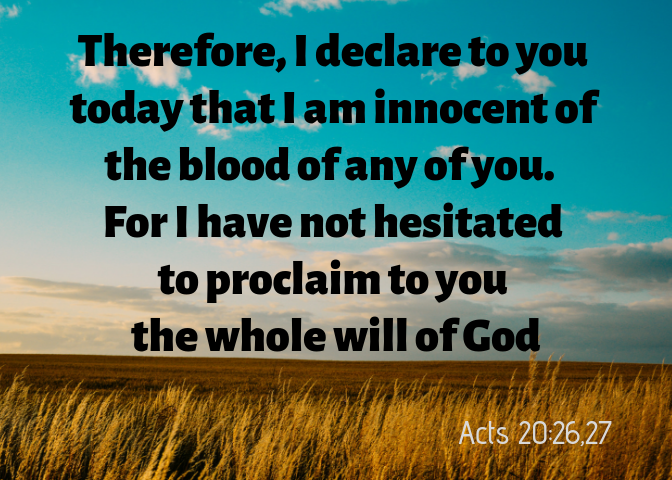
acts 20 26 27

In Acts 20 Paul travels around some more, and is heading towards Jerusalem, but on his way he meets with the Ephesus elders one last time to talk to them and encourage them.  He knows that God’s plan for him will not bring him back to Ephesus and that he would never see them again. He had spent three years with them and knew that they would be a strong pillar in the growing Church and he wanted to make sure that they would be okay.  The Church had come under attack from the Jewish communities and from the government many times during Paul’s ministry and he knew that would continue, so he wanted to prepare them. He knew that those who would come after and try to lead them astray would try to attack him personally in order to get the Christians at Ephesus to doubt him and his message, and therefore their own faith.  Paul reminds them that at all times when he was with them he took care of his own needs, and did not profit off of them in any way and only cared about their spiritual well being.


One of the biggest detractors in the Christian faith is hypocrites.  How many times do you hear about the pastor at a church somewhere being involved in a scandal and then the church folding or many of the people walking away from the faith.  As Christians we are held to a higher standard and when we do not live up to that standard it affects any who look up to us as a role model. Paul’s ministry was successful and had a deep impact on all of western culture because he preached boldly, and he backed it up with a righteous life.  This is also why you need to make your faith your own. People will invariably let you down at some point, but Jesus is a rock on which you can build your life. Of course it is good to have role models, but know that they are only human.

-Chris Mattison