
Gotcha!

Joshua 9-11

When the inhabitants of Gibeon heard what Joshua had done to Jericho and Ai, they acted deceptively. They gathered provisions and took worn-out sacks on their donkeys and old wineskins, cracked and mended. They wore old, patched sandals on their feet and threadbare clothing on their bodies. Their entire provision of bread was dry and crumbly. They went to Joshua in the camp at Gilgal and said to him and the men of Israel, “We have come from a distant land. Please make a treaty with us… Then the men of Israel took some of their provisions, but did not seek the LORD’s decision. 15 So Joshua established peace with them and made a treaty to let them live, and the leaders of the community swore an oath to them. Joshua 9:3-6;14-15  (CSB)

“Be skeptical of everyone, including the skeptics”. I don’t know where this quote or phrase came from, but I often find myself in that mindset. Why? Because of stories like this. There are those out there who would try to deceive and use this deception to take advantage of others. I used to get calls and emails all the time at the church from people who were looking for money to help with something. There was always a story about why they were in this tough situation. The second half of that quote also resonates because sometimes people just like the status quo or throw cold water on other people’s ideas.

Maybe some of those people were deceptive, and maybe some of them were genuine. I don’t know. What I do know is that there were occasions where I would try to give something, but there were times that I did not. I did my best to discern who was authentic, but I couldn’t really know. What I could do was pray about it and see if God gave me a push in one direction or another, but if he didn’t, I’d need to make a choice. In situations of meeting needs or requests, you can’t help everyone, we have finite resources. I do think it is important not to be dismissive of every request because there are people who genuinely have needs and come to churches as a last resort.

When the Gibeonites came to Joshua and the men of Israel, they did their best to pull one over them, and it worked. The leadership did appear to be skeptical and questioned the Gibeonites, but they neglected to check with something powerful that they had at their disposal: access to Almighty God! Rather than checking on what God wanted them to do, to seek wisdom in this situation that some of them even thought might be a little fishy, they made a knee-jerk decision and swore a treaty to do no harm.

Don’t you think that it would have been wise to consult God when there were treacherous peoples all about the land? The Gibeonites got their protection, but they found themselves indentured to the Israelites because of their shenanigans. I guess that beats death? Some might disagree.

When faced with big decisions, we should come before God and seek wisdom. Especially when we are the leaders of his institutions. Whether leading the Israelites four millennia ago or leading in Christ’s Church today, when we face big decisions (skeptical about what is going on or not), we must always ask what God would have us do. We have scripture to guide us, as well as the Spirit of God that will guide us when we are earnestly seeking after him. When we see leaders fall or make ruinous decisions, we can probably rest assured knowing that they did not honestly seek God’s will and input for that decision. Unless God is intent on making a statement with you like he did with Hosea, he is not going to tell you to make decisions that would be considered dubious by wise observers.

-JJ Fletcher

Reflection Questions

  1. Can you think of a time that not seeking God’s decision burned you? How did you respond or recover after?
  2. Do you find yourself to have a healthy level of skepticism, or do you often find yourself being a bit too Pollyannish? Is there value in both? What are some of the drawbacks of each of these traits?
  3. Do you think Joshua and the leaders learned something from this experience?
  4. How do you think it best to navigate people who are too extreme on the scale of being too trusting or distrusting? What can we do to be a good emissary of Jesus in those situations?

Choose Life

*Old Testament Reading:  Deuteronomy 29-30 

*Poetry Reading:  Job 42

New Testament Reading:  Romans 10

 “Therefore choose life, that you and your offspring may live” – Deuteronomy 30:19b (ESV)

In chapter 42, Job again responds to God.  He is humble, accepting that he cannot understand God nor His ways.  He repents for speaking about what he doesn’t understand.  He responds just as God wanted him to, in humility. 

Job’s friends first made their appearance in Job 2.  They “made an appointment together to come show him sympathy and comfort him” (Job 2:11b).  The first thing they did was an outward display of sharing his pain (wept, tore their robes, sprinkled dust on their heads).  Then they just sat with him.  In silence.  For seven days. 

If you’ve been reading along in Job, you have heard their advice.  Much of it sounds good.  Much of it would likely be great advice in a different situation.  Their focus was on what Job had done wrong to incur God’s wrath.  They couldn’t see any alternative to Job’s suffering.  Yet they gave up their silence and tried.  They did their best, but it turns out, they were wrong.  And God wasn’t about to let them get away with it. 

We’ve all been there….sitting (in person, via text, on social media, over the phone, etc.) with a suffering friend not knowing what to say.  Eventually, the silence drives us to speak.  Our desire to help is strong and pushes us to try to solve the problem, to figure out the “why” so they can fix it, or at least understand it.  Our hearts are in the right place.  I think Job’s friend’s hearts were in the right place, too.  They wanted to help. 

God says that His anger burns against them and that they haven’t spoken of Him what is right.  I don’t want to be in that place with God.  While He does offer them a way out – a way to repent – it is humbling, and likely even humiliating.  They thought they were offering good advice to their friend and now they have to humble themselves and ask him to pray for their misspeaking. 

What can we learn from this exchange?  First, reaching out to a friend who is suffering is good.  Sitting in silence is good, too.  But what I take away from this is that we need to seek God before we respond on His behalf.  Before we tell someone what God would have them do, we should ask God.  That can be in prayer or in reading His Word.  Someone once said that God will never contradict His Word, so whatever you “hear” him saying, cross-check it in the Bible. 

And a quick dip into Deuteronomy for some great thoughts to meditate on today…

Deuteronomy 29:18b-19a says, “Beware lest there be among you a root bearing poisonous and bitter fruit, one who, when he hears the words of this sworn covenant, blesses himself in his heart, saying, ‘I shall be safe, though I walk in the stubbornness of my heart.”

Deuteronomy 30:19-20 says, “I call heaven and earth to witness against you today, that I have set before you life and death, blessing and curse. Therefore choose life, that you and your offspring may live, loving the Lord your God, obeying his voice and holding fast to him, for he is your life and length of days, that you may dwell in the land that the Lord swore to your fathers, to Abraham, to Isaac, and to Jacob, to give them.”

I think Job chose life.  Even though he didn’t do anything really big to sin, God called him out on his attitude and words.  He didn’t bear poisonous and bitter fruit and he didn’t hold on to his stubborn heart.  He humbled himself. 

Amy Blanchard

Reflection Questions

  1. Do you know a friend who is suffering?  What can you do to help them?  Remember to start with asking God.
  2. Do you have a stubborn heart that thinks you’ll be safe from God’s wrath?  Consider what choice you are making – life or death, blessing or curse.  Remember that your choice not only determines if you will dwell in the land of God’s promise, it also affects those following you – don’t make it harder for them to choose life and blessing.

Revival

Joshua 9-11

inquire of the Lord

The Israelites have had success after success in conquering the Promised Land.  But they did have the setback due to Achan’s sin, and in chapter 9 they have another setback.  The Gibeonites trick Joshua into granting them a treaty, on the premise that they are not locals, and so will not be in the way of the Israelites’ expansion plans.  You have to hand it to the Gibeonites.  This was a very shrewd move for them, and did grant them their survival.


But this should never have happened, and doesn’t seem to be part of God’s plan, when in other inhabited areas, the entire existing populations were destroyed.  So why did it happen?


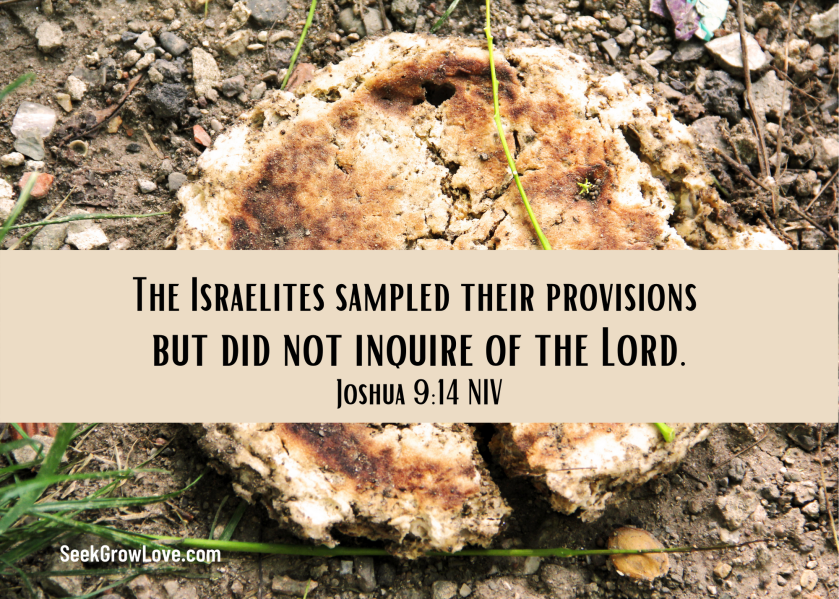
As part of the ruse, the Gibeonites provided evidence of their long journey to reach the area in the form of old wineskins, bread and sandals.  Then, in chapter 9, vs 14-15, “The Israelites sampled their provisions but did not inquire of the Lord. Then Joshua made a treaty of peace with them to let them live, and the leaders of the assembly ratified it by oath.”


And there you have it.  They did not inquire of the Lord.  How foolish they must have been.  How could these people, that had been clearly led by the Lord, abandon His counsel at this critical time?  The answer is because they are like you and I.  Human.  Unfortunately, great success gives rise to self importance and self reliance, instead of giving God the credit He deserves and then continuing to rely on Him.  We have probably all done it.


When times are easy, it is easy to let our relationship and reliance on God slip away.  That is a bad thing.  We are going through difficult times right now.  That is also a bad thing.  But in times like these we need to draw closer to God, seek His counsel, and draw strength from that relationship.  And that is a good thing.


There was a small revival in this nation after 9/11, with a large increase in church attendance.  But, as things improved, it wore off.  Things will assuredly get better from our present reality, but if there is a revival in our own relationship with the Lord, that is a fantastic outcome.  But don’t let that revival slip away when things get better.  Be aware that it is human nature for that to happen, and take steps to avoid allowing your human nature to lead you away from God.


Here is another word of encouragement from scripture.

Psalm 91: 1-6

Whoever dwells in the shelter of the Most High

will rest in the shadow of the Almighty.

I will say of the Lord, ‘He is my refuge and my fortress,

my God, in whom I trust.’ Surely he will save you

from the fowler’s snare

and from the deadly pestilence.

He will cover you with his feathers,

and under his wings you will find refuge;

his faithfulness will be your shield and rampart.

You will not fear the terror of night,

nor the arrow that flies by day,

nor the pestilence that stalks in the darkness,

nor the plague that destroys at midday.


Greg Landry


You can read or listen to today’s Bible passage at https://www.biblegateway.com/passage/?search=Joshua+9-11&version=NIV

Tomorrow’s reading will be Joshua 12-15 as we continue seeking God through the 2020 Chronological Bible Reading Plan