We read yesterday about how our fellowship with each other gives us an opportunity to help one another become more faithful in our walks with God.
Proverbs 27:17(NLT) As iron sharpens iron, so a friend sharpens a friend.
Now we also see wisdom that encourages us to take the long view of the things that we do. God has a plan that spans centuries and generations. Here in Proverb 27 Solomon shows us that we are to work and think with the goals of tomorrow and a new generation in mind.
Proverbs 27:23-27(NLT) Know the state of your flocks, and put your heart into caring for your herds, 24 for riches don’t last forever, and the crown might not be passed to the next generation. 25 After the hay is harvested and the new crop appears and the mountain grasses are gathered in, 26 your sheep will provide wool for clothing, and your goats will provide the price of a field. 27 And you will have enough goats’ milk for yourself, your family, and your servant girls.
Could you put this proverb into a modern form and provide a current event comparison about investments and future outcomes?
In Proverbs 29 we find much wisdom about nations and rulers alternated with practical advice about children, jobs and possessions. Proverbs has a poetic form which is different from the way that we mostly write today. This rhythm and phrasing make it easier for the people to remember and recite. Most of the faithful of that time memorized the Word and were able to speak it when needed. We are spoiled by written Bibles and internet search engines to find the verses that we look for.
Proverbs 29:2(NLT) When the godly are in authority, the people rejoice. But when the wicked are in power, they groan.
Proverbs 29:4(NLT) A just king gives stability to his nation, but one who demands bribes destroys it.
Proverbs 29:12(NLT) If a ruler pays attention to liars, all his advisers will be wicked.
Proverbs 29:14(NLT) If a king judges the poor fairly, his throne will last forever.
Proverbs 29:16(NLT) When the wicked are in authority, sin flourishes, but the godly will live to see their downfall.
-Tom Siderius
Reflection Questions
How do these verses give simple instruction for complex questions of rulership and authority?
Could we write them in a modern version to say the same truth to our country and generation?
& See Bold Question Aboveabout Proverbs 27
Praying God is with you today and this wisdom gives you light to guide your feet and path.
In today’s reading, we see more examples of Saul’s rebellion against God and his hatred of David. Ahimelech the priest had inquired of the Lord for David. In his rage, Saul ordered that not only Ahimelech, but all the priests must be killed – so Doeg the Edomite, one of Saul’s goons, killed 85 priests, then went to their town and killed every man, woman, and child (and its cattle, donkeys, and sheep). In chapter 23, Saul chased David and tried to kill him multiple times.
In chapter 24, David finally has his opportunity for revenge. Saul was again chasing David. David and his men were hiding in the Desert of En Gedi. Saul and 3000 chosen troops were in hot pursuit. Along the way, Saul needed to go to the bathroom. He wanted a little privacy, so he stepped into a cave to relieve himself. Little did he know that David and his men were hiding further back in that very cave.
If you were David, what would you have done? Would you have eliminated the threat to your life, and ushered in your reign as king? To be perfectly honest, I think that’s exactly what I would have done. David’s men encouraged David to kill Saul, but instead, David crept up to Saul, and cut off the corner of Saul’s robe.
Afterward, David was conscience stricken and said, “The Lord forbid that I should do such a thing to my master, the Lord’s anointed, or lift my hand against him; for he is the anointed of the Lord.”
Wow! Clearly Saul was a scoundrel, but David spared his life because God had made him king. I think we can learn a lesson or two from David’s respect for the office of authority, even when the man in the office wasn’t worthy of respect.
This is exactly what we’re told to do in 1 Peter 2:13-14 – “For the Lord’s sake, submit to all human authority—whether the king as head of state, or the officials he has appointed. For the king has sent them to punish those who do wrong and to honor those who do right.”
David’s actions also remind me of Romans 12:17-18 – “Never pay back evil with more evil. Do things in such a way that everyone can see you are honorable. Do all that you can to live in peace with everyone.”
So too, we need to submit to authority, even when we don’t like the person in authority, or what they are doing. Also, we need to be intentional about never repaying evil for evil.
To finish today’s story, because David had spared Saul’s life, Saul promised to leave David alone, and returned home (for now). David and his men went up to their stronghold. God had protected David yet again.
Steve Mattison
(originally posted April 13, 2020 for SeekGrowLove)
Reflection Questions
What do you admire about David?
When have you found it difficult to pass when given the opportunity for revenge, a cutting comment, or having the last word? What is the world’s position on paying back evil for evil? What is God’s? What is the advantage to leaving it up to God to be the judge, rather than taking out revenge for wrongs done against us?
In what ways do you think God wants to see Christians submit to authority today?
Ecclesiastes chapter 9 ended with an expression of the power of foolishness: “Wisdom is better than weapons of war; but one sinner destroys much good” (9:18).
Here in verse 1, the premise of 9:18 is now carried forward. The principle that is being addressed is that a little bit of a bad thing (e.g., foolishness) can completely ruin a good thing. The modern saying “A fly in the ointment” contains the same wisdom and is used to represent how something small (or seemingly insignificant) can have a powerful or far-reaching effect. There are many small things that can produce a powerful effect.
We have another modern proverb to convey the same idea, “One rotten (bad) apple spoils the barrel.” This is a truism as we now know because of microorganisms (e.g., mold, bacteria, yeast), which tend to have a permeating effect. Once they are introduced, they will continue to spread until they have affected every part of the substance and adjacent substances.
Foolishness and sin are often likened to a foul stench, such as Proverbs 13:5—“A righteous person hates a deceptive word, but a wicked person will become a stench and display his shame.” Clearly the “stench” in Proverbs 13:5 is the speech (i.e., words) of the wicked person (i.e., fool). What Solomon has in mind is likely the words of the “sinner” in 9:18, not just the person. Thus, what he is saying is that it only takes a few foolish words to bring about a whole world of destruction. Furthermore, a fool cannot conceal their foolishness, but clearly demonstrates it each time they open their mouth or do anything.
While a ruler or person in authority is not immune to foolishness, verse 4 does not seem to be closely connected with the previous verses but offers advice on how to act in the presence of those with authority. Previously, Solomon had advised that a person follow the command of the king and not argue with him (8:2-9), it seems that he is saying the opposite here. However, the present context is not about opposing the king, but how to deal with him when he is angry with you. To walk out on the king in his anger will only incite him to be even more angry with you. Rather, Solomon suggests to change how you interact with him; it is wise to use a “calm” demeanor, as that can reduce his anger and offense against you.
Part of Solomon’s observational dilemma is that what he sees in the world is perplexing and out of order with what he thinks should be the case. When he sees, “Foolishness is set in many high positions, while the rich sit in a low place. I have seen servants on horses while officials walk on the ground like servants.” The point of Solomon’s examples is to say that if foolishness is in charge, then the world will be upside down and wisdom won’t work as expected.
In another way of looking at the world, Solomon notices that things can happen to the best of us (i.e., skilled and knowledgeable in their craft). One way to see Solomon’s point is that being a skilled expert does not remove all potential danger or guarantee success. The other way is that a skilled expert will fail if they don’t properly apply their knowledge.
Foolishness has a progression to it. The beginning is foolishness (v. 13), but the foolishness deteriorates the situation into becoming “hurtful madness.” Foolish words harm both the speaker and the listener, but a fool is oblivious to this. It seems that the fool has a false perception of understanding or control over life that they don’t recognize how they are stumbling further into foolishness and disastrous consequences.
The delusional consequences of the fool are further elaborated by depicting him as forgetting how to go to a city where he presumably works or needs to go to sell goods. The effort of the fool is compounded by the fact that he does not even have the basic understanding of how to carry out business. And thus, the fool’s effort must be multiplied because of his lack of sense about where he needs to go. To run a successful industry requires knowledge about trade and commerce, and the fool is deceived into thinking they can be successful without it.
If a foolish leader will bring about disorder and chaos, in vv. 16-17 Solomon now contrasts the consequences of foolish leadership with the advantage of wise leaders.
Solomon identifies in verse 16 two detrimental qualities of leadership: being immature and being neglectful. “Feasting in the morning” implies that when leaders should be tending to the business of the kingdom (i.e., in the morning), they instead are reclining to eat. This does not refer to breakfast but a large-scale banquet typically involving entertainment, music, and drinking wine.
The concluding phrase of verse 19 might be the most difficult of the chapter. On the surface, the verse seems to be advocating a sensual lifestyle of eating, drinking, and using money to satisfy one’s desires and enjoy the luxuries of life.
While the phrasing is a little difficult and the Hebrew offers a high degree of latitude in meaning, it seems that what Solomon is affirming is the need to have money in order to buy food and wine and other provisions for enjoying the simple aspects of life that Solomon has been endorsing all along.
Solomon closes with a warning about how to conduct oneself in the presence of a king (or any authority figure). He warns about the dangers in cursing the ruler or person in authority, even in one’s thoughts or “sleeping chamber” (i.e., in secret). The point of the warning is that the danger of consequences is not worth the risk. The king is sovereign and can issue severe punishments. We have a modern saying that expresses the same admonition: “The walls have ears.” The warnings are hyperbolic (e.g., exaggerated) because no one can know another person’s thoughts. But the emphasis is to be overly cautious about how you act and what you say about a ruler or person in authority. You never know who might be listening; and you don’t want to be caught and suffer the consequences.
-Jerry Wierwille
Reflection Questions
What examples can you give of how a little of a bad thing can spoil a good thing? Can you think of a time when you tried to let just a little bit of a bad thing in and it led to big problems and a lot of spoilage? What could you have done differently to lead to different/better results?
What verse do you like best in Ecclesiastes 10? What wisdom do you find in Ecclesiastes 10?
Solomon begins by asking “Who is like the wise man?” in a rhetorical fashion to get the reader to consider if they are like the wise man in the verses that follow where Solomon will set forth several scenarios involving a king (who represents any authority figure) and how certain responses are appropriate or not. The phrase “makes his face shine…hardness of his face is changed” refers to how using wisdom can change the way someone is presenting themselves to their superiors. One’s demeanor and conduct, if done with wisdom, can sway the other person’s opinion of them and earn them their favor.
Verse 3 is probably better as expressing the wisdom in leaving the king’s presence and carrying out his command rather than the instruction to remain since the following phrase instructs the reader to not “persist in an evil thing” by objecting to the king’s command and remaining in his presence to argue and oppose him.
An “evil thing” is likely a reference to a “bad idea” or a proposal that is not favorably received by the king. On the basis of the king’s authority as absolute, anything that interferes with or opposes his will automatically becomes “evil.” However, this is not moral evil, it is just Solomon’s way of describing something that causes trouble (the Hebrew word for “evil” also can mean “trouble”).
Wisdom would say for a person to respect those in authority and not push their agenda or object rudely to their directions. Why is that? Well, Solomon says that “the king’s word is authoritative.” Now, Solomon has in mind a monarchical government where the ruler (i.e., the king) is a totalitarian. This was the common form of government in the ancient world. But in our world, we could think of someone who has a superior rank (e.g., our teachers, boss, or civil leader).
“Whoever keeps the commandment” refers to the person who listens and obeys the king. This person will be safe, and no harm will come to them. Punishment does not fall on the one who does what they are told. Rather, the consequences are reserved for the one who rebels and disobeys.
But if there is a disagreement with the king, Solomon notes that there is “a proper time and procedure,” meaning that there is an appropriate way to provide feedback and one’s opinion for the king’s consideration. The wording here is extremely close to the wording we saw in 3:1—“For everything there is a season, and a time for every matter under heaven.”
Verse 10 begins a new section in Solomon’s discourse in the chapter. The issue that Solomon raises is about justice and retribution. He sets forth a scenario where he sees wicked people live and then die, and he watches them get buried. He even describes them as previously participating in the temple worship of Yahweh, and they received the praise of people in the city where they carried out their wicked schemes.
Here in this section, the pointlessness that Solomon is interested in expressing is about the delay judgment of these wicked people. He asserts that they were never judged while they were alive, and so it seems as though they never were punished, and the victims never received justice for their crimes.
vv. 12-13—this is the first assertion that Solomon makes that departs from his methodology of observation. It is outside the scope of inquiry to know that it will be “better” for the person who fears Yahweh and is reverent before him, since all of his observations point toward an experiential indifference between the righteous and the wicked. In fact, he even notes an inversion that he sees in the world where the wicked live long and the righteous die young.
Solomon is expressing a distinction between what he “knows” and what he “observes.” What he “sees” happening is vastly different from what he internally “knows.” And so, we begin to see the dilemma that Solomon is facing in his quest. But he doesn’t resolve the tension here. He merely presents it.
Solomon expressed a similar idea in 3:16-17, where he said, “16And moreover I saw this under the sun: in the place of justice, that wickedness was there, and in the place of righteousness, that wickedness was there. 17I said in my heart, “God will judge the righteous person and the wicked person, for there is a time of judgment for every purpose and for every deed.”
The judgment of God was not something that Solomon observed. In fact, what he saw was a complete absence of justice “under the sun.” And thus, the issue of delayed justice is brought back up again in verse 14: the righteous are punished and the wicked go free.
Since the judgment of the wicked is not happening in the present world, but Solomon “knows” that it will occur, his advice is to not focus on it, but to enjoy life despite the brokenness and the injustice happening all around. The “joy” that Solomon says is to accompany one’s work and the eating and drinking the fruit of that work has been a theme already mentioned twice before in 2:24 and 5:18.
In certain circumstances in life, we often make a deductive choice on what would be at least a good way to respond. For Solomon, his deduction is at least, “enjoy life,” by eating, drinking, and being merry. This is at least a good response for humankind with the work that God has given them to do.
The exhaustive effort that Solomon has applied to his search has caused him to lose sleep. The lack of any satisfying answer has left him disturbed and unable to find rest. All day and all night, his mind is busy, preoccupied with the question that he feels he must answer. But because he cannot solve it and discover the ultimate meaning of life, he resorted to a simplified suggestion as a baseline of what he knows—it is good to enjoy life as one labors all the days that God has given to them.
Solomon offers verse 17 as a summary of his effort and makes a grand claim that he has observed it all—all the work of God—and his conclusion is that no one can find it out. No matter how thorough Solomon has been or could be in his investigation, his methods fail; he cannot discover the answer to the ultimate meaning of life. And if a wise person thinks that he can figure it out, he’s wrong, Solomon says—He can’t, because no one can.
-Jerry Wierwille
Reflection Questions
Can you give some examples of when what you “see” is different than what you “know”?
What is your approach to people in authority? Is there anything you can learn from Solomon in this chapter regarding your interactions with people in authority?
What are the benefits to being a wise person? What are the limitations to human wisdom?
Let everyone be subject to the governing authorities, for there is no authority except that which God has established. The authorities that exist have been established by God. Consequently, whoever rebels against the authority is rebelling against what God has instituted, and those who do so will bring judgment on themselves.
Wow, this is a tough passage for me. I hate politics. Or more accurately, I really dislike polices, laws, and politicians that I disagree with, especially on a moral basis. We live in a country where it is legal to end the life of a human baby, for no other reason than the mother just doesn’t want it. I have a big problem with that. So how do I deal with that reality in light of this scripture passage?
It would seem that God has allowed the people to be in position that have allowed abortion to become law of the land. And yet God certainly would not approve of this law or many others that exist in our country and other countries. Worse yet, we are told to submit to these authorities.
The truth is, God does not condone all of the decisions of government. He simply allows them to be in place. Sometimes He may use rulers to bless people, sometimes He may use rulers to judge people and sometimes we may not know why he has certain rulers in place. But regardless, the simple message from Paul is that we need to submit to authority in general. This is a model of submission to God. Keep in mind that when Paul wrote this, it was during the reign of the Roman Empire. It was no democracy, and no special friend to Christians – yet he still saw their legitimate authority.
Since governments have authority from God, we are bound to obey them – unless, of course, they order us to do something in contradiction to God’s law. Then, we are commanded to obey God before man. John and Peter demonstrated that in Acts 4:18-19.
I have to live with and submit to the authorities that God has put in charge, but that by no means requires me to blindly follow every edict from those same authorities if it means breaking God’s law. God is the supreme authority, and His rule is superior to anyone He has placed in lesser authority over us.
Let everyone be subject to the governing authorities, for there is no authority except that which God has established. The authorities that exist have been established by God. Consequently, whoever rebels against the authority is rebelling against what God has instituted, and those who do so will bring judgment on themselves. For rulers hold no terror for those who do right, but for those who do wrong. Do you want to be free from fear of the one in authority? Then do what is right and you will be commended. For the one in authority is God’s servant for your good. But if you do wrong, be afraid, for rulers do not bear the sword for no reason. They are God’s servants, agents of wrath to bring punishment on the wrongdoer. Therefore, it is necessary to submit to the authorities, not only because of possible punishment but also as a matter of conscience.
Do you ever find yourself questioning authority? Isn’t it super easy to find the flaws or loopholes with rules? It could be simple stuff like “the speed limit is designed to be safe in all conditions, but traffic is light so it’s no big deal if I go a little faster.”
The problem with this is that it’s not how God intended it.
Did you know that at the time of this scripture writing the Jews were under the authority of the Roman ruler Nero? He was a bad dude toward Christians. Yet this scripture still tells us to submit to authority. How do we reconcile that decree when we know those in charge do not have God’s interest at heart? I think it’s simple, maybe authority isn’t about what a particular rule or ruler is asking of us, but about the who behind it. Not the immediate who, the ultimate who, God. If we submit to the proper authorities in our life, then we’re really just submitting to God’s will. Which ultimately is what we signed up for when we became followers of Jesus. You know, that whole, ‘not my will but Your will’ thing? If we can’t be faithful in the little things, how will we learn to be faithful in the bigger stuff?
It’s kinda backwards to our American culture I know, but if you try to look at it through the lens of just a humble servant of Christ, it’s easier to see. I think our natural inclination is to evaluate each individual request upon us, and then decide if we think it’s worth following or “fair”. But that logic relies on us to make the call, and our decisions can be biased, and change with circumstances or mood. But if we put aside our own judgement, we shine a light that people around us see, that points to God rather than us. As an added bonus, when we follow this principle, it helps us grow in our faith. I always say the best leaders are the best followers.
So the next time you find yourself questioning some authority, try to remember the ultimate “Who” and not so much “the what” is being asked of you.
In Luke, Chapter 22, Jesus sits down to have a Passover meal with his disciples. Starting at the top of verse 24, Jesus immediately begins to interject into an argument between the disciples over who is the most faithful. Jesus, rather, intercedes to say:
“The kings of the Gentiles lord it over them, and those who have authority over others like to be called, ‘friends of the people’. But you must not be like that. Instead, the greatest among you should be like the youngest, and the leader should be like the servant.” (Luke 22:26)
This is an important moment for Jesus’ disciples on a personal level, because at this point in time, they all would have lived through one of the most difficult times in Israel’s recent history. They would have seen various rebellions waged against the Roman occupation of Jerusalem, none of which were successful and all of which provoked Rome unnecessarily. Jesus had seen the Roman occupation for what it was, an inconvenient change of circumstance that only affected the political structure of Jerusalem.
Jesus believed that matters on one’s own internal spirit were where the importance was, and so his statement to the disciples is more than just a generalization regarding their attitude as his followers. It’s a personal rebuke of the mindset most Jews would have lived in, especially from the poor, hard-working classes of people from whence many of his disciples came from. For the people at the bottom of the totem pole, Jesus knew, it mattered not who was at the top. His disciples, and most of us at large, are yet to truly understand that as well as Jesus did.
In these two chapters he healed one person after another, a woman bleeding, a dead girl, blind men, a paralyzed man, the list goes on and on. His healing did two things:
Helped establish and recognize his God given authority
Show that he can heal our physical human needs but also our spiritual needs, the forgiveness of sin
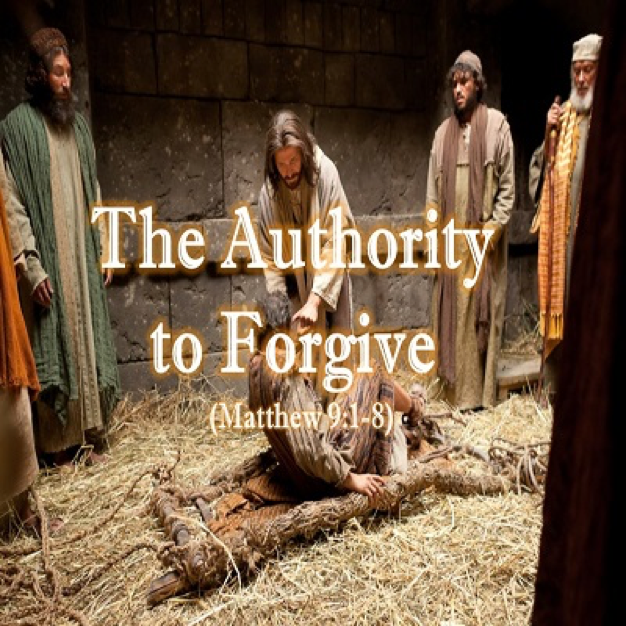
In Matthew 9:2-8 we read about a paralyzed man who had both physical and spiritual healing given to him by Jesus.
2 And they brought to Him a paralytic lying on a bed. Seeing their faith, Jesus said to the paralytic, “Take courage, son; your sins are forgiven.” 3 And some of the scribes said to themselves, “This fellow blasphemes.” 4 And Jesus knowing their thoughts said, “Why are you thinking evil in your hearts? 5 Which is easier, to say, ‘Your sins are forgiven,’ or to say, ‘Get up, and walk’? 6 But so that you may know that the Son of Man has authority on earth to forgive sins”—then He *said to the paralytic, “Get up, pick up your bed and go home.” 7 And he got up and went home. 8 But when the crowds saw this, they were awestruck, and glorified God, who had given such authority to men.
Jesus’ authority was God given and proven through his ability to heal. He makes it clear though, he isn’t here just to heal the physical needs of the people but the spiritual ones as well.





 Seek Grow Love