Head Protection

Old Testament: 1 Kings 11-12

Poetry: Proverbs 14

New Testament: Ephesians 6:17a

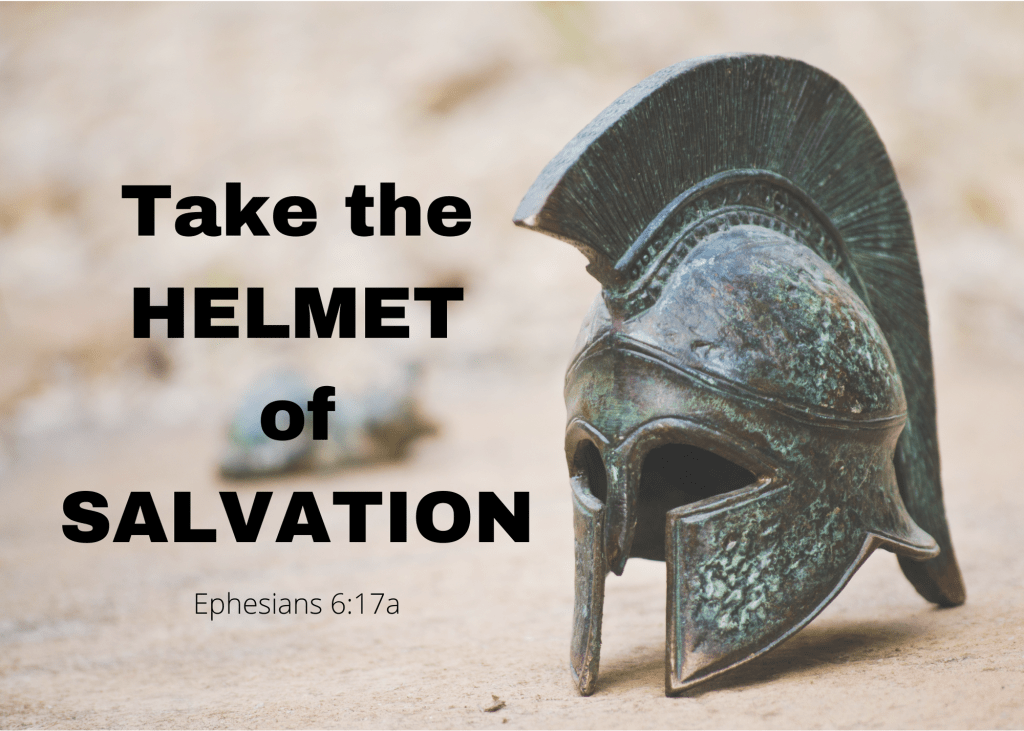
Ephesians 6:17a – “Take the helmet of salvation…”

Here’s a disquieting fact to start our devotion today: According to the International Brain Injury Association, 5.3 million Americans are living with some kind of disability due to a traumatic brain injury. 5.3 million is the population of South Carolina! Of course there are varying degrees of injury, but most are due to car accidents and sports-related incidents. 

And while 5.3 million is a staggering number, I’m willing to bet that there are so many more people living with spiritual battle scars in their minds. 

Our minds are such a vulnerable space and it’s one of the enemy’s favorite areas to attack. At least, that’s been my experience. Anyone else struggle with random thoughts popping up that obviously aren’t from God? 

But why attack the mind? Why not make the heart the primary target? Because our thoughts turn into words, which turn into actions, which turn into habits, which turn into our character. James, the half brother to Jesus, said it this way, “It is the evil that a person wants that tempts him. This desire causes sin. Then the sin grows and brings death.” (James 1:14-15, ICB) This is why it is imperative to protect this part of our body. 

For the apostle Paul, the author of this Epistle, the helmet was the perfect metaphor; after all, he was under house arrest when he wrote this letter. He probably had a lot of face time with a Roman guard who most likely wore some kind of helmet. Each piece of the helmet added another layer of protection against injury or death.

Paul calls this piece of the armor the helmet of salvation. The Greek form of the word for salvation is used only in this verse in all of the New Testament and it means “peace”. As we don this piece of armor, we can have the “peace of God that transcends all understanding will guard your hearts and your minds in Christ Jesus”. (Philippians 4:7)

Where does this salvation or peace come from? It comes from being in the Word of God daily: reading, studying, meditating, and memorizing it. We need to be intentional about the media that we consume and the conversations that we participate in. We need to be aware of entertaining the thoughts that seem to come out of nowhere. Protecting our minds against the thoughts that flow in and out should be something that is carefully monitored as we go about our daily living.

If you want to be in God’s Shalom peace while you engage in spiritual battle, be sure to wear the helmet of salvation.

-Bethany Ligon

Reflection Questions

  1. How do you think the enemy attacks minds? What about yours in particular?
  2. Describe the progression from thoughts to words to action to habits to character. Give an example that leads to ungodly character. Give an example that leads to godly character. Which type of thoughts do you work at thinking most?
  3. What protection is available to you against the thoughts that lead to ungodliness and death? In what ways can salvation and peace mean the same thing? What can you do (today) to strengthen your protection that God has made available to you?

Your Shield of Faith

Old Testament: 1 Kings 9-10

Poetry: Proverbs 13

New Testament: Ephesians 6:16

Do you ever feel like you’re being bombarded with issues, concerns, or worries? Have you ever heard yourself saying, “If it’s not one thing, it’s another”? Maybe you’re just having a typical ‘Monday’ even though it’s Thursday. Or maybe you find yourself clumsy dropping things, forgetting why you walked into a room, or having to deal with “that one person” more often than normal? It’s not so much one big thing, it’s just one little thing after another that really tests your patience. 

My friend, those big things, those small things, those things in quick succession, those repeated things…those very well could be “flaming arrows of the evil one”.

So why does the author of Ephesians, Paul, specifically use the term “flaming” arrows…why not just regular arrows? If a vulnerable soldier were hit by a normal arrow, it would likely only cause damage to himself. But if a flaming arrow hit him, the flame could catch onto nearby flammable material and cause significant damage.  

The comparison leads us to think about how these spiritual attacks affect us and those around us. When we’re experiencing trials and tribulations, how are we treating others? Are we still kind and compassionate or do we take our frustration out on others? When the challenges are mounting up all around us, do we hide out and disengage or do we press on with our commitments and ministries? When the attacks start coming from every angle, are we able to keep our head on straight and make responsible decisions, or are we tempted to act recklessly with our resources and health? 

You see, from the evil one’s perspective, the more damage that can be done with a single flaming arrow, the more successful the attack. It’s not just you and your personal faith; it’s your physical and spiritual health, your relationships and ministries that are under attack.

This is why taking up the shield of faith is so vital when engaging in spiritual warfare. A Roman soldier would have his wooden shield soaked in water so that when a flaming arrow hit its intended target, the flame would be extinguished and not cause collateral damage. 

Likewise, when we are soaked in the Word of God, those attacks become a little less hazardous to how we choose to carry on in the battle. 

In John 7:38, Jesus says, “Whoever believes in me as Scripture has said, rivers of living water will flow from within them.”

The more of the living water that we have flowing through us, the more protected we are from the enemy’s attacks on our faith. We need to stay spiritually hydrated by engaging in the Word of God on a regular and consistent basis. This will build up our faith and protect us from the flaming arrows that are pointed in our direction.

-Bethany Ligon

Reflection Questions

  1. What do you see and recognize as flaming arrows of the evil one? How can recognizing them as flaming arrows of the evil one improve your response to them? Which ones have attacked you or caught you off-guard most recently?
  2. Where/when have you seen a flaming arrow in action – with the potential of injuring or taking down more than just the one it hit? How can we guard against the effect of the flames of these arrows?
  3. How strong is your shield of faith? Does it have weak spots that make you more vulnerable? What can you do to strengthen your shield?

Fitted Feet

Old Testament: 1 Kings 7 & 8

Poetry: Proverbs 12

New Testament: Ephesians 6:15

When was the last time you regretted wearing a pair of shoes? I recently was on the hunt for a pair of gray sandals and I found some that I thought I might like from an online store. I ordered them and at first, they seemed to be very cushy and comfortable. As I wore them throughout the day, I noticed that the straps were rubbing the bottom of my ankle. It never caused a blister, thankfully, but it was just irritating. 

Anyone who is on their feet all day can tell you the value of having comfortable and supportive shoes. Whether it be someone in the medical field, law enforcement, military, food service industry, or in the classroom, having a good pair of shoes is a necessity. 

But what does having supportive footwear have to do with the Armor of God? A soldier’s boots (or sandals as ancient Roman soldiers would wear) are likely the one piece of their attire that they use for hours on end, every single day. They train with their weapons while wearing their boots. They go on marathon-long hikes while wearing their boots. They eat their meals while wearing their boots. And sometimes, they will even sleep while wearing their boots. If a soldier’s feet are sore or tired or have blisters, he or she becomes limited in what they can do – at least without any pain.  

Our verse today talks about being “fitted with readiness”. A soldier must be ready to go at any given moment. Likewise, as believers fighting in a spiritual battle, we must be prepared to take action at any point in time. 

And just what are we to take action with? The Gospel of Peace. This gospel includes the message of salvation and the Kingdom of God. As warriors in a spiritual battle, we need to remember whose army we fight for. When we are laser-focused on what we’re fighting for, we can be empowered and strengthened to fight against anyone or anything that is our opposition. So when temptation or persecution comes our way, we can make sure that we are in the ready position, set to take our Commander’s orders.

But also, the Gospel of Peace is something that we should be comfortable sharing with others who have not yet discovered it for themselves. Being ready to explain to others what we believe and why we believe it is another way to wield this piece of armor. Conversations with our friends, family, work buddies, and even random people you encounter in your day-to-day life can sometimes lead to discussions about our faith. When we are ready to share the Good News, we are showing ourselves to be prepared soldiers in the Lord’s army.

So let’s lace up our boots, and get ready to share the Good News of the Gospel of Peace!

-Bethany Ligon

Reflection Questions

  1. The gospel is only called the “gospel of peace” here in a passage about the spiritual war we are in. How would you describe the gospel of peace and why do you think this wording was chosen for this passage?
  2. Do you feel like you are ready to take action to follow your Commander’s orders today? What do you think could happen if you ARE ready? What could happen if you AREN’T ready for action? What could you do now to be more prepared? Do you think you have ever used an excuse of not being ready when God wanted you to do something?
  3. How can you share the gospel of peace with others this week?

the Breastplate of Righteousness

Old Testament: 1 Kings 5 & 6

Poetry: Proverbs 11

New Testament: Ephesians 6:14b

As we continue our study on the Armor of God, we come across two terms that are not frequently used in our day to day vernacular: breastplate and righteousness. So let’s dig a little deeper in order to come to a better understanding.

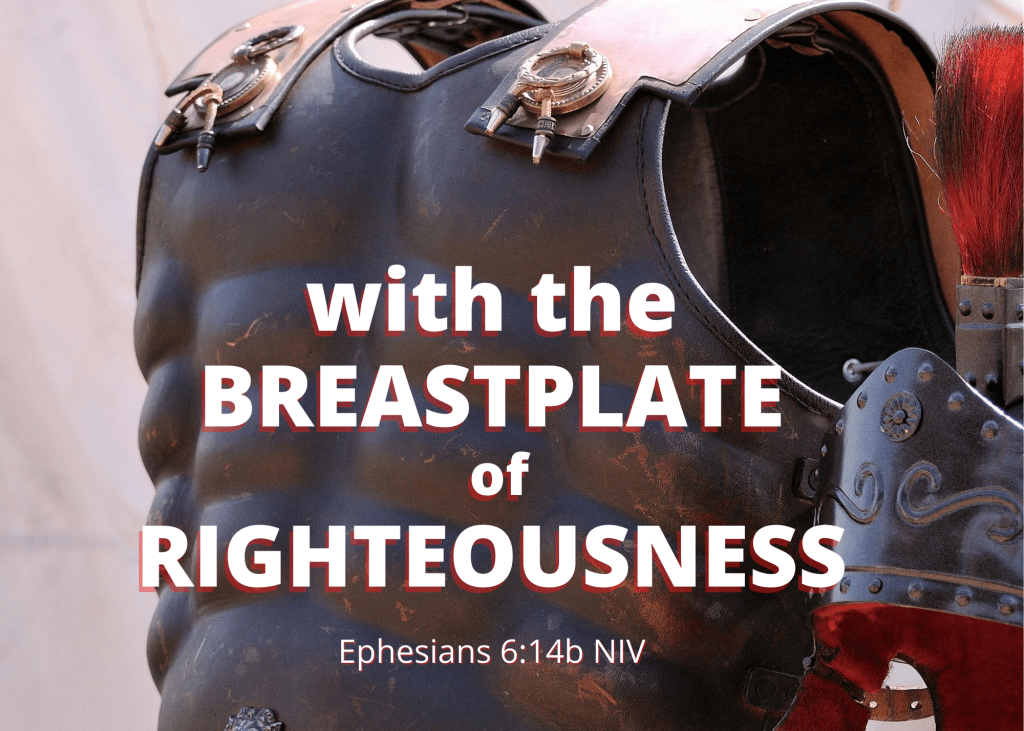
The breastplate is the piece of armor that goes directly on top of the chest, protecting the heart, lungs, spleen, liver, and even the stomach. Longer breastplates would also cover and protect the intestines. Without this vitally important piece of the armor, any direct impalement by a sword, spear, or arrow could prove to be fatal. 

In modern warfare protection, soldiers wear vests made of a material called Kevlar. Invented by Stephanie Kwolek in 1965, its usefulness is not limited to body armor, but extends to brake pads, space suits, and drum heads. It’s been tested to be ten times stronger than steel, is capable of absorbing high-velocity impacts, and withstand extreme hot and cold temperatures. (Thanks Google AI for the information!) Today’s warriors don it knowing that their life could depend on it!

Righteousness is a word that is typically limited to “churchy conversations”. (Unless you were in high school in the early 90’s and claimed that something thrilling was “totally righteous”.) But what does this word really mean? Basically, it means to be in right standing before God; morally and ethically sound; to do the right thing with a pure heart. 

So how does a person become righteous? Romans 3:22-24 says, “This righteousness from God comes through faith in Jesus Christ to all who believe. There is no difference for all have sinned and fall short of the glory of God, and are justified freely by his grace through the redemption that came by Christ Jesus.”

Let’s try to tie this together. When we wear the breastplate of righteousness, we are literally layering on spiritual protection upon our hearts. Without this gear, we are vulnerable to the attacks from the enemy that could prove to be fatal. When we wear this armor of righteousness, we are able to stand before God and be seen worthy and faithful. His Holy Spirit will protect us. 

Some may be tempted to try to shortcut the cost and find cheap substitutes for this level of protection. Whether it be trying to buy our own righteousness by being a “good person” or living an inauthentic lifestyle, where your words and actions cover up a deceitful heart, the Bible is clear that there is only ONE source for a legitimate breastplate of righteousness. We must have faith in Jesus. Faith that accepts Jesus as Savior and Lord. Faith that believes the Lord will fight for us. Faith that commits to standing firm when everything around us crumbles. Faith that submits everything, our hopes and dreams, our plans and purposes, our resources and relationships, our past, present and future to the One who is called Jesus, the Christ, the Son of the Living God. 

Yes, it is costly. But the protection and confidence that it provides is invaluable for the fight that we must fight. “For our struggle is not against flesh and blood, but against rulers, against the authorities, against the powers of this dark world and against the spiritual forces of evil in the heavenly realms.” (Eph 6:12)

-Bethany Ligon

Reflection Questions

  1. How would you rate your righteousness: “to be in right standing before God; morally and ethically sound; to do the right thing with a pure heart”?
  2. How would you rate your faith in Jesus? What happens if you try to have righteousness apart from faith in Jesus? What does faith in Jesus lead you to be and do?
  3. How does a breastplate of righteousness protect you from the powers of this dark world? What would Satan want you to believe about the breastplate of righteousness? Where do you see this attitude/belief in the world?

Belt of Truth Buckled

Old Testament: 1 Kings 3 & 4

Poetry: Proverbs 10

New Testament: Ephesians 6:14a

Heads up! This devotion is going to take you in a mini dive into the history of the buckle of all things! But first…

Many of us have read our key verse more than a handful of times in our lives. And we’ve even been taught about the belt of truth in our Sunday School lessons. It’s been explained that in ancient times, before a foot race or prior to battle, runners and warriors would tuck their long garments into their cloth belt, in order to provide free movement for the legs. 

As I considered this first half of this verse, the word buckle stuck out to me. My thoughts went a little something like this:

“Wait a minute…a buckle in ancient Roman times? This doesn’t make sense. The earliest I’ve ever seen buckles in history books is on the Pilgrims. Did Roman soldiers wear buckles?”

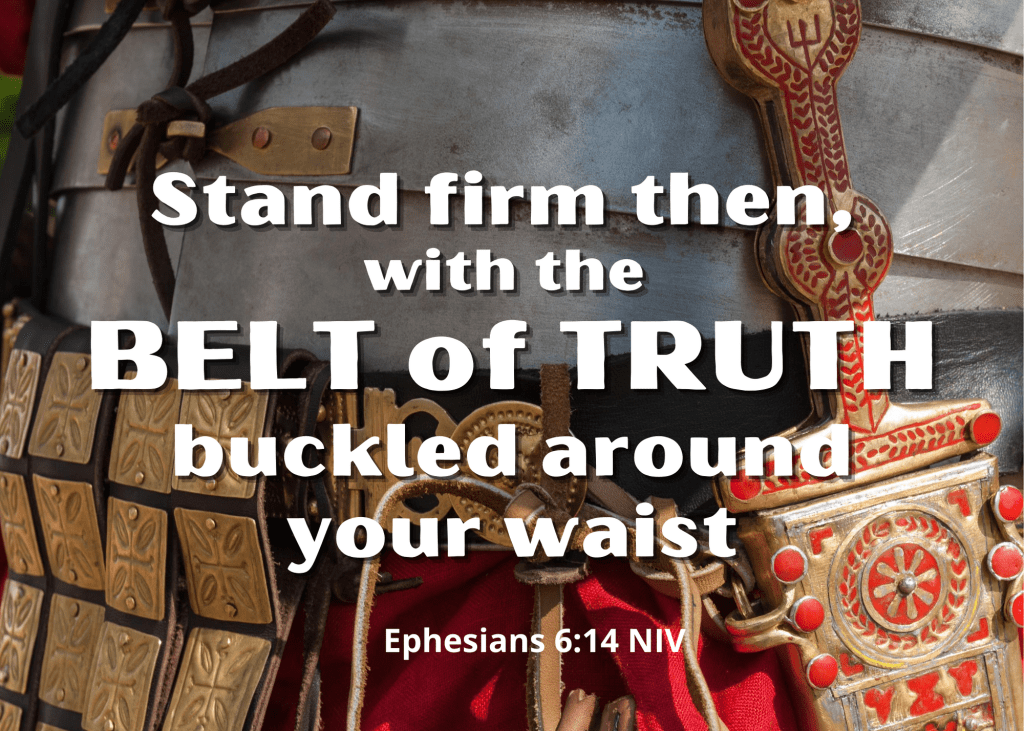
A few clicks in my web browser confirms that indeed, buckles were part of the Roman body armor. Depending on the type of armor, there could be one main buckle, or in segmented forms of armor, many mini buckles to hold all the pieces together. What’s more, the more elite soldiers had super fancy buckles, whereas those that served in the infantry had simpler and more practical buckles. 

Who knew???

With this new knowledge, our key verse today starts to take on an expanded meaning. Without the buckled belt of truth, the breastplate won’t stay in place and the protective plates on the shoulders wouldn’t be able to stay attached. Also, the tunic part of the armor which protected the groin wouldn’t have anything to attach to if it weren’t for the buckle. 

It all starts with the buckle on the belt. Just like it all starts with Truth. 

  • John 14:6 – “I am the way, the truth, and the life.”
  • John 8:32 – “Then you will know the truth, and the truth will set you free.”
  • 2 Timothy – “Do your best to present yourself to God as one approved, a worker who does not need to be ashamed and who correctly handles the word of truth.”
  • Psalm 25:5 – “Guide me in your truth and teach me, for you are God my Savior, and my hope is in you all day long.”
  • Ephesians 1:13 – “And you also were included in Christ when you heard the word of truth, the gospel of your salvation…”

The start of our key verse in Ephesians chapter 6 begins with “Stand firm then…”. If we are ignorant of the Truth, there is no way that we can stand firm. We must know the Truth of YAHWEH, and His Son, Jesus. We must know the Truth of salvation and the coming Kingdom. If we fail to know these truths, then our efforts to stand firm against the attacks of our opposition will be for nothing. 

So buckle up and stand firm in Truth.

-Bethany Ligon

Reflection Questions

  1. What would happen if you went into battle but couldn’t keep your pants up, or were restricted by your long garments? How important is truth? How do the other components of the armor rely on truth? What happens if we try to stand firm without truth?
  2. What truths do you believe about YAHWEH, His Son, Jesus, salvation and the coming Kingdom? Are there any that you are unsure about and need to study more? How do these specific truths affect other pieces of your armor: salvation, righteousness, faith, and gospel of peace?
  3. What can you do today to be better buckled into the truth?

Be STRONG in the LORD

Old Testament: 1 Kings 1-2

Poetry: Proverbs 9

New Testament: Ephesians 6:10-13

Ephesians 6:10-13 – “…Finally, be strong in the Lord and in his mighty power…”

If you were to look at the different video playlists I have curated in my Youtube profile, you’d see that a majority of them are workout exercise videos. I have playlists for upper body strength, lower body strength, pilates and barre workouts, HIIT and stretching videos. What can I say, I need variety in my life if I’m going to pursue a lifestyle that includes regular exercise. 

But physical strength and endurance is not what the apostle Paul is talking about in the sixth chapter in his letter to the Ephesian church.

Nor is Paul referring to mental toughness. The kind of fortitude that prisoners of war or persecuted believers must endure when they are held captive in inhumane environments. 

Paul writes the words, “be strong in the Lord and in his mighty power”. These words are almost identical to what we read in Joshua 1, verse 9, “Have I not commanded you? Be strong and courageous. Do not be terrified; do not be discouraged, for the LORD your God will be with you wherever you go.”

Joshua was preparing for a physical battle that had spiritual consequences. We probably are not preparing for a physical battle; however, if we are actively pursuing a life centered on the Gospel message, we are indeed engaging in a battle that has spiritual consequences. 

So what does it mean to be “strong in the Lord and in his mighty power”?   

First, I think it means that we must recognize that if we are going to do anything in the name of Jesus, we are stepping into battle against the devil’s schemes. We become a threat that must be neutralized. A soldier prepares for battle by donning on their tactical gear. We need to do likewise.

Second, “be(ing) strong in the Lord and in his mighty power” means that our own efforts, our intelligence, our will power, our connections, our resources are insufficient protection for what we are up against. If it were up to only us, then our efforts would be whooped before we even really got started.

Once we acknowledge that we are in a battle and we are without adequate protection, what are we left with? We will only be successful in spiritual warfare with our faith. A faith that says:

We believe that God is who He says He is.

We believe that nothing is impossible for God.

We believe that God is faithful to His people.

We believe that God will fight for us. 

We believe that God has already won the ultimate battle.

When we cling to these truths, we are “strong in the Lord and in his mighty power” and we can withstand any kind of opposition that we are tasked to face and endure. And we will be victorious. 

For whatever battle you might be facing today, remember that you are not alone. You serve a God who loves you and has empowered you with His Holy Spirit to stand firm and do great things. Keep the faith and believe.

-Bethany Ligon

Reflection Questions

  1. How strong are you – physically, mentally, and spiritually? Of these three areas in which do you spend more workout time developing? How does one go about strengthening spiritual muscles? Why are spiritual muscles important?
  2. What do you believe about God and His Son Jesus and how does believing each statement help prepare you for spiritual battle?
  3. What do the devil’s schemes look like? When does he win battles? What can you do to stand against him in God’s power?

Let’s Go Fish!

Mark 1:17 NIV for SGL

Old Testament: Numbers 17 & 18

Poetry: Job 15

New Testament: Mark 1

I used to own a pair of fish that my best friend gave me. I thought I was a decent fish owner. But then I went off to Australia for three weeks and when I returned, I came home to find that the slow-release food supply that I put into the tank, didn’t dissolve. My poor fish starved to death. Oops.

So your reservation to take seriously any of my mentioning of fish, fishing, or fishermen would totally be understandable.

But I ask that you hear me out, just this once, for this particular topic. After all, I did my due diligence and Googled some information.

Mark 1:17 says, “Come, follow me,” Jesus said, “and I will make you fishers of men.”

Being a fisherman was way back then and continues even today to be a daily job. Likewise, as we follow Jesus daily, our casting of nets should happen every day we are around others. If we are called to be fishers of men, all of our interactions need to be with the purpose of building relationships and showing others, verbally and nonverbally, what life with Jesus as our Lord looks like.

Peter and Andrew knew when the best time to go fishing was. According to www.takemefishing.org (I’m totally serious… ) the best time to fish is usually later on in the day. I know that there are probably a gazillion other variables that should be considered, so don’t go dismissing the bigger picture here. Later in the day, the fish are primed for feeding because their metabolism and digestion are roaring. There is a lesson for us here – in order for people to win others to Christ, they need to be primed. In God’s own timing, a person’s heart will be open to receive the Gospel. As fishers of men, we need to be praying for those opportunities to present themselves so we are able to discern what to say and when to say it.

We know from verse 16, that Simon (later called Peter) and his brother Andrew used nets for fishing. Not a pole, line and lure, but nets. They caught hundreds of fish at a time. When Jesus says that he will make us fishers of men, I think His intention is that we not just teach a few people about Jesus, but that we influence hundreds of people, over our lifetime, to consider what life as a follower of Jesus would look like.

We also know from verse 16, that fishing was not a solo effort. It demanded at least a pair to get the job done. Our faith is meant to be in a community. Yes, Jesus goes off to a solitary place in verse 35 of Chapter 1, but that doesn’t mean we live in a vacuum. Working and serving with other believers is how our faith is supposed to be carried out.

I fully admit that sharing the Gospel is not my strength. But as I read this verse, I became convicted that this is something that I need to take more seriously. That’s partly why I chose it to be the verse to memorize for the week. So even though it is a short verse and easy to commit to memory, it’s potential to change my life and the lives of those around me, is significant.

Wanna go fishin’?

-Bethany Ligon

(Originally posted for SeekGrowLove on September 11, 2017)

Reflection Questions

  1. How have you been helped by your fishing community? How can you help them?
  2. How committed are you to following Jesus and fishing for people? What do you find hardest about these jobs? What gets in the way?
  3. Pray to God about how He would like to see you fishing for men/people. What does it look like? When and where will it be done? Who will your fishing partners be?

God’s Restoration

Old Testament: Numbers 31-33

Psalms Reading: Psalms 74

New Testament: 2 Corinthians 11

My Bible notes explain that Psalm 74 is from the time of the exile, after the nation of Israel had been destroyed and the temple left in ruins and the promised land completely ravished. The first half of the Psalm is a recounting of how the sanctuary of the Almighty was decimated by the enemy. The second half of the Psalm is a cry out to God to do something about it. Verse 12 is the pivot point between the two halves. 

As I read Psalm 74, my inner first-born older-sister voice says something like, “Well, what do you expect? Your insolent behavior was basically an invitation to the enemy to come and wreak havoc. You opened the door to the temple wide open with your disobedience. And now you realize your mistake and want God to fix it???”

As if I never did anything foolish. Not once have I been disobedient. And I never have had to deal with the consequences of my poor choices. Nor have I ever asked God to come to my rescue and defend me when I got in over my head. Nope, not at all. Not me.

Maybe this Psalm hits a little too close to home. Because there have been so many times when my disobedience has left me on my knees. I said something that shouldn’t have been said; I ignored God’s voice telling me to walk the other way; I refused to forgive; I thought too highly of myself. And when I realized what I got myself into, the only thing I could think of doing was crying out to God for help.

While God fully desires us to be obedient, he knows our human nature and capability to mess things up from time to time. He wants us to call out to Him. He longs for us to recognize our need for Him. So even when we open the door of our hearts to something less than God’s best and our lives are turned inside out and upside down, He will come and restore us to who we are meant to be.

Thank you God, for being full of mercy and grace and hearing me when I call out. Thank you God, for not turning your back on me when my mess is a result of my foolishness. Thank you God, for loving me unconditionally, that even though I may have to suffer the consequences of my actions, you redeem me.

-Bethany Ligon

Reflection Questions

  1. When has your disobedience caused the need for restoration?
  2. Is there an area of your life that you have already experienced God’s restoration? What did it look like when it was in ruins? What does restoration look/feel like?
  3. What has God revealed about Himself in today’s Bible reading?

To Be Near God

Old Testament Reading: Numbers 28-30

Psalms Reading: Psalm 73

New Testament Reading: 2 Corinthians 10

What is the longest that you have prayed for something? A couple of days? A few weeks? Multiple months? Several years? Maybe a decade or two? 

For me, I prayed for something for over ten years. The words may not have been on my lips each day or recorded in my journal on a regular basis, but it was in my heart for a very long time. There were times when I looked around and wondered why God wasn’t answering this prayer. Why did he seem to be responding to others before me? Why did it appear that even nonbelievers were ‘living their best life’ and here I was, trudging along, waiting for God to do something.

Eventually, I saw an answer to my prayer. It didn’t come in a way that I anticipated, but God answered. Hallelujah! 

I find myself in another long-term praying situation. Every once in a while I see a glimpse of what I hope for, but it doesn’t last for long. It’s frustrating. At times I feel powerless because nothing I seem to do makes any difference. At other times, I am jealous of others who have what appears to be what I am asking God for. 

As I read Psalm 73, I identify some with the author in his observations that life just doesn’t seem fair. But I have come to realize that when I am looking at ANYTHING other than God, my perspective, my attitude, my desires, become skewed.

When I am intentionally seeking after God, my confidence in His plan and timing grows; my heart’s desires change, my thoughts are transformed. I become spiritually stronger and sustained when I stop comparing my life to the world and start trusting that God has bigger and greater plans in store for my future. 

So for now, I will lift up my hands and reach out to my Father who will take hold and provide all that is needed while I wait for an answer. And even if that answer doesn’t make sense, doesn’t seem fair or doesn’t match my timeline, I can trust that His way is better than my way and He alone is enough.

-Bethany Ligon

Reflection Questions

  1. What is the Psalmist’s attitude and focus in the first half of Psalm 73? What is his attitude and focus in the second half? What is the turning point? What are your favorite verses in this Psalm?
  2. When does life seem unfair to you? What is your typical response? Even when the situation remains the same, how can your attitude and focus change?
  3. What do you learn of God and His characteristics in today’s Bible reading?

Eternal Perspective

Philippians 1

Saturday, August 20, 2022

Philippians 1:10 – For I want you to understand what really matters, so that you may live pure and blameless lives until the day of Christ’s return.

Perspective is everything. As a junior high school science teacher, I got to teach students about galaxies within the universe and molecules and atoms; from the macro to the micro and everything in between. And what we learned is that depending on your perspective, your observations and conclusions may vary. 

It’s very easy (at least for me) to get wrapped up in the business of each day. Which means I sometimes lose sight of the bigger picture. What I appreciate about this specific letter from Paul to the church in Philippi, is that it’s a wonderful reminder to keep the most important things at the forefront of our thinking at all times. 

When we view life with an eternal perspective, instead of a right here, right now point of view, we are able to consider what really matters. Life becomes less about grabbing drive through dinner after a long day of work and more about being pleasant to the fast food worker. It becomes more about continuing to give to your family even though you’re exhausted from making tough decisions earlier in the day. It becomes more about being grateful and expressing joy because you’re making a difference in the lives of others. 

When we live with an eternal perspective it becomes easier to give even when we don’t feel like we have much to offer. It becomes more important to meet up with your neighbor to extend assistance for a need that they have when you understand the potential impact it might bring. It becomes a joy to worship, a pleasure to study Scripture, and a relief to rest in the shadow of our Rock when we are mindful that nothing is more important than seeking Him through whom all blessings flow. 

May today be your reminder to take some time to understand what really matters, so that you may live pure and blameless lives until the day of Christ’s return.

-Bethany Ligon

Application Questions

  1. What is most important to you?
  2. How does your life show what is most important to you?
  3. What situations cause you to forget your eternal perspective? How can you renew your dedication to the eternal perspective?