Two Kinds of Eternity

OLD TESTAMENT: Daniel 12

POETRY: Psalm 139

NEW TESTAMENT: John 12:12-19

Jesus says, in the gospel of John, “God loved the world in this way: He gave his unique, one and only Son, that whoever believes in him should not perish but have everlasting life.” (3:16) Later, in the Revelation of Jesus, we read that anyone whose name is not written in the book of life shall be judged, but that those who conquer will never have their name blotted out of the book of life. (3:5)

As we come to a close in Daniel, we are struck with weird, disconsonant numbers. Yesterday, I gave you a giant history lesson; maybe today you are worried about a deep dive into math! Let me give you some hope, we aren’t doing math. (I can hear the sigh of relief from here.) 

Instead, I am going to get very personal and very honest: eternity awaits you. This is not an “infinity-and-beyond” kind of aspiration. While the New Testament is very explicit in the book and verses we looked at above, it is what permeates the teaching and focus of Jesus. Eternity is coming. Whether at his return or at the end of our lives and our resurrection into the next, there is something coming. In Daniel 12 (and most places in the Bible) there is one resurrection at the end of the world. Daniel is full of metaphor and numbers, but here, the language is bolstered by the literal teachings of Jesus, and also other places in the New Testament. Daniel 12 tells us there will be a real, literal resurrection. Those who sleep will rise. But with one resurrection, there are two outcomes. One is everlasting life. One is shame and everlasting contempt. The gospel of John repeats as much: “Do not marvel at this, for an hour is coming when all who are in the tombs will hear his voice and come out, those who have done good to the resurrection of life, and those who have done evil to the resurrection of judgment.” (John 5:28-29 ESV) What does everlasting shame and contempt mean? Humans are not, in and of themselves, immortal. We die, the dead know nothing (Ecc. 9:5), the dead do not praise God (Psalm 115:17); instead the dead are, metaphorically, asleep, unaware of the passing of time. This matters because what is offered in Revelation is eternal life or the second death. Not torture forever, but the finality of hope, and the end of existence. 

I am not a fire-and-brimstone kind of guy, and I won’t want to scare you. I want you to think through your options. Today, you have set before you life and death. More than that, you have eternal life or eternal death. I beg you, choose life! Jesus, the sacrifice for our sins, the ruler of God’s kingdom, the lamb slain from the foundation of the world, he desires to write your name down in his book of life. He, like his father, does not desire that any should perish, but all, whoever calls upon him, should live and live eternally. 

My friends, may you call upon the name of the Lord Jesus. 

May your name be found in the Lamb’s book of life. 

May you spend eternity with all those who have called upon Jesus.

May you be blessed so that you may see God in his kingdom. 

Remember, one day, we will all go on our way. We will all rest in death. 

May we stand side by side in our allotted places at the end, covered in the grace of Jesus. 

Amen. 

-Jake Ballard

Questions:

  1. It’s your turn to study! What are the connections between 1290, 1335, and “time, times and half a time”? Reading Revelation may make some of it clear, but you should ask your pastor. Be really specific and make your pastor think! 
  2. Some of our Christian brothers and sisters think that judgement means an eternity of pain and suffering. Can you understand why they might believe that? Can you see why it is wrong? List out some reasons in the Bible or in theology or philosophy that it might be wrong and explain them: “Human mortality” or “God’s love and justice” are good starting places, but think about going deeper. 
  3. Beyond numbers and judgement, I encourage you, during this time of Advent, to trust in what God has done in and through Jesus, our savior. I encourage you to trust him with your life and with your resurrection. I encourage you to talk to your pastor, youth pastor, or caregivers about becoming baptized, and finding forgiveness so that your name may never be blotted out of the book of life. God bless you as you seek him. 

Judgment: The Positive and The Negative

Old Testament: Ezekiel 33 & 34

Poetry: Psalm 105

New Testament: Revelation 20

     Revelation 20 involves God’s judgment, and it may make sense to put 19:20-21 in your mental image of the passage so the beast, the false prophet and their armies are in there. Verse ten reiterates the judgment of the beast and the false prophet, pairing them with the devil they had served. I see the passage with alternating sections of negative and positive references to judgment (19:20–20:3, 7-10, 15) and (20:4-6; 11-14). Grouped this way the text has every use of “lake of fire” (a different phrase appears in 21:8).

     After 19:20-21 establishes the punishment of those who served the dragon, chapter 20 opens with very satisfying language about the serpent not being able to deceive the nations. He is chained and sealed away for a thousand years.

     The description of the saints’ resurrection which follows in verses four to six may seem notably out of sequence. The first resurrection takes place at the last trumpet, in the twinkling of an eye (meaning in the time it takes to blink; 1 Corinthians 15:52). At Christ’s return the dead in Christ rise first, at the sound of the trumpet, and his servants who remain alive rise to meet him just afterward (1 Thessalonians 4:14‑17). That happens before Jesus fights the armies of the antichrist. It seems that the first resurrection was skipped over in Revelation 19. It also seems questionable for there to be an evaluation of the martyrs like is described in the vision. God knows all about them – they are raised because of who they are. It seems that the evaluation was described just for the sake of the vision, and what this passage presents as “judgment” clearly would need to be a fully positive judgment.

     Recognizing all of that, I think God wanted this text here, after a description of what happened to the devil. It contrasts what happened with those who accepted the mark of the beast (dead) and the leaders of the conspiracy (burning) and the one who inspired that conspiracy (imprisoned for a thousand years) to those who stood firm against it (they come to life and reign with Christ for a thousand years). Considering what these martyrs suffered, God wants to emphasize their acceptance and glorification, although that called for it being addressed out of sequence.

     In verses seven to nine Satan is again free, for a short time. Perhaps this represents a winnowing of the nations before God makes the next big change in the status of earth. Satan again deceives the nations who are willing to be deceived and assembles them for judgment (even if he doesn’t understand that is what he is doing). And this time judgment comes on him as well. God is closing out the books, after this there won’t be anyone else around able to be tempted. God could have left this entire story unmentioned, but He wanted us to know this part of the future, to be aware that our enemy will be permanently dealt with. (Not that Genesis 3:15 didn’t already indicate it.)

     I like the imagery in verse 11, as though perhaps God’s majesty surges up, and all that is nearby is not holy enough to remain. “Earth and heaven fled away, and no place was found for them” (v. 11). We continue to be reminded that this is a vision, as the lake of fire is still present for the later part of the vision and did not flee away. Maybe this is looking toward the next part of the story, that God is in the process of replacing heaven and earth (2 Peter 3:12). The description of death and Hades being thrown into the lake of fire is very positive (v. 14), but also serves as another reminder that we are reading about a vision (as it is hard to figure how John knew this happened except by being made aware of it).

     Elements of both the positive judgment scenes (v. 4-6, 11-14) can be found in Daniel 7:9ff, with the thrones, the books, and the fire, but they are mixed. It is a common statement that prophets of the Old Testament saw future events like we might see a distant mountain range, unable to tell very well how large a valley was between the peaks. Events from Christ’s first coming and second coming could be discussed right next to each other in a passage. With Daniel 7, making distinctions relevant to the existence of multiple resurrections wasn’t purposeful. And with Revelation John could not see and appreciate all the things happening in fully accurate order.

     I questioned whether to think of the judgment in Revelation 20:11-15 as neutral, or to break it between a positive first four verses and a ‘negative’ verse 15, because it raises the idea of someone’s name not being found in the book of life. It is interesting to think that verse 15 involves a resurrection too late in history to be relevant for the reader and so may not be intended as a warning for us. But I suppose it will be a warning to people during the millennium.

     Lord, your judgments are true. Thank you for offering your mercy. Please open my heart to accept your gracious offer, for myself, and for others. Don’t allow me to remain burdened with the past. Don’t let me be held back by refusing to forgive. Lord, let me listen so well to you now that I will not be deceived by the evil one or accept any of his lies. Let me seek your truth, and love it. In the name of your beloved son, Amen.

-Daniel Smead

Reflection Questions

  1. What do you think it will be like for people in the millennium to read the Bible?
  2. How does it make you feel to think that God is eager to praise those who have faithfully served Christ?
  3. The text refers to “priests of God and of Christ” who will “reign with Him for a thousand years” (v. 6) – have you given much thought to what that might involve?

Time to Wake Up

Daniel 12

Thursday, November 3, 2022

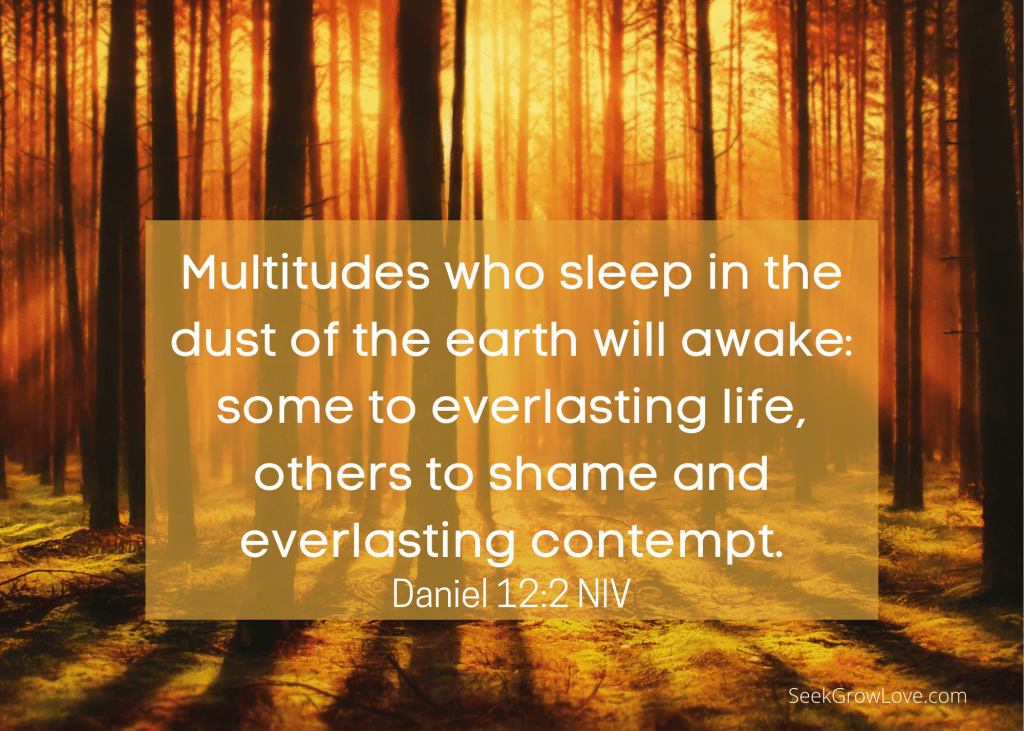
Daniel played many roles in his life including a great prophet of God. We continue to be blessed, inspired and perhaps warned by the writings of Daniel. Not only did he share God’s insights with the kings and people of his time, but today we also see God’s plan unfold in Daniel’s writings. We see the future for those who faithfully follow God. It states, “many of those who sleep in the dust of the ground will awake, these to everlasting life, but the others to disgrace and everlasting contempt. Those who have insight will shine brightly like the brightness of the expanse of heaven, and those who lead the many to righteousness, like the stars forever and ever”.

We read about deliverance for everyone whose name is found written in the book. King David had written of this book of life in Psalm 69:28 and many years later we see the book mentioned again in Revelation 3:5. It states, “He who overcomes will thus be clothed in white garments; and I will not erase his name from the book of life, and I will confess his name before My Father and before His angels.”

These amazing truths were passed down from one group to the next, sometimes one generation to the next. Daniel faithfully served the LORD at the time and in the place that the LORD set for him. We have that same privilege today. Don’t feel that you are unable or are unqualified to share. You have the message from the LORD through the scriptures and when you walk closely with Our LORD, that is all you need. Share the Good News with those around us. We want to share in the assurance that Daniel had. It states, “then you will enter into rest and rise again for your allotted portion at the end of the age.”

-Rebecca Dauksas

Reflection Questions

  1. When you think of the future do you usually think about tomorrow, 5 years down the road, 25 or 50 years from now, or eternity? What part of the future excites you? What part scares you?
  2. How often do you consider the book of life? What are your thoughts and feelings when you do? How many familiar names do you expect will be found there?
  3. How can you lead many to righteousness by sharing the good news? What has God given you to do so?

Resolution 1: Drink More Water and Less Kool-Aid

Revelation 17

The eternal feasting from Thanksgiving to Christmas has begun to catch up with me (it’s not just you, promise).  This pre-New Year’s week (and it’s bloating) is often cited by many as their week of revelation and insight into the preparations of what they might change in the upcoming year. While any time – month, day, or hour – is welcome to change, this week I will be focusing on some resolutions presented to us in the continued reading in the prophecy of Zecheriah, the Revelation of John, and the beginnings of Matthew.  While many of the passages are filled with prophetic, symbolic, end-time images, I will try to remain focused on the big picture: the message or warning presented in the passages.  Our eyes should be open, our ears listening, and our spirit attune to the world around us, not only because we become reflective as our year draws to an end, but because the drum roll quickens towards the end of this present evil age.  We should hasten our efforts, not to simply shed a few holiday pounds, start a new hobby, or get organized, but to make changes and to carry on efforts that will make lasting impacts in the Kingdom of God.

Speaking of eternal things, did you know, Kool-Aid, when stored properly, really doesn’t expire?  It is a seemingly innocent drink, yet there is a crushing idiom out there beckoning people not to partake in the consumption of this perpetual potion: You might hear an older generation say, “Don’t drink the Kool-Aid ”.  This expression actually means don’t believe everything you hear, especially because it presents a very real threat.  It might seem that the origins of this phrase refer to the high sugar content, the unnatural color, or the artificial flavor of the name brand fruit drink of childhood and beyond.  It is true, there isn’t much wholesome about this drink (sorry, grape. I still love you tho❤️); however, this isn’t where our figurative turn of phrase is born.  Instead, the origin is far more tragic than the attack on our blood-sugar.  The notorious event is referred to as the 1978 Jonestown Massacre, where hundreds of innocent men, women, and children died by drinking, or being forcibly injected, with a combination of Flavor-Aid and poison.  This presents a more tragic history behind the coinage, but draws a parallel to today’s reading in both Zechariah and Revelation.  The words below remind me that there is a great coming (or even present) evil, or a more perilous and poisoned Kool-aid that is brewing and being passed as legitimate name-brand Gospel.

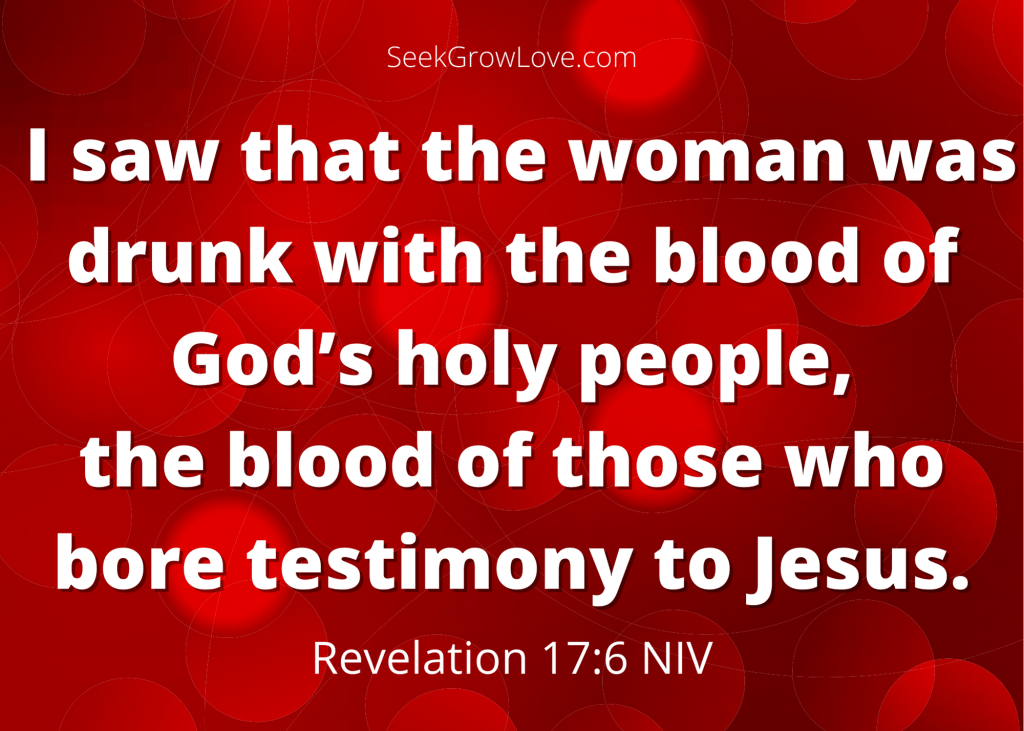
“I saw that the woman was drunk with the blood of God’s holy people, the blood of those who bore testimony to Jesus.” – Revelation 17:6

The prostitute on the beast paints an ironically sobering picture, becoming intoxicated on the blood of saints and lying with the kings of the earth.  Those who take part in this great debauchery against God, may do so willingly, but it seems many do so unwittingly, astonished and deceived by the spectacles of ungodly power (v.8) . There will be those who are not in the Lamb’s Book of Life who attend churches, have ministries, and even blog about Christ, but give-in to tinted truths, sweet lies, and god-like power, because it is a more “palatable” gospel, requiring less real change and more gratification.  The love, justice, mercy that take root in another source other than our Heavenly Father, may look pretty, taste sweet, and have some of the same notes, but it is filled with poison.  It will never quench your thirst.  It is just empty calories leading you closer to death.  Stop the endless following, swiping, and double-tapping – look up.  Turn off the continuous bombardment of the news cycle – look up.  Quit chasing after causes that don’t lead to the saving Gospel message of Christ – look up. Don’t drink the Kool-Aid.

Now, this begs the question, what then should we drink?  Coffee!  Wrong. Tea? Still wrong.  Soda?  Getting colder.  Simply, water.  No beans, no leaves, no syrup, no colors, no nonsense straight-from-the-tap water.  It is what your body is craving, essential to every major function in your body, beginning at the cellular level.  Among many other things, water aids in digestion, stabilizes the heart, regulates blood pressure, flushes away the toxins, and provides protection to the day-to-day function of our organs and joints.  Such is true for our Living Water, the Gospel message and the Spirit of God present in our daily walk.

Jesus answered, “Everyone who drinks this water will be thirsty again, but whoever drinks the water I give them will never thirst. Indeed, the water I give them will become in them a spring of water welling up to eternal life.” – John 4:13-14

“On the last and greatest day of the festival, Jesus stood and said in a loud voice, “Let anyone who is thirsty come to me and drink. Whoever believes in me, as Scripture has said, rivers of living water will flow from within them.  By this he meant the Spirit, whom those who believed in him were later to receive. Up to that time the Spirit had not been given, since Jesus had not yet been glorified.” – John 7:37-39

While there is a metaphor to be drawn for each of these literal benefits, there is an inherent advantage, understood or not, from consuming water.  Yes, we are trying to flush away perpetuated falsehoods, but drinking living water in and of itself is simply refreshing.  Make time for God’s Word.  Worship Him in your car.  Honor Him with your time. Live out the Gospel through actions and bear the testimony of Jesus Christ. Resolve to fill your tumbler and carry it wherever you go because there are so many ready to make the switch from the Kool-Aid to the quenching Living Water.

-Aaron Winner

Read or listen to today’s Bible reading plan passages at Bible Gateway here – Zechariah 5-6 and Revelation 17

The Books are Opened

Revelation 20

Revelation 20 6.png
You have a destiny.
It sounds like a movie or a great novel. I’m not Morpheus encouraging you to take the Red-Pill, or even a Wardrobe beckoning you to take your place upon the throne at Cair Paravel.
We are discussing something much more crucial: eternity. 
 
In Revelation 20, we are witness to two resurrections and therefore, two judgements. While Jesus in Matthew 25 tells us there will only be one judgement, with some sheep and some goats, Revelation expresses the security of the saved by expressing their own resurrection as separate. Instead of being raised and judged all together, all those who fought against the beast and his mark will reign with Christ and live forever, being raised in an earlier better resurrection, free of fear of the second death. Revelation then shows us that there will be those that, no matter what, will stand against God, and will march against the Lamb. God will smite them and Christ will judge them from the great white throne. There are many books opened, but there is one crucial book, the Book of Life. Those whose name is written in the Book will live, those whose name is not written in the book will die. Those whose name is not written in the Book will be like the goats of Matthew 25, who go off to shame and everlasting contempt.
 
A question we may ask ourselves is “which is the most accurate description of the final judgements? Is it all people into sheep and goats (like Matthew 25) or two separate judgements separated by 1000 years (Revelation 20)?” And that is a good question.
 
A good one, but the WRONG one.
 
The question we MUST ask is, “Am I a sheep or a goat? Is my name written in the Book of Life? Will I be raised in the first resurrection?” This is the correct question, because it is also the one we can answer with assurance. 
If you have believed in the name of Jesus, 
if you have fed the hungry, given water to the thirsty, clothed the naked, visited the sick and imprisoned, (Matthew 25)
if you have refused the mark of the beast, the authority of this world, (Revelation 20)
if you fought against the anti-God system of the world by speaking the message of Christ in love, 
THEN you have been promised by God Himself that you will be raised to eternal life. 
 
May you, my brothers and sisters, be among the sheep, raised in the first resurrection, and may you never need to fear the second death.
Jake Ballard

The Parable of the Lost Ring

Luke 15

Luke 15_10

It was the beginning of a Louisiana winter when I lost my wedding ring just a couple years into my marriage.  It was a beautiful white gold ring with an inscription of our anniversary on the inside of the band.  It was a perfect reminder of my covenant in every way; however, its faults were it was a little loose when my hands were cold, and of course, it had me for an owner.  My friends and I were readying to play a football game on a Sunday afternoon and I was warming up by tossing the ball with a friend.  In a bit of foreshadowing for the events of the day, my ring slipped off as I caught the ball.  I picked it up off the ground, remarked how cold it was that afternoon, thought about placing my ring inside my pocket but thought it might fall out if it was there.  I put the ring back on my finger, only to lose it at some point in the next couple of hours of our pick-up game.

As we finished playing, my heart immediately sank when I realized it was gone.  I felt a cold sweat build on my forehead, my gut churned, and I held back tears, disappointed that I had lost something so precious.  My friends helped me look for almost an hour without success.  In the muddy, mushy, marshy Louisiana ground, I could see the imprints of our shoes and feet, I could see heaps of crawdad holes, but none of us saw the silvery reflection of my ring buried within the mire and muck.

In Luke Chapter 15, Jesus tells a series of three parables with a similar subject of a possession that has gone missing. In “The Parable of the Lost Sheep”, the master realizes that one of his flock is missing, and leaves behind 99 others to search for the lost one.  In the “Parable of the Lost Coin”, a woman takes account (to tie to our theme from yesterday) to realize she has misplaced a day’s earnings and does the equivalent of turning up couch cushion, investigating under the bed, and sweeping every nook and cranny to uncover it.  In “The Parable of the Lost Son” a father turns his son loose with an inheritance, but is actively looking for his return.  In addition to the same topic, each story ends in a similar resolution: what has been lost has become found and there is great rejoicing.

For me, there are two great takeaways as I ponder the collective meaning of these parables.  The first: to be lost, you have already belonged.  It is true that we each must find the Master in order to be saved, but He is the one who never stops searching.  Our Lord desires that not even a single sheep goes astray and is left without the safety of the shepherd (2 Peter 3:9).  Additionally, my thoughts turn to the Book of Life.  In Revelation 3, we are presented an image that our names are not written into the Book at the transition from “lost” to “saved”, but have already received a place there and are blotted out at the end of a life that is not found in Christ.  We are always His, but like the lost son, we make the decision to be found.

The second takeaway is the wonderful rejoicing that occurs when we turn our lives over and are indeed found.  There is a literal fiesta in the firmament to celebrate our Savior’s joy that we are alive again. No longer do we share the fleeting moments of a mortal life with our Father, but have the hope of an eternity of His presence, living with Him in His kingdom, our intended inheritance instead of passing pleasures. We, too, should echo the heavens and revel in each return.

Unfortunately, the resolution to my own parable of the ring isn’t as joyous as our Jesus’.  I searched for the ring for weeks, beseeched friends I know with metal detectors, offered rewards, but none of these measures ensured the retrieval of my wedding band.  I resigned my search, and my ring is forever lost in the loose Louisiana earth.  Maybe, as I like to imagine, it is the crowning jewel at the bottom at some crawdad family’s hole. With this being said, I can’t help but be thankful that my God has called me his treasure and that he never stops searching for me.  He finds me in my wandering, revealing and moving His will and His way through His words, waiting for my silhouette to again darken the horizon when I have gone astray – a Father who never fails finding those who desire to be found in Him.

-Aaron Winner