There really isn’t a good enough word to describe how majestic God is, not even a list of words can do Him justice! The rest of verse one says, “You have set your glory above the heavens.” David points out in this Psalm that we can see God’s majesty in the work of His fingers (His creation)– specifically mentioned is the moon and the stars.
After looking to the vastness of God’s creation, David asks in 8:4, “what is man that you are mindful of him, and the son of man that you care for him?” David goes on to say that God crowned us with glory and honor. We are such a small piece in God’s creation that it is hard to imagine that God cares so much for us. And even more than that, He gave us dominion (rule or control) over the rest of His creation.
Wow! So often I read a Psalm like this and don’t really take in its powerful message. God made the whole world and everything in it. That includes people. That includes you and me. Do you feel crowned with glory and honor? Do you feel watched over and cared for?
As the world turns further and further away from God’s path it is easy to become discouraged. To wonder, “How bad was it in Noah’s day that God ended most of mankind?”. Psalm 14:1a says, “The fool says in his heart, “There is no God.” There seem to be fools aplenty – all you have to do is turn on the news, log on to Facebook, listen to the conversations around you in a restaurant or grocery store. Fools are everywhere. All of the Psalms from today’s reading offer great encouragement for those who follow God.
Amy Blanchard
Reflection Questions
What in God’s creation speaks of God’s majesty to you? Mountains, oceans, colors, wildlife, sunrises/sunsets, music, a newborn, etc.?
As you consider that God made – and makes – all people, consider that this statement includes you. Also consider, this includes your bossy sister, your nosy neighbor, your know-it-all relative, etc. Who might you need to start seeing through God’s eyes?
2 Samuel begins with Saul’s death. Chapter one tells of his death and David’s reaction. Chapter two shows David seeking God’s advice and being anointed king over Judah, the northern kingdom. Also, we see Abner anointing Ish-bosheth, Saul’s remaining son, king over Israel, the southern kingdom.
Both armies met at the pool of Gibeon. 2 Samuel 2:14 says, “And Abner said to Joab, ‘Let the young men arise and compete before us.’ And Joab said, ‘Let them arise.’” They arose, each sending 12 men to fight. They each caught their opponent by the head and thrust their sword in their opponent’s side. All 24 died. Not the brightest way to fight! A battle broke out after this and one of Joab’s brothers, Asahel, ran after Abner; Abner ends up killing him. That brings Joab and his other brother, Abishai, pursuing Abner. Joab ends up retreating, but David’s men won the battle 20 deaths to 360 deaths. Chapter three tells of Joab and Abishai getting their revenge on Abner and of Ish-bosheth’s death.
There you have the cliff notes version of the first four chapters of 2 Samuel.
There are two stories in these chapters that show David’s moral character. If you remember, there were a couple of times when Saul was chasing David when David could have killed him and did not because Saul had been anointed by God. Even though it would have been viewed as a proper response to the situation, David didn’t do it. In 2 Samuel 1 an Amalekite man comes to David to report Saul’s death. He tells how Saul, near death already, asks to be put out of his misery and how he honors that request. David kills him. In 2 Samuel 4 we read that after Abner was killed Ish-bosheth lost his courage. Two captains of raiding bands for Ish-bosheth realized they were on the losing side and wanted to find a way to show their loyalty to David. They killed Ish-bosheth and brought his head to David. They were proud of their actions, and thought David would be as well. Just like the Amalekite man, David has them killed.
One more side note…In chapter four we are also introduced to a character who doesn’t come into play until chapter 9. Verse 4 says, “Jonathan, the son of Saul, had a son who was crippled in his feet. He was five years old when the news about Saul and Jonathan came from Jezreel, and his nurse took him up and fled, and as she fled in her haste, he fell and became lame. And his name was Mephibosheth.” Just keep that mouthful in mind (muh·fi·buh·sheth).
Amy Blanchard
Reflection Questions
When you think of your own moral character, how would you rate yourself?
When the world says something is right and good do you consider if that is how God views it? Who do you choose to follow?
Keeping in mind 2 Samuel 1:14, what are some things that David – and God – would suggest we should be afraid of?
We all think that what we want, the way we think something should be, is a just cause. But is it, really? Lots of things can sound like noble causes, but would they be in God’s eyes? I have been known to think I’m right about something when I’m actually wrong. For example, because texts & emails don’t allow for any verbal cues or body language to help with interpreting the message, they are often misunderstood. I have made the mistake of assuming someone’s intent based on a few words I read on my phone. I have made the mistake of responding unbecomingly – by responding directly to the person with a bad attitude, or worse yet, talking to others about what they sent to me, pleading my “just cause”. I have found myself in the position of having to humble myself and apologize. Maybe you’ve been there, too.
David considered his cause to be just and he wanted God to be the one to vindicate him.
In Psalm 17, David calls on God
To hear him – verse 6b: incline your ear to me; hear my words.”
To show him His love – verse 7a: “Wondrously show your steadfast love,”
To protect him – verse 8: “Keep me as the apple of your eye; hide me in the shadow of your wings,”
David also takes a look at himself
Verse 3b: I have purposed that my mouth will not transgress.”
Verse 4b: “I have avoided the ways of the violent.”
Verse 5: My steps have held fast to your paths; my feet have not slipped.”
David tells God what his enemies are doing
Verse 9a: “the wicked who do me violence”
Verse 10: “they close their hearts to pity; with their mouths they speak arrogantly.”
Verse 12: “…like a lion eager to tear”
David asks God to stop the wicked
Verses 13: “Arise, O Lord! Confront him, subdue him! Deliver my soul from the wicked by your sword,”
David raises his just cause before God. He fully trusts God will see the good and right as well as the ugly and evil. He believes God will respond justly, because that is His character.
Amy Blanchard
Reflection Questions
Taking time to do a self-evaluation can help us see our “causes” (desires) in a more accurate light. When faced with a negative situation, before responding or reacting ask yourself some important questions:
Are my priorities what I want them to be?
Am I being self-centered?
Do I need to right a wrong?
Are you confident in your choices to welcome God’s testing of your heart? If not, what can you do to move in that direction?
A quick review of the story of how David and Abigail meet (if you haven’t already, I highly recommend reading 1 Samuel 25):
David has been running from king Saul for some time
David and his men camped in the wilderness near a rich man’s flock of sheep and their shepherds
When it became time to shear the sheep David sent some men to ask the owner (Nabal) for some sheep & food for his men
They went on a feast day – a day of celebrating the profits the owners of the flocks would make
David’s men tell Nabal how they had protected his shepherds and flocks and then ask for food to be shared with them in thanks for their efforts
Nabal, whose name means “fool”, sent David’s men away empty handed
David’s response was to command, “Every man strap on his sword!”
One of Nabal’s shepherds went to Nabal’s wife, Abigail, and told her what had happened – he understood that Nabal’s response to David would bring harm to the household
Here is where we meet Abigail. Abigail is one of my favorite Bible characters. She is brave, wise and humble. A great example of strength.
The first thing we learn about Abigail is in verse 3 where we are told she is discerning and beautiful. We then see her in action in verse 18, “Then Abigail made haste and took two hundred loaves and two skins of wine and five sheep already prepared and five seahs of parched grain and a hundred clusters of raisins and two hundred cakes of figs, and laid them on donkeys.”
And, it’s not just what she does, but how she does it! First, she reacts quickly. When we know the right thing to do we should “make haste” and get it done.
Reading on we see David ready to kill every male in Nabal’s household. But Abigail intervenes. Verses 23-24 say, “When Abigail saw David, she hurried and got down from the donkey and fell before David on her face and bowed to the ground. She fell at his feet and said, “On me alone, my lord, be the guilt. Please let your servant speak in your ears, and hear the words of your servant.” Again, we see her moving – she hurried and got down. Then, even though she had nothing to do with Nabal’s words and inaction, she offers David great respect by bowing before him. She asks that Nabal’s guilt be on her. Why would she do this? To save her whole household. So, after reacting quickly, Abigail humbles herself to make peace for her household.
Only after humbling herself does she offer the gifts of food she brought for David and his men. The tangible gifts are secondary to her words, posture/body language, and attitude.
Abigail boldly tells David he should accept her gift and not continue with his plan to attack. She reminds him that he doesn’t want to have that blood on his hands/conscience when he becomes ruler over Israel. David accepts her gift and blesses her for her cautionary words of advice.
Abigail’s strength does not stop with this one encounter with David. She continues to exhibit strength when she goes home and courageously faces her husband, telling him she went against his directives. She even bravely waits until he has sobered up from celebrating before approaching him. This news kills Nabal.
In verse 31 Abigail asks David to remember her. In verses 39-42 we see David hearing about Nabal’s death and sending for Abigail to be his wife. The strength of character she demonstrated to David wound up providing for her at a time when she would have likely had nothing left and no one to take care of her.
Amy Blanchard
Reflection Questions
Do you consider yourself to be strong? Discerning, acting quickly, being humble, being a peace-maker, bold, courageous, brave…this is strength. True strength comes from God; ask Him to help you grow in these areas.
When faced with conflict or a negative situation, whether involving your own choices or not, what do your words, posture/body language, and attitude reflect is in your heart?
After studying the Underground Railroad, my family and I toured a local church that played a major role in helping escaped slaves reach freedom. Though the dismal, subterranean tunnel boasted no modern amenities, its hidden passage beneath the church’s sanctuary had served as a refuge for countless escapees on their way to freedom. How I wished the walls could talk! There are no written records of the tunnel’s guests from that time period, probably to protect the identities of the escaped slaves (and besides, most local records were destroyed in the 1913 flood that ravaged this region), but shards of pottery and discarded animal bones from choice cuts of meat provide evidence of the meals that were smuggled in to nourish the “fugitives.” I was speechless while envisioning the grueling journey a desperate, sweet soul must have endured to arrive this far north – more than 60 miles beyond the Ohio River – weighed down by the well-preserved foot chains that had been found in that very tunnel.
The escaped slaves were hungry for safety. “Safety” is a concept that we often take for granted in this twenty-first century, first-world country; in many countries, simply proclaiming Christianity could cost one’s life. I find it interesting that God designated several cities of safety for his people in the Promised Land. These were cities to which anyone could escape who had accidentally killed someone, in which they would safely await trial without threat of the victim’s family avenging the (potentially innocent) murderer.
Though we no longer have similar cities of refuge, this concept is a foreshadowing of sorts to Jesus: in him, we sinners find refuge from our enemy. “We run to Christ to escape the danger we are in from the curse and condemnation of the law, from the wrath of God, and from an eternity in hell. Only Christ provides refuge from these things, and it is to Him alone that we must run. Just as the cities were open to all who fled to them for safety, it is Christ who provides safety to all who come to Him for refuge from sin and its punishment.” (quote source).
“He is our refuge and strength, an ever-present help in trouble.” Psalm 46:1
“Therefore, we who have fled to him for refuge can have great confidence as we hold to the hope that lies before us. This hope is a strong and trustworthy anchor for our souls.” (Hebrews 6:18, NLT)
I am so grateful for the hope that lies before us! Aren’t you?!
-Rachel Cain
Reflection:
Look up synonyms for the word “refuge.” Which one stands out most to you in your journey of faith?
“He kept every promise he had made to the Israelites; each one came true.” (Joshua 21:45) What a powerful verse! God is always faithful. Reflect on his faithfulness in your life by writing a memoir or journal about how he has moved in your life, and share it with those close to you.
“And if you faithfully obey the voice of the LORD your God, being careful to do all his commandments that I command you today, the LORD your God will set you high above all the nations of the earth… But if you will not obey the voice of the LORD your God or be careful to do all his commandments and his statutes that I command you today, then all these curses shall come upon you and overtake you.Deuteronomy 28:1;15 (ESV)
Motivating my four children, ages 4 to 12, requires different strategies. My 12-year-old is motivated by rewards, i.e., if you do all your chores and then some extra work, you can have an extra 30 minutes playing the Switch. Consequences, however, don’t seem to faze her quite as much. The other 3 children are less cut and dry and require a more measured approach with rewards and consequences; however, one great challenge is follow-through. As busy parents with hundreds of things to do each day and limited energy reserves, it can be difficult to be consistent and follow through on our threats and promises.
God is not inconsistent. God is merciful, but he follows through on his promises. In Deuteronomy 28:1, he promises a blessing in return for obedience, but in Deuteronomy 28:15, he promises punishment for disobedience. It’s the same as a carrot and stick. Something tasty to motivate or something that brings pain to correct course. We see through Israel’s history that even though God followed through on his promises of blessing, he still had to break out the stick to use on a hard-headed people.
Over the past couple of weeks, I have been preaching from Romans 7-8. In Romans 7, Paul writes about not understanding his actions. Paul knows what is right, he knows what God desires of him, and he wants to be obedient, but there’s a problem. Despite the faith in and knowledge of God’s ways, Paul succumbs to human desire and does the things he does not want to do, i.e., the things of the flesh. Can you believe it? Paul, the apostle, was a “slave” to sin in the flesh! Is that hard to believe? Paul is human like us, and despite what we know is right, we often don’t do the right thing. Why, why, why? Because sin is ingrained in the flesh.
There are debates on something called original sin, which is not something we’ll get into here, but it is clear we learn how to sin from an early age. We are naturally selfish as children; we need to be self-focused to survive, but as we mature, we should become less self-focused and more focused on the big picture. In the Christian view, we should be imitating Jesus, who humbled himself (Philippians 2). Jesus was a model of selflessness and submission to God’s will. Jesus did not want to die, yet he was obedient to the point of death so that many could be ransomed from the death that comes from sin; he saw the big picture. Though we can see the big picture, we often fall short of the kind of selflessness that Jesus modeled.
Unlike the Israelites under the old covenant, we have Jesus in clear view. We are not holding out hope for a future savior but rather holding onto the promise that the blood of Jesus has covered our sins past, present, and future. While we are called to obedience, God does not hold our salvation in limbo every time we mess up. We are faced with the present consequences of our mishaps with sin, but we have constant forgiveness through the blood of Christ Jesus. “If we confess our sins, he is faithful and just and will forgive us our sins and purify us from all unrighteousness”1 John 1:9 (NIV). We don’t have to go through the carrot and stick metaphor as partakers of the New Covenant in Christ’s blood. We must strive to be obedient, but fess up when we miss the mark, and move forward in each new day as we are redeemed by the blood of the lamb.
-J.J. Fletcher
Reflection Questions:
Why do you think it is so hard to balance the desires of the flesh with the knowledge of the living God and some pretty clear instructions on his will for us?
Is it easy to become discouraged when we fall short? What are some obstacles to confidence in our faith walk?
Does a tendency toward legalism sometimes impede our ability to deal with flaws in ourselves and others?
Is there a place for carrot-and-stick dynamics in church life and discipline?
What would Paul think about the way that some modern churches deal with reconciling the desires of the flesh with faithfulness to the gospel?
So things are not going well for the Israelites. In yesterday’s reading, we see that distrust in God led to the destruction of many and the curse of roaming around the desert – which would eventually lead to the death of everyone over 20 years old when they grumbled against the Lord. In today’s reading, God first curses the people by demanding offerings brought in fractions. Frankly, I would have found this worse than being stuck in the desert. 2/10, ⅓, 3/10, ¼ , WOW! This would definitely be a sacrifice of praise for me!
Now you would think that having seen God’s miracles and blessings, people would accept Moses as their human leader and do what was required of them. But in Numbers 16, a man named Korah, a Levite, decides he’s had enough. I don’t know if he blames Moses for the things that have gone wrong on this journey or he just liked picking fights with those in leadership. But long story short, God decides He’s not even going to mess around and swallows Korah, along with his cronies who sided with him and all their households and all that they owned.
In Numbers 17 God uses the familiar rod (the same rod He turned into a snake, sent a few plagues and split the Red Sea) to prove that Moses and Aaron are the leaders He anointed. God had Moses collect a rod from each of the 12 tribes of Israel, and write the name of each tribe on the rods, Aaron representing the Levites. He would then cause one to bloom and the one that blooms was the rightful leader. I don’t think it’s a spoiler to tell you which one bloomed… to the point of producing almonds! I would think that seeing the ground opening up and swallowing a lot of people who had been complaining against Moses and Aaron would have been enough for me to keep my thoughts to myself. However, apparently, there was still some complaining but after the budding of the rod, no one questioned Aaron’s position after that, Yeah…I kind of think that’s weird too!
Today’s reading ends with, “Behold, we parish, we are dying, we are all dying! Everyone who comes near the tabernacle of the LORD, must die. Are we to perish completely?” Cheery. Even cheerier… WE are all dying. The people of Israel (at that moment) finally realized they were one mistake away from death. They needed a savior. WE need a savior. I am so grateful this is not the end of the story.
-Maria Knowlton
Reflection Questions
What was Korah’s (and those who aligned with him) sin, or sins?
How did Moses handle this rebellion?
How do you tell who God has chosen as Christian leaders?
Some of you may be old enough to remember the old Sunday School song, “12 Men Went to Canaan Land” and you held up your ten fingers and then gave the double thumbs down when you sang “10 were bad.” Then you held up two fingers and gave two thumbs up while you sang “and 2 were good!”
In today’s reading we see the stark difference between fear and faith and why 10 were bad and two were good.
In chapter 13, twelve spies, one from each tribe in Israel, came to scope out the land of Canaan, the land flowing with milk and honey, the land God had promised.
In his commentary, David Guzik, reminds readers that there was no need for this reconnaissance mission. According to Ezekiel 20:6, God had already searched this land and promised it to them. So some people were already distrusting God from the beginning.
“Some saw giants big and strong,” 10 of the Israelite spies came back with scary accounts of many giants in the land that made the spy’s look like grasshoppers. One theologian stated that “fear performed the miracle of adding a cubit to the stature.” 😉 and on top of that, the city is heavily guarded! Obviously, there was NO way to defeat them!
“Some saw grapes in clusters long.” All of the spies agreed that the land was made of fertile soil and it would be easy to grow wonderful food there. This was definitely the place God had promised them!
“Some saw God was in it all,” But only two spies, Joshua and Caleb, had unshakable faith that God would deliver what He had promised and bring them into this land.
I love how F.B. Meyer put it, “ They saw the same spectacles in their survey of the land; but the result in one case was panic, in the other confidence and peace. What made the difference? It lay in this, that the 10 spies compared themselves with the giants, whilst the two compared the giants with God.” WOW! Did that statement convict you?!? It sure convicted me!
It’s easy for us to figure out who was good and bad back in the Old Testament. Hindsight from over 3000 years ago is 20/20. But what about you? When troubles come your way, which spy describes your response? Are you comparing you to your troubles, or your troubles to God?
“10 Were Bad and 2 Were Good!” Which one are you?
-Maria Knowlton
Reflection Questions
How is Caleb described in Numbers 14:24? is there anyone you know today who could also wear that description well?
“10 Were Bad and 2 Were Good!” Which one are you? Do you generally compare yourself to your troubles and experience fear and panic? Or, do you more often compare your troubles to your God and rest in faith and peace?
What was the reward for Caleb and Joshua? What was the punishment for the 10 spies? What was the punishment for all those who listened to and trusted the report of the spies? Who are you listening to today? How does who you listen to today determine whether you will receive a reward or punishment?
Ok quizzers and especially National Quizzing Director, Jacob Ballard, hear me out! Numbers 7 should be part of the quizzing materials next year! I mean, while it is the longest chapter in Numbers, you really would only need to memorize 5 verses!
Numbers 7 is very repetitive because all 12 tribes of Israel come to present their gifts to the Tabernacle, and they all give almost exactly the same thing (apparently there was no Tabernacle gift registry 😉). But that was actually on purpose as God wanted all of the people to praise and participate in the rights and responsibilities equally. He wanted every tribe to be fully devoted to Him no matter the size of the tribe. That is a reminder to us that even if we are all of different socio-economic statuses, we all bring the same thing to God, our hearts and our devotion.
Numbers 8 describes how God set the descendants of Levi apart as royal priests. Whenever I have read about the jobs of the Levites, I’ve been glad that was not my calling. These guys were not standing around praying all day. They were working hard as they had to do a LOT of butchering. Like. All. Day. Long! My husband used to work in the meat department at our local grocery store. It is a lot of bloody, messy work. Ugh… and don’t get me started on cleaning all the tools! But these priests understood the importance of their jobs, helping God’s people atone for their sins through the sacrifice of the animals they raised. And it wasn’t a one-time thing for each person; it was continual for all of each person’s life. This reminds me of how thankful I am that we don’t have to do that anymore because of what Christ did for us (Hebrews 10). Besides eternal salvation, we also don’t have to spend a great deal of our time butchering animals and barbequing them!
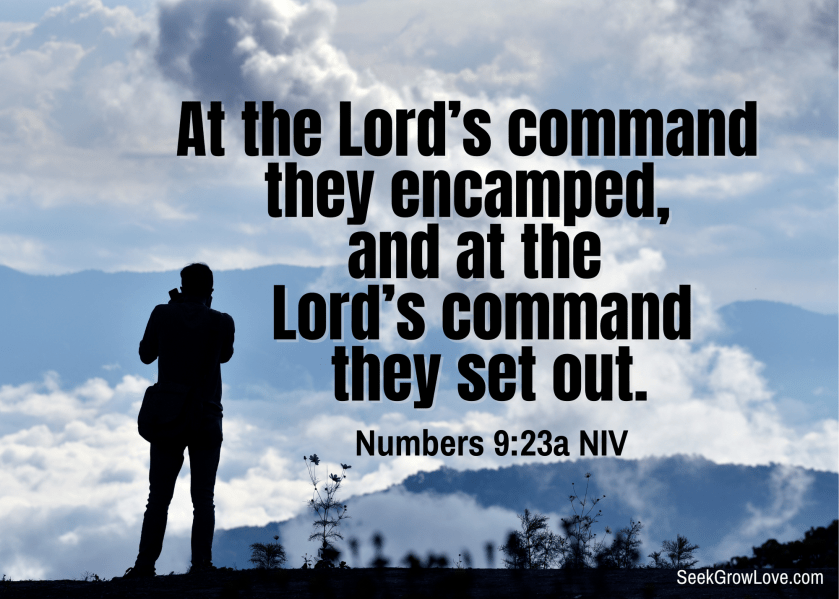
Numbers 9 discusses God’s decrees on celebrating the Passover and then their “moving” protocol. Growing up in the Air Force, I think I can understand never knowing how long you would be in any given spot. Sometimes God would have the Israelites stay for a few days, sometimes for a few years. I don’t know if this is the reason, but I suspect God did not want them to become too comfortable where they were and wanted them to remember their current position was not their home. We too would be wise to remember that where we are now is not our permanent home and we should not become too comfortable within the world.
-Maria Knowlton
Reflection Questions
Have you ever moved at God’s command – or stayed put at His command?
How do we tell today when and where He wants us to go – or stay?
What are you learning about God in Numbers so far?
Chapter 20 of Leviticus is perhaps the most difficult passage in the entire Bible for modern readers in the United States. In this chapter, the practice of homosexuality is condemned as strongly as cheating on a spouse, beastiality, and incest: the practice is condemned so harshly that it is punishable by death within Israel. While we generally still disapprove of the other inappropriate sexual unions listed in this chapter, homosexuality has taken a major swing in the opposite direction, being viewed as completely okay for people to pursue, even within the Church: in fact, the majority of Christians in the United States now view this once-condemned practice as totally acceptable for anyone, even Christians. For example, as recently as 2024, the Methodist Church voted to reverse its anti-LGBTQ+ positions, creating a major division within the denominations: they now allow for even their religious leaders to be openly practicing these once-condemned practices from the Bible.
So what is a Christian to do today? We have clear and strong prohibitions in Leviticus to avoid homosexuality and other inappropriate sexual practices, and yet, Christians today are completely divided on whether to be accepting of these practices or not. As people who believe that God gave us the Bible, and who take its commands seriously, how are we supposed to understand such difficult texts in 2025?
We come back to the discussion on “holiness”: God desired that His people would live differently than those around them. He says of His people:
“I am the LORD your God, who has separated you from the peoples.” – Leviticus 20:24
“Thus you are to be holy to Me, for I the LORD am holy; and I have set you apart from the peoples to be Mine.” – Leviticus 20:26
It is absolutely true that homosexuality has been a practice throughout the world for as long as humans existed: people were practicing it in the land of Canaan when this book was written (Leviticus 20:23), people were practicing it in the Roman world when Jesus and the apostle Paul were preaching, and people are practicing it around the world now. It has been and will likely continue to be a practice throughout the world until Jesus returns. However, does that mean Christians are allowed to participate in such things? Does the New Testament have anything to say about it, since we are under a new covenant than the Israelites?
The command for God’s people (Christians) is still to remain holy and not conform to the standards of the world: we are expected to live, speak, and act differently than those around us, just like the Israelites were commanded to do. Although some of the specifics are different, like the food laws, the standards on morals and sexuality still remain under the new covenant.
“Do you not know that the unrighteous will not inherit the kingdom of God? Do not be deceived; neither fornicators, nor idolaters, nor adulterers, nor effeminate, nor homosexuals, nor thieves, nor the covetous, nor drunkards, nor revilers, nor swindlers, will inherit the kingdom of God.” – 1 Corinthians 6:9-10 NASB1995
“… the law is not made for a righteous person, but for those who are lawless and rebellious, for the ungodly and sinners, for the unholy and profane, for those who kill their fathers or mothers, for murderers and immoral men and homosexuals and kidnappers and liars and perjurers, and whatever else is contrary to sound teaching.” – 1 Timothy 1:9-10 NASB1995
As someone who has friends and family members who are actively involved in homosexual lifestyles, it is extremely difficult for myself to read these passages because I love all of them: I want them to be in Paradise with me when Jesus returns. However, our deep desire for our loved ones to be saved in God’s Kingdom doesn’t change the standards that He has set forth for being accepted into that Kingdom, and we cannot choose to disobey those standards because we don’t want to agree in our hearts. God makes the rules, not us, and we are called to simply listen and obey His instructions: as God’s people, we are expected to live “holy” and different lives than the world around us. We cannot compromise on what’s clearly been commanded, even if it’s difficult in our world today to go against the new standards being taught to us by the world.
“Therefore, I urge you, brethren, by the mercies of God, to present your bodies a living and holy sacrifice, acceptable to God, which is your spiritual service of worship. And do not be conformed to this world, but be transformed by the renewing of your mind, so that you may prove what the will of God is, that which is good and acceptable and perfect.” – Romans 12:1-2 NASB1995
“Do not love the world nor the things in the world. If anyone loves the world, the love of the Father is not in him. For all that is in the world, the lust of the flesh and the lust of the eyes and the boastful pride of life, is not from the Father, but is from the world. The world is passing away, and also its lusts; but the one who does the will of God lives forever.” – 1 John 2:15-17 NASB1995
-Talon Paul
Reflection Questions
What rules did you have growing up that you didn’t appreciate or always agree with? Did you only have to obey the rules that you would have written yourself?
What characteristics of God make Him the best rule maker? What might He have been thinking when He created male and female and called them “very good”?
What does God want His people to be separate from today? Why be holy? Who/what wins when Christians follow the ways of the world instead of God’s way? Who loses?
How do you think God wants us to respond today to a world (and sometimes a church) that accepts and celebrates what God says is an abomination?






 Seek Grow Love