Shalom from Tennessee! This is Stephanie Schlegel writing this week as we continue through the Bible. We lived in Israel for 25+ years where our five children were born and raised. So I’ll be adding in some extra thoughts and pictures from and about Israel. 🙂
The first verse of Numbers 21 caught my attention as it still relates to today! The king of Arad fought against Israel and took some captives! :0 I’ve been reading the news of the current captives slowly being released and talk of what to do with Gaza. Surprisingly, three times in chapter 21 Israel fought against their enemies and destroyed their cities and took possession of them. For a LONG time Israel has had to contend with those against them, including up to today!
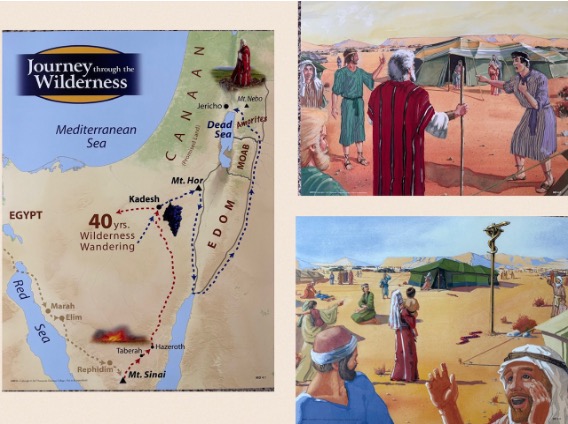
In their travels they got thirsty, hungry, and cursed the manna God provided for them! It also says they spoke against God and Moses, their leaders. Thus, God sent fiery serpents among them, in which many were bitten and killed. So they asked forgiveness, and that Moses would pray to God to remove them.
Included is a picture from the ABEKA Bible Flash-a-Card Series 3 of the life of Moses. These sets have many great pictures of Bible stories not normally seen in children’s books. We used them in our congregation’s children classes in Israel as they were taught in Hebrew. They’re great for home use as well for children and grandchildren.
Complaining about what one eats is a good lesson for all ages! Bites from deadly snakes is a rough punishment in the desert. There was a period of time while raising our children that if they complained about the food I made for dinner then they’d be doing the dishes afterwards! The complaining stopped quickly! Actually, I wasn’t even sure if they liked what I made or not as they ate it with no comments. Haha! Occasionally, after a new recipe I’d let them vote after dinner on the count of three with a thumbs up or down (or sometimes in the middle), so I could get some feedback. 🙂
One of the teachers/moms in our children’s class in Israel made a “bronze serpent” on an upside down mop with paper twisted around the top of it and then covered with duct tape and spray painted it bronze. It was a good visual aid for the kids! (I couldn’t find a picture of it since it was before the days of cell phones).
Jesus recalled this incident in John 3:14,15, “And as Moses lifted up the serpent in the wilderness, so must the Son of Man be lifted up,that whoever believes in him may have eternal life.” Thankfully, we can look to Jesus during troubled times and after we’ve failed and need forgiveness. May God help us not to complain but to repent and give thanks.
“So, whether you eat or drink, or whatever you do, do all to the glory of God.” 1 Cor. 10:31
-Stephanie Schlegel
REFLECTION QUESTIONS
1. What was the Israelites punishment for complaining? Did the punishment seem just or too harsh? What are some things that you’re complaining about that perhaps need to be addressed?
2. How does complaining against God, leaders, and food hurt us? What’s something we can do to change that?
3. The bronze serpent that they looked at to be saved eventually became an idol! Is there something in your life that has helped you that now has turned into a negative effect that maybe you should break away from? We can pray and ask God to show us and help us to turn from it.
The first time I ever set up a tent without my husband was when I took my just about to be 10 year old son to Cub Scout camp. Unfortunately, both of us were a little too short to reach all the parts we needed to secure the tent. BUT! Luckily, another parent came over and helped us out. He also gave us some tips about tent camping. However, he forgot one small detail, or maybe he thought it was common sense. He didn’t mention that we should sweep the ground before setting up the tent so there would be no rocks underneath. The first night was very uncomfortable (the next few nights we were so exhausted that we didn’t care)!
I suspect that the people of Israel were getting pretty good at setting up tents by the end of Numbers 10. This chapter lays out the order in which the tribes of Israel were to move when God would lift the cloud. It is interesting to note that Moses asks his brother-in-law for assistance since he was from around those parts. My Bible footnote states that “Divine guidance does not exclude using human help.” I think that could apply to so many areas of our life! God often puts just the right person into our lives at just the right time to carry out His will!
But sometimes the people in our lives can bring us down. In chapters 11 and 12, we find that the people are complaining, a lot, so much that some of them want to go back to Egypt! I don’t know for sure but I think it’s reasonable to guess that it probably started with a few people and soon others followed. Of course, this caused God to get a bit aggravated, sending fire and plagues against those who complained. Even Miriam, Moses’s sister, got a plague of her own, developing an acute case of leprosy. Fortunately for her, God forgave her and healed her.
Today’s reading really reminds me that while God does send people into our lives to better us and for His glory, there are those who will pull us away from God. When deciding who is who, look at the overall life of the person. What does their life look like? What does their relationship with God look like? If they are a mess and far from God, I guess you could learn what NOT to do! However, we would be wise to listen to the ones who will lead us in the ways of the LORD (and will remind you to sweep before setting up a tent)!
-Maria Knowlton
Reflection Questions
Does your circle of influencers include more helpful people who will help lead you in the way of the Lord, or more complainers who will arouse the Lord’s anger? Who specifically do you know who could be beneficial to spend more time with?
What would others say about you? Are you more known for your complaining or for leading in the way of the Lord?
When you do complain, what are you more likely to be complaining about? and to whom? Would there be a better use of your time and words?
A number of years ago I led one of my churches through the 21 day Complaint Free Challenge. The challenge was to go for 21 days in a row without complaining. We each were given a purple wristband to wear throughout the challenge. You were to wear the wristband on the same wrist for 21 straight days. If you caught yourself complaining, then you had to switch your wristband to the opposite hand and start your 21 day challenge again. Some of the studies I read said that it takes most people about a year to go 21 consecutive days without complaining. I forget how many months it took me to get to that point.
What was the purpose? To help people break the habit of complaining. For many people complaining is simply a bad habit. Will Bowen, who invented the 21 Day No Complaining Challenge says that most people complain for one of 5 reasons using the acronym G.R.I.P.E.
Get Attention
Remove Responsibility
Inspire Envy
Power
Excuse Poor Performance
When we habitually complain to get attention, to remove responsibility (shift the blame), inspire envy, exert power or excuse our poor performance, we dig a behavioral rut and complaining becomes our default response to just about any situation. That’s a sinful habit from which we need to repent.
In order to break the bad habit, like any bad habit, one must counter the undesired behavior with more desirable behavior. The goal of the complaint free world experiment was to improve the world by reducing the amount of complaining that goes on. During that process I became aware of just how often I did complain. I don’t like hearing other people complain all of the time, I don’t think anyone does. Parents don’t like to hear their kids complain all of the time. Spouses don’t like to hear their husbands/wives complain all of the time. Children don’t like to hear their parents complain all of the time. Students don’t like to hear their teachers complain, and teachers, I’m sure don’t like to listen to their students complain. Churches don’t enjoy hearing their pastor complain all of the time and pastors don’t like hearing church members complain a lot the time. And guess what…even God gets fed up with human beings complaining all of the time.
In today’s reading, God has been busy taking care of Israel. He led them out of slavery to the Egyptians by performing ten amazing signs. When Israel was being chased down by Pharaoh’s army and looked like they were doomed for destruction, God miraculously parted the waters and brought them through on dry land. God led them by cloud during the day and fire during the night. God was taking them on a journey to a land that he was going to give them. God was doing nothing but good for them.
And how did God’s people respond to all of this goodness? They complained. We’re thirsty… we’re hungry. They sounded like a bunch of whiney kids on a long trip. If you’ve gone on a long trip, the experience is very different for the parents up front and the children in the back. Think about a family going on vacation. The parents are the ones preparing for the trip. Mom’s doing the laundry, packing everyone’s clothes, preparing snacks, arranging for neighbors to come and feed the animals and water the plants. Dad is making sure the car is running well, changing the oil, getting the mail stopped, gassing up the car, checking the route to make sure there are no road closures. The parents buy the tickets for wherever they are going, pay for the meals along the way, pay for the hotel rooms, make sure the kids have stuff to do in the car/van/suv. And what do the kids do? They complain: I’m hot… I’m bored… I’m hungry…I’m thirsty… I have to pee… sister’s looking… brother hit me… and are we there yet? I had 11 children and I know what I’m talking about here.
Imagine Moses… and God. They are moving roughly 2 million men, women and children across the wilderness toward the promise land. There are no McDonalds on the journey. There are no Holiday Inns with an indoor pool. There are no air conditioned SUVs with built in blue ray players and no iPhones or Nintendo Switches to keep them occupied. They are tired, they are hot, they are thirsty and hungry, and they are complaining… a lot!
If I’d been Moses or the Lord I would have been tempted to say “Ya’ll be quiet or we’re turning around and going back!” Fortunately the Lord, and Moses, have more patience and grace than I ever had:
Exodus 16:6 So Moses and Aaron said to all the Israelites, “In the evening you will know that it was the Lord who brought you out of Egypt, 7 and in the morning you will see the glory of the Lord, because he has heard your grumbling against him. Who are we, that you should grumble against us?” 8 Moses also said, “You will know that it was the Lord when he gives you meat to eat in the evening and all the bread you want in the morning, because he has heard your grumbling against him. Who are we? You are not grumbling against us, but against the Lord.” 9 Then Moses told Aaron, “Say to the entire Israelite community, ‘Come before the Lord, for he has heard your grumbling.’” 10 While Aaron was speaking to the whole Israelite community, they looked toward the desert, and there was the glory of the Lord appearing in the cloud. 11 The Lord said to Moses, 12 “I have heard the grumbling of the Israelites. Tell them, ‘At twilight you will eat meat, and in the morning you will be filled with bread. Then you will know that I am the Lord your God.’”
God heard their grumbling and he gave them quail and manna to eat. There it was, as much as they wanted. They were able to eat their fill. And after that they never complained again. Well, that’s not true…. before long they were complaining about being thirsty too.
What God should have done was give each of them a purpose wristband to remind them not to complain. It would take them a few more lessons before they quit complaining.
I’m sure God does get tired of hearing our complaining… but he still loves us and he even gives us ways to complain in the Bible. Many of the Psalms are called Psalms of complaint and/or Psalms of lament. Jesus himself, while he was on the cross prayed one of those Psalms of complaint/lament, Psalm 22 which begins: “My God, my God why have you forsaken me?” When we are suffering real pain, real sorrow, real trials, God wants us to turn those into heart felt prayer and we should. God is able to handle our complaints and do something about them. At the same time, too often our complaining comes from a place of ingratitude. The ungrateful complaining that fails to acknowledge and appreciate God’s blessings needs to stop; legitimate complaining for true hurt in faith is something God is ready and able to hear and respond to for his glory and our blessing.
Jeff Fletcher
(originally posted on February 4, 2020 for SeekGrowLove.com)
Reflection Questions
What could the Israelites have said instead?
What happens when you are around people who are complaining? What positive message could you share with a complainer?
Try it out just for today – how long can you go without complaining and grumbling? What could you say instead every time you catch yourself (almost) complaining? How long do you think it would take you to go 21 days without complaining? Will you take the 21 Day Challenge?
In Jonah chapter 3, the great city Nineveh repented, and they turned towards God. Afterwards, God had mercy on the people and relented on the upcoming disaster that Jonah was warning them of.
For those who follow God, it should be easy to rejoice when God shows his mercy and love. However, in Jonah chapter 4 we see that Jonah was displeased with the mercy that was afforded to the people of Nineveh. Why was Jonah angry at this? This is possibly due to Nineveh being the capital of the nation of Assyria, an enemy of Israel. Perhaps being on opposite sides, Jonah wanted to see his enemies destroyed, or perhaps his own personal morality guided that the Ninevites deserved destruction. Perhaps the disaster never befalling Nineveh also delegitimized the words that he spoke to them, and made him feel less powerful. Either way, Jonah’s heart was not in the right place, and God saw to it that Jonah saw this too.
After Jonah complained to God, he rested. There, God allowed a plant to grow. Jonah found joy in this. Then, God caused the plant to die in the morning, and called in a great heat to overcome the area that Jonah was in. Again, Jonah cried out at the demise of the plant that he had.
God then likened this plant to Nineveh. It gave great joy to Jonah despite him not being the reason it grew, and it was only there overnight. So too Nineveh should also receive mercy even if recently they turned from their wicked ways.
Although only 11 verses long, Jonah 4 reveals a lot to us about who God is, and how we should interact with him. First off, God used the plant as a metaphor for Nineveh, much like how his son Jesus would use parables to teach spiritual lessons to people in ways that they may understand.
Secondly, God has love for people, even for those that are not his chosen people. Perhaps Jonah may have disagreed with this at the time, but regardless this goes on to show the legitimacy of the great commission given by Jesus in Matthew 28, and carried out through the rest of the New Testament. The love of God is for everyone.
Thirdly, we should always want what God wants. Even if we do not understand God, or if we do not agree with the way things may be going for us, we must adopt the viewpoint that aids so many people throughout the Bible: “not my will, but yours be done.” “Yours” referring to God, our father in heaven.
-Colby Leggitt
Reflection Questions
Even when we feel that we are worthless, how can we remind ourselves of the greater purpose that God has called us to?
Why was Jonah so upset that God relented to the disaster to befall Nineveh? How can we connect this to times in our lives when we are angry that things don’t go our way?
What does God tell us about the worth of being angry (without very good reason)?
Was God’s lesson on Jonah too harsh? Are such tribulations the kind of tough love that is needed sometimes for us to see things the way God wants us to?
Ok, we know that things are not going to go well when we read, Now the people complained about their hardships in the hearing of the Lord, … (Numbers 11:1)
Why would they do that? The Israelites grumbled, argued and complained, but this never works out for them. Honestly, if we look at our own lives, are we guilty of this too? Do we show God that we are thankful for our life and the provisions that He gives us? If I may quote Madame Blueberry: “A thankful heart is a happy heart.” But, the Israelites are not thankful, and they are not happy. In Numbers 11, they complained about their hardships in the hearing of the Lord, and when he heard them his anger was aroused. Then fire from the Lord burned among them and consumed some of the outskirts of the camp.
So, surely they adopted a new way of doing things, a new way to react to the situations that arose. Nope.
“The rabble with them began to crave other food, and again the Israelites started wailing and said, “If only we had meat to eat! We remember the fish we ate in Egypt at no cost—also the cucumbers, melons, leeks, onions and garlic. But now we have lost our appetite; we never see anything but this manna!” (verses 4-6)
Wow. Yep that slavery, that was the good life. Sure, they lived lives of servitude, but they had cucumbers.
Unfortunately, this complaining spread until Moses heard the people of every family wailing at the entrance to their tents. The LORD became angry and Moses was troubled. This is where I think we can learn from the way Moses responds. He asked the LORD. He is troubled because he is in a situation that is impossible for him to handle alone. He just has an honest conversation with the LORD. We see him react in the same way that he did in chapter 9 when he is asked a question about the Passover feast. He told the people to wait until he found out what the LORD commanded concerning them. I think that is how all of us should handle hardships. We should talk with God about what ever is troubling us. If we are in a continual conversation with the LORD, we bring him our praises and requests continually too.
Moses told Him that he could not carry all those people by himself; the burden was too heavy. The LORD had a solution for him. The LORD would take some of the power of the Spirit that was on Moses and put it on seventy of Israel’s elders. They shared the burden of the people so Moses did not have to carry it alone. As far as the request for meat, the quail arrived when the LORD said it would. Even Moses did not know how God could do it, but again he talks with God about it. I wonder how things would have gone for the Israelites if they had humbly thanked God for their manna and asked for meat. The LORD could even have thrown in cucumbers if He wanted to. From today’s reading lets be encouraged to pray continually sharing our hardships and praises with God.
-Rebecca Dauksas
(first posted for SeekGrowLove on September 3, 2016)
Reflection Questions
When hardships hit do you spend more time complaining or praying?
If you were a pastor/youth leader or spiritual counselor for the Israelites what issues or problems would you address with them? Which of these problems do you have as well? What could they – and what can you – do to work towards fixing these problems?
What do you learn about the Lord God in Numbers 11?
In Numbers 20-21 we encounter the Israelites at the end of their journey as they wrap up their years in the wilderness and prepare to enter the promised land of Canaan. Unfortunately, before they do that, we see a purging of a generation of people who had rebelled, distrusted, and quarreled with themselves and with the LORD. In Chapter 14 God had instructed them that only Joshua and Caleb would enter the promised land, and now we see God was serious. In Numbers 20:1 Miriam dies, in verse 12 Moses is told he will not be entering the promised land, and by the end of the chapter Aaron is dead. No special privileges here for being a priest, a leader, or related to a special someone who “was a really good person most of the time”.
In recent years I’ve heard more and more talk about generations. Terms like X, Y, Z’s, Millennials, Zillennials, Baby Boomers. All have their strengths and weaknesses, and since I fall right in-between two, depending where I am or what is being said, I might want to associate with one more than another. That is because there are stereotypes of generations, but none are always accurate nor are they particularly important or beneficial. No matter what, as a body of Christ, we are an intergenerational people, and research continues to show the benefits of multigenerational worship and education. The year of your birth simply does not have anything to do with who we are in Christ. What does matter is our faith in Jesus and being a follower of him. In today’s reading, we see a generation dying out who knew God, yet had managed to waste the better part of 40 years not doing much to please Him, but doing a great job finding things to fight and complain about. We are currently living in a world where fights and complaints are the norm, and also one where our life expectancy is dropping. Many people born in recent generations have a lower life expectancy than their parents did. We are on this earth for a finite time, and unless we live until Jesus returns, we will “rest with our fathers” the same way people have been doing since the days of Numbers.
But, the story of Numbers doesn’t just end with death and burials, and ours doesn’t have to either. Joshua and Caleb (and crew) did get to the Promised Land. And we see more symbolism again in this idea since Yeshua can be translated as Joshua in Hebrew (our OT character leading them to the promised land) and when translated into Greek/from Greek can be translated as Jesus (our NT character through whom we have hope of our promised land in the kingdom). There is lots more out there to learn about as far as name studies if that interests you which I’ve learned a bit more about through a friend who has “Yeshua is my king” stickered across his back window. I couldn’t help ask about that one the first time I met him!
Another thing I found interesting as I read Numbers 20-21 is that a lot of the pagan enemies they are fighting on their way to the promised land are their “relatives”. The Edomites come from Esau (who was later named Edom), the Moabites and Ammonites come through incestuous relationships through Lot, and for that matter, all of them go back to Noah’s three sons! But, it didn’t matter if you were a descendant of Abraham or a relative of someone who once believed in the one true God. The people who entered the promised land were those who trusted and relied on Him, humbling themselves to allow Him to lead. Everyone else who didn’t worship the one true God as he instructed them to, set apart and holy according to his expectations. . . they were enemies. It didn’t matter if they had heard YHWH, the God of Israel, was powerful and real and they were a little scared of him. It mattered if they honored and obeyed him, and they certainly did not. While family trees can be interesting, that is about all they are good for when it comes to things of eternal perspective. The fact that your great grandpa was an elder who walked 10 miles uphill to go to church every Sunday doesn’t matter, and whether or not your relatives called themselves Christians or you attended church as a kid does not matter for your future. What matters is that in your present, regardless of which generation you are from or how much longer you may have left on this earth, you humble yourself before God and let Him lead. The wilderness surrounds us, but the promised land to come is real.
Yesterday I ended with a verse I really liked about Jesus being the sacrifice for sins for all of us, for the whole world for all time. No more sacrifices required, and we are cleansed and forgiven. That is beautiful and true. But, the verse immediately following is too. It tells us how God expects us to respond to that gift and is a good way to wrap up our studies in Numbers this week I think.
“And by this we know that we have come to know him, if we keep his commandments.” (I John 2:3, ESV)
-Jennifer Hall
Reflection Questions
What did this Israelite generation have going for them? What were strikes against them? What most important thing did they keep forgetting?
Right now, this week, have you been more like Joshua and Caleb – intent on trusting a great big God who saves and will lead you into the Promised Land – or the generation that will not survive the wilderness – losing sight of God’s greatness as you focus instead on complaining, arguing, living in fear and negativity and quarreling with the Lord? Are there any changes that need to be made starting today?
What does God reveal about Himself in the passages we have read from His Holy Word today?
A couple of years prior to Numbers chapter 11, the Israelites were enslaved in Egypt. They were being mistreated by the Egyptians, and they wanted out! God answered their plea, and he delivered the Israelites from the Egyptians. It wasn’t an easy process though, as man could not have done it alone. God had to perform a number of miracles along the way to free the Israelites.
If we fast forward back to Numbers 11, the Israelites begin to complain because they are hungry. They complain to Moses who then complains to God. It’s as if the Israelites completely forgot all of the miracles that God performed in the first place to get them out of Egypt. When I read about how the Israelites complain time and time again about being hungry, thirsty, or whatever, I get irritated with them. I ask how in the world could they complain after all that God has done for them?!
Unfortunately, the more I think about the Israelites complaining, the more I realize similarities between them and many of us today, myself included. God may not have rescued us from the hands of the Egyptians, but He has done so much more than we could ever begin to ask. God laid down his own Son for us, so that we could have everlasting life in His coming Kingdom. That’s powerful! After all that God has done for us, we still have our bad days. We still have our days in which we complain to God about the current issues we are experiencing in life.
From the outside looking in, the problems that the Israelites faced seemed like such small issues in the big picture, and the truth of the matter is that they were. The same could be said about many of the small issues that we face on a daily basis and have the audacity to complain to God about after all He has done for us. I’m all for being honest with God and expressing our real, raw feelings to God, so I don’t think that’s the issue. Rather, maybe we shouldn’t let the small issues that we may experience affect us so much. We need to put all the temporary issues that we experience into perspective. Most of the issues that a lot of us, myself included, may complain about aren’t even worth complaining about in the first place!
A small bump in the road may seem like a giant mountain when we are going through it, but hindsight is often able to put those issues into perspective. Let’s work on putting those small issues into perspective in the moment, which is a lot easier said than done. If we do this, then our positive attitudes will uplift us and those around us.
A note from Psalms:
“Send out your light and your truth; let them lead me; let them bring me to your holy hill and to your dwelling!” Psalm 43:3
This ties directly in to our conversation yesterday about being led by God. Pray for God to send out his light and truth to us to lead us where He sees fit.
A number of years ago I led one of my churches through the 21 day Complaint Free Challenge. The challenge was to go for 21 days in a row without complaining. We each were given a purple wristband to wear throughout the challenge. You were to wear the wristband on the same wrist for 21 straight days. If you caught yourself complaining, then you had to switch your wristband to the opposite hand and start you 21 day challenge again. Some of the studies I read said that it takes most people about a year to go 21 consecutive days without complaining. I forget how many months it took me to get to that point.
What was the purpose? To help people break the habit of complaining. For many people complaining is simply a bad habit. Will Bowen, who invented the 21 Day No Complaining Challenge says that most people complain for one of 5 reasons using the acronym G.R.I.P.E.
Get Attention
Remove Responsibility
Inspire Envy
Power
Excuse Poor Performance
When we habitually complain to get attention, to remove responsibility (shift the blame) inspire envy, exert power or excuse our poor performance, we dig a behavioral rut and complaining becomes our default response to just about any situation. That’s a sinful habit from which we need to repent.
In order to break the bad habit, like any bad habit, one must counter the undesired behavior with more desirable behavior. The goal of the complaint free world experiment was to improve the world by reducing the amount of complaining that goes on. During that process I became aware of just how often I did complain. I don’t like hearing other people complain all of the time, I don’t think anyone does. Parents don’t like to hear their kids complain all of the time. Spouses don’t like to hear their husbands/wives complain all of the time. Children don’t like to hear their parents complain all of the time. Students don’t like to hear their teachers complain, and teachers, I’m sure don’t like to listen to their students complain. Churches don’t enjoy hearing their pastor complain all of the time and pastors don’t like hearing church members complain a lot the time. And guess what…even God gets fed up with human beings complaining all of the time.
In today’s reading, God has been busy taking care of Israel. He led them out of slavery to the Egyptians by performing ten amazing signs. When Israel was being chased down by Pharaoh’s army and looked like they were doomed for destruction, God miraculously parted the waters and brought them through on dry land. God led them by cloud during the day and fire during the night. God was taking them on a journey to a land that he was going to give them. God was doing nothing but good for them.
And how did God’s people respond to all of this goodness? They complained. We’re thirsty… we’re hungry. They sounded like a bunch of whiney kids on a long trip. If you’ve gone on a long trip, the experience is very different for the parents up front and the children in the back. Think about a family going on vacation. The parents are the ones preparing for the trip. Mom’s doing the laundry, packing everyones clothes, preparing snacks, arranging for neighbors to come and feed the animals and water the plants. Dad is making sure the car is running well, changing the oil, getting the mail stopped, gassing up the car, checking the route to make sure there are no road closures. The parents buy the tickets for wherever they are going, pay for the meals along the way, pay for the hotel rooms, make sure the kids have stuff to do in the car/van/suv. And what do the kids do? They complain: I’m hot… I’m bored… I’m hungry…I’m thirsty… I have to pee… sisters looking… brother hit me… and are we there yet? I had 11 children and I know what I’m talking about here.
Imagine Moses… and God. They are moving roughly 2 million men, women and children across the wilderness toward the promise land. There are no McDonalds on the journey. There are no Holiday Inns with an indoor pool. There are no air conditioned SUVs with built in blue ray players and no iPhones or Nintendo Switches to keep them occupied. They are tired, they are hot, they are thirsty and hungry, and they are complaining… a lot!
If I’d been Moses or the Lord I would have been tempted to say “Ya’ll be quiet or we’re turning around and going back!” Fortunately the Lord, and Moses have more patience and grace than I ever had:
Exodus 16:6 So Moses and Aaron said to all the Israelites, “In the evening you will know that it was the Lord who brought you out of Egypt, 7 and in the morning you will see the glory of the Lord, because he has heard your grumbling against him. Who are we, that you should grumble against us?” 8 Moses also said, “You will know that it was the Lord when he gives you meat to eat in the evening and all the bread you want in the morning, because he has heard your grumbling against him. Who are we? You are not grumbling against us, but against the Lord.” 9 Then Moses told Aaron, “Say to the entire Israelite community, ‘Come before the Lord, for he has heard your grumbling.’” 10 While Aaron was speaking to the whole Israelite community, they looked toward the desert, and there was the glory of the Lord appearing in the cloud. 11 The Lord said to Moses, 12 “I have heard the grumbling of the Israelites. Tell them, ‘At twilight you will eat meat, and in the morning you will be filled with bread. Then you will know that I am the Lord your God.’”
God heard their grumbling and he gave them quail and manna to eat. There it was, as much as they wanted. They were able to eat their fill. And after that they never complained again. Well, that’s not true…. before long they were complaining about being thirsty too.
What God should have done was give each of them a purpose wristband to remind them not to complain. It would take them a few more lessons before they quit complaining.
I’m sure God does get tired of hearing our complaining… but he still loves us and he even gives us ways to complain in the Bible. Many of the Psalms are called Psalms of complaint and/or Psalms of lament. Jesus himself, while he was on the cross prayed one of those Psalms of complaint/lament, Psalm 22 which begins: “My God, my God why have you forsaken me?” When we are suffering real pain, real sorrow, real trials, God wants us to turn those into heart felt prayer and we should. God is able to handle our complaints and do something about them. At the same time, too often our complaining comes from a place of ingratitude. The ungrateful complaining that fails to acknowledge and appreciate God’s blessings needs to stop; legitimate complaining for true hurt in faith is something God is ready and able to hear and respond to for his glory and our blessing.
In our final chapter of James we find a teaching that is difficult for many of us. We find that we are taught to have patience. I find it difficult to be patient many times when I see someone behaving in a way that is not good for them, especially when it is someone whom I have invested time and care into. We care so deeply for so many people and it is hard to watch them go down a path that leads to destruction. He reminds us first of all that the things we have amassed for ourselves on this earth are of little value in the long run. He reminds us to store up our treasures in our eternal future, NOT in this temporary life, where moth and rust destroy.
We are told in verse eight to strengthen our hearts because the return of the Lord is “at hand”. We are to patiently await the return as we seek to serve Him in our thoughts and actions. In verse nine he says that we are not to complain about one another, remembering that the judge is at the door. It is not our job to complain about each other and to cause strife. It is not even our job to judge one another, we are to encourage with our actions and speak the truth in love.
James also tells us that we will face difficult times and we need to remember in those times that God is on our side and He is full of compassion and mercy. He uses the example of Job and reminds us that in the end, although his struggles were many, he still praised the LORD. In verses thirteen through eighteen he reminds us that no matter our circumstances we should prayerfully seek God.
Is anyone among you suffering? Then he must pray. Is anyone cheerful? He is to sing praises. 14 Is anyone among you sick? Then he must call for the elders of the church and they are to pray over him, anointing him with oil in the name of the Lord; 15 and the prayer offered in faith will restore the one who is sick, and the Lord will raise him up, and if he has committed sins, they will be forgiven him. James 5:13-15 NASB
He also reminds us that we should not think that we are not capable of the incredible feats God has accomplished through others. He says Elijah was a man just like us, … and he prayed. This is the answer to so many of our issues that we have today … and he prayed.
Unfortunately, as we experience life we will find times when brothers and sisters in Christ turn and choose not to follow. We are encouraged to turn him back to save his soul and cover his sins. We sometimes think when we have fallen short that our sins are too much for God to forgive. Who am I to say that the blood of Christ is insufficient for the forgiveness of my sins? James says this will cover “a multitude of sins.”
We must remember to be patient with one!
We must remember to strengthen our hearts because Christ is returning!
We MUST remember to pray in EVERY situation!
We must encourage one another to turn back to God when we fall!
One of the most difficult things I have done in my life was move rocks. Last year at UP: PROJECT we moved, what seemed to be, a mountain at Timber Oaks Retreat center. During this time the majority of us had a hard time not complaining after the 4th day of “Rock Duty”.
Paul writes in Philippians 2:14 “Do all things without grumbling and disputing.” In this passage of Philippians 2 he is referring to the idea of being selfless. When we saw that giant hillside of rocks it made us grumble about how little we think we did, but in a selfless mindset we should understand that we did more than we think we did. There were at least 30 of us on that trip and it took around 5 days to get the hillside to look even remotely like we did something, and we even had a tractor! Paul, and I assume Christ, would call us to not grumble when we serve others but focus on what we are doing to help the ones we serve. Just imagine if 4 or 5 people had to do the work of 30! Next time you serve remember why you are serving and put a smile on your face.








 Seek Grow Love