
Old Testament: Nehemiah 9 & 10
Poetry: Psalm 23
*New Testament: John 3
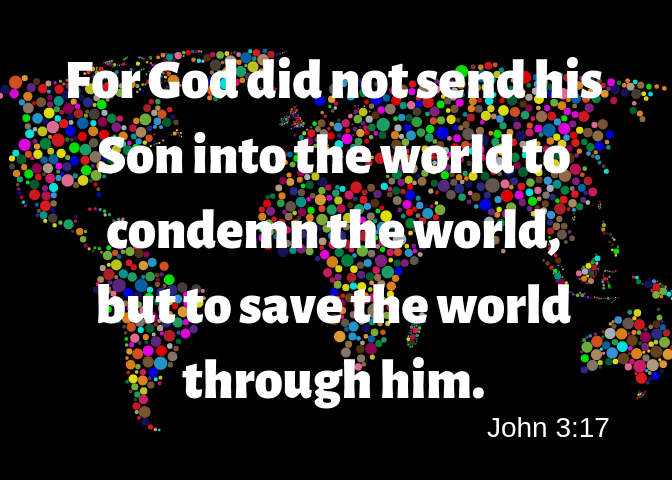
“Indeed, God did not send the Son into the world to condemn the world, but in order that the world might be saved through him.” John 3:17 (NRSV)
What does it mean to be saved? We all know the correct Sunday school answer. Yes, Jesus died on our behalf so that we can be forgiven of our sins and receive eternal life. I believe this is true, and at the same time, I believe the concept of salvation has to go deeper and wider than that simple transactional formula.
There’s an important question that needs to be asked. Saved from what? We all have a concept of what being saved from something looks like. Stranded on an island, you are saved by the passing boat that just happened to see your fire. You’re trapped in a burning building, but a courageous firefighter is able to find you and carry you out just before the building collapses. These are the scenarios that play out in our imaginations, the books we read, and the movies we watch.
Is being saved any different in the Bible? The Old Testament has a fairly developed idea of salvation, but the goal of the “afterlife” is really not in view. It hints at the concept of resurrection at times, but that belief didn’t fully develop until sometime in between the Old and New Testaments. In the Old Testament, salvation is usually about deliverance from a real physical threat. A prime example of this is the Israelite exodus out of Egypt. They were being delivered out of slavery, oppression, and a very close call with death itself. The focus of salvation in the Old Testament is also much more about the collective than the individual. A large theme in the prophets is the restoration and healing of the people and nation, with deep connections to the covenant between God and his people.
The concept of salvation does evolve in the New Testament, but keeps its roots firmly planted in the soil of the Old Testament. Salvation in the New Testament finds its center in the person and ministry of Jesus. It becomes more inclusive by expanding out from the Jews to all nations and people groups. While collective salvation remains a reality, individual salvation is brought into the conversation more. There grows to be more emphasis on grace, eternal life, and the new covenant.
So far I haven’t answered the question of what we are being saved from. Consider John 3:36 (NRSV) – “Whoever believes in the Son has eternal life; whoever disobeys the Son will not see life, but must endure God’s wrath.” On the surface, it sounds a bit like we need to be saved from an angry God who will hunt us down and deal out the punishment we deserve. That is the mental picture that comes to mind with the word “wrath,” but it doesn’t best reflect the character of God. What could instead be meant by the “wrath” of God?
There are consequences to sin. We know that ultimately, those consequences lead to death (Rom 6:23). It may be that God disciplines or punishes us for our sin in an active sense, and at the same time, some of the punishment and suffering we feel is due to natural consequences of what we have done. When we sin, we separate ourselves from God and cultivate a living “hell” in our life and in the lives of everyone around us. We are then living in a space that invites destruction and death. God doesn’t have to threaten to punish or destroy us, because left to our own devices, we may very well just destroy ourselves. I may be taking an interpretive risk here, but maybe “wrath” is primarily God allowing us to suffer the natural consequences of our own stupidity.
What we need to be saved from is our state characterized by exile, separation from God, Sin, and Death. The meanings of those things overlap and tangle so much that we might as well be talking about the same thing. Instead of living in our own twisted upside-down realm, we are meant to experience abundant life under the rule of our merciful God. Jesus didn’t show up to condemn us, but to invite us back to where we really belong. He is the mediator who was able to restore our connection to the divine. He’s the portal back to the realm where we belong.
Salvation is still very much about us being delivered from a real threat. We are being delivered from our own hazardous wasteland into the Garden, and we are called to be cultivators of the grace, abundance, and life that grow there. Salvation has as much to do with the present time and place as it does with eternity.
-Jay Laurent
Reflection Questions:
1. What have you been saved from, or how have you experienced salvation?
2. What do you think it means when Jesus tells Nicodemus he must be “born from above”?
 Seek Grow Love