Over 3,000!

Picture1rebecca

I like books. But I find that I like the idea of reading a book, more than I actually like reading the book. Some of you can relate. I have books that I started, but just never finished.  I like the possibility of what the book is promising. Maybe it is becoming more organized, getting better grades, learning another language, do it yourself projects, restoring an old car, …there are countless things that we can learn from books.

The greatest book of course is the one that God has given us.  It is the book that we continue to read through our lives. Why? We have been doing some in depth Bible study during our Grow devotions. What is it that this collection of 66 books is promising to the reader?

The Bible makes some incredible promises. Promises that have happened, that are happening and that will happen. And of course, the importance of these promises rests in the fact that they are offered from God.  He is speaking through the scriptures to us. For instance, the promise that we can know who God is. “Come near to God and He will come near to you”. (James 4:8) Or the promise that we can become God’s children. “See what great love the Father has lavished on us, that we should be called children of God!” (1 John 3:1) We are also offered the promise of forgiveness. “If we confess our sins, he is faithful and just and will forgive us our sins and purify us from all unrighteousness.” (1 John 1:9)

Those promises are amazing because we can be forgiven and we can connect with our Creator. We can grow our relationship with Him so close that we can call Him, “our Father”. And just like a loving Father teaches a child the things they need to know, He teaches us through the scriptures.  We can learn how to make decisions and how to live. And He promises us His Holy Spirit. His Spirit enables us to live lives that show love, joy, peace, patience, kindness, goodness, faithfulness, gentleness and self-control.

I recently read that a Bible scholar states that there are over 3,000 promises from God through the scriptures. That is huge, but we know that those promises will be fulfilled because God is the one making them. We can trust God because He will follow through on His promises. So no matter what, lets continue to study this incredible book with a message of love that is filled with promises written from Our Father.


His divine power has given us everything we need for a godly life through our knowledge of him who called us by his own glory and goodness. Through these he has given us his very great and precious promises, so that through them you may participate in the divine nature, having escaped the corruption in the world caused by evil desires. 2 Peter 1:3-4


-Rebecca Dauksas



Peacemakers

blessed are the peacemakers, for they will be called children of God

The older I get, the more I realize I’m an exact replica of my mom. We like the same movies, we think (and overthink) the same things, we’re both textbook ISFJ’s, and we both spend hours looking at houses for sale that we’ll never afford. Matthew 5:9 says, “Blessed are the peacemakers, for they will be called children of God.” If we’re children of God, we should strive to be like God, reflecting His character. When people see us, they should see the love of God in our lives.

In the face of conflict, it’s hard to be love. We often want to be right more than we want to be love. Jesus, however, is the perfect example of how to be love in the face of conflict. We often overlook that he was a human just like us; his challenges, even 2,000 years ago, are a lot like our challenges. This week, we’ve tried to answer how Jesus resolved conflict to give us insight into how to deal with our own conflicts.

Jesus resolved conflict with great urgency. Stop running away from conflict no matter how overwhelming or scary the problem may be. Don’t let unresolved conflict fester; instead, deal with it directly and quickly.

Jesus was a persistent diplomat. Jesus gave us a three-step plan to dealing with sin and conflict within the church. First, go to the culprit alone, then bring another trusted member or two of the church with you, and finally bring the conflict to the church as a whole. We don’t have the power to save people, but we can be patient, loving, persistent, and cover them with prayer.

Jesus saw each conflict as an opportunity for grace. Jesus preached that if someone hits you, don’t hit back; instead, turn your other cheek. We have the chance to be love to someone who may have never truly experienced how intense and whole God’s love is. Sure, they might not deserve grace, but neither did we.

Jesus disciplined out of love. Ah yes, Jesus flipped tables and even fashioned his own whip. Love isn’t always rainbows and butterflies; sometimes, it’s a harsh slap to the hand. As brothers and sisters, we’re supposed to refine each other so that we may all follow Jesus a little closer every day.

Jesus embodied forgiveness. Just as you have experienced the joy and freedom that forgiveness brings, give that same joy to someone else. Forgive as you have been forgiven.

Jesus submitted to God’s will even when it was hard. Jesus’ submission led him to the cross. God has prepared a cup for you, too, representing His will for your life. Will you be obedient to what God has filled your cup with?

My prayer is that you feel encouraged and equipped to tackle the conflicts in your life with love just as Jesus did.


-Mackenzie McClain

Silence and Submission

but Jesus made no reply, not even to a single charge

This week, we’ve seen Jesus be the peaceful yet persistent diplomat. He’s preached about turning the cheek and walking the extra mile. He’s told stories about forgiveness and even flipped over tables. Today, we see Jesus be silent. Matthew 27:11-14 tells of the exchange between Jesus and Pilate shortly after Jesus’ arrest:

Meanwhile Jesus stood before the governor, and the governor asked him, “Are you the king of the Jews?”


“You have said so,” Jesus replied.


When he was accused by the chief priests and the elders, he gave no answer. Then Pilate asked him, “Don’t you hear the testimony they are bringing against you?” But Jesus made no reply, not even to a single charge—to the great amazement of the governor.

On the surface, the story of Jesus before Pilate is about a conflict between, you guessed it, Jesus and Pilate. On a deeper level, it’s the resolution of a conflict between Jesus and God. The night before this encounter, Jesus was severely troubled by God’s will.

Then Jesus went with his disciples to a place called Gethsemane, and he said to them, “Sit here while I go over there and pray.” He took Peter and the two sons of Zebedee along with him, and he began to be sorrowful and troubled. Then he said to them, “My soul is overwhelmed with sorrow to the point of death. Stay here and keep watch with me.”


Going a little farther, he fell with his face to the ground and prayed, “My Father, if it is possible, may this cup be taken from me. Yet not as I will, but as you will.” (Matthew 27:36-39)

Jesus repeats this prayer two more times. He earnestly pleads to his Father to provide him a way out. Jesus is obviously conflicted because he wants to obey his Father, but he also doesn’t want to die. Jesus’ sentiments seem familiar. I often find myself wanting to obey God, but wishing God would call me to do something different. God has given each of us a cup, too. I find some of the things God has filled my cup with really fun and exciting, like getting to teach the middle schoolers at my church every week. Other things that God has filled my cup with are a lot harder to swallow. Loving my enemies? Forgiving those who have hurt me? Denying myself? Obedience and submission to God’s will is not a pick and choose; it’s an all or nothing.

Jesus refuses to defend himself before Pilate as an act of obedience toward God, it’s the resolution of last night’s conflict. It’s Jesus saying, “Okay, God, not my will, but Your will.” In his silence, there is submission. Jesus’ cup was beyond difficult to swallow, but he did it for God—he did it for you and me.

What’s in your cup? Will you be obedient to what God has filled your cup with?


-Mackenzie McClain

Forgive(n)

Jesus answered, _I tell you, not seven times, but seventy-seven times-2

Matthew 18:21-35

If you’ve ever sat down and had a conversation with my dad, he’s probably told you about a restaurant he’s been to. He loves to research unique restaurants in every city we visit. When he falls in love with a new restaurant, whether it’s the hole-in-the-wall diner with the best burgers and apple pie or the breakfast place with cinnamon rolls bigger than your face, he wants to tell everyone about it. When you discover and experience something so special, you have to share it. Forgiveness is the same way.

Being forgiven has got to be the most joyous and freeing thing you have ever experienced. God, through the sacrifice of Jesus, freed you from your bondage, your sin, your shame, and your death. Now, it’s your job to give away that same forgiveness (warning: it’s not quite as easy as talking about giant cinnamon rolls)

Jesus tells a story about a master and his servants that resembles an episode of Downton Abbey, but lacks really good music. A servant owes his master 10,000 bags of gold, a debt he is not able to repay, so the master orders that he gives up everything, including his wife and children, to be sold. The servant begs for forgiveness, and the master cancelled the debt and let him go.

The story takes an unfortunate twist.  The servant encounters a fellow servant who owes him 100 silver coins. The newly freed servant violently chokes the other servant and demands that he pay back his debt. The indebted servant begs for forgiveness, but he was thrown in prison. Those who witnessed the hypocrisy were outraged and reported everything they saw to the master. The master calls the servant he forgave in and says, “You wicked servant, I canceled all that debt of yours because you begged me to. Shouldn’t you have had mercy on your fellow servant just as I had on you?” The master then handed the servant over to the jailers to be tortured until he paid back all that he owed.

We’re the first servant. We were forgiven by our master for a debt that we could never repay. We’re free, and now a choice is before us: will we forgive those who have done wrong to us? Tread carefully because the consequences of this situation are severe. If we don’t forgive, we will not be forgiven. Jesus says that if we don’t forgive our brother or sister, we will be subject to the same treatment as the servant. Forgiveness is hard, but it’s our responsibility to share the joy and freedom that comes with forgiveness.

Think about someone who has hurt you. Maybe they haven’t even sought out forgiveness, but it’s up to you to make the first step. As you experience how hard forgiveness can be, thank God for forgiving you because it wasn’t easy for Him either—He watched His son die for you.

Forgive as you have been forgiven.

-Mackenzie McClain

Indiana Jones Jesus

spur-2

“When it was almost time for the Jewish Passover, Jesus went up to Jerusalem. In the temple courts he found people selling cattle, sheep and doves, and others sitting at tables exchanging money. So he made a whip out of cords, and drove all from the temple courts, both sheep and cattle; he scattered the coins of the money changers and overturned their tables. To those who sold doves he said, “Get these out of here! Stop turning my Father’s house into a market!” (John 2:13-16)

For many years, this passage confused me. I thought Jesus preached peace, but here he is flipping tables and fashioning his own whip. He seems more like Indiana Jones than the Jesus I learned about in Sunday School. The image of Jesus throwing a tantrum in the temple is so jarring and powerful because it is an exception to his otherwise gentle and peaceful nature.

In this story, Jesus reminds me of the mother of a young toddler. Most of the time, the mother is sweet, gentle, and tender-hearted towards her child. One day, however, the child reaches to turn the knob of the stove, igniting the flame. The mother slaps the child’s hand away to teach him that he should never touch the stove, because it could seriously hurt him. The mother doesn’t usually go about slapping her child, but when the consequences of a situation are severe, serious actions must be taken. Even though the mother may have hurt or scared her young child, she did it in the child’s best interest. Sometimes a slap to the hand is much more loving than an “it’s okay, sweetheart.”

At first glance, Jesus’ wrath in the temple may seem out of character, but really, it’s just a different manifestation of his character than we are used to seeing. At the core of Jesus’ character is a passion for the Church, a cause he would eventually die for. When he sees people taking advantage of the Church, he is understandably angry and disturbed. He takes a slap to the hand approach here because of the severe consequences of the situation. Jesus is no less loving than before; his love is just shown in a different way.

Confrontation makes me uneasy, but sometimes it is necessary. I’m not saying you have to make your own whip like Jesus did, but be willing to engage in uncomfortable discussions to help discipline a brother or sister out of love. Hebrews 10:24 says, “And let us consider how we may SPUR one another on toward love and good deeds.”  A spur is a small spike on the heel of a horse rider’s boot used to direct the horse. Like the slap on the hand, the spur may temporarily sting, but it serves a purpose. We have a responsibility to spur our brothers and sisters on toward following Jesus a little closer each and every day.

“We’re all rough drafts of the people we’re still becoming” –Bob Goff, Everybody Always


-Mackenzie McClain

Lose-Win

whoever wants to be my disciple must deny themselves and take up their cross and follow me

Yesterday, we talked about Jesus’ procedure of dealing with sin inside of the Church, but what are you supposed to do when someone who never claimed to be a Christian sins against you? Jesus’ answer to that question may surprise you. Have you ever heard of a win-win conflict resolution approach? Well, Jesus’ approach is more of a lose-win. As followers of Christ, we give up our right to hurt people who hurt us. Instead, Jesus calls us to treat each conflict as an opportunity for grace—an opportunity to show God’s love to someone who has maybe never experienced it.

In Matthew 5:38-42, Jesus describes his upside-down approach to dealing with conflict, “You have heard that it was said, ‘Eye for eye, and tooth for tooth.’ But I tell you, do not resist an evil person. If anyone slaps you on the right cheek, turn to them the other cheek also. And if anyone wants to sue you and take your shirt, hand over your coat as well. If anyone forces you to go one mile, go with them two miles. Give to the one who asks you, and do not turn away from the one who wants to borrow from you.”

Jesus defies logic, saying that if someone mistreats you, give them grace, but Jesus doesn’t just talk about grace, he embodies it. The outcasts, the troublemakers, and the “rough around the edges” are the people we often ignore or set aside, but these were the kinds of people Jesus spent his time on earth interacting with. These were the kinds of people Jesus died for. These were the kinds of people we were before we were adopted into God’s love. Just as grace transformed you, grace can transform the people who hurt you.

If we want to be a reflection of God’s love in the midst of conflict, we must first trade in our pride, our need for justice, revenge, or being right, for humility. In Matthew 16:24-25, Jesus says to his disciples, “Whoever wants to be my disciple must deny themselves and take up their cross and follow me. For whoever wants to save their life will lose it, but whoever loses their life for me will find it.”

Today, be intentional about being love to someone who may have never truly experienced how intense and whole God’s love is. If someone hurts you, give them more grace than they know what to do with. They don’t deserve grace, but neither did we.


-Mackenzie McClain

Conflict Within the Church

speaking the truth I love-2

Jesus makes a distinction between conflict outside and within the Church. The bonds we have with people in the Church are different—we’re brothers and sisters. As brothers and sisters, we have an obligation to correct, discipline, and mentor each other. Proverbs 27:17 says, “As iron sharpens iron, so one person sharpens another.”

Just like rubbing iron together creates friction, there is sometimes friction in our relationships, especially when sin tries to sneak its way between us. Sin and conflict, if not handled properly, can fracture the unity of the Church. Jesus’ passion was the Church, He went as far as dying on a cross for the sake of preserving the Church for all eternity. Sin is the enemy of Jesus’ preservation mission, so we must handle sin and conflict inside the Church carefully but also with great urgency. Fortunately for us, Jesus lays out a three-step plan to dealing with trouble in our churches.

In Matthew 18:15-17, Jesus says, “If your brother sins against you, go and tell him his fault, between you and him alone. If he listens to you, you have gained your brother. But if he does not listen, take one or two others along with you, that every charge may be established by the evidence of two or three witnesses. If he refuses to listen to them, tell it to the church. And if he refuses to listen even to the church, let him be to you as a Gentile and a tax collector.”

The first step when a problem arises in the Church is to go directly to the culprit in private—doing so with love, mercy, and understanding. Jesus says it’s our responsibility to resolve conflict whether we’re the ones causing it or not. As peacemakers, we get the privilege in joining Jesus in his mission of preserving the Church. If the culprit listens and repents, congrats, you’ve completed your mission in record timing. If your mission was unsuccessful, don’t give up just yet. The next step is to take along another trusted member or two of the Church to confront the culprit. There is power in numbers. If the culprit refuses to listen yet again, bring the issue to the Church itself. This is the Hail Mary attempt. Pull out every stop and go the extra 500 zillion miles, praying that God will multiply your efforts. Up until this point, Jesus’ objective has been mercy, but if this final step fails, justice takes over. This unrepentant culprit is now considered  a Gentile or tax collector, meaning he is no longer a part of the community of believers. Paul draws upon Jesus’ teaching in 2 Thessalonians 3:6, saying, “In the name of the Lord Jesus Christ, we command you, brothers and sisters, to keep away from every believer who is idle and disruptive and does not live according to the teaching you received from us.” If this is the fate of your mission, find peace in the fact that you are not responsible for changing hearts. You can love people, but you don’t have the authority and power to save them.

Today, pray for your church. This amazing connection we have to each other as believers of the one true God is frail and fragile in this broken world. Where there is a crack, more sin and troubles are sure to find their way in, so we must confront each crack diligently, following the procedure Jesus lays out for us in Matthew 18. Yes, confrontation is uncomfortable, but so was being nailed on a cross. Jesus never said it would be easy; he said it would be worth it.


-Mackenzie McClain

How Did Jesus Resolve Conflict

make every effort to live in peace with everyone and to be holy

At the grocery store, if someone’s cart is blocking the Reese’s Puffs, I’ll pretend to be intensely interested in the Raisin Bran until my fellow shopper moves their cart. Even the tiniest of confrontations makes me uneasy. I hate conflict even more than I hate Raisin Bran. I don’t like to make waves, ruffle feathers, or stir the pot. Can anyone relate?

Conflict is simply the clash of wants. Conflict isn’t inherently bad. Sure, it’s unpleasant, but it’s natural. Since God created everyone with different and unique interests, passions, and ideas, our wants aren’t always going to align (in my experience they usually don’t). Because conflict is inescapable, we should learn how to resolve it in a way that is pleasing and honoring to God.

God calls us to be peacemakers. Hebrews 12:14 says, “Make every effort to live in peace with everyone and to be holy.” We’re supposed to make EVERY effort to be at peace with EVERYONE? That seems like a tall order, and it is. God never said it would be easy, but He said it would work.

Jesus is our perfect example of a peacemaker. Without sin, Jesus dealt with conflict head on. We place Jesus on a pedestal (as we should, I mean he literally saved the world), but we sometimes forget that he is a human, too. Hebrews 4:15 says, “For we do not have a high priest who is unable to empathize with our weaknesses, but we have one who has been tempted in every way, just as we are—yet he did not sin.” Jesus understands how difficult dealing with conflict can be. The Teachers of the Law and Pharisees were constantly trying to trip him up, one of his best friends betrayed him for a few dozen pieces of silver, and he was arrested and crucified for a crime he didn’t commit. Jesus saw each conflict as an opportunity for grace. There’s a lot we can learn from our soft-spoken, table-flipping Savior.

One of Jesus’ first lessons about dealing with conflict comes from the Sermon on the Mount. In Matthew 5:23-24, Jesus highlights the urgency of resolving conflict, “If you are offering your gift at the altar and there remember that your brother or sister has something against you, leave your gift there in front of the altar. First go and be reconciled to them; then come and offer your gift.” This week, as we explore how Jesus resolved conflict, remember that there is great urgency in settling the conflicts in our lives. Don’t let unresolved conflict fester; deal with it swiftly and directly.

Is there unspoken tension between you and a friend? Is there an action you need to seek forgiveness for? Do you need to forgive someone for a wound you haven’t dealt with yet? What can you do today to bring peace to a rocky area of your life?


-Mackenzie McClain

Love and Forgiveness

1 Corinthians 16 14

Throughout this week we have discussed topics on having a Christ-centered life, God’s Will vs. our will, our purpose in life, worshipping by singing, standing up for Christ, and thriving. Today we are going to discuss two important attributes and characteristics of Christians. We, as Christians, should love and forgive. Here’s why!

God’s Word, the Bible, sets the example of a Christian’s life. Throughout the Bible we find the word love. Love is a strong word. Right? A lot of times we use the word love without meaning.

To begin, I believe 1 Corinthians 13:4-8 is the Bible’s definition of love.

“Love is patient, love is kind and is not jealous; love does not brag and is not arrogant, does not act unbecomingly; it does not seek its own, is not provoked, does not take into account a wrong suffered, does not rejoice in unrighteousness, but rejoices with the truth; bears all things, believes all things, hopes all things, endures all things.”

-1 Corinthians 13:4-8

Here are other scriptures that reference love:

“Let all that you do be done in love.” -1 Corinthians 16:14

“The one who does not love does not know God, for God is love.”

-1 John 4:8

“A new commandment I give to you, that you love one another, even as I have loved you, that you also love one another. By this all men will know that you are My disciples, if you have love for one another.” -John 13:34-35

“Greater love has no one than this, that one lay down his life for his friends.” -John 15:13

“So now faith, hope, and love abide, these three; but the greatest of these is love.”

-1 Corinthians 13:13

“We love because He first loved us.” -1 John 4:19

God wants us to love Him, His Son, and each other. God loved us first! He loved us before we were born! He loved us so much, that He sent His one and only Son to die for the sins of the world. That’s pure love. Jesus Christ was obedient to His Father and followed His will. Jesus loves us too! We should love God with everything we have. We should display the love of God so others can know Him and receive His love. If we do not love one another, then we do not know God! God is love! Everything revolves around love.

Another important Christian characteristic is forgiving others. I understand, it’s hard to forgive people sometimes. It’s hard to forgive people who make fun of you, call you names, or just act rudely. But it’s something we have to do!

In Matthew 6:9-13, Jesus teaches His disciples the Lord’s Prayer. In verse 12, Jesus says that we should pray to our Heavenly Father, “And forgive us our debts, as we also have forgiven our debtors.”

That’s huge! We are praying and asking God to forgive us of our debts and sins. After and only if we also forgive those who sin or have debts against us.

That’s right! You heard it! We have to forgive others so God will forgive us.

Jesus continues by saying in Matthew 6:14-15, “For if you forgive others for their transgressions, your heavenly Father will also forgive you. But if you do not forgive others, then your Father will not forgive your transgressions.”

That is plain and simple to understand. We need to forgive one another, if we want to be forgiven by God.

Love and forgiveness flow together hand in hand. If we love one another, we will forgive one another. If we do not love one another, we will not forgive others. If we do not love, we do not know God, because God is love.

Because of God’s love, we have pathway to salvation. He gave His Son, Jesus, as a perfect sacrifice to die on the cross for our sins. Jesus Christ lived, was crucified, died, was resurrected, and is coming back again! That’s the Good News of the Gospel.

“For the wages of sin is death, but the free gift of God is eternal life in Christ Jesus our Lord.”

-Romans 6:23

We all are sinners, and the price of sin is death. Sadly, because of sin, we all will die. Jesus gives us hope. Because of the shedding of Jesus’ blood, God has forgiven our sins. If we accept Jesus Christ as our Lord and Savior and are baptized, we will be saved. We have hope that when we die, we will be asleep in Christ, until He returns. When Jesus Christ returns, the dead in Christ will be raised and those who lived a righteous life will be resurrected to life eternal in the Kingdom of God. Don’t you want to be a part of that? I know I sure do!

Today I encourage you to live a Kingdom life. Love one another and forgive those who sin against you. God wants us to live according to His Word, His will, and His way. We are His children!

-Brenan Dominguez 


Hi everyone, 

I enjoyed sharing several topics with you all this week! I hope you have grown in your faith and learned something new this week from these devotions. I hope and pray that you will continue to grow and learn. I encourage you to read your Bible daily. Every time you read your Bible you will learn something new! Remember that God has a plan and a vision for your life. Find that vision, set a goal, and work toward achieving the goal. Our ultimate goal as Christians should be glorifying our Heavenly Father. 

If you need someone to talk to, you can always leave a comment here or find me on facebook.

Until next time, 

“The LORD bless you and keep you; The LORD make His face shine upon you, And be gracious to you; The LORD lift up His countenance upon you, And give you peace.” -Numbers 6:24-26

Thrive

john 10 10

Life can be tough, and it can seem like we are facing an uphill climb every day. It can feel like we are going through the motions, and we are just trying to make it to the next weekend, day off, or vacation. We are going through life, and we are just surviving it. I don’t think we were meant to live this way. God wants to live in us and work through us, He wants to give us life. There is an abundance of life in Jesus Christ, one that brings joy, peace, patience, and kindness. We weren’t made to survive – we were made to Thrive.

What does it mean to thrive? When you Thrive in life, you prosper. You grow. You flourish.

Here’s some references of thriving in the Bible:

“I made you thrive like plants of the field. You grew up and matured and became very beautiful. ” -Ezekiel 16:7a

“Not that I speak from want, for I have learned to be content in whatever circumstances I am. I know how to get along with humble means, and I also know how to live in prosperity; in any and every circumstance I have learned the secret of being filled and going hungry, both of having abundance and suffering need. I can do all things through Him who strengthens me.”

-Philippians 4:11-13

“These things I have spoken to you, so that in Me you may have peace. In the world you have tribulation, but take courage; I have overcome the world.”

-John 16:33

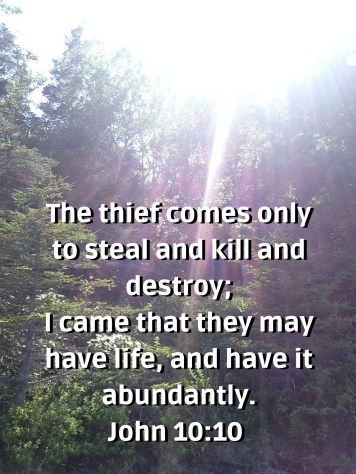
“The thief comes only to steal and kill and destroy; I came that they may have life, and have it abundantly.” -John 10:10

God wants us to have an abundant life. He gives us courage and strength because His Son, Jesus Christ, overcome the world. We are called to thrive like plants in the field! We need to Thrive in our faith and Christian deeds. We need to root ourselves in Christ, and trust God’s plan for our lives. Even when times get tough, we should seek God and point others to God. We should let God be the gardener in our lives and THRIVE.

I don’t know where you are in your walk with Christ. But I do know that our Heavenly Father is calling you to Himself. God is constantly calling you to know Him and to make Him known. Start digging into God’s word and let Him show Himself to you.

Don’t just survive life – Thrive in it.

Brenan Dominguez