Healed How?

2 Kings 5-8

Second Kings chapter 5 includes another miracle performed by God through Elisha.  Yesterday we considered four miracles from chapter 4, today we will consider one from chapter 5, the healing of Naaman of leprosy.  Rather than focusing on the miracle, let’s focus on the heart of Naaman.

In Second Kings 5:10 we find the words of Elisha to Naaman of how he can be cured of leprosy, “Go, wash yourself seven times in the Jordan, and your flesh will be restored and you will be cleansed.”  These seem like simple, albeit specific, instructions.  In the next verse we read, “But Naaman went away angry and said, ‘I thought that he would surely come out to me and stand and call on the name of the LORD his God, wave his hand over the spot and cure me of my leprosy.”  Naaman seems to have some pretty simple, albeit specific, expectations of how God would show up in his life.  In his first statement, I wonder if Naaman feels a little ignored or slighted that Elisha did not come out himself to see him.  Naaman is a man of some importance within Aram but Elisha sends his messenger to Naaman rather than coming out himself.  This is a good lesson to us to not think too highly of ourselves as well (Romans 12:3). 

Naaman goes on to communicate what he assumes will happen before he has an encounter with God.  He assumed Elisha would stand, call on God’s name, and wave his hand.  This might seem unique to Naaman, but are we sometimes a lot like Naaman.  Take a moment to consider how you expect to meet with God in worship.  Are there things you anticipate will happen before you experience God during a worship service?  Do you assume there will be songs led by a guitar or piano?  Do you think the speaker must have a dynamic presence on a stage?  Do you think God will show up if the singers have perfect voices and the lighting is ideal?  Is there a simple, albeit specific, formula that you expect to occur in worship before you think God will show up?

I would challenge you today to consider breaking free from your expectations of how to experience God and to lean into the method that is consistent in Scripture and historically.  Naaman experienced God when he followed God’s direction.  This is when we will experience God as well.  When we follow God’s direction for our lives or for our church, we will experience God and the blessing He has in store for us.  By Second Kings 5:14 Naaman was talked into obeying God and it says, “So he went down and dipped himself in the Jordan seven times, as the man of God had told him, and his flesh was restored and became clean like that of a young boy.”  It was obedience to God that brought about an encounter with Him.  It is our obedience to God, that brings about an encounter with Him today.

-Michael Cisler

Reflection Questions

What are your assumptions, or even preferences, of how you expect to encounter God?

What are the areas in which you need to continue to move toward obedience to God, rather than following your own path?

How can you begin to make that step of obedience today, or what is the first step you can make today?

Triumphant

John 12

April 9

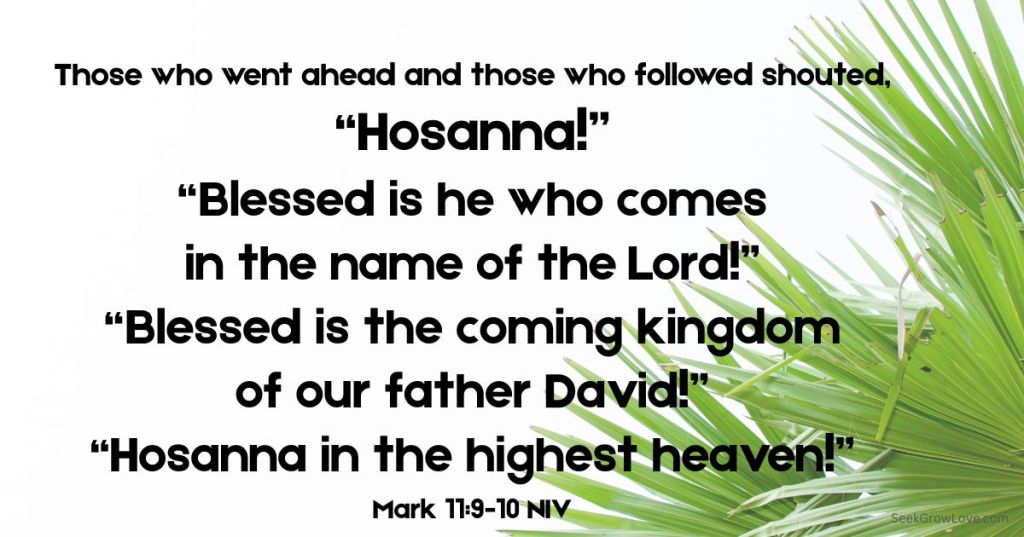
The next day the great crowd that had come to the festival heard that Jesus was coming to Jerusalem. So they took branches of palm trees and went out to meet him, shouting,

“Hosanna!
Blessed is the one who comes in the name of the Lord—
    the King of Israel!”

John 12:12-13

The headings in our Bibles weren’t original to the text. I’m not sure who came up with the name “Triumphal Entry” for the portion of text we’re going to look at today, or when it was so titled, but it begs some questioning.

Triumphal implies the celebration of a great victory or achievement. And while on this day, crowds lined the streets with palm branches and shouted praises to him; within days of the hosannas, the crowd turned ugly, demanding His crucifixion.

You see, the people shouting ‘Hosanna’ had false expectations. They expected Jesus to restore Israel to its former glory, to establish God’s earthly kingdom with them at the top. What they didn’t know was that the true enemies that had to be defeated were not the Gentiles, but rather sin and death. And this could not be done on a white horse and with great armies. Instead, it took humility, a willingness to take the form of a servant and submit to the punishment that God’s people deserve for their sin.

Paul describes this perfect picture of humility in Philippians 2. He says that Jesus, “emptied himself, taking the form of a slave” and that he “humbled himself and became obedient to the point of death – even death on a cross.”

Throughout Scripture we find that humility is the path to victory and exaltation. We don’t expect to find real strength in those who are humble. But God has a way of turning our expectations upside down. He has a way of showing his glory through things we revile.

As we near our Easter celebrations, let’s prepare our hearts by seeking humility in our own life. Let’s also seek to see Jesus as he really is. Immediately after He ascended into heaven in Acts 1:9, he was seated at the right hand of the Father. He was triumphant over sin and death, he lives in triumph now, and he will return one day to triumph forever over the evil of this world.

That is something to celebrate.

-Susan Landry

Questions for Reflection and Discussion:

  1. Do you ever think about asking God to correct you if you’re wrong in any of your beliefs?
  2. How can we grow in humility?
  3. Look up the following verses about Jesus being seated at God’s right hand and discuss: Colossians 3:1, Ephesians 1:16-21

Not What You Expected

2 Kings 5-6


As ignorant, stuck-up, entitled humans, we often think we know what we need. We have this nice little idea of what will make our lives better, and we go to God expecting Him to grant us our wishes. But the thing is, we don’t know what we need; we don’t know how God works or what He plans to accomplish through us, or how He even uses our situation for His glory.


In 2 Kings 5, we read about one particular ignorant human who went to Elisha hoping to be healed of his leprosy, despite being a gentile and enemy of Israel. Now this man, Naaman, wasn’t mistaken in thinking he would receive the help he needed, but what he thought he needed and what God knew he needed were two separate things. When Elisha told Naaman to wash 7 times in the river Jordan, he became angry and almost turned around to head home, because this wasn’t the grand solution he expected to hear. Fortunately, however, his servants reminded him what was at stake, and what he should be willing to try for the sake of healing his leprosy. So Naaman, I imagine quite reluctantly, went down to the river and followed Elisha’s instructions. And what do you know – he was healed!


After experiencing this miraculous restoration of health, Naaman knew who the one true God was (and is), and came back a changed man. Even in the few paragraphs we read about Naaman, we can see a drastic difference in his overall attitude and behavior. God changed his heart. If Naaman wasn’t lucky enough to have those servants around, he would’ve missed out on everything he gained in his short encounter with Elisha. Because of his own pride and desires, he
was prepared to walk away from the only chance he would ever get at healing his fatal disease, and finding a relationship with his Creator.


Naaman’s story can serve as a reminder to let go of our self-conceived ideas of what is best for us, and instead trust God to handle every situation His way. God’s way is always the best way, whether or not we are capable of understanding it. He has a plan for all His children, and this plan has already been set in motion. He answers our prayers in ways we could never imagine,
and sometimes in ways we can’t even see. We have to trust that our loving, heavenly Father knows what’s truly best for us, and that everything He does is part of the ultimate plan He has for us to live together with Him in His eternal Kingdom.


God knows what you need, all you have to do is trust Him.

–Isabella Osborn

Today’s Bible reading passages can be read or listened to at BibleGateway here – 2 Kings 5-6 and Proverbs 7