
Graphic Material

Ezekiel 5-9

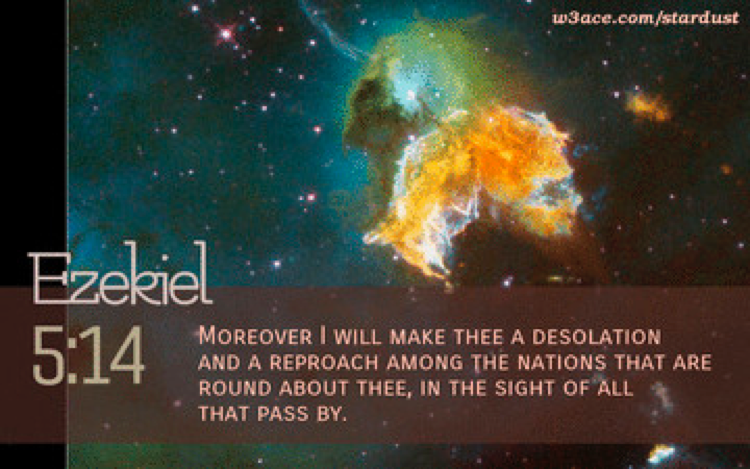
ezekiel 5 14

Monday, March 20

This portion of Ezekiel is, admittedly, difficult to read.  It’s a pretty graphic account of God impending judgment against the city of Jerusalem and his people, Israel.  God tells Ezekiel to shave his head and beard.  This would have been an act of mourning for most people, but it was double disturbing for Ezekiel, since he was a priest and normally forbidden from shaving his head or beard.  Ezekiel was told to burn, take a sword to, and scatter his cut hair.  This was to symbolize what was to happen to Israel.  A few hairs were kept back, symbolic of the remnant who would not be destroyed.

God accuses his people, Israel, the chosen nation, of being worse than the other nations.  They broke the law more than the nations that did not have the law.  God was bringing his judgment against His own people.  The description of the siege almost defies comprehension, including cannibalism of both parents and children.  This was to serve as a warning to the other nations: if this is how God treats his own people for their idolatry, beware of what he will do to you.

In Ezekiel six God makes it clear that their judgement is upon them because of their idolatry. However, there is a remnant that will be spared and live in captivity and will come to repentance.

In Ezekiel seven, a special emphasis is made regarding their idolatrous attachment to gold and silver.  This wealth that they turned to and fashioned into idols will be unable to save them from the coming judgment.  All the money in the world can’t save you from judgment.

In Chapter eight Ezekiel has a vision of the temple in Jerusalem.  This includes the “Idol of jealousy” which we discover is the pagan god Tammuz.  Tammuz was the Sumerian god of food and vegetation.  At the summer solstice there was a period of mourning as the people saw the shortening of days and the approaching drought.  Sacrifices were made to Tammuz at the door of the Jerusalem Temple.  This was an absolute abomination to Israel’s God, YHWH as He made it clear that He alone was to be worshipped as God (see Deuteronomy 6:4-5).

In Chapter Nine an angel is sent out to put a mark on all of the people of the city who did not commit idolatry and worship Tammuz.  They would be spared.  But then all those who did not receive a mark would be destroyed.  This is reminiscent of the story of Exodus, when the doorposts of the Israelites were to be marked with the blood of the sacrificial lamb, and those with the mark were spared their firstborn sons dying when the Angel of Death passed over their houses.  It also points to the future (See Revelation 13) when the beast will cause people to have a mark on their forehead or they would not be able to buy or sell.  This is contrasted with those in Revelation 14 who have the name of God and of the lamb on their foreheads.

God is a God of love and mercy.  God has provided a means for us to be rescued from the consequences of sin.  There is a way for each of us to be spared the final judgment of God that is coming.  Jesus Christ, the lamb of God is the only means by which we can escape judgment.  Along with God’s mercy is His holiness.  God will not allow sin and rebellion to continue on earth forever.  A day of judgment is coming for all the earth just as it did for the nation of Israel.  God tolerated their sin for only so long, and then came the time for judgment.  Mercifully, God spared those who repented by placing His mark upon them.  God has been tolerating sinful rebellion on earth, but a day is coming when He will destroy sin and sinners who have not repented and turned away from their sins and turned to him through Jesus Christ.  Ezekiel’s harsh imagery should remind us that we must not forget that God’s wrath is coming from which we all need to escape, and we need to warn others.  This won’t make us popular, but doing God’s will is seldom popular among the rebellious.

-Pastor Jeff Fletcher


(Photo Credit: http://w3ace.com/stardust/)
God’s Watchman to A Generation

Ezekiel 1-4

ezekiel 1

Sunday, March 19

Ezekiel was a priest in Israel during a tumultuous time in their history.  The Northern kingdom had been decimated by the Assyrian empire and its people scattered and assimilated resulting in a complete loss in their identity as a distinctive people of God.  The Southern Kingdom of Judah was now being systematically taken apart by the Babylonians.  Ezekiel was among the early members of Judah’s elite leaders who were taken captive to Babylon.  Ezekiel was now a priest living in a foreign land where he had no access to the temple of Jerusalem and the religious symbols that helped shape his life and give him meaning and purpose.

In today’s readings God comes to Ezekiel in a series of visions.  These visions  are recorded as a type of scripture known as apocalyptic- where something is revealed or unveiled.  In addition to portions of  Ezekiel there are apocalyptic passages in the books of Daniel, Isaiah and Joel.  God reveals what is going to happen as He brings an end to the present age preparing the way for the age to come or coming Kingdom of God.  You will notice some similarities between Ezekiel 1 and Revelation 1 and 4.

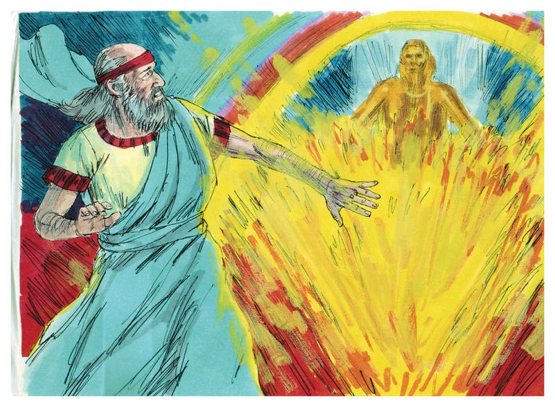
Ezekiel’s description sounds like something in a science fiction movie- 1:27-28 says: “ I saw that from what appeared to be his waist up he looked like glowing metal, as if full of fire, and that from there down he looked like fire; and brilliant light surrounded him.  Like the appearance of a rainbow in the clouds on a rainy day, so was the radiance around him.  This was the appearance of the likeness of the glory of the Lord. When I saw it, I fell facedown, and I heard the voice of one speaking.”

Imagine if, for a brief instant, God permitted you to have a vision of himself in all of His glory.  You would probably struggle to find the right words to communicate what you saw.  So it is with Ezekiel.  He is overcome by the glory of God and he falls on his face.

The whole of Ezekiel is surrounded by the image of a holy God.  But God’s people, Israel, have been disobedient to God.  Ezekiel is appointed by God to serve as his “watchman” (3:17) for the people Israel in captivity.  His mission is to warn God’s people of their sins and to call them to repentance.  Ezekiel 2:7-8: “You must speak my words to them, whether they listen or fail to listen, for they are rebellious.   But you, son of man, listen to what I say to you.”

The job of a watchman is to stay awake, keep one’s eyes open, and warn if anything dangerous or illegal is taking place.  It might also include a warning to those who are tempted to trespass.  Ezekiel’s job was to warn God’s people about the consequences of their sins and the coming judgment of God.  God tells Ezekiel essentially: “you need to warn the people about my coming judgment.  If they don’t listen to your warning, then they will suffer the consequences, but if you fail to warn them, then I’ll hold you responsible for their sins.”  God was letting Ezekiel know that he had a mission, to share God’s word with people.  If the people didn’t listen or heed the warning, it was on them, but if he refused to give the warning it was on him.

As followers of Jesus Christ today, we are called to be priests in this world.  Like Ezekiel,  we are living in an age where much of Christianity has been decimated by a massive turning away from God and people are scattered and assimilated into the world resulting in a complete loss in their identity as a distinctive people of God.  And like Ezekiel, we are to keep watch and issue warnings to the people of the world.  As with Ezekiel, sometimes we will warn people and they won’t listen.  If that’s the case, it’s on them.  But if we fail to do our job and give the warning, then it’s on us.  People won’t always like what we have to say- prophets and priests are sometimes labelled as intolerant and not very popular, but that should not prevent us from doing the work God has given us to be His watchmen to our generation.  (Note: our job is not to be the judge, it’s not our place to condemn the world, but to tell them what God tells us to tell them, which is the Gospel.)

-Pastor Jeff Fletcher

My name is Pastor Jeff Fletcher.  I’m one of the old guys.  I first attended what is now FUEL (then it was called National Camp) back in 1977 and I’ve been a camper or on the staff for most of the past 40 years.  I’m a graduate of Oregon Bible College, (Now ABC) and I’m completing a Master’s Degree from Eastern Mennonite Seminary.  I’ve pastored Churches in Illinois, England, Louisiana, South Carolina and now Virginia.  My wife Karen and I have eleven children and 4 grandchildren and my daughter, Karee Anne is getting married this Saturday, March 25.  In addition to pastoring a Church I also work as a hospital chaplain.  I am passionate about bringing the message of God’s loving presence to people who are hurting and in need of hope and purpose in life.