Heart Change

OLD TESTAMENT: Isaiah 44 & 45

POETRY: Psalm 107

NEW TESTAMENT: James 2:14-26

Faith or Works

How are we saved?  We are saved by grace alone, through our faith in Jesus Christ.  But what comes out of our faith?  Shouldn’t it be works?

If we start with works and try to earn our righteousness, we won’t get there.  We cannot earn salvation.  However, if we have faith, works should come out of that.

I think most people reading this probably know these things.  You’ve probably heard a sermon, read a devotion on it, etc.  But do we live that way?  Do we live in a way that is trying to work on all the individual things in our lives, to clean them up one by one, to do the good things we are supposed to?

Alternatively, we can focus on growing our faith.  On accepting the gift given to us and let the good works come naturally as a result of that.

The youth group at our church recently read in Romans 12 which lists many snippets on how we should be living “love must be sincere…be joyful in hope…share with God’s people who are in need.  Practice hospitality…live in harmony with one another…do not be conceited…” and many more. 

We could use this as a checkbox of good works to make sure that we are doing the right things to show our salvation.  But that doesn’t address our hearts.  If we need a checklist to make sure we are loving one another, we need to go back and look at our hearts.  What we talked about in class was to pray to have our hearts changed so that living this way would come naturally out of the overflow of our hearts.  And I think this relates to the faith vs works question. 

If our faith is sincere, our hearts are changed, and the result of that is good works.

A checklist can be a good way for you to ask yourself – am I living as one whose heart has been changed – but I don’t think it is good to be living our lives based off of a checklist.  It focuses you more on the tasks rather than the effects of what you are doing or the purpose behind it.

So maybe ask yourself if you are doing these good things, or avoiding the bad, but if you aren’t meeting the things on that list, don’t place your focus there.  Instead, pray for God to change your heart and you should start to see that happen more and more.

~Stephanie Fletcher

Reflection Questions

  1. Where have you seen faith without works? Where have you seen works without faith? Why, do you think, God is looking for both, working together?
  2. Are you living as one whose heart has been changed? Are you living out your faith daily? What evidence do you have to support your answer?
  3. What specific heart change can you pray for?
Examining God’s Credit System

Romans 4

May 20

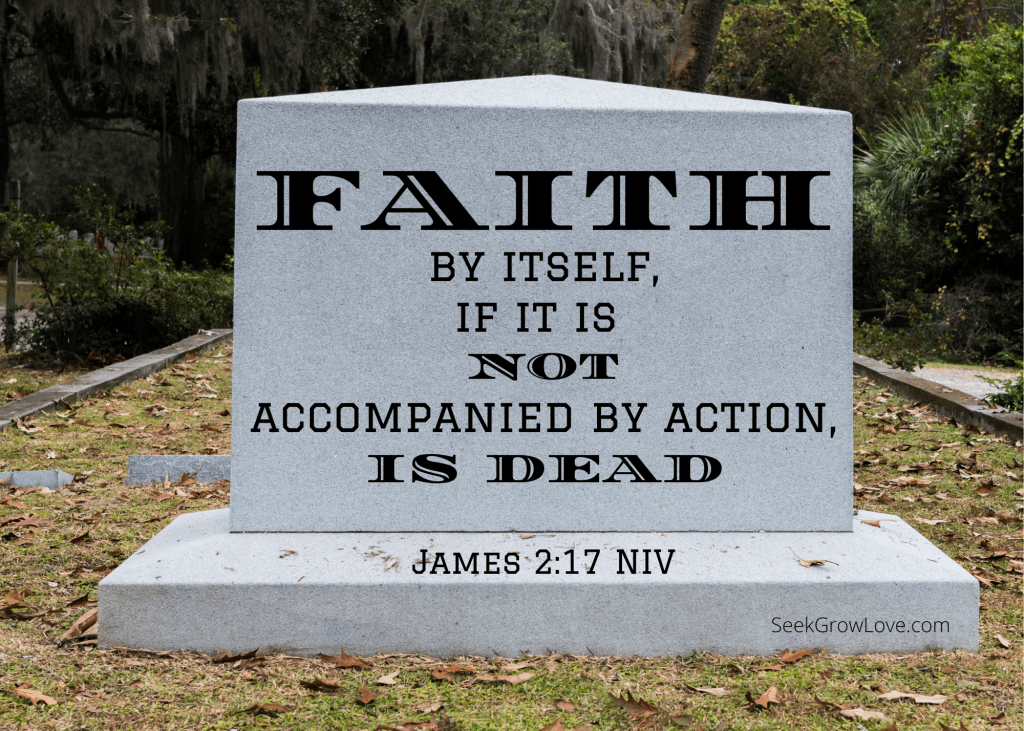
We often hear the phrase, “Faith without works is dead,” quoted from James chapter 2, in sermons and lessons about the importance of DOING. Now these are a wonderful set of verses, however, Romans 4 clarifies that works without faith are also dead. Our works, and the goodness of our works, are measured on a human scale; any good deed one might do could have any number of motives. God looks at the heart, not our outward performance, in order that we may be saved by grace and not by our own works. 

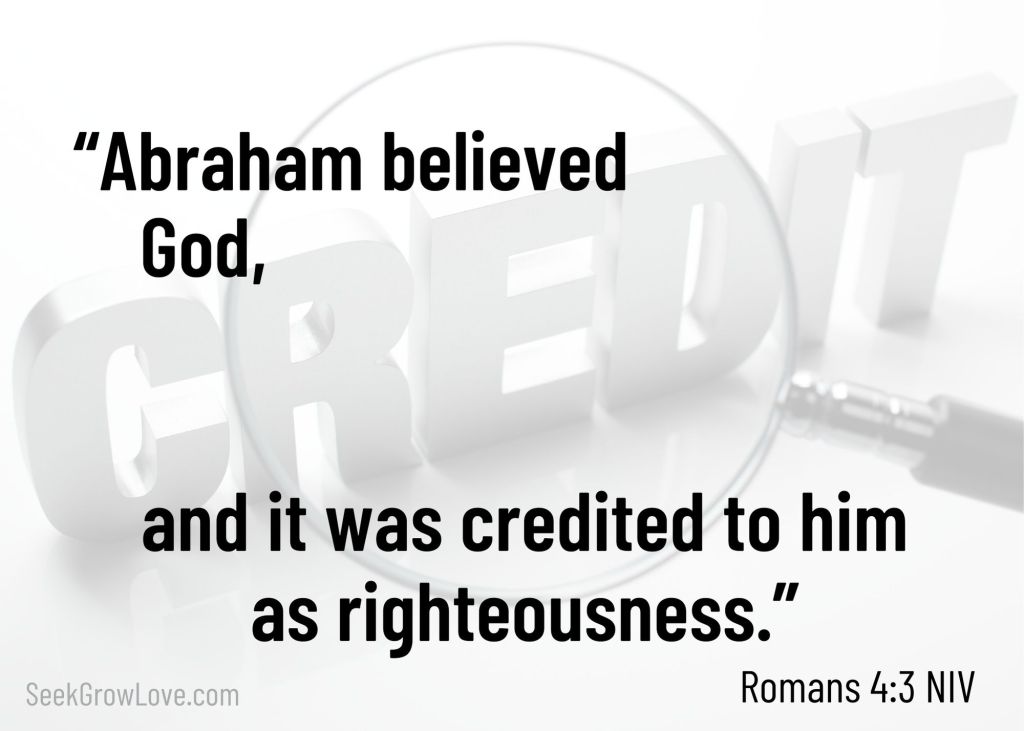
“And to the one who does not work but believes in him who justifies the ungodly, his faith is counted as righteous” Romans 4:5

Paul admits that Abraham’s works are impressive; he displayed his righteousness in the way he lived. However, his works alone were not what made him righteous in God’s eyes. God sees much more than we ever could. Abraham was promised that he would be the father of many nations because of his righteousness of faith, for it is true belief in our LORD that determines godly righteousness, and God saw that Abraham truly believed. 

This is such a beautiful thing, because this process of forgiveness and redemption and justification applied to Abraham “not just for his sake alone, but for ours also” (Romans 4:23-24). We are justified not by works, but by faith, because 1. our works could never cut it, and 2. our works are a faulty means of character assessment. Because God looks at our hearts to determine our righteousness, our hearts are what we need to keep in check. Don’t sully your good works with a hardened heart. Every good work we do should be done for the sake of serving our Father, and not for the purpose of serving our own selfish desires, greed, and self-centeredness. Good works need to sprout from a pure motive, or else it’s no longer a good work. I thank God that we, like Abraham, may be counted righteous by our faith, and hope that we all will strive to be just as intentional in our inward thoughts, emotions, and faith (what God sees) as we are in our outward actions, words, and works (what man sees). 

-Isabella Osborn

Discussion Questions:

  1. How do verses 5-8 give us hope? Who is justified under this blessing?
  2. If godly righteousness does not come through the law or works, but by faith, then why is it sometimes so hard to attain godly righteousness?
  3. How can you grow in godly righteousness? 

Dead Faith

James 1-5

I have enjoyed going through the first half of the book of Acts with all of you, as the book of Acts is one of my favorite books in the Bible.  I am fascinated with the history of the church after Jesus ascended to heaven, and there is no better source to take a look at than the book of Acts.  I hope you all enjoyed the first half of Acts as well.  Today, we cover the book of James, another real solid book (really all 66 books are real solid).  James is one of the first books of the Bible that I would have a new believer read, as it has a ton of applicable information.  The book provides great stepping stones to living a godly life.  If you haven’t read the book of James before, stop whatever you’re doing (Well, I guess that means stop reading this devotion), and read the book of James for yourself.  If you have read it before, I would still encourage you to revisit this piece of gold.

            James covers a wide range of topics throughout his book.  Today, we are going to spend most of our time covering two topics found in the book.  Before we do that though, I want to mention the other topics found in James.  If there is a topic that interests you, then go ahead and see what James himself has to say about it.  The main talking points in James that we won’t talk about are: hearing and doing the word, the sin of partiality, taming the tongue, wisdom from above, warning against worldliness, boasting about tomorrow, warning to the rich, patience in suffering, and the prayer of faith.  Much could be said about each of these different topics.  There is simply not enough time/space to mention all of these topics in our devotion.

            With that being said, we will talk about the testing of our faith and the relationship between faith and works.  I wanted to talk about the testing of our faith because it connects very well with what we have been talking about with the book of Acts.  In the first 14 chapters of Acts, we saw a handful of people suffer because of their faith in Jesus.  What does James have to say about this?  Well, James says, “Count it all joy, my brothers, when you meet trials of various kinds, for you know that the testing of your faith produces steadfastness.  And let steadfastness have its full effect, that you may be perfect and complete, lacking in nothing,” (James 1:2-4).  In summary, James says to consider it a joy!

            I don’t know about you, but it is not my initial thought or feeling to consider a trial a joy.  I think a large reason is because it is not fun or enjoyable to go through a trial.  However, when we think about the effects of enduring through trials of various kinds, we can come away with an appreciation.  When we successfully endure through a trial, it can produce steadfastness, which enables us to be a more complete, well-rounded person. 

Every single time that someone goes through a trial, they either grow closer or they grow further away from God.  The heroes of our faith that we took a look at in Acts went through various trials, and it appears that they grew closer to God.

Our next main topic is the relationship between faith and works; they have an interesting relationship with one another.  They have caused a lot of discussion and even some disagreement in Christian circles.  According to James, “Faith by itself, if it does not have works, is dead,” (James 2:17).  That means that a faith that is not accompanied by any works is useless!  We need to remember though that it is by God’s grace that we are saved, and we accept that grace through our faith, not our works (Ephesians 2:8).  However, we can’t accept God’s grace with a dead faith; it must be a living and active faith that we have to accept God’s grace.  We already mentioned that a faith without any works is dead and useless.  That means that we must accept God’s grace through our faith, but we have to accompany our faith with our works.

At an initial glance, it can appear at times that James and Paul (in Ephesians) clash with one another.  However, that is not the case at all.  They both show how faith and works have a beautiful relationship with one another.  I remember being stumped over the relationship between faith and works for some time.  It took me awhile to see how they work together, and I hope this very short explanation can help clear up the confusion that any of you may have between faith and works.

Well, there we have it, folks.  This past week we got to spend time in Acts and James.  We have learned a handful of very valuable lessons from the likes of Paul, Peter, and James.  If you have read the devotions for this week, I hope you stick with it!  There is lots of great content ahead, as we get to explore the writings of Paul and others.  As always, there is also a great lineup of writers to help us all dig into God’s Word.  God bless!

-Kyle McClain

Today’s Bible passage can be read or listened to at BibleGateway here – James 1-5

Tomorrow we read Acts 15-16.

Faith ____ Works

James 2

James 2 14 NIV

In Chapter two of James he continues to tell us that we need that Humble Pride and we are not to judge others in partiality. We must not look at others and decide that God isn’t going to use them because we don’t like the way they look. Just as we may turn away from a book when the cover is worn and frayed, we occasionally turn away from people when we see they are worn and frayed. The thing we must remember is sometimes the books, and people, that are worn the most are worn from use not from neglect. When we look at someone we should seek the potential that our LORD sees. When Samuel went to anoint the king he would have overlooked David but God was looking at David’s heart.

In the same way that we tend to judge by what we see on the surface James tells us that our faith is to be more than mere words.

When you look at Faith ______ Works, what would you place in that blank?

  • Faith or works
  • Faith VS. works
  • Faith and works

We know that we are cleansed of our sins by faith (not by works), so why would James ask in 2:14, “Can faith with no works save you?” Do Paul and James have a long-standing disagreement on this matter? No, they agree beautifully! James is not saying that we are saved by our works but that our works are evidence of our faith. In verses 15 and 16 he says that empty words mean nothing. For example, if I simply say I am feeding my dogs regularly, yet I give them no food; eventually they starve. They will not survive on my words or good intentions alone. The same is true of our faith. Luke just told us last week of that “great cloud of witnesses” in Hebrews 11 that were all shown to be faithful and that faith was made evident in the works they did for God.

James says if we have true faith it will be shown by our actions! He says in verse 19 that if all it took was a belief in the truth that God is one then even the demons would be okay, because they believe and shudder. Although they believe, their actions and their allegiance are not inline with God’s plan. They understand truth but choose to do their own thing. We need to understand truth AND let that truth move us to action for God!

James says that we need a Faith that Works!

If our faith is not causing us to work for God we must ask ourselves, “Do I truly have faith, or do I have empty words?”

-Bill Dunn


A Dead Faith

James 2 17 (1)

Happy Labor Day. This holiday was started to give praise to the American workforce for their contributions to our country. What does the Bible say about our work for God. Obviously we know the Bible says that works can’t save someone. Paul writes in Galatians that salvation is a gift of God through Jesus. This idea that work isn’t needed has kind of permeated our Christian culture.

We can’t be Blind to what the Old and New Testament says about our relationship to God and the work that produces. In Proverbs, Solomon gives us many verses like 6:6 where we are to consider the ant and how hard they work and 31:10 where the virtuous women is praised for her work. Solomon says work is good to keep us from poverty and this is both physical and spiritual.

In the New Testament, James tells us that our faith and works are married together and can’t be separated. All of the people of faith in Hebrews were commended for what they did. So on this Labor Day maybe we honor God with some work for what he has already done. We can’t earn salvation but we can say thank you by what we do.

-Joseph Partain