Ending on a Hopeful Note

 Today we are wrapping up the book of Ezekiel.

Ezekiel is, at times, quite difficult to read. Perhaps not as bad as Leviticus, but it is definitely one of the tougher Prophets to get through. The first two thirds of the book is about judgment (not a very happy subject). But you’ve made through that and arrived at the uplifting stuff about Israel’s restoration and their place in the Millennial Kingdom.

In Chapter forty-seven we read about a river that flows from the temple. When the water pours into the Dead Sea, it turns the salt water fresh. Fish will be in this river, and fisherman will stand on its shore, casting their nets, catching many different species of fish. Trees will grow along its banks, bearing fruit monthly. “Their fruit will serve for food and their leaves for healing.”

In Chapter forty-eight, the final chapter, we read about the division of the land among the tribes of Israel. A special portion of this land will be set apart for the LORD and be given to the priests and in its center will be a sanctuary for the LORD. There will also be a city, with twelve gates named after the tribes of Israel; this city will be called “the LORD is there.” Yahweh is there.

As has been already mentioned, Ezekiel is writing this book in a tumultuous time for the Israelites. They are in a hopeless state. Feeling forsaken and wondering if God will ever restore His people. The last fifteen chapters of Ezekiel offered the Israelites hope that God would indeed restore them. Ezekiel ends on a hopeful note: a city in the middle of the Promised Land named Yahweh is there. Those who were in a land that was not their own, suffering under the hands of great oppressor would have certainly been uplifted by such a promise from a God who shows He won’t forget His people.

We, too, serve that God who doesn’t forget and doesn’t break His promises. Even when you’re in the deepest, darkest, depths of depression have hope. Even when the world is crumbling around your feet, and it seems like it will never get better, know it will. Even when your doubts overtakes all other feelings you have, believe God is stronger. He has a plan. He’s made a promise. And He keeps His promises. One day we will be in God’s Kingdom and Yahweh will be there.

IMG_0026

Where Wisdom Can Be Found

Proverbs 1-3

pro-1-33-ww-notrace-9x

Saturday, January 21

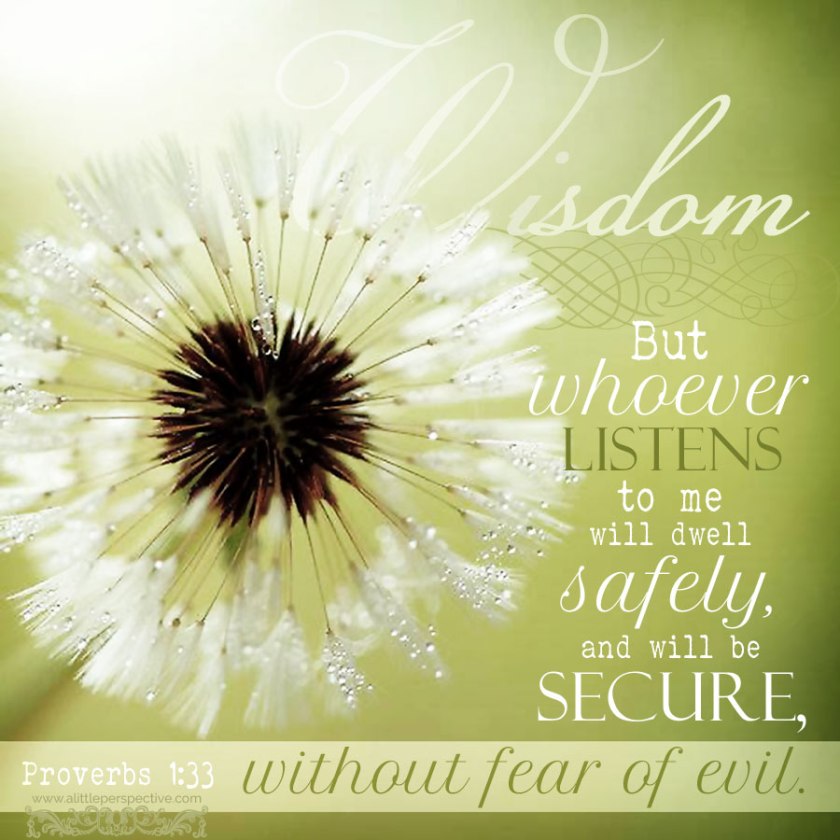
There is a great contradiction in today’s world. In a time when we are experiencing exponential expansions in knowledge, we are also suffering significant shortages in wisdom.   We had placed value so high on creation and discovery, that many have lost what is labeled as “common sense,” in the process.  There are plenty of planes, but no pilots, plenty of shells, but no yokes, plenty of bark but no bite? Wood? No matter.  I see it in adults and students alike.  They are missing a critical component in the navigation of life: wisdom.

.

Today, begins our reading in Proverbs, The Psalms’ more practical brother.  Much like an instruction manual, a lesson plan, or a mission briefing, Solomon, King of Israel and our author, lays out the purpose of this book in the opening verses:

“ <These Proverbs are> for gaining wisdom and instruction; for understanding words of insight; for receiving instruction in prudent behavior, doing what is right and just and fair for giving prudence to those who are simple, knowledge and discretion to the young” – Proverb 1: 2-4

The faith of Proverbs is not theoretical, hypothetical, or abstract. It is the pragmatic and clinical day-to-day application of faith.  It is the “how-to” or “for Dummies” book of those who are trying to live for Christ.  Even without true understanding of the meaning behind these words, one only needs to put them into practice, and they will immediately benefit. Solomon was granted special insight to God’s infinite knowledge and ultimate goodness. Through this, he had the ability to prioritize, see the sequence of events, discern the lasting outcomes of every decision, and sense the overriding nature of man  throughout his reign.  How did he obtain such a gift?  He asked (2 Chron 1:7-12).


“For the Lord grants wisdom!  From his mouth come knowledge and understanding.  He grants a treasure of common sense to the honest.  He is a shield to those who walk with integrity.  He guards the paths of the just and protects those who are faithful to him.” – Proverbs 2:6-8


“If you need wisdom, ask our generous God, and he will give it to you. He will not rebuke you for asking. But when you ask him, be sure that your faith is in God alone. Do not waver…” – James 1:5-6a


Thankfully, the wisdom of Solomon is available to us.  Yes, literally, here in the Proverbs, as we pour through a lifetime of wisdom in a handful of days, but also in a direct-to-us, handpicked for today’s questions and quandaries type of way.  The only condition is, like Solomon, we ask.  You don’t have to have a certain number of gray hairs, grow a long beard, or wear your glasses on a chain.  God has promised to give generously to all, without finding fault.


Let this time you spend in Proverbs begin or reignite your prayerful pursuit of God’s timeless wisdom.

-Aaron Winner

(photo credit: http://www.alittleperspective.com/proverbs-1-2016/)

Victory Set in Motion

Psalm 120 – 131

psalm126-3

Tuesday, January 17

J.R.R. Tolkien, the author responsible for the conversion of C.S. Lewis, insisted that his series, The Lord of the Rings, was not a direct metaphor or allegory of the Christian message, yet this series is steeped in Tolkien’s faith. It reminds me of a popular phrase where I’m from, “You can take the girl out of the country, but you can’t take the country out of the girl.”  When you are living for Christ, everything you touch becomes infused with your faith.


One such example that parallels Christian faith and hope, is from the second book in the trilogy, The Two Towers.  Go ahead and push up your glasses; indulge me. It’s about to get a little nerdy.


Near the climax of the story, the humans and elves are defending a last-resort fortress, Helm’s Deep.  The orcs, which greatly outnumber their foes, have come to take the fortress in the night.  They advance and breach the stronghold.  It is only a matter of time before all is lost. At the moment when defeat is certain for the human-elf alliance, those who remain are reminded of a promise made by a wizard friend, Gandalf, “Look to my coming on the first light of the fifth day, at dawn look to the east.”  As the sun rises over the mountain top, it reveals that Gandalf has literally “called in the cavalry,” assembling the Riders of Rohan.  Using the dawn’s blinding light to their advantage, they charge down from the mountain, break the enemy ranks, and leave the orcs to retreat.  Gandalf’s perfect planning was the difference in tragedy or triumph..


I am counting on the Lord; yes, I am counting on him. I have put my hope in his word. I long for the Lord more than sentries long for the dawn, yes, more than sentries long for the dawn. – Psalm 130:5-6


Norman Vincent Peale, minister and author of “The Power of Positive Thinking”, states that God answers prayers three ways: “yes, no, and wait a while”.  “Yes,” is obviously the easiest answer to hear.  We immediately receive the desires of our heart (Psalm 37:4) and celebrate.  “No,” is difficult to hear, but it brings closure.  Knowing a door is closed, helps us move in a different direction (2 Samuel 12:13-22). However, “wait,” is the toughest of the three.  “Wait,” means you must stay in the heat of battle (Exodus 17:8-12). “Wait,” means you must hold the enemy at bay (1 Corinthians 10:13). “Wait” means you must maintain tremendous trust, complete courage, and unfaltering faith to set aside what you want NOW, because God has a perfect time, one MUCH better than NOW, to fulfill His promise to you.

I look up to the mountains— does my help come from there? My help comes from the Lord, who made heaven and earth! – Psalm 121:1-2

Praise the Lord, who did not let their teeth tear us apart! We escaped like a bird from a hunter’s trap. The trap is broken, and we are free! Our help is from the Lord, who made heaven and earth. -Psalm 124: 6-8

And the other nations said, “What amazing things the Lord has done for them.” Yes, the Lord has done amazing things for us!  What joy! – Psalm 126:2-3

Whether it is college, career, children, or commitment that you are waiting upon, God is actively working on “amazing things,” preparing to fulfill and complete those who are willing to persevere (James 1:2-4). In the dead of night, when the odds are stacked against you, faithfully fight and look to the Lord and His promises for your help. He will soon overwhelm you with the victory that has long been set in motion.

-Aaron Winner

(Photo credit: http://markryman.com/BLOG/2013/11/03/a-fortune-of-joy/         Original photo by YousefTOmar)

Make Our Days Count

Psalms 38-42: Making all of our days count by living for God.

makecount

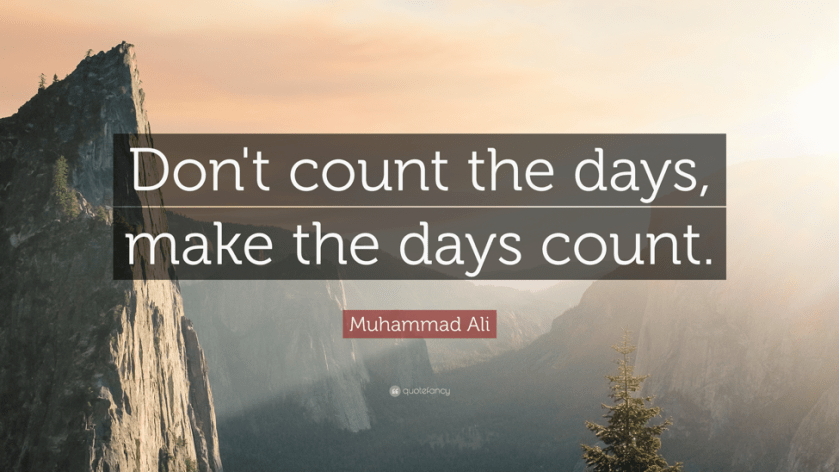
The New Year is just around the corner, and I have to say that I love each January 1st for all the possibility that it brings. When I was younger, I would pull out my journal or notebook and brainstorm the different New Year’s resolutions that I could pursue in the upcoming year. 365 days, 8760 hours, 525,600 minutes, or 31,536,000 seconds seemed like so much time waiting to be filled up with the sky only being the limit of what could be accomplished.

But, flash forward to the middle of the year (about the time of Fuel to be exact) and all the possibility seems a little less grand. The things that could fill up the New Year shrink a little more and a little more as the calendar days get a big slash through until wham, the calendar says December 31st.

Every year, as I begin to assemble my next planner and everything I want to accomplish, I always stop and think about the ways that God might use me in the upcoming year. It’s interesting that nestled between all of the psalms that we’ve been reading, we find psalm 39. In this psalm, David is struggling with sin for which he is seeking forgiveness. In the middle of his laments and prayers, we see this line in verse 4-5:

“LORD, reveal to me the end of my life and the number of my days. Let me know how short-lived I am. You, indeed, have made my days short in length and my life span as nothing in Your sight. Yes, every mortal man is only a vapor.”

Wow, what humility to pen these verses. Mortality has always been hard to come to grasp with, and death is one of, if not the, final enemy that is defeated at the end of time. That being said, what would you give if you could know how ‘short-lived’ you would be? Would you want to know? I would be hesitant to ask for knowledge, but I understand why David would want to know. If you can learn to make the most of the time you have left.

God may never reveal to us when the end of our life will be, but Moses in psalm 90:12 says a similar phrase when he asks God to “Teach us to number our days carefully so that we may develop wisdom in our hearts.”

When we are able to number our days and see how fleeting they are, we can recognize the importance of making each one count (so think about that the next time you binge watch your favorite show on Netflix). We all make choices of what we are going to pursue, so I encourage you to think about what choice you are making this year.

Each year, between the week of Christmas and New Year’s Day, we can always stop and reflect. We started this week by looking to the cross, we can begin each year recognizing that the cross and all the many gifts, blessings, and guidelines it brings with it is at the center of our life. Then, as the New Year comes to pass, we can rely on God to accomplish the work He has in store for us. By centering our lives around God, we can truly make our days count.

-Cayce Ballard


Our Refuge

Psalms 31-34: God our stronghold, our refuge.

“The LORD is the stronghold of my life –

of whom should I be afraid?” – Ps. 27:1b

Imagine you are in a battle, with your enemies pressing you on every side. You need a place to regroup, get rest, and then continue fighting. Where would you seek your refuge?

This scenario might be hard to imagine for most of us, who have never fought a battle, but David, who wrote several of these psalms, knew exactly what it was like to be pursued by an army. In many of these psalms, he refers to God as his refuge, fortress, and stronghold. God is the place where he goes to receive rest, to be rescued.

One of the main attractions to visit while in the city of London is the Tower of London. This structure, that was built over the past millennia, was designed in such a way that it would prevent attacks from arrows, canons, and more. The base of the White Tower even has walls that are 15 feet thick!

Though the strongholds that David was referring to may have not been built like medieval buildings, the purpose of them would be the same. They were designed to be impenetrable. To be a safe place amidst the arrows, swords, and fighting. A refuge that David could come to for peace in the turmoil of a fighting life.

We, like David, can come into the refuge of God’s fortress. God can be our stronghold! When we follow God’s direction and trust in him, we have walls shielding us that are much thicker than those of the Tower of London. Praise God who protects even in the turmoil of this life.

-Cayce Ballard

Praying through the Ups and Downs

Psalms 25-30: Praying through the Ups and Downs

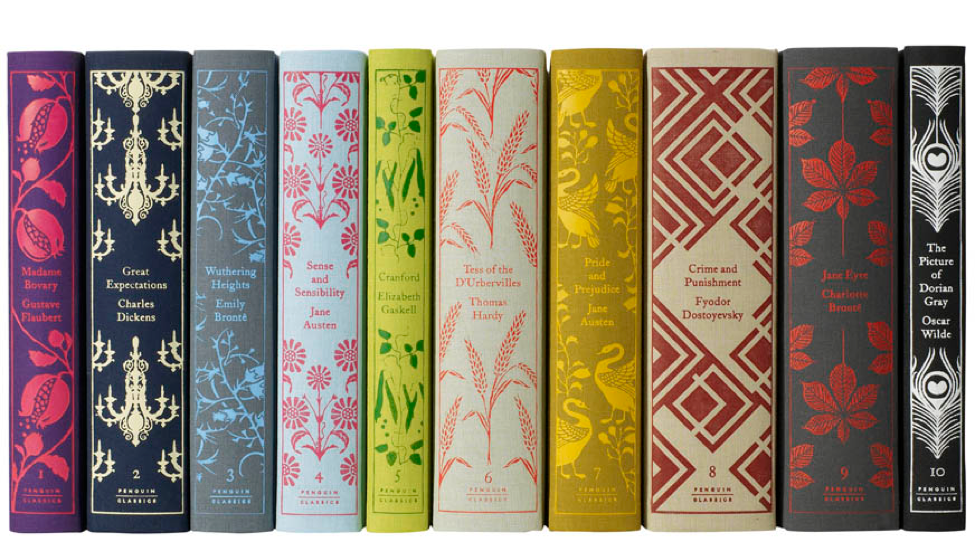
As an English major, I have come to be a voracious reader, and one of my favorite past-times is cuddling up with a good novel and a cup of coffee. In all my reading, I’ve come to see patterns in books.  I am now able to discern what I will like to read and what I won’t. A common thread through all the books I like is how they display a wide range of emotions of humanity, not just the good aspects. Instead of painting a glossy, rose-tinted picture, the novelists try to capture how broken the world is, and by doing so, show something much deeper, a common humanity.

I love novels and reading, but I will be the first to say that I do not look to these things for my hope and salvation. When I want to look to something that speaks to my life now, I look to the Bible. As I read through the Psalms, I recognize in scriptures the same thing I love in literature through these prayers and praises. The Psalms we read for today, Psalms 25-30, were all written by David. In these Psalms, David pleads to God for vindication and deliverance and praises God when he does so. These wonderful prayers model for us how we can come to God in all our pain as well as our joy. In both of these places, God longs to hear from us.

Like novels and books help the author to communicate to us, Psalms shows us how we can communicate with God and the many ways that God can communicate back, through His word, nature, and more. These prayers show us how to come to God in a way that is pleasing to Him and open up our hearts to what He wants from our lives.

God longs for us to pursue Him with prayer, and the New Testament focuses on this heavily. Jesus gives us an example of prayer in Luke 11 with the Lord’s prayer. Paul says in Ephesians 6:18 and 1 Thessalonians 5:17 to pray constantly. These examples and admonitions about prayer point to the same thing that David’s psalms do: we should communicate with God all the time. James says it best in his letter, chapter 5 verse 13, “Is anyone among you suffering? He should pray. Is anyone cheerful? He should sing praises.”

As we can see in the Psalms and through the life of Jesus, prayer is the backbone of our faith. To know and pursue God we need to communicate with Him, and prayer is where that communication, that relationship, begins. We don’t have to gloss over our problems or focus on them solely. God longs for our whole humanity, and we, like David, can bring it to Him.

-Cayce Ballard

books

Our Boundary Lines

boundarylinesWhen the Israelites finally entered the Promised Land after wandering for forty years, they had a big job to do. After taking possession of the land, they had to divide the land between the twelve tribes. Joshua was given this job, and you can find the boundary lines of each tribe in Joshua 16-21. These boundary lines were designed by God so that each tribe would have access to enough good land to survive. They were a provision from God as the Israelites settled into their new home.
Hundreds of years later, David talks about boundary lines in Psalm 16. He says,

“LORD, you are my portion

and my cup of blessing;

You hold my future.

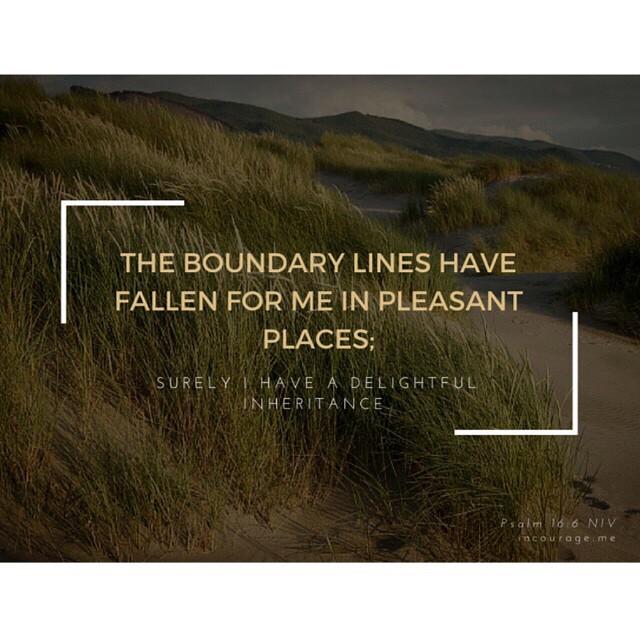
The boundary lines

have fallen for me

In pleasant places;

Indeed, I have

A beautiful inheritance.” –vv. 5-6

The boundary lines David was talking about were not only boundary markers on the ground dictating the land he would inherit. These boundary lines concerned something far more important. These boundaries established a spiritual inheritance that we also receive, the Kingdom of God.

Hebrews 9:15 says, “Therefore, He is the mediator of a new covenant, so that those who are called might receive the promise of the eternal inheritance.” Jesus is our mediator, so that we can receive our promised inheritance. The portion that we receive, our future and our inheritance, is the Kingdom of God. Indeed, our boundary lines have fallen in pleasant places!

Like many of David’s psalms, his celebration of God does not end with a praise. David always includes action. If we continue to read through the rest of Psalm 16, we see the reflection of a heart change in David’s life. He praises God, because God counsels Him- through his meditation on God’s word, he reflects on how he can better live for God. Through David’s purposeful study of God’s word, he walks on the path of life, which leads to the Kingdom.

Often, we think about boundaries as hemming and restricting us. David rejoices because, though the law does give him restrictions on how to live, he sees that life with the law is pleasant. Our boundary lines are great not only in the future to come, but also this world now.

Let’s rejoice in our inheritance and follow David’s example of walking and reveling in God’s word and presence.

-Cayce Ballard


Photo Credit: https://pbs.twimg.com/media/B8CzfQUIcAAi1yT.jpg

Look to the Cross

Psalm 8-14

prettyplace.jpg

“When I observe Your heavens,
the work of your fingers,
the moon and the stars,
which You set into place,
what is man that you remember him,
the son of man that you look after him?” -Ps. 8:3-4

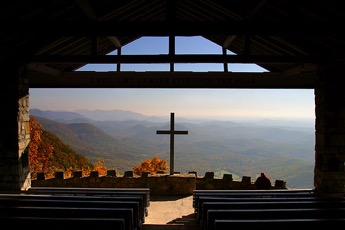
A few years ago on the UP Project, me and several other groggy kids were woken up at 5am to travel up into the heart of the South Carolina Blue Ridge Mountains.  Our destination was Pretty Place, an open chapel in a camp ground. From the chapel, the view of the ridges of the mountains are held in stunning display as they roll towards Greenville. The view can easily take your breath away. But, this chapel never held the view above the object that was placed directly before it.

In the middle of this lookout is a cross, and sitting in the pews, you can’t look at the view without first looking at the cross.

Psalm 8 describes our wonderful God and creator, who made the heavens majestic and us the caretakers of this world. Like David, there have been many times that I have called out, “Who am I, Lord? Who am I that you should remember me?” Travelling through this country and others, the magnificence of God is always in my mind, the way that he formed so many different places for us to inhabit. But, again I think, who are we to be the partakers of this beauty? My thoughts turn back to that image of the cross, held in stark relief to the blue hills below.

Today is Christmas, a day where we celebrate the birth of the heir to David’s throne, Jesus Christ! During this advent season, I remember that my Savior, God’s son, was born for me, and there are many times when I echo David’s question of ‘who is man that you remember him?’ When I think about the great love that God has for us, that he would send his son to die for us, my breath is taken away, similar to, but much greater than, the feeling I had as I gazed out over the mountains. God gave us this great gift, even while we were still sinners. Even on, especially on, this quiet (or perhaps rather hectic) Christmas morning, we should dwell on the Savior that was born for me and you.

Through Jesus’ birth and, like that cross symbolizes, his death, the great divide between God and man was overcome. The position of the cross at Pretty Place should mirror the position of the cross in our lives. The beauty of this world and its comforts are all secondary to the gift we have from God. Without Jesus’ death, we are nothing, but with the death of Jesus, we become God’s adopted children. Praise God for this wonderful gift we have been given!

-Cayce Ballard

Cayce is a Senior this year at the University of South Carolina, studying Secondary English Education. She plans to continue her education next year in the M.T. program at USC. She loves traveling, reading, and playing with her new puppy, Finnegan. Cayce leads a Young Adult Bible Study based on the Grow reading plan.  She would like to thank everyone for contributing to these devotions.

Photo Credit: http://m0.i.pbase.com/u15/jrandyh/upload/20105330.pplacec01.jpg

Yahweh, God of Angel Armies, Knows My Name (I Chronicles 24-26)

Tuesday, November 22

psalm-84-10-11_ipad_original

For the past year we have heard all about “fly over states”. I Chron. 24-26 could be called fly over passages in the Bible. You know what I mean. The lists and lists and lists of names that leave you wondering what inspiration of God those chapters hold. But just like all the people living in those fly over states want their voices to be heard, God lets us know he is watching and listening and involved with lives. This “memory-ing” that God walks us through gives a glimpse of the order that went into the tabernacle and how involved he was in the process, knitting it all together so it could bridge lives back to their roots. Back to an understanding that God was ever present and they were his children.

I diligently read through the list of names hoping to find a Jabez crying out to God in prayer to redeem his name and make him more than everyone believed him to be (I Chron. 4:10). And there in chapter 26, among the list of doorkeepers, I was rewarded with Obed-Edom. God makes a point to say that he had blessed him and his family of 62 doorkeepers. Doesn’t sound like the greatest position in the world, but these were men ready to serve and blessed of God to do so.

Through a set of unfortunate circumstances the Ark of the Covenant resided at the house of Obed-Edom for three months. David was attempting to move the Ark to Jerusalem and when the cattle carrying the Ark stumbled, Uzzah reached out to steady it and fell over dead.

Obed-Edom took a huge risk and must have had great faith in God along with confidence in his children to live alongside the Ark. When David decides months later it is time to take the Ark to Jerusalem, Obed-Edom could have stayed at home, but he decided to go and continue to serve. His love of God and desire for others to know that goodness had cast out all fear.

Another interesting thing about Obed-Edom is he wasn’t willing to rely on past efforts to be good enough. He had received blessing from God and wanted to stay in close relationship. By human standards leaving all you have to be a doorkeeper, that honestly wasn’t the flashiest of jobs, probably didn’t make sense to many. Obed-Edom must have agreed with what David said in Psalms 84:10, 12 – “For a day in Your courts is better than a thousand elsewhere. I would rather be a doorkeeper in the tent of my God than to dwell in the tents of wickedness… Blessed is the man who trusts in you.”

Take time today to draw close to God and know he will bless you for the effort you put into spending time with Him. Never doubt that our God of Angel Armies knows you by name and desires to make you known to future generations for your deeds of service.

Someone is counting on you living like you know you are a child of the Most High.

Keep Spreading the Light,

Glennis Walters

(photo credit –  http://www.theversesproject.com/verses/204/Psalm-84.10-11)

Faith of Our Fathers (1 Chronicles 11-13)

Friday, November 18

13-wordle-1-chronicles

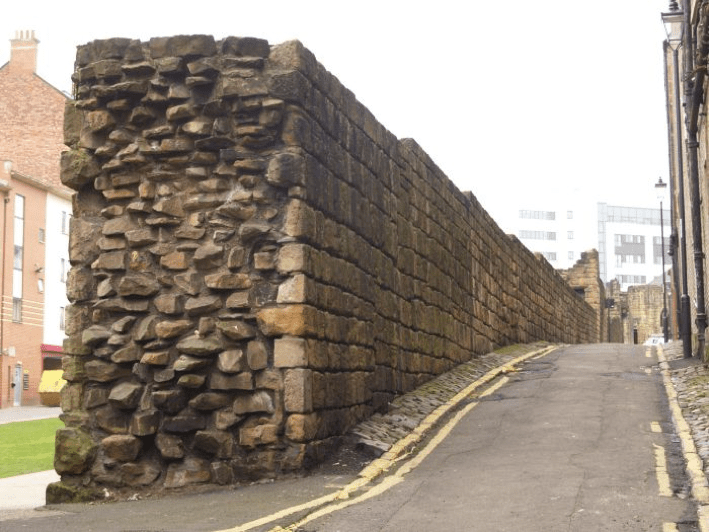
As I mentioned in the devotion a few days ago for 1 Chronicles 1-2, tradition says that this book was probably written after the Israelites returned to Jerusalem following 70 years in exile.  This was probably during the time that Jerusalem was being rebuilt, a time with a lot of struggles and fear.   There were not walls around the city.  There were enemy nations around.  They had not had their own kingdom in the entire time most of the people had been alive.  This was all new for them.

These chapters start the retelling of the time when David was king, a prosperous time in their history.  In 1 Chronicles 11:4, it says:

David and all the Israelites marched to Jerusalem (that is, Jebus).  The Jebusites who lived there said to David, “You will not get in here.”  Nevertheless, David captured the fortress of Zion, the city of David.

Then in verse 8, it says about King David:

He built up the city around it, from the supporting terraces to the surrounding wall, while Joab restored the rest of the city.

This must have been very encouraging at this time to see that David had to conquer and then build up Jerusalem, including the walls, during his reign.  The nation was greatly blessed while David reigned, so why couldn’t they rebuild and be prosperous and be blessed again.  David had trusted God, and they were now trusting God, so they could look forward to blessings and protection just as the people in the time of David.

We can all look back to the people in the church before us, and see how they trusted God, and how the church has been blessed through them.  This may be people in our family, in our local church, or others that we know of.  Their examples and the things that they have done through faith should teach us that with faith, we can also have protection, peace, and blessings as we serve the LORD.

-Andrew Hamilton