
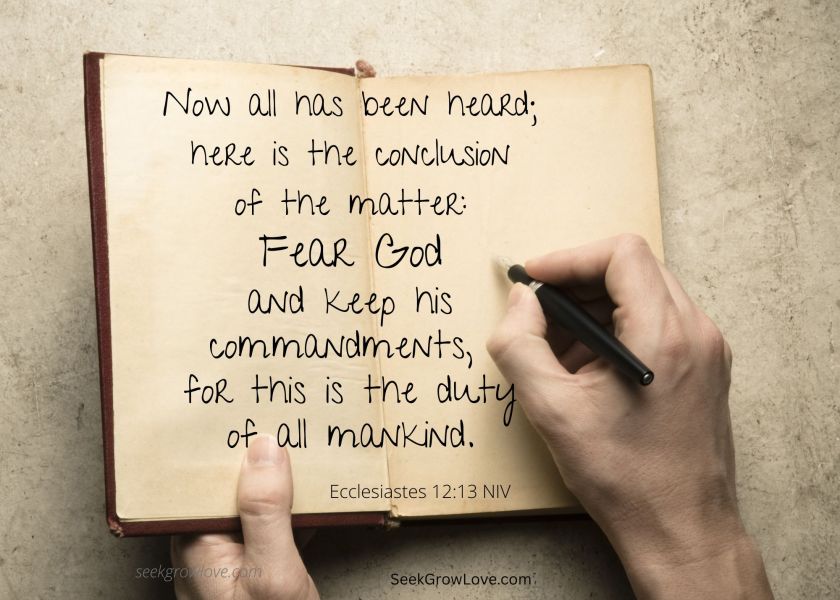
In Conclusion…

Ecclesiastes 11-12

Psalm 106

1 John 5

-By Paula Kirkpatrick (MN)

Picture a beautiful sunny day in the countryside.  Fluffy white clouds move across the blue sky as a gentle wind blows.  A young shepherd boy named David, tending his father’s flock of sheep, is enjoying the beauty of God’s creation surrounding him.  He attentively cares for the sheep, assuring water and green pastures are available to them, keeping a watchful eye out for dangerous animals that could threaten them. 

As David did his work each day, he often composed songs of praise to God, singing and playing his harp.  His whole life was attuned to his heavenly Father, honoring and following Him.

It’s not hard to see why David, the shepherd boy, was chosen to be the next king of Israel to replace Saul.  His seven older brothers passed by the prophet Samuel, but none of them were God’s choice.  It was young David, out in the field, tending the sheep, communing with His Creator, who was eventually anointed as the next king of Israel.  Why? 

“God sees not as man sees, for man looks at the outward appearance, but the Lord looks at the heart.”  (I Samuel 16:7b)

David did not live an easy life.  After Samuel anointed him as the next king of Israel, he would not take the throne for 15 years.  During that time, he experienced astounding victories and merciless defeats.  He killed the detestable giant Goliath, yet fled for his life from jealous King Saul.  He was praised by throngs of people for his mighty triumphs in battle, yet committed moral failure with Bathsheba, even having her husband killed in battle. 

Yet throughout David’s life, the Lord was by his side.  From the young shepherd boy to the ailing, aged king, he sought and served God; repentant when he sinned, faithful until the end of his life. 

Ecclesiastes 12:1a proclaims, “Remember also your Creator in the days of your youth.”    David did that, lived that.  His strong, steadfast relationship with his Lord enabled him to withstand life’s trials and challenges. 

In Psalm 37:25, aged David declares, “I have been young, and now I am old; I have not seen the righteous forsaken.”

Whatever age we may be, God will not abandon us. 

BUT, IF YOU ARE YOUNG, I say this with heartfelt conviction.  NOW, is the time to serve the Lord.  DON’T WAIT!

He is always there to listen. 

“This is the confidence which we have before Him, that, if we ask anything according to His will, He hears us” (I John 5:14)

He is always there to help you with your problems. 

“For whatever is born of God overcomes the world; and this is the victory that has overcome the world—our faith.” (I John 5:4)

He is always there to love you. 

”We have come to know and have believed the love which God has for us. God is love, and the one who abides in love abides in God, and God abides in him.” (I John 4:16)

Let God’s overwhelming love envelop you.  Respond with gratitude and resolve to serve Him faithfully.

“For this is the love of God, that we keep His commandments; and His commandments are not burdensome.” (I John 5:3)

As the writer of Ecclesiastes concludes his discourse, he offers the same guidance. 

“The conclusion, when all has been heard, is: fear God and keep His commandments, because this applies to every person.”  (Ecclesiastes 12:13)

Reflection Questions

  1.  Why is it important to “remember” and serve God when we are young? 
  2.  In I John 5:3 and Ecclesiastes 12:13, how does the love of God and fearing God      compare, in keeping His commandments?  

Prayer

Dear God of Heaven & Earth – I praise You for Your always superior wisdom, love and righteousness. Thank You for Your amazing creation and the miraculous gift of life and Your presence. May I faithfully serve You, fear You, love You all my days. Help me to speak truth and the good news, always guiding others in knowing You, keeping Your commands and preparing for Your Son’s incredible and coming return. In his name I pray, amen.

The Conclusion

Old Testament: 1 Chronicles 23 & 24

Poetry: Ecclesiastes 12

New Testament: Colossians 3:1-17

In the final portion of the book, Solomon turns to remind his readers to think often of their Creator early in life before all the “evil days” come. His point is not to just think of God when you are young, but the need to establish the foundation of one’s life in their youth. The phrase “evil days” probably refers to old age (and eventually death). As life goes on, there is more opportunity for trouble and adversity. Old age has its host of difficulties and struggles. One’s youth is often thought of as the best of times, and during that period of life it is good to develop the habit of remembering the Creator before the days of “evil” come. That doesn’t mean that older individuals cannot “remember” the Creator. Solomon is simply asserting that this practice is best formulated and built into the foundation of life at an early age before life’s complications arise and produce much turmoil and frustration.

Verses 1-7 is a whole poem that focuses on the remembrance of one’s youth and the pleasures of life that a young person is able to enjoy in contrast to the gradual decline of physical abilities and the dulling of the senses with age, a relentless progression ultimately toward death. To be “afraid of heights” and the “terrors…in the road” refer to the weakening of the body and the feebleness that accompanies aging to where a person cannot defend themselves. The “almond tree will blossom” is likely a figurative reference to the graying of one’s hair with age, like the white blossoms of the almond tree when it is in season.

The complicated saying that the “grasshopper will be a burden” likely represents small activities and simple tasks; when you are old even the smallest endeavors can seem difficult. Furthermore, when one’s “desire will fail” perhaps refers to sexual desire, but if that is true, by metonymy it refers to the failing of the physical body in general. And the “age-long home” is the place, after the failing of the body, when a person goes to the grave.

Verse 8 is a large inclusion (i.e., bookends) restating the thesis that Solomon presented at the outset of the book in 1:2, ““Utterly pointless,” says the Sage. “Everything is pointless!”

The change in voice to the 3rd person (i.e., “the Sage”) perhaps indicates that a narrator is giving an epilogue to the foregoing discourse (chs. 1:1-12:7). This epilogue functions to frame the previous discourse and Solomon’s investigation.

The summary of what Solomon discovered is that to submit to and obey God is what it means to truly live as a human being. It might be difficult to understand why Solomon asserts the “pointlessness” of life so heavily and exposes it in so many facets of life under the sun. His approach can appear to lean toward doubting everything or concluding that nothing ultimately matters (i.e., nihilism). But the pointlessness of everything he saw has driven him in the end to a deep piety and dependence on God. To understand that everything that happens under the sun has no ultimate significance or meaning only draws out the fact that meaning must reside outside of life under the sun and the work that humans do. In the face of all the oppression, injustice, uncertainty, and death in life, the Sage finds the only true meaning in life is humbling oneself before the Almighty Creator and remembering that he is God, and we are not. Our role as creatures is to worship and obey the one who makes everything and to not try and control or manipulate life, because everything we can try and do on our own is ultimately pointless. The only ultimate meaning is found in relation to the Ultimate Being whose breath fills the world and whose hand spans the universe. It is to him that we are accountable and will be judged for everything we do, whether good or evil.

So, let’s live for Yahweh and trust in him and not in our own understanding. We are weak and finite creatures, and our meaning and purpose in life can only be discovered through an obedient and faithful relationship with our God and Creator. This is the wisdom of the book of Ecclesiastes.

-Jerry Wierwille

Reflection Questions

  1. If you were to write a book of wisdom – what would your conclusion be? Where did you learn this “wisdom” from? Do you think God would agree with your conclusion?
  2. Regardless of your age, what changes have you seen in yourself as you have grown older? How does growing older affect your wisdom? What changes in your relationship with God would you like to see as you keep growing older? What can you do to bring this about?
  3. What challenges do you find in Ecclesiastes 12? Will you rise to these challenges?

The Big Reveal on the Meaning of Life

Ecclesiastes 12

Thursday, July 21, 2022

After plodding through Ecclesiastes 1 and 3 over the last two day’s devotions, we are finally at Ecclesiastes 12, where Solomon has his reveal about the meaning of life.  Verse 1 starts out the chapter with, “Remember your Creator in the days of your youth, before the days of trouble come and the years approach when you will say, I find no pleasure in them.”  

The next 7 verses highlight why the elderly may not find pleasure in their old age – because they experience things like fading eyesight, losing hearing, developing tremors, stooping because of osteoporosis, losing teeth, unable to sleep – and then die.

So what does it mean to “remember your Creator?”  Is this like “remember to take out the trash?”  No.  And it entails a lot more than just thinking about Him once in a while. When you’re tempted to enjoy the pleasures of sin, remember your Creator.  When you’re tempted to live your life in rebellion against God, remember your Creator.  When your peers are doing something you know is wrong and you’re tempted to join in, remember your Creator.  It means putting God at the forefront of your thoughts, dedicating your life to Him, and living for Him.

I think there are several practical reasons to start serving the Lord while you are young.   Here is a partial list:

  • Life in a close relationship with God is satisfying and fulfilling, so the earlier you start that relationship with Him, the longer you’ll experience meaning in your life.
  • By accepting God while you are young, you will spare yourself a lot of pain and problems that you would experience in a life of rebellion against God.
  • You may want to live it up while you are young and plan on a “death bed confession” (giving your life to the Lord just before you die).  But we never know when we may die.  Accidents happen.  And you don’t want to suffer the eternal consequences of not devoting your life to the Lord.
  • You may get dementia as you age, and won’t be able to make a decision for the Lord late in life.
  • As people age, they get more set in their ways and find it more difficult to change.

I think Solomon is giving good advice, “remember your Creator in the days of your youth.”  

At the end of Ecclesiastes 12, we finally come to Solomon’s conclusion when seeking the meaning of life.  Ecclesiastes 12: 13-14 read, “Now all has been heard; here is the conclusion of the matter:  Fear God and keep his commandments, for this is the whole duty of man.  For God will bring every deed into judgment, including every hidden thing, whether it is good or evil.”

Fear includes a lot more than being scared of God.  It includes being in awe of Him.  Giving Him reverence.  Giving him glory.  Giving Him your life (living for Him).

To paraphrase Solomon, the bottom line is this:  

You can live your life your own way, and experience a life that is meaningless and unfulfilling, then die.  Or you can live your life God’s way, and experience a life that is meaningful and fulfilling, and then die.

Either way, you will die.  And when Jesus returns, you will face judgment.  If you have lived your life your own way, you will face condemnation and the second death.  If you have lived your life for God, you will receive commendation and will enjoy eternal life.

The only rational choice is to “fear God and keep his commandments.”

You don’t have to be rational.  But you do have to choose.  Choose wisely.

–Steve Mattison

Application Questions

  1. Look again at the list of reasons to start serving the Lord while you are young. Is there anything else you would add to it?
  2. If you have started serving the Lord, when did you start? Why was that a great time to do it? If you haven’t yet, what are you waiting for?