Different – Like Jesus

Mark6BellaPic

Mark 6


Wow! It’s now been a full week since Fuel ended, and I’m sure that many of you who attended are, like me, missing your friends, your classes, the sessions, and the overall atmosphere. But hopefully, we have been able to take what we learned that week and apply it to the way we live our everyday lives. How to be (drum roll, please)…DIFFERENT! We can see many examples of how to be different and serve the way Jesus served in Mark chapter 6. I think of this chapter as a sort of series of steps telling us how we are meant to serve.

So Jesus starts this chapter off with saying, “A prophet is not without honor except in his own hometown and among his own relatives and in his own household.” (Mark 6:4) The King James version actually says, “in his own country.” So in essence, he’s telling us, “Hey, I know you like your friends, your family, your home, and it’s easy to feel comfortable there, but I need you to GO OUT and share the truth with the world.” It is not God’s will for us to stay confined to our own little nook of the world. We have to go love everybody, everywhere. Don’t be afraid to venture outside your comfort zone, and love people there.

The next main point Jesus gets to is that when you stop in a town to share the truth with people, they might not accept it; they may simply say “no”. In that case, our job is to “shake the dust off our feet” (Mark 6:11), and move on. Because what happens when we stay in one place, working on bringing the same person to the truth for too long? We miss out on bringing so many other people to the truth! If someone is not willing to accept the truth and live for God, we have to know that it’s time to move on and find people who are. Because our mission is to get as many people into the Kingdom as possible.

After the sad and brutal story of the death of John the Baptist, Jesus told the disciples to “Come away by yourselves to a secluded place and rest for a while.” (Mark 6:31) In order to help other people build a relationship with God, we need to keep ours strong. Luke 5:16, one of the memory verses from last week, says “But Jesus Himself would often slip away to the wilderness and pray.” So one important step we have to take in our lives is to take the time to go somewhere by ourselves and focus on our own spiritual health, so that we may be better equipped to go out and make disciples.

In verses 33-44, we read about how Jesus fed five thousand people with five loaves of bread and two fish. It says in verse 34 that Jesus saw them and felt compassion for them. But he didn’t just push the feeling away and continue on; he acted on his compassion. He did something. It may seem impossible to do what Jesus did, but God provides you with the means to do what you are called to do. And it’s not impossible by the way – if God thinks that you should feed five thousand people with a couple of tacos and a strawberry shake, you will feed five thousand people with a couple of tacos and a strawberry shake.

Next we come to Jesus walking on the water. His disciples were astonished when he climbed in the boat all nonchalant after walking out to the middle of the sea to calm the winds for them. Why were they so flabbergasted? I mean, they just witnessed him feed five thousand people with five loaves and two fish! Well, in verse 52 we read that they “had not gained any insight from the incident of the loaves, but their heart was hardened.” Don’t let your heart be hardened. Open your eyes to the things God is doing all around you, and let it affect you. Let it change your mindset, your behavior, the very way you live your life. Because that’s why God let Jesus do these crazy things, so that we could see His power and have faith in Him. Later on, in verses 53-56, we see how the people of Gennesaret recognize Jesus and flock to him, assuming that he can heal them, because they know he has before. Flock to Jesus. Know his Father’s power. Trust in Him. Let Him make you different.


-Isabella Osborn



Stand in Awe of God

Eccles 4 4 (1)

Ecclesiastes 4:1-5:7

Solomon, as cheerful as ever, writes about what he witnessed around him; the tears of the oppressed, power on the side of the oppressor, and no comfort for the oppressed. Who are the oppressed today, in our world, our country, our community? People are oppressed based on ethnicity, religious beliefs, economic status, gender, you name it. Some appear to less oppression than others but it is an illusion. We are all subjugated to one great oppressor, sin! Solomon rightfully says that we have no comforter … here on earth at least. He reminds us to look at what role we each play in the oppression of others for we cannot be a comfort if we are part of the problem, whether we realize it or not.

The dead! The dead are free from oppression … and happiness … and joy … and living. Peter wrote that it is only those who trust in God that may see the good that can come out of suffering. Thank you Peter for being a ray of sunshine! He says this though because we have a hope in Jesus of an eternity where sorrow and suffering will be no more. Peter was, as we are, on the other side of the cross so to speak so we have a better understanding of the impermanence of this life and its troubles and of the future promise of life in the coming kingdom.

But for today, greed and envy are tremendous motivators for oppression. When people strive for more wealth and power they rarely care for who gets pushed aside, trampled on or abused. It is a grabbing after that which will only give momentary happiness. Solomon suggests that it is better to have one handful with tranquility. … Yeah I read that and did not get it at first either. He is saying that we should not over reach or overextend ourselves. His wisdom guides us to be content with what we have, with what God has provided.

In chapter four Solomon gives two examples. The first is of a rich man whose insatiable thirst for more isolated him to the point that he had no partnership. He did not share with anyone and one day realized the immensity of that loneliness. In contrast, Solomon commends sharing in relationship. There are advantages in this as he points out. In companionship we find greater profit, a good return from our labor. We are able to help one another in difficult times when we are together. He pities those who have no one to help them when they fall. Together we can provide each other with comfort but there is no one to comfort the selfish and greedy. Companionship also affords greater protection when facing dangers. He goes further with that by saying that two is good but three is even better.

The second example is that of a poor but wise youth who succeeds the foolish king. He comes from nothing and it is implied that he was imprisoned at one point. But he rose to power and everyone followed him. He had it all! In time the people grew tired of him and he lost everything. All of his striving after money, power, and adoration was ultimately meaningless. It all comes and goes like the wind.

You might look at the opening verses of chapter five as advice or instruction on proper worship, the proper attitude, appropriate practice of prayer, and the respectful payment of vows. The reality though is Solomon is warning against straining our relationship with God. He warns against making rash vows. Rash vows become the “sacrifice of fools” and the “speech of a fool”. He advises us to be thoughtful before coming to God with an oath or vow. To consider our own limitations and our motivations. We ought to weigh all things against God’s word so that we know that it is good according to His perfect will. “What is the big deal about making vows?” A vow is a promise and for the God who always keeps His promises, breaking our promise is detestable to Him.

Whether facing oppression or battling against the sins of greed and envy, trying to stay humble enough to be content with what we have or avoiding quick words and rash vows, Solomon always returns to our Creator God. ”Therefore stand in awe of God”, trust in Him and His providence. In awe of Him rather than standing in awe of ourselves. Then we can face the troubles and strife with great endurance. Then we can rise above our baser nature. We can find contentment and dare I say … meaning!

To be continued …


Jeff Ransom


Courageously, Humbly Compliant

Joshua 5

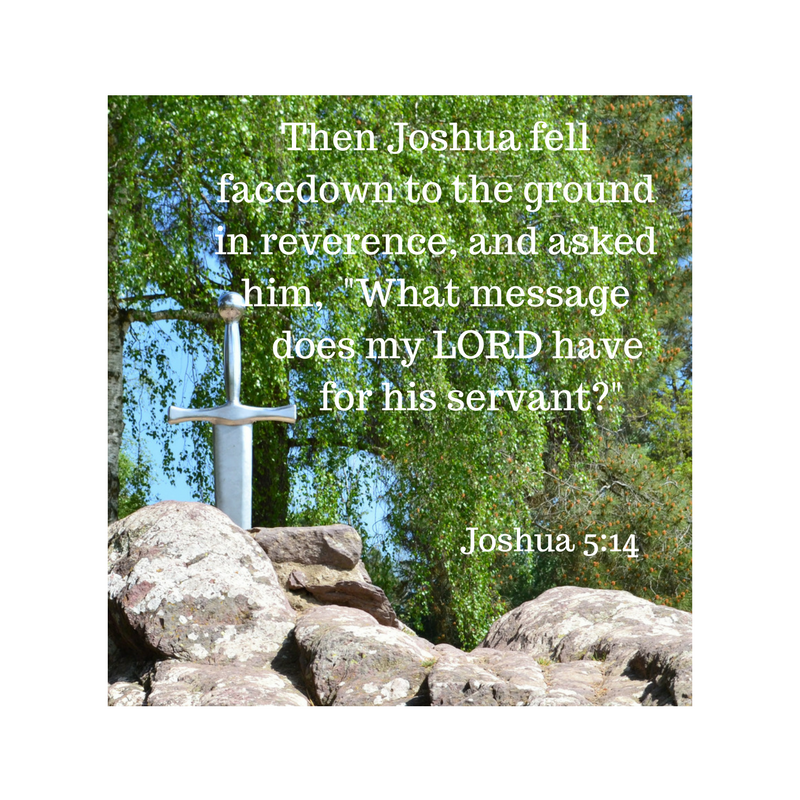
Joshua 5 14 (1)

Friday, October 13

There are a lot of great tidbits in today’s reading of Joshua 5.  Go ahead and read it and see what you find.

I love the part about the foreign kings’ hearts melting as they lost courage to fight against the Israelites and their powerful God.   (vs 1).

I love the part about the men following through to show they were committed to a new start in following God with their whole mind, body and strength – being set apart as God’s unique and chosen people (vs 2-9).

I love the part about the Israelites eating food grown in Canaan for the first time – and the manna from the sky – which God had provided for 40 years – stopping on the very next day  (vs 10-12).

But my favorite part is when Joshua is approaching Jericho and meets an armed man – but he can’t tell if he is friend or foe.  So he courageously approaches him and asks.  The man, with drawn sword replies, “Neither, but as commander of the army of the LORD I have now come.” (vs 14).   I am impressed with Joshua – not only brave and courageous, but humble as well.  Joshua, and all of the Israelites likely, considered Joshua to be the commander of the army of the Lord – until meeting this man/being with drawn sword.  But rather than arrogantly questioning this – he falls at his feet and instead asks what message the Lord has for Joshua.  I pray that I would be as courageous as Joshua – along with as humbly compliant.  Not standing up to God, or his commander, not proudly speaking of my battle plan or claiming titles – but at his feet – asking for directions – and then courageously stepping out to do them.

-Marcia Railton