The book of Lamentations is heavy. It is a raw, unfiltered look at grief. Jerusalem has fallen, the temple is destroyed, and the people are either dead, exiled, or living in deep suffering. The city walls have been torn down, homes burned, leaders captured, and the streets are empty. Hunger, fear, and loss have touched every household, and the once-proud city is now a place of desolation. Every chapter is filled with heartbreak, and the writer doesn’t shy away from addressing the pain.
But this is more than just a story of destruction. It’s an honest record of what it looks like when life falls apart. When the consequences of sin, both personal and collective, are unavoidable. The people knew God’s commands, and they chose to break them. Now they are living with the fallout, and it’s not pretty.
What stands out is how Lamentations holds both grief and hope at the same time. In chapter 3, right in the middle of all the sorrow, comes this anchor: “The steadfast love of the LORD never ceases; his mercies never come to an end; they are new every morning; great is your faithfulness” (Lamentations 3:22–23). It’s not spoken after things get better. It’s spoken in the middle of the storm. That’s what makes it powerful for us. We all face seasons that feel like ruins, and the truth is, they do not always get better. Our faith cannot rest on whether life is comfortable or whether blessings are obvious. It has to be steady, no matter the circumstances. Like Job, who said, “The LORD gave and the LORD has taken away; may the name of the LORD be praised” (Job 1:21), we are called to worship God whether life is full or stripped bare. The struggle may not lift quickly, but we can rest in the salvation we have through Christ and in knowing that our God is a Redeemer. Even when we cannot yet see it, He is at work.
Lamentations reminds us that it’s okay to be honest about our pain, but it also calls us to cling to God’s character in the middle of it. His faithfulness isn’t proven by how quickly He fixes things, but by His presence and unchanging promises even while we wait.
Reflection Questions
Lamentations shows the people facing the full weight of their choices. How does acknowledging the reality of your own situation, without excuses, change the way you pray?
The writer of Lamentations keeps talking to God even when he feels unheard. How can you practice staying in conversation with God when your prayers seem unanswered?
The book ends without a neat resolution, yet with eyes still turned toward God. How can you hold on to hope when you have no guarantee of when or how God will act?
(Thank you, Dustin Farr, for writing this week! Dustin is a first-time writer for SeekGrowLove and we look forward to hearing more from him. He is a recent Graphic Design graduate.)
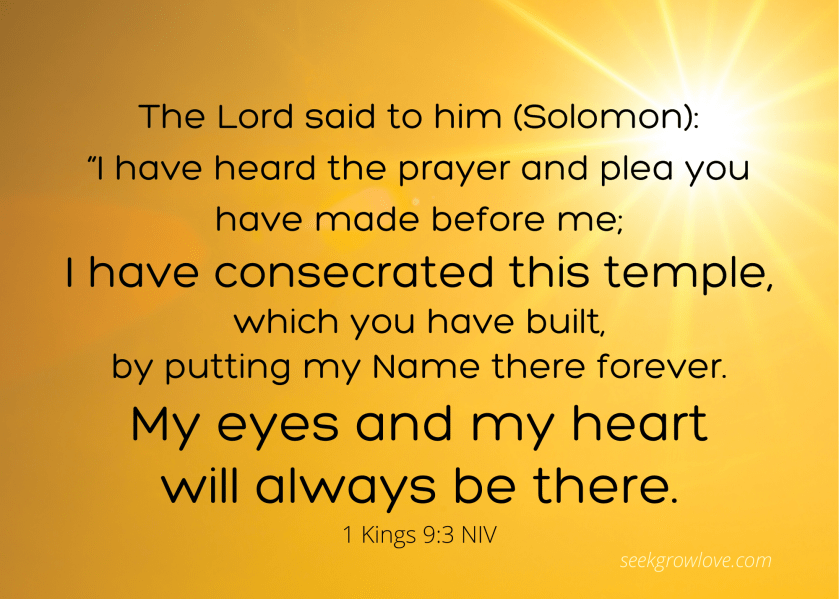
1 Kings 9:1-7(NLT) So Solomon finished building the Temple of the LORD, as well as the royal palace. He completed everything he had planned to do. 2 Then the LORD appeared to Solomon a second time, as he had done before at Gibeon. 3 The LORD said to him, “I have heard your prayer and your petition. I have set this Temple apart to be holy—this place you have built where my name will be honored forever. I will always watch over it, for it is dear to my heart.4 “As for you, if you will follow me with integrity and godliness, as David your father did, obeying all my commands, decrees, and regulations, 5 then I will establish the throne of your dynasty over Israel forever. For I made this promise to your father, David: ‘One of your descendants will always sit on the throne of Israel.’ 6 “But if you or your descendants abandon me and disobey the commands and decrees I have given you, and if you serve and worship other gods, 7 then I will uproot Israel from this land that I have given them. I will reject this Temple that I have made holy to honor my name. I will make Israel an object of mockery and ridicule among the nations
2 Chronicles 8:12-15(NLT) Then Solomon presented burnt offerings to the LORD on the altar he had built for him in front of the entry room of the Temple. 13 He offered the sacrifices for the Sabbaths, the new moon festivals, and the three annual festivals—the Passover celebration, the Festival of Harvest, and the Festival of Shelters—as Moses had commanded. 14 In assigning the priests to their duties, Solomon followed the regulations of his father, David. He also assigned the Levites to lead the people in praise and to assist the priests in their daily duties. And he assigned the gatekeepers to their gates by their divisions, following the commands of David, the man of God. 15 Solomon did not deviate in any way from David’s commands concerning the priests and Levites and the treasuries.
A great question we can ask about Kings and Chronicles is “why were the histories of the children of Israel recorded twice?”
I think that the answer is in the perspective of the leaders and kings actions in the books of Samuel and Kings where the perspective is that of God and how He sees what the kings and men do, and where their hearts are. In Chronicles it is much more the picture from the historical standpoint of man to the things that the kings do. When we read, we see motive from God’s viewpoint in the Samuel and Kings records. We see more of a historical view in Chronicles. I am not a student of who wrote down the Chronicles, but scholars who are think that maybe one or two men wrote down the book after the return from Babylon, perhaps Ezra. They wrote because it would give their people a history that maybe they did not know. And also to help to give legitimacy to their present kingdom after the captivity. By emphasizing the faithfulness of God they were giving hope to the people that God would reestablish them in the land and as a kingdom.
Are you inspired by this history to be more trusting of God and His Word?
Kings has unique information that is not in Chronicles, and vice versa. The information and perspective are different, and we need to read both books. Also the Chronicles are considered to be the last books added to the Hebrew cannon of scripture and are last in their scrolls of books. The reason for the first and second books of both is related to the size of a scroll that could be produced at that time, not to a discontinuity between the first and second books.
-Tom Siderius
Reflection Questions
Do you feel it is important for us to read these records?
What perspective should we have on these historical records?
I hope and pray today that God is giving you more confidence in His faithfulness and care as we read through these OT records.
After Moses fled Egypt and saved the Midianite women from the jerks at the well he settled down and had children and lived a simple life as a farmer/shepherd. Meanwhile the rest of the Israelites were groaning in their captivity in Egypt and their cry rose up to God and he took pity on them (Exodus 2:23-25). God was then ready to call up Moses out of the wilderness so that he can carry out God’s plan.
Exodus 3:10-15
10 So now, go. I am sending you to Pharaoh to bring my people the Israelites out of Egypt.”
11 But Moses said to God, “Who am I that I should go to Pharaoh and bring the Israelites out of Egypt?”
12 And God said, “I will be with you. And this will be the sign to you that it is I who have sent you: When you have brought the people out of Egypt, you will worship God on this mountain.”
13 Moses said to God, “Suppose I go to the Israelites and say to them, ‘The God of your fathers has sent me to you,’ and they ask me, ‘What is his name?’ Then what shall I tell them?”
14 God said to Moses, “I am who I am. This is what you are to say to the Israelites: ‘I am has sent me to you.’”
15 God also said to Moses, “Say to the Israelites, ‘The Lord, the God of your fathers—the God of Abraham, the God of Isaac and the God of Jacob—has sent me to you.’
“This is my name forever,
the name you shall call me
from generation to generation.”
It is very interesting that Moses had to ask God about his name. In the eyes of the Israelites God had abandoned them when they were enslaved in Egypt, and they had mostly wandered away from God since then and had taken on the gods of the Egyptians. It was the mindset of the Israelites that God had forsaken his promises to Abraham, Isaac and Jacob and Moses was basically asking if God was wanting to start over in his relationship with the Israelites and form new covenants. God emphatically states that he is to be known to his people as the God of Abraham, the God of Isaac, and the God of Jacob, to remind them that those promises still stand, and will stand for eternity. It is helpful to remember God in terms of what he has done for you or your loved ones, which is why God instructs the people to remember him as the God of Abraham so they will remember the stories that have been passed down of God’s faithfulness to their ancestors.
We need to be reminded of the fact that God does not change his mind like we do. God does not forget a promise. Just because things have changed in our lives and we are having doubts doesn’t mean that God is no longer the one who created the foundations of the earth. If we have sinned, or walked away from God for a time, or had a traumatic event in our lives it doesn’t change the fact that God IS, and that the blood of His Son Jesus can still cover our sins.
-Chris Mattison
(Originally posted for SeekGrowLove on Oct 3, 2018)
Reflection Questions
What do we learn about Moses in the first 3 chapters of Exodus?
How did the first 40 years of his life, spent in Egypt in the Pharaoh’s house, help prepare him for the job God selected him to do when he was 80? How did his years in Midian help prepare him? What talents, characteristics, knowledge, wisdom, connections, experiences, failures and accomplishments are in your past and present that could be useful for a future task God is preparing you for?
What examples of God’s faithfulness would you do well to remember and pass on to the next generation so they can remember, too?
What does it mean to you that God wants to be known by this same name forever? What does it tell us about God? What does it tell us about the past, present and future?
As a history buff, I love touring historical monuments. Even pre-digital-selfie days, I would try to capture a film-based image of myself at national memorials and important sites to remember the adventure. When we’ve studied certain landmarks and events in our homeschool, I’ve proudly shared my visual memories with my (thoroughly unimpressed) children. I’m hoping they will be more impressed when we take them on a historical tour of the East Coast next month, but I’m already preparing myself to accept their inevitable apathy (while I have enough fun for the whole lot of us!).
In Joshua chapter 4, we find the throng of Israelites having just completed the journey across the Jordan River (no simple task, especially at flood stage). What do you think was of first priority? Moving on to their destination? Getting a snack? Setting up camp for the night?
No, God had bigger plans – plans that might seem trivial to us, but that were much more important in the eternal perspective. He told Joshua to select twelve men (one from each tribe) to select a large stone from the river and bring it to their campsite for the night. They would then stack the stones near the river to build a monument representing the twelve tribes of Israel. “In the future, your children will ask, ‘What do these stones mean?’ Then you can tell them, ‘This is where the Israelites crossed the Jordan on dry ground. For the Lord your God dried up the river right before your eyes, and he kept it dry until you were all across, just as he did at the Red Sea… so that all the nations of the earth might know the power of the LORD and that you might fear the LORD your God forever.’” (Joshua 4:21-24, NLT)
God knew that the Israelites had a tendency to worship other gods and forget His faithfulness. With more challenging battles ahead, God wanted them to have a visual reminder of how He had provided for them in miraculous ways. Not only that, but He wanted the other nations to know the power of God! This monument served as a memory-sparker to help the Israelites pass down the legacy of their God to their children.
As a parent, I know firsthand how easy it is to get caught up in the day and forget to share about God’s faithfulness. But God, who created children, surely knows that two of the favorite activities of children are 1) playing with rocks and 2) asking a bazillion questions, so a large and unavoidable monument made of rocks was the perfect reminder for parents to share with their children about God’s provision! But God didn’t want them to remember him only when they passed the monument; he wanted his people to remember him all of the time!
Deuteronomy 6:4-9: Hear, O Israel: The Lord our God, the Lord is one. Love the Lord your God with all your heart and with all your soul and with all your strength. These commandments that I give you today are to be on your hearts. Impress them on your children. Talk about them when you sit at home and when you walk along the road, when you lie down and when you get up. Tie them as symbols on your hands and bind them on your foreheads. Write them on the doorframes of your houses and on your gates.
That section of scripture contains the Great Shema, a major tenet of our faith. Don’t overlook the part about remembering God’s faithfulness! We are called to talk about God constantly throughout our day, remembering Him together from the time we get up until we go to bed and all the time in between. This can even be as simple as praying when we hear an ambulance or thanking God for lovely nature.
We might feel inadequate for such an important task as helping those around us to remember God throughout the day, but remember the words of Paul from our reading in I Corinthians 1:27-29: “God chose the foolish things of the world to shame the strong. He chose the lowly things of this world and the despised things and the things that are not – to nullify the things that are, so that no one may boast before him.” Even Moses, the man chosen to lead God’s people out of slavery, insisted that he could not do it because of a stutter, among other excuses. (We all like to give excuses, don’t we?) But God used Moses in mighty ways, and He has plans for us too – if we will choose to remember his ways and live for him.
-Rachel Cain
Reflection: -What are your excuses for not doing some of the things God has asked you to do? Debunk those excuses and pray to God to soften your heart.
-How can you help pass along the message of God’s faithfulness? What memory-sparkers would God like to see you create? How can you remember and speak of God and His faithfulness more throughout the day?
In our homeschool history lessons, my children and I have been learning about much of the world exploration that happened following the Reformation. Prior to this time period, two entire continents – North and South America – were largely unknown to the charted world. When there was religious persecution in England, the Puritans, who believed they should be able to worship God in their own way rather than under the thumb of the Church of England, decided to venture to the New World, where they could be truly free. Explorers had already paved the way for their travels; some colonies survived, but some did not. These Pilgrims were supposed to arrive at an existing Virginian village, but because a fierce storm blew The Mayflower off course, they ended up in Massachusetts instead. Their journey was wrought with difficulties, but they were careful to make note of God’s provision along the way, such as providing a kind Native American named Squanto who knew English (as a result of his own hardship of being sold into slavery in England for a time) and taught them how to grow food and survive the winter. Though half of the Pilgrims died that first year, they joined with their new Native American family after the first fall harvest to give thanks to God for his blessings.
Psalm 118 begins and ends with praise; what a great reminder of how we should start and finish each day! It continues on to tell of difficulties and challenges, but immediately shares how YHWH God showed up each time, a reminder of His faithfulness and provision.
Last week, many of us gathered to thank God for our blessings, remember the historical first Thanksgiving, and express gratitude for our religious freedom. Thanksgiving is perhaps my favorite holiday; it’s often a simple gathering with a mighty feast of both food and gratitude. My favorite part of the day is participating in the Cain family prayer song. Before we dig into our meal, thirty or more of us – original Cains, their spouses and families and extended families, and many friends – hold hands and sing “Give Thanks with a Grateful Heart” in a variety of harmonies. This sends shivers through my body as it reverberates through the large room that was once a church sanctuary and in which there have been countless prayers offered and innumerable songs sung. I always think of the bookend verses of Psalm 118 (verses 1 and 29, NIV) on Thanksgiving, but it is wise to remember at the beginning and end of every day of the year: “Give thanks to the LORD, for he is good! His faithful love endures forever.”
Reflection:
-Commit to memory the first and final verses of Psalm 118. Then practice saying them as you wake up for the day and as you tuck yourself back into bed at night.
-Gratitude is an attitude! How can you cultivate more gratitude?
There are few moments as peaceful as gazing at the stars on a clear evening. While it is easy to feel insignificant as you consider expanse and distance of space, it can, ironically, make you feel closer and connected. I contemplate how Abraham looked at the same stars as a promise of a nation, David pondered the same heavens in the Psalms, and wise men looked to the same sky to follow the sign that a Savior had been born. While this backdrop has slightly changed since its inception from God, it is a constant source of contemplation of our Creator.
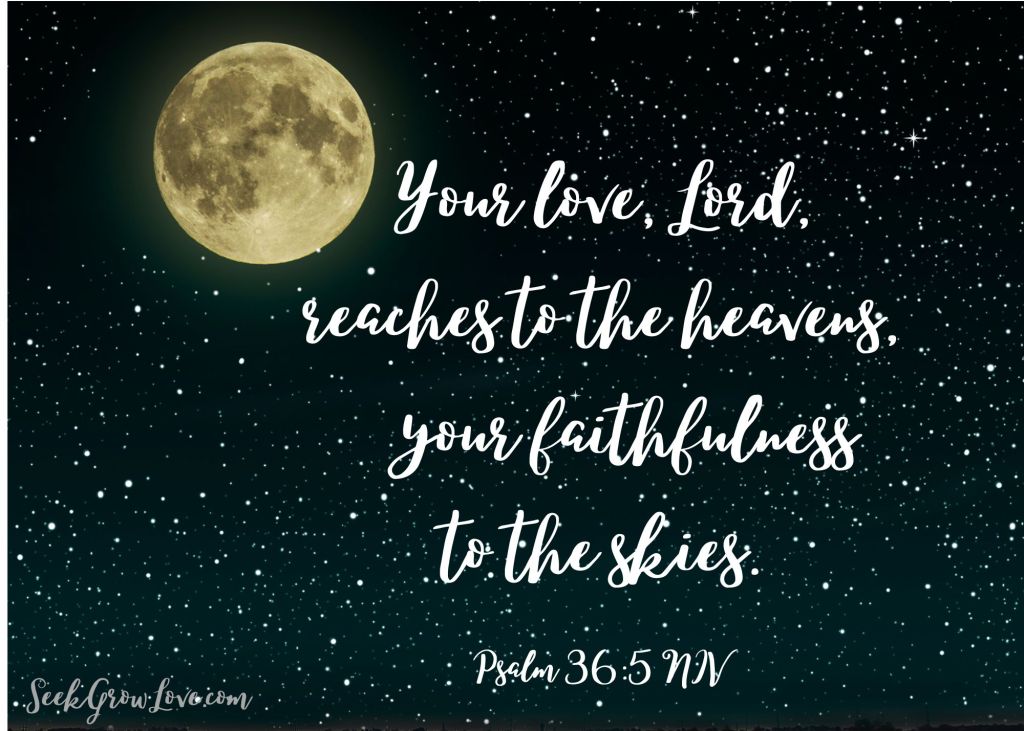
“Your love, Lord, reaches to the heavens, your faithfulness to the skies. How priceless is your unfailing love, O God! People take refuge in the shadow of your wings.” – Psalm 36:5, 7
How wonderful to know that our God’s love reaches to the heavens. It literally can find us up in a plane, on a rocket, or wherever the technology of our generation takes us; moreover, his love reaches as far as the heavens, meaning it can find us in any location at any time. The same is true for his faithfulness. It endures in any situation, setting, or circumstance. This combination creates not only a love that can find us, but also a love that can sustain us. The Love of God is our refuge. He is our shelter from the storm and the sustenance through scarcity. Jesus Christ speaks to the weariness of living in the present evil age when he pleaded, “Come to Me, all who are weary and burden, and I will give you rest (Matt 11:28).” In the ransom of our Savior, and in the comfort of the Spirit of God, we can find rest.
“”I have told you these things, so that in me you may have peace. In this world, you will have trouble. But take heart! I have overcome the world.” – John 16:33
Rest isn’t shut-eye. It isn’t “me” time. Finding rest in the unfailing love of God means spending time walking and talking with our Father. If you want rest, set your alarm a few minutes early to pray over your day and your mission field. If you want rest, offer praise to God in the middle of the night in the exhaustion of new parenthood. If you want rest, spend your break at work reading a devotion. If you want rest, ask for direction in your next steps under the stars. Even though we are guaranteed trouble in this life, when we live in the shadow of our God, we can solace in His enduring love in any time, in any condition, and in any place.
-Aaron Winner
Reflection Questions
What do you already know about the stars and heavens God has created? You might enjoy doing even just a few minutes of research on the stars. What impresses you most about the starry night sky God created?
Have you experienced the rest and peace Jesus the Son of God offers? If you have, how would you explain it to someone who hasn’t? If you haven’t, how can you put yourself in a position to come to Jesus, listen to him and receive his peace and rest?
How can you arrange your day – and night – to find more opportunities to find rest in the unfailing love of God?
(I am sorry this is arriving so late in your email inbox. I thought I had published this morning – but apparently had shut the computer before it completed. My apologies.)
Though I’ve always struggled with anxiety, I can trace a lot of my childhood anxiety back to one source: the 5 o’clock news. I dreaded the hour-and-a-half each evening that my Dad would sit down in his recliner and turn on the television to hear the journalists report the sad and scary happenings of the day. I grew up near Dayton, Ohio, which has several times been on the “ten most dangerous cities (of its size) in the USA” list, so there were a lot of terrifying updates about local robberies and murders, not to mention domestic and global catastrophes, such as the Persian Gulf War and the Oklahoma City bombing. My tender heart had great difficulty accepting such chaos and pain in the world.
Then as a sophomore in college, I witnessed a hit-and-run, a robbery gone awry that resulted in the vehicular homicide of a sweet man, beloved in his community. I was forced to relive that terrible day many times over the next several years as a prime subpoenaed witness, until a series of unfortunate mishaps with the trials resulted in the guilty suspects being released with a clean record. I was aghast that the lawyers could be so slimy as to defend people who were clearly guilty of theft and murder, and that such evil could exist in the first place.
With all the terrible things in the world today, it causes me to wonder, how much worse could it actually have been back in Genesis 6 when God felt he needed to start again with godly people on Earth?
The world became corrupt again after Noah, and the wickedness in human hearts has continued for millenia. Paul warned Timothy, starting in verse 2, that in the final days, “people will be lovers of themselves, lovers of money, boastful, proud, abusive, disobedient to their parents, ungrateful, unholy,without love, unforgiving, slanderous, without self-control, brutal, not lovers of the good,treacherous, rash, conceited, lovers of pleasure rather than lovers of God— having a form of godliness but denying its power.” Paul reminds Timothy to stay away from such people. That list sure sounds like the tendencies of a lot of people in this world and on the news today… and if I’m being completely honest, it sounds a lot like me at times too, when I lose my Christ-focus. I, too, have been “such people.” I am a sinner saved by grace, and I need to humbly remember how Jesus has saved me. I also need to be careful when I am in the world, to not be of it; it is important to not be influenced by people who are doing evil things, or I might sway to become a part of the sin and be pulled away from my relationship with God. Yes, we need to share the love of Jesus with everyone, but also have boundaries in those relationships.
Sometimes new Christians think that following Jesus should be The Easy Life, but the Bible is very clear that we will have difficulties as followers of Jesus. In verse 12, Paul promises that “everyone who wants to live a godly life in Christ Jesus will be persecuted.” Jesus himself said that we will have trouble, but he has overcome the world! (John 16:33). So Paul reminds Timothy two verses later to keep focused on what he has learned, keep the legacy of faith alive. By focusing on what we knew in the good times, we can have the strength to make it through the difficult times.
Then in verse 16, he reminds Timothy that the scripture is a guidebook for life, a manual for living. By following the God-breathed scriptures, we can have the training and correction we need to be ready to do good work for him, and (I would add) to fight any battle that we might face: “All Scripture is God-breathed and is useful for teaching, rebuking, correcting and training in righteousness,so that the servant of God may be thoroughly equipped for every good work.” I believe that is true today as well. The scriptures have survived for thousands of years because God wanted us to have them as a roadmap for our journey in this life, His special guidance through which He still speaks to us.
I’ll never forget how I beamed with pride as I sat in the front seat of our old red Dodge Omni hatchback, filled to the brim with camping supplies for our family’s annual vacation to the Hocking Hills KOA campground, with the Rand McNally road atlas sprawled over my 10-year-old lap. I was my Dad’s “navigator”; I had the very important job of following the criss-cross lines on the map (which my Dad had conveniently highlighted prior to our departure) to help us arrive at our vacation destination, leading the way for the rest of the clan in the car behind us. Until I was a young adult, I believed I was a good navigator. However, when my husband Dan and I got married and began to go on trips together (before smartphones were commonplace and while GPS car systems were still out of our price range), I realized that a modern Ferdinand Magellan I was not. As a directionally-challenged individual, my mis-reading of maps led us on many, shall we say, unplanned adventures. (Now, we reminisce about those frustrating adventures with a half-smile as we thank God for the invention of Google Maps and data plans.) It turns out that I wasn’t the navigator at all; my Dad had already highlighted the route and knew where he was going. He gave me the map and taught me how to read it at a basic level, but ultimately he was leading us the whole time. Likewise, God has given us a map (the Bible), and He shows us the best way to live. But we need to read His word, study His “map” and seek His ways for our lives through prayer and wise counsel. Then we will be better equipped to do His work.
-Rachel Cain
Reflection questions:
As a Christian, we are guaranteed persecution in this life. Think and pray about ways that you can prepare yourself to face those trials.
In what practical ways can you encourage and support other Believers who are facing trials?
Look back on your life. How have you felt God’s leading through prayer and His word? How do you sense Him leading you today? (It’s a great idea to keep a journal of God’s faithfulness and answered prayers, which you can read again during difficult times!)
In this chapter, Paul, awaiting a trial before Caesar, finds himself stuck on a ship in the middle of a storm with 275 others. To me, this sounds like a very frustrating situation to be in; being taken as prisoner despite being innocent, and then being completely ignored when you (an experienced traveler on the Mediterranean) warn against continuing on through the storm even in this current season, and consequently being trapped at sea in the midst of a perilous storm.
But Paul did not lose faith, and he would not let his fellow passengers give up either. After being tossed about in the storm for days on end, Paul encourages everyone onboard:
“Men, you should have listened to me and not have set sail from Crete and incurred this injury and loss. Yet now I urge you to take heart, for there will be no loss of life among you, but only of the ship.” Acts 27:21-22
He proceeds to tell them of the angel who promised not only his own safety, but also that of everyone with him on the ship.
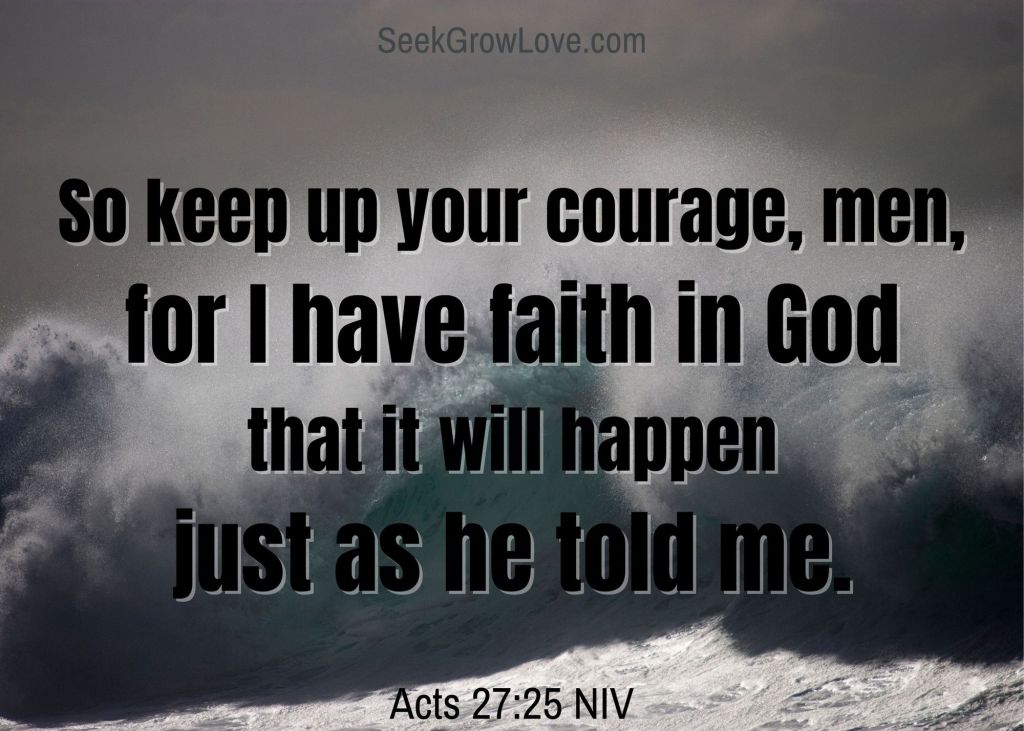
“‘Do not be afraid, Paul; you must stand before Caesar. And behold, God has also granted you all those who sail with you.’ So take heart, men, for I have faith in God that it will be exactly as I have been told.” Acts 27:24-25
Weeks passed, and though everyone stayed alive, their situation had yet to improve. But still, Paul insisted that they would all be okay, urging them to eat while giving thanks to God. Eventually there was a shipwreck, in which the soldiers planned to kill the prisoners to avoid their escape, however the kind centurion Julius would not allow them to carry out this plan, and they all made it safely to shore.
In Acts chapter 27, we watch as an epic tale unfolds (once again), and points us to the unrelenting faithfulness of our God. This amazing miracle was a small-scale example of what God is going to do for the entire world. As terrible as it gets, and as hopeless as our situation may feel, God’s promises do not change; He will always follow through. So we can eat our bread and find peace, even in the middle of the most terrifying of storms, resting in the knowledge of God’s coming Kingdom and never losing faith that His promises prevail. He will not fail you, He will not let you down, and He will not break His promises. So take heart, for I have faith in God that it will be exactly as I have been told.
-Isabella Osborn
Discussion Questions:
How can you be an influence to help others find hope in their storms?
In what ways has the knowledge of God’s promises and faithfulness affected your life?
When do you find it most difficult to take heart? How can you help remind yourself, even in these trials, of the hope we have in Christ Jesus?
As the book of Judges opens, we are very hopeful for the future of Israel. Joshua came after Moses and brought them into the Promised Land. The Israelites had become strong and were beginning to drive out the other nations from the land, a punishment from God on their deeds (see Genesis 15:6 and Deuteronomy 20:17-18). Unfortunately, as the generation after Joshua dies off, we find out that the Israelites are in serious trouble: they have not been listening to their God, and are doing things that were evil in His eyes, just like the people they were supposed to drive out.
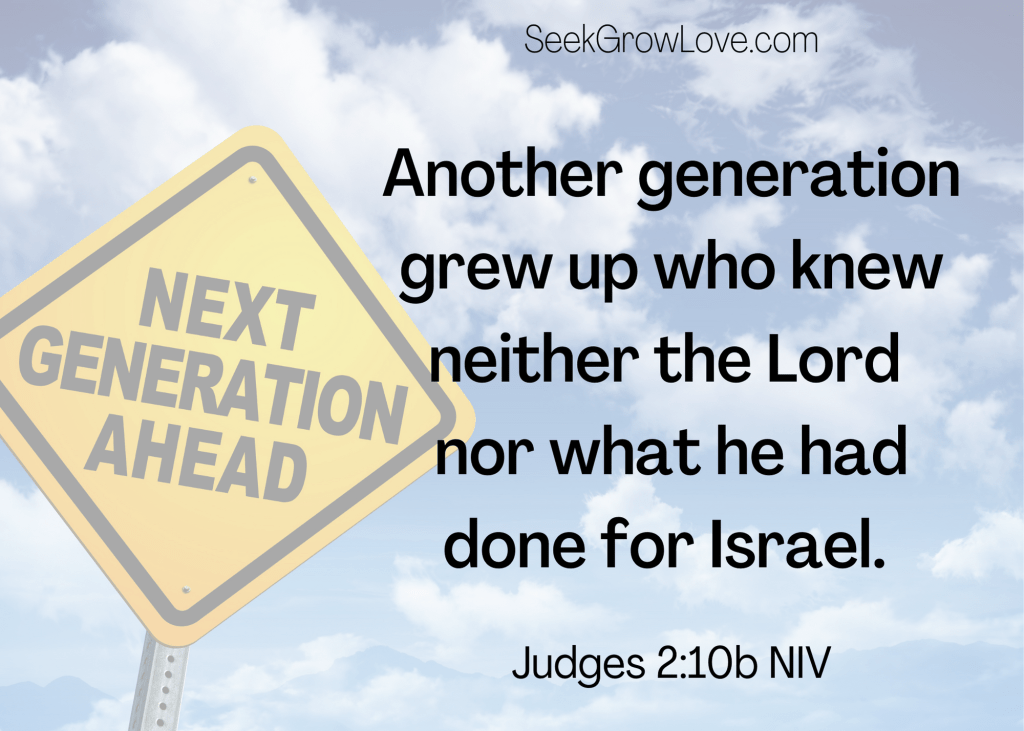
One of the major reasons why they didn’t obey God is that this new generation did not know God or His ways (v. 10). How would an entire generation of Israelites not know the stories of the exodus from Egypt, the parting of the Red Sea, or God’s faithfulness through the wilderness? This is probably baffling to us looking back on it; surely these stories from the past would have been enough to convince anyone to believe and obey God, right? But what if this story is the same as our own? What if we have forgotten God’s faithfulness and mercies over the years, or not talked about them with the next generation like we are commanded to do? (Deuteronomy 6:4-9)
Things around us in the United States and in our churches have changed dramatically over the last few decades. There are many who have been raised without any knowledge of God or Jesus, and one of the major reasons why is the lack of people passing down their stories and beliefs to the next generation (not the only reason, but a big one). In fact, I had a friend who didn’t know that we celebrate Christmas as the birthday of Jesus until he was 21 years old! Former missionary fields, like Africa, are now sending their own missionaries back here because we have fallen so far away from the faith. Maybe the writer of Ecclesiastes had it right: “there is nothing new under the sun.” (Ecclesiastes 1:9)
-Talon Paul
Questions to Consider
Think about your life and story; are there ways that God has moved and worked to bring you to the place where you are now? Don’t forget these stories, like the Israelites before us. I encourage you to take time this week and reflect on how God has been faithful to you.
To those who have been in the faith for many years: have you been telling your stories and testimonies to those who are younger? What can you pass along to the next generation to help them trust in God more?
To this current, young generation: Israel was punished for their disobedience, but we don’t have to be. We can make a decision right now to be different from them and choose to worship the one true God with all of our hearts, souls, minds, and strength. Will you make that decision today? Will you forsake the gods you have set up in your hearts and trust in the only One who can truly save?
de·vo·tion | \ di-ˈvō-shən (noun) – 1. a feeling of strong love or loyalty; 2. the use of time, money, energy, etc., for a particular purpose 3. prayer, worship, or other religious activities that are done in private.
So it begins. A new year, a new beginning! (but in reality, pretty much the same as yesterday, just with a couple minutes more or less daylight than the surrounding days depending on which hemisphere you live in.) As anticipated, we are beginning a new set of readings for this year! Yay! Today it begins with Matthew 1, which goes through the family tree of Jesus through the line of his father, Joseph., and the DM from God about Jesus. It is a showcase of how God has been devoted to his people, Israel, faithfully moving generation-to-generation, literally or metaphorically, to begin the path of Jesus Christ and the redemption of us who follow Him. In so doing, God displays his devotion to us; His love, His use of time, and the pouring out of His holy blessing. Because of this, we should do nothing less than be devoted to Him in the same manner (John 4:19). What does it mean to be devoted to God? Today, we look at the three definitions for the word devotion to gain a clearer picture of how we can remain faithful, not only to reading God’s word this year, but drawing closer to Him through this daily activity.
When Joseph woke up, he did what the angel of the Lord had commanded him and took Mary home as his wife. But he did not consummate their marriage until she gave birth to a son. And he gave him the name Jesus. – Matthew 1:24-25
1. A Strong Love or Loyalty – On our very best days, we seek God in every aspect of our day. We plan alongside Him; we move with Him; and it is because we love Him and desire to do His will. But then there are other days where we are faithful and devoted to Him, and our flighty human nature begins to tug. Those days, usually Mondays, we are in a place of love, but not necessarily acting on a response. We still must find the will to be faithful, true, and loyal, because God is still in these moments forgiving, restoring, healing, and moving us. Devote yourself to reading the Word of God throughout this year. Hopefully, in this blog. Follow, share, and do His will in this manner and your relationship with Him will grow stronger.
Thus there were fourteen generations in all from Abraham to David, fourteen from David to the exile to Babylon, and fourteen from the exile to the Messiah. – Matthew 1:17
2. The Use of Time for a Particular Purpose – It is obvious from reading the genealogy in Matthew 1 that God uses time precisely. This may be used as evidence that God had created a family tree from Adam to Second Adam, Jesus, before the creation of the world. He set them apart. There is no doubt that setting aside time for a particular purpose has its perks. Christians have been doing it for centuries, coming together at the same time and location to worship God. In doing this, the weekly life of the family or individual is governed by their meeting as a body of believers, “Sorry, we can’t do that because we have church.” In the same manner, your individual time of worship and devotion with God should govern each of your days, not simply be the remaining portions. Set aside time that doesn’t have distractions, doctor’s appointments, or drudgery. This is time only for you and God.
Because Joseph, her husband, was faithful to the law, and yet did not want to expose her to public disgrace, he had in mind to divorce her quietly. But after he had considered this, an angel of the Lord appeared to him in a dream and said, “Joseph son of David, do not be afraid to take Mary home as your wife, because what is conceived in her is from the Holy Spirit. – Matthew 1:19-20
3. Religious Activities Done in Private – Joseph wanted to “put away” Mary privately instead of humiliating her in public because he was faithful. WHAT?! He was faithful to the law and the customs of His people, which many of us often confuse with the Will of God. It is also in private that Joseph receives a direct message – God’s will is moving in a much different direction and will change the foundation and fulfillment of the Law. Being devoted to God is not solely in the public display, although the symbols of baptism and communion are important public, visible representations that acknowledge our walk with Christ. Before giving us the model prayer in Matthew 6, Jesus discourages us from making our prayer, devotion, and fasting times something that we draw attention to because when we do, we draw attention to ourselves. It is welcome, and highly encouraged, that you read these devotions alongside someone you know, but it’s not to showcase your devoutness, or to shout in the streets your sufferings for Christ, or to display your streaks. There will be time to declare your faith and testimony in public, but it is guided by what is done behind the closed doors of those who are devoted.
-Aaron Winnner
QUESTIONS TO PONDER/DISCUSS –
you may pick and choose your favorites
In this chapter we see several names for the baby born. What names do you find in verses 1, 16, 21, 23, 25 (some are repeated) and what is the significance and meaning of each? Footnotes may be helpful. What will help us remember the importance of these names?
Which definition of devotion do you feel you are doing the best with right now? Which one could use a little work? What would your family, friends, neighbors say you are devoted to? Better yet – what would God say you are devoted to?
The angel told Joseph in a dream, “Do not be afraid to take Mary home as your wife…” (Matthew 1:20). Think about what God may be wanting you to do today, this week, this month, this year. It might go against your natural tendencies or the customs of the land. It may be something that causes you fear and some anxiety. Pray for the direction and follow-through to step out in devotion to God and be an active part of His plans for redemption.
Many people find great benefit from the practice of journaling – often writing down thoughts, questions, feelings, quotes helps them stick a little better. You may enjoy daily writing out a verse from each chapter. You can either write out the verse pictured with each devotion, or when reading through the day’s chapter look for a special verse that you want to write down to take with you through the day.
The link to read today’s chapter, Matthew 1, on BibleGateway.com is now at the top, directly below the title and picture.
And here’s the reading plan for the year to print and mark your progress. Looking forward to Seeking Growing and Loving together with you in 2022! God has good things in store for those who seek Him!






 Seek Grow Love