
Deuteronomy 32-34, Psalm 91
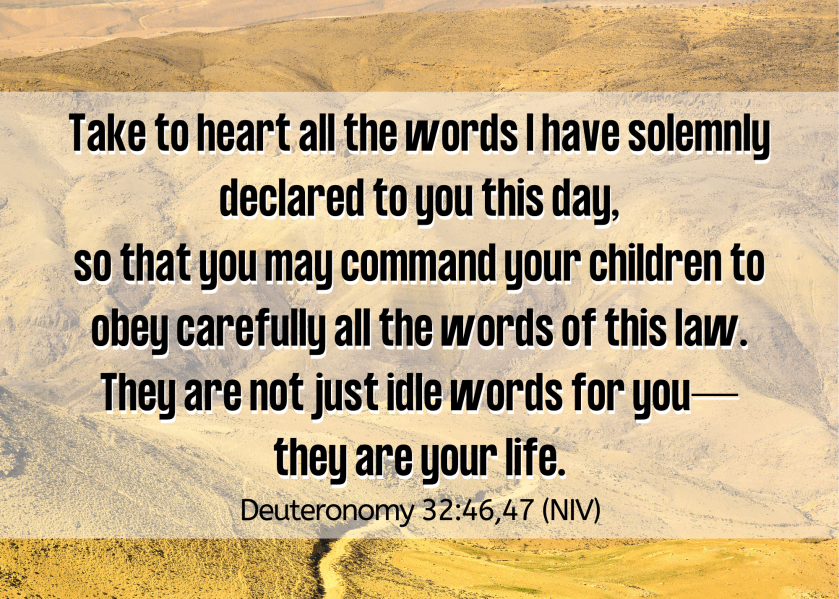
Even things that were written with a specific audience in mind can contain principles that we can apply, too. Our look at this section of Deuteronomy this week has shown us a number of these principles.
As we dig into these final chapters, I want to back up a smidge to chapter 31 from yesterday’s reading. It fits a bit more to mention it here, as a lead-in to the close of the book. What I thought after reading chapter 31 was this:
How depressing for Moses.
Here he is about to die, and God decides to tell him that, by the way, these people that you served all these years…they’re going to totally screw up and abandon me. (I believe the phrases God uses include, “prostitute themselves to foreign gods”, “forsake me” and “break the covenant they made with me”)
Clearly God knows what he’s doing, though, as he further prompts Moses to take this information and write a song that the Israelites can sing as a reminder. (Showing what a great teacher God is, knowing that songs stick in our minds!)
Blackout Poetry
The song of Moses can be found in Deuteronomy 32. I want to take a look at it by singling out certain words and phrases. Blackout poetry is a form of poetry in which you take an already printed piece (article, story, anything) and black everything out except the words you want to shine a light on. In this instance, I think it can help us get a feeling for the heart of God in these words.
Listen
Proclaim … Oh, Praise the greatness
He is the rock…A faithful God who does no wrong
To their shame they are no longer his children…warped and crooked…foolish and unwise
He made you and formed you
Remember
He found…He shielded..cared for..guarded…fed
Abandoned God…Rejected the Rock
Jealous…Angered
“I will hide my face from them,” he said… “They angered me with their worthless idols.”
Fire kindled by my wrath
Heap calamities upon them…wasting famine…pestilence…plague…fangs…venom
Perish
Scatter
“If only they were wise and would understand”
The LORD will judge…and have compassion…When he sees their strength is gone and no one is left
I have wounded and I will heal
Rejoice
He will…make atonement for his..people
Speaking of poetry, Psalm 91 is a beautiful picture of God’s protection and provision. (You can read it here https://biblehub.com/bsb/psalms/91.htm ) One phrase I want to single out is in verse 4. It tells us that
“His faithfulness will be your shield.”
In Moses’ song, he says that our God is,
“A faithful God who does no wrong, upright and just is he.”
We are foolish and unwise, weak and broken, and often fail. But we can depend on God’s faithfulness. We can trust that he does what he says he will do. After all of this Moses tells the people in 32:47, and I remind you today:
“They are not just idle words for you—they are your life.”
Susan Landry
Today’s Bible reading can be read or listened to at https://www.biblegateway.com/passage/?search=Deuteronomy+32-34%2C+Psalm+91&version=NIV
Tomorrow we will begin the book of Joshua (chapters 1-4). Don’t miss out – Be Strong and Courageous – as we charge ahead on our 2020 Chronological Bible Reading Plan.
And if you haven’t started consistent daily Bible reading yet…now is a great time to start. Come read with us and see God at work – through the books of Old Testament history – and in your heart.


 If you are in that moment, remember that God does not leave Elijah there, and he doesn’t want to leave you there either. Instead, he says, “Get up and eat (v. 5). After Elijah eats twice, he goes on a journey forty days and forty nights to the mountain of God. There, Elijah waits, first through a great wind, then through an earthquake, and lastly through a fire. In each of these places, he does not hear God’s voice. Finally, he hears it in the soft whisper, as God asks him “What are you doing here Elijah?” (v. 13) Elijah responds by saying, “I have been very zealous for the Lord God of Hosts, but the Israelites have abandoned your covenant, torn down your altars, and killed your prophets with the sword. I alone am left, and they’re looking for me to take my life” (v. 14). Elijah feels this despair because he had forgotten what God just showed him. In the desert when he was hungry, God was there with provision. He had forgotten that in the showdown, God was there with provision. When we turn our eyes from God to focus on our fractured circumstances, it can lead us to doubt. But, one remedy for that doubt is not only to remember the character of God but also to remember how God has exhibited that character in previous actions of faithfulness. We can trust in him not only because of what we know from the Bible but also because of what we know from our own lives. So, if you are in a wilderness period in your life, pause and remember God’s past faithfulness instead of dwelling on your despair. These reminders can help us to remember that even in our darkest times, God will carry us through.

 Seek Grow Love