Revelation 7- Gifts & Rewards

OLD TESTAMENT: Lamentations 1-2

POETRY: Psalm 119:105-112

NEW TESTAMENT: Revelation 7

Chapter 7 is one of the passages in Revelation which can seem like it reverses or unworks what God had done before. God had called out a people for His own, setting Israel apart. Then God sent Jesus and brought up an upheaval in the relationship of God and humanity. The events of Pentecost launched the church, and while it took some time for Jews and Gentiles to be combined in one organization it can be a surprise for people to find Israel identified here again, and not just as a nation but with 12 tribes. But even in this context the tribes are set together with the peoples of the world, based on their common acceptance of God and the Lamb.

 At the start of the chapter a period of calm is established. Perhaps this does not follow chronologically from the events that were described just before, we may be stepping away from that part of the vision to get another angle on things. We are told about four angels who have been authorized to bring destruction with the four winds of the world – from the four main directions – but for now the angels are keeping the winds still at the instruction of another angel holding the seal of God. In this time of calm that angel seals 144,000 people, 12,000 each from 12 tribes of Israel. This is a vision so perhaps the sealing process passed quickly, as can happen in a dream.

The identities of the tribes who were sealed create a small puzzle. We are used to reading of Joseph’s blessing being passed to his sons Manasseh and Ephraim (for the ‘half-tribes’), forming a set of 12 tribes only when Levi is excluded from the normal count. Levi gets excluded because Levi’s descendants gained a special role with God in the time of Moses and that was treated as their inheritance instead of land. But here Ephraim is excluded, and we have the “Tribe of Joseph” and the Tribe of Manasseh joining the Tribe of Levi. We lose Dan, the northernmost tribe, instead. Why? It might be because Ephraim’s name is so associated with the line of kings who brought idolatry to Israel, and that Dan was the tribe first associated with idolatry in the time of the judges (Judges 18:30-31). But we also have in Ezekiel 48:2 the prophecy that Dan will be in the kingdom and receive land, so there is something symbolic happening here rather than something permanent.

The larger point is that God continues to have a portion of people who are sealed for Him – God never gave up on Israel, never gave up the promises made to Abraham, Isaac, Jacob, David, etc. The results may not look like what people were expecting at different points along the way, but God does not forget to give gifts (just as God does not forget to give punishments, which the previous chapter was establishing). The significance of the seal itself in the Revelation vision doesn’t come up until chapter 9, but in marking those who are with God it provides protection (at least). I see this as being rather like the Passover in Egypt, but rather than being told to remain safe within certain buildings marked with blood the people themselves were marked for God and therefore able to travel with protection. And unlike those earlier Hebrew people they were not being told to separate themselves from everyone else, the context pairs them with a crowd “beyond count” from every nation and people.

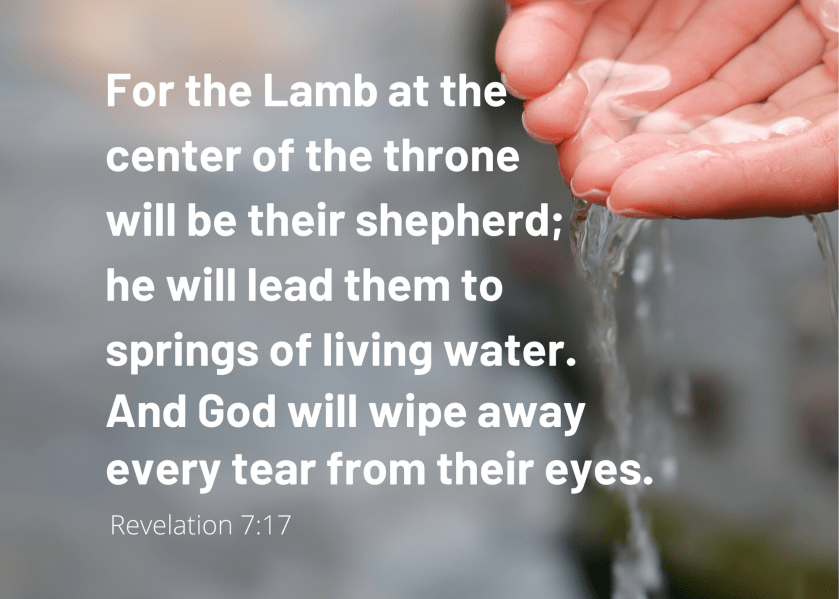
The crowd in white robes sounds much like those who had been slain (6:11) who were “waiting” for their fellow servants who were to die. We are told that these many “came out of great tribulation” (7:14) but are not told how many (if any) survived it. This may be another reference to the souls from under the altar. Or others may have been added to the number. What is clear is that God rewards His servants. It says they shall hunger no more, thirst no more, and no longer will the sun beat down on them. It sounds like we are being told that the curse on the soil doesn’t apply to them anymore; they no longer must be concerned about working by the sweat of their brow to eat. Springs of living water are being offered, and God Himself will wipe the tears from their eyes. Pain and struggle is being reversed – permanently. You can see why I think this chapter may step out of the chronology of the vision to give an overview of promises that are being offered, refreshing our memory of joy.

Lord, you keep your promises, even the ones I don’t fully understand. Please help me to take seriously what you have said to me, and what I say to you. Thank you that you love so much better than I do. Let me be committed to learning from you, not simply facts or ideas, but growing as a person and growing in my relationships with others and with you. Help me to remember that you never want anything bad for me. Help me trust you to show me right paths. Thank you, Amen.

-Daniel Smead

(originally posted for SeekGrowLove on Nov 22, 2022)

Application & Reflection Questions

  1. Who will receive the punishments of Revelation 6? Who will receive the rewards of Revelation 7?
  2. What do we learn from Revelation 7 about worship, commitment and faithfulness?
  3. What are some gifts and rewards God has already given to you? What gifts and rewards are you still looking forward to? Give thanks to God for what He has done, is doing, and will do!
Listen to Me

Old Testament Reading: Isaiah 51-52

Poetry Reading: Psalm 84

New Testament Reading: Mark 15

Our Old Testament reading today, coming from Isaiah 51 & 52 starts with a call to attention.  In the first 7 verses the reader is instructed three times to “listen” or “pay attention”. In fact, depending on your version, you might even have a good old fashioned “Hearken!”  Isaiah 51:1 calls those who are pursuing righteousness to listen and verse 7 speaks to those who know righteousness. I was challenged as I considered the implication that those being asked to listen were those pursuing rightousness when I consider how poorly a job I do at times pursuing God compared to pursuing everything else. Even amidst Assyrian captivity, the LORD was aware of His people and this chapter is full of comfort for them. We are showered with words like joy, gladness, thanksgiving, and justice. I even found myself humming “Therefore the Redeemed of the LORD shall return. . .” reading through this chapter. The source of comfort and hope described throughout Isaiah 51 is attributed to the LORD. It isn’t going to come from political freedom, overtaking enemies, gaining wealth, or stockpiling weapons and food. It comes from,

“. . .the Lord your God, who stirs up the sea so that its waves roar (the Lord of armies is His name). 16 And I have put My words in your mouth and have covered you with the shadow of My hand, to cestablish the heavens, to found the earth, and to say to Zion, ‘You are My people.’ 

 New American Standard Bible (La Habra, CA: The Lockman Foundation, 2020), Is 51:15–16.

Thankfully, while he was speaking to the nation of Israel at that time when he said “You are my people”, today, if we are believers and followers of the promised Messiah talked about in Isaiah, we are also His people. We also have a hope of eternal security and an unshakable kingdom yet to come.

Isaiah 52 continues the message of removing the weight from the burden of sin and oppression and shares a message of liberty and redemption.  Isaiah again seems to be conducive to use for song lyrics if you are familiar with “Our God Reigns” which is based on this chapter. And Chapter 52 concludes with the exalted servant Messiah imagery. The sprinkle he offers in verse 15 doesn’t come in rainbow variety as a donut or ice cream topping. It is the same word used in Leviticus 16 referencing sacrificial blood. The servant was sacrificed for our sins. And at his name, one day, every knee should bow.

Behold, My Servant will prosper,

He will be high and lifted up and greatly exalted.”

 New American Standard Bible (La Habra, CA: The Lockman Foundation, 2020), Is 52:13.

-Jennifer Hall

Reflection Questions:

1.  How might “pursuing righteousness” look in your life?

2.  Are you one of God’s people, and if so, how does that change and affect your life?

3. What might you need cleansed of today as you consider the sacrificial sprinkling of blood for your redemption?

Tell Me Again

1 Chronicles 22

March 19

My daughter loves Pride and Prejudice by Jane Austen. She loves watching each new version that comes out – and then rewatching the old classic again, too. Each new director has a slightly different angle on Austen’s original work of art so watching multiple versions helps the viewer appreciate Austen’s storytelling abilities and intent.

Similarly, God created the nation of Israel (and Judah) and gave them a deep and meaningful history – the story of God at work through His people. Since then, there have been various written (and inspired) versions to capture God’s work of art story of these people and their triumphs and failings. And each version shows a slightly different angle of the same characters, events, and the God who was over them all. And so we have 1st & 2nd Samuel and 1st & 2nd Kings written to tell of the history of Israel from the time they clambered for a king, through the kings of United Israel: Saul, David and Solomon and then the many kings of the Divided Kingdoms of Northern Israel and Southern Judah, leading up to the exile, first to Assyria for unfaithful Israel, and then years later to Babylon for Judah. The story was well-told. It emphasized the fact that the troubles that came upon Israel were because of their unfaithfulness to God and their disobedience to Him. They could have chosen a better way that would not have ended in exile, but instead they gave up God’s offered blessings to follow the pagan neighbors in idolatry and disobedience. It was important for God’s people in exile to see that connection.

Fast forward many years – Babylon has been overtaken by Persia and the Persian king (prompted by God no doubt) allows Jews to start returning to what had been their Promised Land so many years before. This is a new generation that grew up exiled from their homeland, surrounded by foreign people, customs, gods, and culture. God was calling them back again to be a holy people in a holy land devoted to Him. Their time-out was over. But, they needed to know the story of where they came from and the God who was over all.

It was time to tell the story again. It was time for 1st & 2nd Chronicles to be written. About 50% of what is written here was already told before in other books of the Old Testament, but this time the writer was coming from a slightly different angle.

They needed to show the returning Israelites they were God’s people – not Babylon’s or Persia’s. So 1st Chronicles begins with about 9 chapters of genealogies and lists of family names and positions. Imagine the thrill of finding your family name and tracing it all the way back to Adam. This is your family. You are a part of God’s chosen family. He has a plan that includes you and your family.

They needed to show the people how to worship the One True God, again. So, 1st & 2nd Chronicles includes many chapters detailing the roles and names of the Levites, priests, the worship singers and musicians, and gatekeepers, as well as David’s plans for the building of the first magnificent temple, the supplies he collected, the gifts given for the temple, and then Solomon’s final preparations, the temple furnishings, the ark of the covenant and the dedication of the first temple. The returning Israelites would be setting all this up once again – it was important for them to know and understand the history and glory and excitement the first temple designers, builders, priests and participants experienced. They needed to convey the joy and awe that comes with the awesome responsibility of worshiping the Lord God.

They needed to show the victories and triumphs that can be had when one truly seeks the Lord. The Chronicler chose to focus more on the positive examples through the history of Israel. 29 chapters include the good things about the reigns of David and Solomon when Israel was enjoying God’s richest blessings. And when he writes of the Divided Kingdom, he primarily writes about Judah – the country that had some good kings and continued the line of David.

It was a great time to remember the heroes of their faith as they now had a second golden opportunity to create a holy people in a holy land. In 1 Chronicles 22, we, too, can be encouraged and energized by David’s example. We can be encouraged to give generously, to work hard, to follow God’s plans not our own, to pass on the work of the Lord to our children, to teach them well to strive for understanding and discretion, being careful to obey the Lord for that brings success. Just as in the time of David, and the time of the return from exile, so today is a day to remember all these things.

“Then you will have success if you are careful to observe the decrees and laws that the Lord gave Moses for Israel. Be strong and courageous. Do not be afraid or discouraged.” – 1 Chronicles 22:13

“Now devote your heart and soul to seeking the Lord your God.” – 1 Chronicles 22:19a

-Marcia Railton

Questions for Reflection and Discussion

  1. If you were writing a history of the nation of Israel during Old Testament times, what would you make sure you include and what are the overall themes you would want your readers to know?
  2. Who in your life has been a positive godly role model for you? What have you learned from them? How can that help you when you begin a new endeavor or challenge in life?
  3. Can you point to any victories in your life when you were seeking the Lord? What about any exiles or punishments for falling away from the Lord? What can be gained from each experience? How can you use your experiences to help others?

A New and Improved Covenant

Jeremiah 33 & 34 and Hebrews 8

Following God and obeying His will does not mean that we will have a life free of problems as we can see from so many of the stories in the Bible. It does mean that God is with us as we go through the hard times. Sometimes life is harder for us when we tell others what God wants them to hear.  As we read Jeremiah 33 & 34, we see that this is true for Jeremiah. Jeremiah is still imprisoned by King Zedekiah and Jeremiah is still obeying and trusting in God and telling them what God has told him to say. In Jeremiah 33:2-3a it says “This is what the Lord says, He who made the earth, the Lord who formed it to create it, He whose name is the Lord: ‘Call to Me and I will answer you,‘” Isn’t it amazing that the God who created the universe wants us to call out to Him, and it’s equally amazing that He WILL answer. We all have hard times that we go through, but we can call out to our Father and He will walk with us through the hard times. But He wants us (and the Israelites & Judeans) to know that there is a bright future when all the hardships will be over and we will live in joy and peace.

It says in Jeremiah 33:11b “Give thanks to the Lord of armies, for the Lord is good, for His mercy is everlasting,” God is a good God and His mercies are everlasting, and He has a great future in store for His children. God reminds them that a day is coming when His word will be fulfilled. In Jeremiah 33:14-16 we have a prophecy about Jesus and it says; “Behold, days are coming,’ declares the Lord, ‘when I will fulfill the good word which I have spoken concerning the house of Israel and the house of Judah. In those days and at that time I will make a righteous Branch of David sprout; and He shall execute justice and righteousness on the earth. In those days Judah will be saved and Jerusalem will live in safety; and this is the name by which it will be called: the Lord is our righteousness.’

In Chapter 34 God tells Jeremiah to tell King Zedekiah that Babylon will come in and take over and he will meet King Nebuchadnezzar face to face, but he says that the king would not die by the sword but that he would die in peace. As we learn in the rest of the chapter that is exactly what happened.

We have all seen commercials about something that is “New and Improved,” which means that something was not as good as it should have been or there would be no need for improvement. Hebrews 8 is all about a new covenant that has been established through Jesus, our sacrificial lamb, and now our high priest. The reason there had to be a new covenant was because the first one was not faultless, but the new covenant is. Hebrews 8:1 “Now the main point in what has been said is this: we have such a high priest, who has taken His seat at the right hand of the throne of the Majesty in the heavens, without fault.” Jesus was the perfect sacrificial lamb, without fault or blemish.  We have read some of these verses already because they were taken from Jeremiah 31:33. Anytime a verse is used in both the Old and New Testament, we should pay attention to what it says. Hebrews 8:10-11.  “For this is the covenant which I will make with the house of Israel after those days, declares the Lord: I will put My laws into their minds, And write them on their hearts. And I will be their God, and they shall be My people.  And they will not teach, each one his fellow citizen, and each one his brother, saying, ‘Know the Lord,’ for they will all know Me, from the least to the greatest of them.” God is constantly working in our lives because He is a God of love, He loves His children, and He wants to be our God, and for us to be His people.  

-Sherry Alcumbrack

Today’s Bible reading passages can be read or listened to at BibleGateway.com here – Jeremiah 33-34 and Hebrews 8

Better Days are Coming

Jeremiah 31 & 32 and Hebrews 7

Do you feel like many of us, and you want to hear some good news? I’m thinking that the Judeans may have been feeling this way. Can you remember times that were pure joy? I used to love summers, no school, visits with family, church camps, and family vacations. It was the best time of the year! Looking back we forget the bad times and just remember the good days. The chapters of Jeremiah 30-34 are referred to as the book of encouragement, it was the good news after all the doom and gloom. We get to read about the brighter days that are coming for Israel and Judah together again. There are better days ahead.

The Bible is a book about us having a relationship with God. Jeremiah is about a restored relationship with God. When we have a relationship with someone, we want to spend time with them, we talk to them, we ask them questions because we want to know everything about them. This is the kind of relationship God wants with His children. Jeremiah 31:1 “At that time,” declares the Lord, “I will be the God of all the families of Israel, and they shall be My people.”  And in verse 3 it says “The Lord appeared to him long ago, saying, “I have loved you with an everlasting love; therefore I have drawn you out with kindness.” God loves us, with an everlasting love but he allows us to make the choice if we will return His love. Not only is He a God who loves, but He is also a God who judges. We have to decide if we will return His love, seek Him, and follow Him. Jeremiah 31:33 says, “For this is the covenant which I will make with the house of Israel after those days,” declares the Lord: “I will put My law within them and write it on their heart; and I will be their God, and they shall be My people.” That is His deepest desire, that we be His people. At this time the nation of Israel and Judah were separate, Israel had been in exile for years, and Judah was going to be captured by Babylon in the near future.

In Jeremiah 32 King Zedekiah has had Jeremiah shut up in the palace guard prison because the king wanted Jeremiah to quit prophesying that they would be captured by Babylon. But this is what God told Jeremiah to tell His people and it is exactly what will happen. God tells Jeremiah, the children of Israel and Judah have done evil for years, they have turned their back on me, they have followed other gods, and they have burned their children as sacrifices to Moloch. They have done evil things. But when they call out to God, He will bring them back to their land and verse 38 once again says “And they shall be My people, and I will be their God!” When we call out to God, He always accepts us back.

Hebrews 7 is about a new covenant, in the first covenant the Levites were the priests for Israel. Jesus was not a Levite he was from the line of Judah. He was made our high priest not because of his lineage but because he led a perfect life that made him worthy of being a priest. Hebrews 7: 26-28 “For it was fitting for us to have such a high priest, holy, innocent, undefiled, separated from sinners, and exalted above the heavens; who has no daily need, like those high priests, to offer up sacrifices, first for His own sins and then for the sins of the people, because He did this once for all time when He offered up Himself.For the Law appoints men as high priests who are weak, but the word of the oath, which came after the Law, appoints a Son, who has been made perfect forever.” When Jesus, our High Priest, returns to set up the kingdom, our better days will be here to stay. What a glorious day that will be.

-Sherry Alcumbrack


Today’s Bible reading passages can be read or listened to here at BibleGateway.com – Jeremiah 31 & 32 and Hebrews 7

What can we learn from a 7 year old king?

Evil Won’t Stop God’s Covenant

2 Kings 11-12


Have you ever thought about how absolutely insane it is that somehow, David’s lineage made it all the way to Jesus? Through 14 generations, 490 years, and an abundance of disappointingly disobedient kings, God kept his promise to David (2 Samuel 7). As we read through the Old Testament, it becomes clear that God’s people are not always godly people. We watch as countless kings mess up, disobey, lose their faith, forget God, and pass their bad habits onto the
next generation. But God’s covenant prevails. Nothing could break it, no matter the odds.


In today’s reading, Athaliah, the mother of the late King Ahaziah, sets out to end the house of David, killing Ahaziah’s entire family in a cruel effort to keep a firm grip on the throne. Miraculously, however, she fails. Ahaziah’s courageous sister, Jehosheba, safely hides away one of her brother’s sons, Joash, and keeps him hidden for six years until he can be anointed and crowned King of Judah. Athaliah is put to death, and the young Joash grows into a good and righteous king.


God didn’t let go of the promises He made to David, even when it seemed all was lost. Through both wicked kings, like Ahab and Ahaziah, and good kings, like Jehoshaphat and Joash, the royal line of David continued on, all the way to Jesus Christ. God had a plan, He made a promise, and He followed through. And this was a large-scale plan, spanning over 400 years. So we never need to doubt His plan for us. Jesus will return, he will establish God’s Kingdom, and if we
believe, we will live there forever in eternal fellowship with our Heavenly Father. No matter how lost the world may seem, no matter how hopeless we may feel, our God will carry out His promises.

-Isabella Osborn

Today’s Bible reading passages can be read or listened to at BibleGateway here – 2 Kings 11-12 and Proverbs 10

Dem Bones…Can They Live?

Ezekiel 35-37


It would probably be blasphemous to suggest God asks silly questions, so I won’t. But I would imply that the creator of the universe makes inquiries which His creatures wouldn’t. I don’t think most of us, upon seeing a valley full of human bones, dried out by years of the sun beating down on them, would think to ask: Can these bones live? No, I think the first question would be: “What on earth happened here?” Followed by: “What’s the quickest way out of this place?” But that is not what happens in chapter 37 of Ezekiel. No, Ezekiel doesn’t get to ask a question, instead, one is posed to him by God, “Can these bones live?” And he responds with either the biggest cop-out of an answer there is or the wisest: “Only God knows.” I would lean towards wisest. God’s not trying to learn something from Ezekiel; He is trying to reveal something to the prophet so Ezekiel can relay it to the people of Israel, which is why he doesn’t try to guess at an answer. Ezekiel doesn’t care to have his opinions heard by God; he wants to know what God has to say. We would do well to learn this trait from the prophet–you could say it would be quite profitable (sorry!).

While Ezekiel doesn’t provide a yes or no answer to the question, God does: yes, these bones will live again. These bones, representing the house of Israel, who have been cut off from their land, and whose hope is gone, will live again. God’s people who, time after time, have rebelled against Yahweh and received mercy only to rebel further, will once again experience the grace of God and return to the Promised Land. This vision, like all those received by the prophets, is first for the Jews. It concerns God’s People and it is for God’s People, but there is much for us, as Christians, to learn from the words of the prophets today.

A few things we should recognize from this particular revelation and meditate on are (1) God’s relentless love for His people, despite their blunders, foolishness, and obstinate ways (to put it mildly). (2) That God can (and does) redeem those who have been abused, discarded, and forgotten. (3) We can (and should) have hope and trust in Yahweh, despite any and every problematic, perilous, or pernicious situation we may be in. The God we serve does not cower at death, does not withhold second chances, and does not fail to love the unlovable. Neither should we. 

– Joel Fletcher

Today’s Bible passage can be read or listened to at BibleGateway here – ht

tps://www.biblegateway.com/passage/?search=Ezekiel+35-37&version=NIV

Tomorrow we will read Ezekiel 38-39 as we continue on our

Standing in the Gap

Ezekiel 22-23

Ezekiel 22 30 NIV sgl


Within chapter 22 of Ezekiel we see different messages that God is trying to send to us through His prophet that are about Judah and Jerusalem.  We see all the ways that they sinned and that God is going to punish them because of their sins.


“‘This is what the Sovereign Lord says: You city that brings on herself doom by shedding blood in her midst and defiles herself by making idols,  you have become guilty because of the blood you have shed and have become defiled by the idols you have made.” (Ezekiel 22:3,4)


In many ways our society does these same things.  The violence against minorities and the bloodshed in our streets in recent times has gotten to the point where many cannot take it any longer, and it is starting to rip our society apart.  The continued war against the unborn has cooled down compared to decades past, but continues to claim hundreds of thousands of innocent lives per year.


Our society also excels at creating new idols and finding things to worship besides God.  We have gotten so good at it that we dedicate whole tv shows to it.  Covid has helped to highlight some of the idols in our lives.  If the loss of a season of football or the delay of a tv show has you devastated, then that might be an idol for you.


In the day of Ezekiel God looked through the land for a person who could intercede for Israel before him, like Moses did when God saw the Israelites making the calf to worship and wanted to wipe them out.  Sadly this time God did not find such a person, Ezekiel was only there to record God’s word and pass it on to the people, so God’s judgement was poured out on the people when the Babylonians invaded.


 “I looked for someone among them who would build up the wall and stand before me in the gap on behalf of the land so I would not have to destroy it, but I found no one. So I will pour out my wrath on them and consume them with my fiery anger, bringing down on their own heads all they have done, declares the Sovereign Lord.” (Ezekiel 22:30-31)


All of the Israelites welcomed sin into their lives and did not try to fight it, and in many ways our society today welcomes sin and chases after it.  If we follow their example and do not fight against sin then we will end up on the wrong side of things when God again pours out his wrath on the earth because of the overwhelming sin and corruption on earth. This is a call to action for us to stand firm on the battlements, even if we are alone, and fight against idolatry and evil, so that when Jesus returns he will find some righteous people left.

Chris and Katie-Beth Mattison


Today’s Bible reading passage can be read or listened to at the Biblegateway site by clicking here – Ezekiel 22-23

Tomorrow’s reading will be Ezekiel 24-27 as we continue on our 2020 Chronological Bible Reading Plan

The Throne and the Temple

1 Kings 9 and 2 Chronicles 8

1 Kings 9 3 NIV sgl

In today’s passage, the temple in Jerusalem has been built along with the palace and throne of Solomon. David wanted to build the temple for God, but he was a man of war and bloodshed. Therefore God used David’s son, Solomon. In the passage from 1 Kings 9, we read God making a covenant with Solomon. We know about the Abrahamic and Davidic Covenants, but here we have the Solomonic covenant. There are lots of warnings in it, but there are two main verses I want to focus on. Each hold promises that I want to focus on today; two things that should interest us in this Older Testament text after the revelation of Jesus Christ.
First, in 1 Kings 9:5, God promises that, according to verse 4, if Solomon is righteous, then “you shall not lack a man on the throne of Israel.” Though the children of Solomon did turn away and not follow God with their hearts, we can see that God stays true to the promise he made to David and Solomon. Christ, the son of Solomon (Matthew 1:6-7), will rule on the throne of David and Solomon. He will sit on the throne of the New Jerusalem over the Kingdom of God on the earth. What a glorious day that will be. We can trust and hope that during these uncertain times, we have the certainty of Christ reigning among his people in the future. God has declared it, he has promised. If He speaks it, He will fulfill it. (Numbers 23:19)
Secondly, a metaphor for Christ is the “chief cornerstone” (1 Peter 2:4-8). It’s a building term; it was the most important stone in the entire project. The whole building was measured off the cornerstone. If the cornerstone was strong and level, the whole house would stand. If it was crooked or wrong, it would fall. Christ is the cornerstone, and we are stones in this holy building that God is building. And this building is not just any building! In both 1 Corinthians 3:16 and Ephesians 2:21, it is clear that the people of God collectively are the NEW TEMPLE OF GOD. God promises in 1 Kings 9:3 that he consecrated a house where he will dwell, that he put his name there forever, and His eyes and His heart will be there perpetually. But the house where God dwells now is not a building in Jerusalem, but in the community of the redeemed. When the people who have been saved gather together, God’s eyes are there, God’s heart is there, and His name is put into us forever.
Praise be to God that through Christ our Lord we have been given a savior who will rule on the throne of David and Solomon, a savior who builds his people into the temple where God dwells.
Jake Ballard
Tomorrow’s passage will be Proverbs 25 & 26 as we continue the 2020 Chronological Bible Reading Plan

A Time-Out

Psalm 43-45, 49, 84-85 & 87

Psalm 85 8c NIV

Sometimes when I am reading through the Psalms I just get this weird feeling that someone must have copy and pasted a new verse into my Bible while I was sleeping – and there it is for me in the morning.  It is so relevant and timely and hits me where my heart is.  Surely this wasn’t written 3,000 years ago, was it?  Just think of all the differences from their society to ours: architecture, technology, transportation, languages, clothing, careers, and entertainment, just to name a few.  How could that ancient book speak to me today in 2020?  And yet, the most important things have not changed at all.  God – and human nature.  He is still the Almighty.  And we are not.  But as His created beings, even thousands of years later, we still have all the same emotions, fears, desires, weaknesses, hopes, pride, and insecurities.  So thus, these ancient words, were written for me, today.

One such verse that stuck out to me in today’s reading is Psalm 85:8.  Read it a few times.

“I will listen to what God the Lord will say;

he promises peace to his people, his saints —

but let them not return to folly”

So much in this verse:  The importance of listening to God – He is talking but am I listening?

God promises peace.  We know trouble comes, expect it, deal with it, knowing that God gives His Son – and peace – to his people.  (John 16:33)

Be His people – His saints.  Strive for righteousness – it’s what His kids do.  Be His people – His saints – to get the peace (see above).

And – today’s kicker – “But let them not return to folly.

As we sit today in Covid-19 isolation and everyone is chomping at the bit to return to “normal”,  I wonder, how much of “normal” would God call folly?

I checked the dictionary to see what exactly is the definition of folly.  Lexico.com defines folly as “lack of good sense; foolishness; a foolish act, idea, or practice.”  Sounds like a good thing to avoid.  There was another definition for folly that I found interesting and perhaps strangely fitting: “A costly ornamental building with no practical purpose, especially a tower or mock-Gothic ruin built in a large garden or park.”  What type of structure was our previous  “normal” building?  What are the dangers of spending our time and finances and priorities on a life/building that looks really good on the outside, but lacks any “practical purpose”? That would be folly, indeed.  What practical purposes would God want us to pursue?  Where did our priorities lie?  What did we always want to do – but never had time for?  What did we do with the majority of our time?  What about our finances?  What role did the pursuit of wealth play in our old normal?  A lot is said about that in another one of today’s passages, Psalm 49.  Make sure you give it a read and see what it says about “riches without understanding”.  How much of our life was a beautiful outside,  but lacking a purpose – folly – foolishness.  

I pray we don’t go back to “normal”.  I pray I don’t return to folly.  I pray through this time we evaluate our purpose, even better yet, God’s purpose.

As a parent and day-care provider for over 20 years I have sat many a cute little behind in the all-powerful time-out chair.  And it is always with the hope that when the time of isolation and consideration is past the offender will walk free – but not to return to their former folly.  The purpose of the time-out chair is to ponder – what is my real purpose?  Do I want to get that prized toy, regardless of how it might hurt my friend?  Will anger, sulking and a bad attitude make my day better?  Are my wants and wishes the only ones I should consider?  And, so often, the preschool time-out chair shows its worth in returning a child, not to normal or to folly, but to a fresh purpose – be the best I can be.

We have been given a little time-out.  Let us use our time-out wisely.  Consider our past folly.  In what ways are we beautiful outsides – with no practical purpose?  What part of “normal” will you work to avoid?  What can we do today, and how can we plan for tomorrow, to concentrate on seeking God, His purposes and His peace.

With Much Love and Prayers,

Marcia Railton


Today’s Bible reading can be read or listened to at https://www.biblegateway.com/passage/?search=Psalm+43-45%2C49%2C+84-85%2C87&version=NIV

Tomorrow we read some more of the family reunion genealogies from 1 Chronicles 3-5 as we continue the 2020 Chronological Bible Reading Plan.

Seek.   Grow.   Love.