Learning in Peru


Simon Peter asked him, “Lord, where are you going?” Jesus replied, “Where I am going, you cannot follow now, but you will follow later.” Peter asked, “Lord, why can’t I follow you now? I will lay down my life for you.” – John 13:36-37
“It’s time to go!” says a voice calling from the driver’s seat indicating you might be left behind if you don’t leave now. A friend or a family member receives your last look, a last hug, a last “see you later”, and maybe a tear or two. It never gets any easier to say goodbye to people we love, yet such is the nature of life. To move in the direction of God, often means to experience seasons of friends and family being at varying distances. I would imagine it was difficult for Jesus to say goodbye to his friends like Lazarus, his mother, Mary, and the eleven remaining apostles whom He spent a great deal of time with on this earth. But He was called to be somewhere else, to mediate between us and God (1 Tim 2:5) and to prepare us for a time when He can be with us all who love Him and keep His will.
In Revelation 19, we are given a picture of the marriage supper of the Lamb. This is an event where the church will be reunited to celebrate with Christ – altogether, simultaneously, fulfilling the promise in Hebrews that no one would be left out but “God had planned something better for us so that only together with us would they be made perfect.” – Hebrews 11:40 – Not only will we be reunited with our loved ones from our present, but also those who departed from us along the way, that fell asleep in Christ (1 Thes 4:14). We have been told this, so we don’t give up. We fight the good fight . We have the endurance to be different.
“For I am now ready to be offered, and the time of my departure is at hand. I have fought a good fight, I have finished my course, I have kept the faith:” 2 Timothy 4: 7,8
“If you keep My commandments, you will remain in My love, just as I have kept My Father’s commandments and remain in His love. I have told you these things so that My joy may be in you and your joy may be complete.” John 15:11
But for most of us, and potentially all of us reading this blog, today is not our last day of breath, but a day we leave behind someone we love, either through proximity or heaven forbid, through physical death. So how can we make sure we don’t forget about this promise to be reunited with the ones we love?
1. Seek His word in your life. First, this means reading your Bible. It is not an instrument to be used solely on Sundays and Wednesdays and at church camp. We are told that the word of God in the scripture is alive and actively ready to convict and confirm on thoughts, motives, and actions (Hebrews 4:2). You are called to live out every day for Christ, so this means the Word of God must be present. Reading and subscribing to this blog is a great start, but so is a Bible reading plan, or verse of the day bookmarks. Also, spending time in prayer is a way to monitor your spiritual life and receive direction and confirmation from God. As we seek to become more spiritually mature, we begin to thank God for a lot more, recognizing the blessings in our life that change the way we pray for the things we desire. We can pray for God’s will, or in His will, as we wait because we recognize that we are already truly blessed. This is a discipline, an exercise program. If you have been a spiritual couch potato, don’t expect to run a Bible marathon or become a prayer warrior overnight. Even introducing the smallest of these disciplines will begin to make a dramatic difference into your spiritual health.
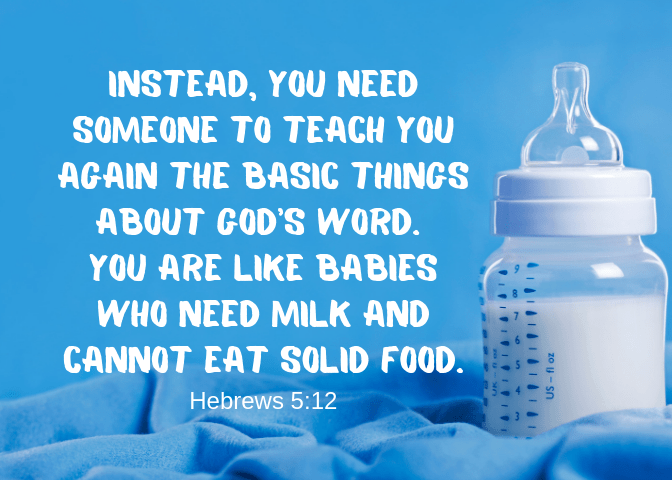
2. Find a ministry. Do the ministry. When we become idle, when we don’t have anything to do, that is when sin gets a jump on us (Proverbs 16:27-29). We consume junk on screens, we find people to talk about, and we become open to other forms of ungodly entertainment. The devil can be just as busy binge-watching Netflix (that should step on some toes) or scrolling through social media (and the ones I missed the first time) as it is in those who are actively seeking out ways to do evil in this world. This quote by Edmund Burke addressed to another statesman rings true in the Christian life too, “The only thing necessary for the triumph of evil is for good men to do nothing.” It is time to find and actively participate in a ministry. To move from the milk to the meat. To not simply believe but to act. Don’t know where to start? Look at the list provided by Jesus in Matthew 25 as he separates the sheep and the goats. Ministry is truly a win-win. When you are busy fulfilling the Word of God, there is simply less time to get caught up in the stuff that doesn’t matter.
3. Be a part of the church. We are not called to do the above mentioned things solely in isolation. When we put our faith and trust in Jesus Christ, we become part of a greater entity: the church. It is not simply a building, in fact, it has nothing to do with the structure you meet in at all. The church is full of people who are trying to do the same as you: live better for Christ. There is a small caveat. Like you, they are not perfect yet. However, everyone in the church has their own unique gifting, function, and strengths. You don’t have to do this alone. So what if they don’t have the style of music you want at the church. So what if there isn’t a large group of people your age in the church. So what if your friends and family live far away from your church. Inside your community of believers you still have a function, can be held and hold people accountable, and find ways to strengthen and edify one another for the purpose in which you’re called. It is also important to understand the church is connected beyond the group you meet with on Sundays. Your friends at camp, your bestie from college, a group of people at a break table or lunch table can talk about and worship God together. Find a way to connect with other believers, and you will be further shored up against evil.
4. Let the grace of God do the rest. Often times when we come back from a fulfilling spiritual experience, we are immediately presented with our greatest challenges. The trajectory up of spiritual life will not be a perfect, upward-moving diagonal line. Inevitably, we will always find a spiritual low after a spiritual high. Don’t let the waves of doubt and defeat toss you and capsize the great life, truth, and hope you have. You will mess up. You will know the good you should do and not do it sometimes (Rom 7:15-20). You may go several days without reading your Bible, become stagnant in your ministry, or remove yourself from the church because you feel guilty you have committed an unforgivable sin. Don’t give up. Let God take control and understand that He gives grace to all generously. This is a free gift, so don’t waste your time “feeling bad” or “not worthy.” Take heart. Get back up. Seek God. Renew your commitment to His commandments because each day is a new day. Do everything not to depart from God, and He too, will do everything it takes to ensure you will never have to depart from Him or the ones you love that have fulfilled the same call, together united at the marriage supper of the Lamb.

The first half of this chapter paints a rather bleak picture of thriving human sinfulness. “Lovers of themselves, lovers of money, boastful, proud, abusive, disobedient to their parents, ungrateful, unholy, without love, unforgiving, slanderous, without self-control, brutal, not lovers of the good, treacherous, rash, conceited, lovers of pleasure rather than lovers of God – having a form of godliness but denying its power. Have nothing to do with them. … who are loaded down with sins and are swayed by all kinds of evil desires, always learning but never able to acknowledge the truth“ (2 Timothy 3:2-5, 6b-7). That’s a pretty good list of nastiness. And it hits so many types of people: the materialistic, the teen rebel, the violent criminal, the power-hungry politician, the educated professor who denies God.
And sometimes, it hits me, too. I can be proud – especially when I think I am right, but “they” are wrong. I can be ungrateful – to God and to those who have given of their time and talents for me. Sometimes love does not shine through me. I don’t always exercise self-control and bite my tongue when I ought. Too often I have chosen loving pleasure over loving God – watching one more episode and then suddenly “too tired” to read His Word.
It is so easy to point the finger at evil and the dark side around us. And, definitely DO be aware of its prevalent influence in the world so you don’t unknowingly get sucked up in it yourself. But carefully watch yourself as well. Where do you need to work so you reflect more God and less world?
In the second half of this chapter Paul flips to writing on the light/Godly side of things. He speaks of his own life – his purpose, teaching, faith, and love as well as persecutions and suffering (3:10,11). This bed of roses indeed comes with many thorns. He writes, “In fact, everyone who wants to live a godly life in Christ Jesus will be persecuted.” (3:12). Because of the wickedness and deception in the world (see verses 1-9), Christians must expect and be prepared for many trials when they are actually acting like and following Christ.
But, don’t give up says Paul! “Continue in what you have learned and what you have become convinced of…the holy Scriptures which are able to make you wise for salvation”. Who couldn’t use more wisdom for salvation?? Sign me up! I am ready for more wisdom that leads to salvation. I saw in the first half of this chapter my own darker side. I am in need of more and more wisdom for salvation. And, that is found in God’s Holy Scriptures.
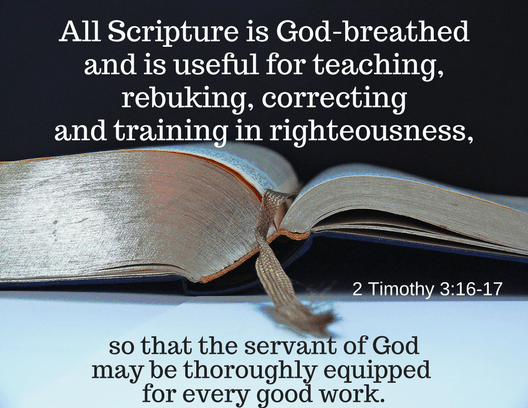
But, that’s not all! There’s more good found in God’s Word. For, “All Scripture is God-breathed and is useful for teaching, rebuking, correcting and training in righteousness” (3:16). Here is the key to standing against the evil in the world and in myself – God’s Word! He breathed it for me. He breathed it for you. And it is useful, over and over again, every time it is opened. It gives wisdom for salvation, it teaches, it rebukes (which I do indeed need from time to time), it corrects, and it trains me to be righteous (which I always need).
But, there is still more! With God’s Word we can be, “thoroughly equipped for every good work.” (3:17). Do you long to do good works for Him – open His Word. Are you discouraged by the evil of the world – open His Word. Are you ready to be wise for salvation – open His Word. Breath in what God breathed out for you.
Marcia Railton

2nd Timothy 2:2 – the pass it on verse. “And the things you have heard me say in the presence of many witnesses entrust to reliable people who will also be qualified to teach others.” It’s not enough to believe it, know it and even share it. We must be intentional about to whom and how we share it – so that it will continue to be taught long after our fleeting breath is gone. Are you sharing God’s Word? Good! Are you teaching from His Word? Great! ALSO, prayerfully consider who and how you ought to be mentoring to do the tasks God has given, both now and in the future.
Or, maybe you aren’t currently sharing God’s Word and teaching from His Word. Maybe you feel you just don’t know enough to start. Or, you know you can’t do it as well as those you see doing it in your church now because you aren’t as experienced as they are. After all, you don’t have the training to be a pastor or a Sunday School teacher. That’s okay. If you have the heart and desire and are ready to grow – ask those who are working how you can be involved! Learn from them now before they are gone.
And – keep at it – even when hardships come (2:3)
Strive to please Christ – your commanding officer (2:4)
Remember the rules (2:5)
Endure – so you can reign (2:12)
Do your best for God (2:15)
Use His Word wisely (2:15)
Avoid false teachers and godless chatter (2:16,17)
Be holy and useful – no matter what your shape, size, age, job is (2:20,21).
Run away from evil (2:22)
Run after what is right and stick with God’s people (2:22)
Stop arguing (2:23)
Be a kind teacher (2:24)
Gently instruct even those against you (2:25)
Here near the end of Paul’s life he had so much Godly wisdom that he was faithfully passing on to Timothy – so that Timothy could pass it on to those he was teaching and training – so that it would be passed down the generations to you and to me. What will you do with it today? Read 2 Timothy 2 and see what God wants you to do to pass it on.
Marcia Railton

“Timothy, my son, I am giving you this instruction so that by them you may strongly engage in battle, having faith and a good conscience. Some have rejected these and have suffered the shipwreck of their faith.” ~ 1 Timothy 1:18-19
1 Timothy is jam-packed with rich truths that Paul wrote to Timothy, a mentee in the faith. 1 Timothy was written sometime between 62-67 A.D. while Paul was out of prison. He wrote to Timothy, a person who he had known since about 46 A.D. and who was currently ministering in Ephesus, a town in Asia Minor. A majority of this letter focuses on how to ‘do church,’ discussing a range of topics from worship services to church leadership to interactions between church members.
1 Timothy begins with an instruction to remind people to not teach different doctrines or pay attention to myths or genealogies (1 Tim. 1:3-4). In doing this, Paul said that the people were promoting “empty speculations rather than God’s plan, which operates by faith.” Wow! That’s a powerful statement. The discussions of the people of the church in Ephesus were not glorifying God. Instead, they were people just carelessly making a prediction about topics related to the concepts Paul taught. The discussions of the people were like junk food instead of a wholesome diet. They tasted good in the moment, but they ultimately produced nothing of value for the people.
We need to ask ourselves what type of instruction we are filling ourselves with, as well as what types of instruction we are giving others. If are not taking in any instruction or teaching about God’s word, we will starve. God’s word is our daily bread, and we daily have to get into the word to get the nourishment that we need. Once we do, we have to look at the type of teaching we are getting. Are we taking in things that will build us up and draw us closer to God? Or does a majority of our Bible study focus on acquiring knowledge that we could use in a debate or class but ultimately leaves us spiritually unfulfilled? If we are teachers, we also need to ask ourselves these same questions. Is what we are teaching empty speculation, or are we teaching what Paul was teaching? Paul said that his ultimate goal for the instruction he gave was to produce a love that “comes from a pure heart, a good conscience, and sincere faith” (1 Tim. 1:5). If that is not our goal for what instruction we take in and give, then we need to reevaluate our purpose for that instruction.
Paul recognized the importance of analyzing the purpose for what we do. When we reject producing pure love as our goal, we can lead ourselves and others down a path that leads to the shipwreck of their faith. In other terms, when we are not placing God’s plan first in our lives, we are choosing to not allow God to work in our lives. Let’s all strongly engage in the battle of our faith. This begins with the spiritual food that we take in. Make sure that you are taking in good things, not empty things.
~ Cayce Fletcher
Romans Chapter 12
Therefore, I urge you, brothers and sisters, in view of God’s mercy, to offer your bodies as a living sacrifice, holy and pleasing to God—this is your true and proper worship. Do not conform to the pattern of this world, but be transformed by the renewing of your mind. Then you will be able to test and approve what God’s will is—his good, pleasing and perfect will.
This!
These are some of the wisest words that Paul shares in Romans. And that is saying a lot.
“In view of God’s mercy.”
After the abundance of mercy that God has shown us, we should desire to please him and properly worship Him. So how do we do that? By offering our bodies as sacrifices to God by being HOLY and PLEASING to Him.
How do we know what holy and pleasing looks like to God? By renewing our minds in God’s word. Paul lays it all out right there for us. Isn’t this easy?
“Do not conform to the pattern of this world.”
This warns us that the world’s system – the popular culture and manner of thinking that is in rebellion against God – will try to conform us to its ungodly pattern, and that process must be resisted. And yet, many of us find ourselves being conformed to the world all the time. It sneaks up on you sometimes. Is our mouth just as foul as our coworkers? Do we covet the latest ‘thing?’ Has your position on the sin of homosexuality moved? Is viewing pornography ‘no big deal?’ Do you seek revenge against someone if they have wronged you? (That one is addressed later in this same chapter.)
How do we know if these things are wrong or not? By being transformed by the renewing of our minds. This is the OPPOSITE of being conformed to the world. Our minds start out being ruled by feelings, rooted in the flesh. At that point we look just like the world. But we need to have a source of truth – God’s world – that tells us what is right or wrong, despite what our feelings tell us. Feelings lie. The world lies. But God’s word never will.
We can only be transformed in our minds by becoming more and more familiar with what God’s Word says. Do you really stand out from the world? As a Christian, you should. The transformation you experience, from your old way of thinking and acting, should be as complete as Bumblebee or Optimus Prime from the Transformers movies when they transform from vehicle form to robot form.

Finally, Paul is not calling us to be completely separate from the world, but instead to not be like the world. We need to stand out in the world in such a way that we attract attention, and hopefully then draw others to God. If we completely separate ourselves from the world, changing the lives of unbelievers would be impossible.
Greg Landry

Please don’t let the author’s name shock you from reading his crafty prose.
Nailed it!
Parable of the Sower
By Spock the Vegan
Jesus told of a certain man
who planted seeds in his land.
Some seeds were seen where they lay
by birds that came and ate them away.
Some fell where they had not much earth
and sprung up, but water was dearth.
when the sun came up they were dried,
and without much root, they died.
And some seeds fell among the weeds
the weeds sprung up and choked those seeds.
but others fell into good ground,
and brought forth the best fruit around.
The seeds are your testimony of God and his word.
The birds are evil people who change what you heard.
The shallow earth is the tribulation that is brought,
and without good root your testimony is naught.
The weeds are temptations of riches and power
that give your testimony no support or bower.
The good ground is the nourishment of friends and God’s word.
The fruit is good deeds by your testimony stirred.
Submitted by Julie Driskill

Peter
Andrew
James
John
Philip
Bartholomew
Thomas
Matthew
The other James
Thaddaeus
Simon
Judas
In today’s reading we observe Jesus delivering the ultimate pep talk to the “Dream Team” – excluding one. (Spoiler alert: by the end of the Book of Matthew it will be abundantly clear that one of these gentleman will be ejected from the team.) This pre-game speech comes on the heels of Jesus overwhelmed with the needs of the people he’s encountered in the past few weeks. He needs help, so he enlists these 12 with quite a rallying cry. They will soon be experiencing “on the job training” and his instructions are enduring.
Jesus makes it explicitly clear just where the “Dream Team” is to deliver his message: the lost sheep of Israel. (verse 5) “Don’t go to the Gentiles or any Samaritan village.” It was not quite time to take this radical message to the other communities. Perhaps Jesus thought the message would be better received first within Jewish circles since prophecies had been foretold for HUNDREDS of years regarding his coming? (Or not.) Doesn’t take long before the hometown crowd turns from cheers to jeers as the game progresses and one of those “Dream Team” players plots to sabotage the whole tournament.
“The Kingdom of Heaven is near.” (verse 7) This is the message the disciples are to deliver. They will proclaim this message of power and authority given to them by Christ himself when they demonstrate these actions: 1) Heal the sick. 2) Raise the dead. 3) Cleanse those who have leprosy. 4) Drive out demons.
Sure Jesus… Need anything else?
As you might imagine, this is quite a directive, and he wasn’t quite done instructing. “Travel light” was just the tip of the iceberg. For the rest of the chapter Jesus spells out what to keep an eye out for. He tells you not to get discouraged even though you should expect to be unwelcomed, flogged, arrested, hated, persecuted, abandoned and lied about by your family, and most likely, killed. Where can I sign up?
My favorite verses of why this is all to occur shoots from verses 16 & 17. “I am sending you out like sheep among wolves. Therefore be as shrewd as snakes and as innocent as doves.” Beth Moore, a renowned Bible teacher recently tweeted it best,
“What I think has happened here is that in our discipleship, we are not teaching what is normative in the believing life. When we carry our cross and we follow Jesus, we are walking into a storm. We were told that in Matthew 10 we will be ‘sheep among wolves,’ not wolves among sheep.”
Beth goes on to further tweet that “sheep among wolves” means Christians will be “persecuted,” “criticized,” “imprisoned” and even killed for speaking the truth.
“We have been very proud of the fact that we have not subscribed to a prosperity gospel. But what we have subscribed to is a pampered gospel where we are so afraid of suffering and we are so afraid someone is going to criticize us and hurt our feelings.”
Hello. That sounds just like January 15, 2019, and speaks to WHEN. Once again we see that God’s word is timeless and a double-edged sword for all generations cutting to the heart of the problem. Whatever it takes, no matter how unpopular, we must contend for the gospel. Just like Jesus called the disciples to move out of their “comfort zones,” we too must grow a thicker skin. Beth’s final tweet about this subject sums it up:
“All that stands between us & an astonishing work of the Holy Spirit is repentance. Quit being scared of rocking a boat that has run aground on an island of compromise. Walk on water.”
What would our lives and our futures look like if we invested our earthly time and resources into eternal values? How would you live if you were completely confident that every act of love, service, or unselfishness would carry reward where it mattered (and lasted) most – even if nobody in your neighborhood, church, or community ever noticed? “And if anyone gives even a cup of cold water to one of these little ones because he is my disciple, I tell you the truth, he will certainly not lose his reward” (Verse 42).
We are now mid-January. How many of us have long forgotten our resolutions for the New Year? Jesus was trying to teach his “Dream Team” to not focus on the here-and now. Instead of looking for New Year’s resolutions we can keep, what if we tried finding some that could actually keep us.
Sign me up. Lord, please teach me to play on your team!
-Julie Driskill

I grew up in the Church. From the time I was a baby I’ve been in Church. I’ve been taught the Bible my entire life. As a preacher’s kid I sat and listened to my dad preach every Sunday. I remember as a child sitting in Sunday School and being captivated by the flannel graph stories (look it up, it’s a real thing). I would see the picture of the ark, and the different animals gathered 2×2 going into the ark.
I still have my first Bible. It was an illustrated children’s Bible, it had a zippered case. I read the Bible stories and enjoyed looking at the pictures. When I was six my mom taught me to say the 66 books of the Bible in order. It made it much easier to follow along and look up verses. I could also easily win the “sword drills” a kind of contest to see who could look up various verses the fastest. I even learned to memorize some verses. John 3:16, Psalm 23 and John 11:35 were some of my early favorites. I like John 11:35 because at church camps they often had you quote a verse from memory as you were in the lunch line. John 11:35 was the shortest and easiest verse in the whole Bible to memorize: “Jesus wept.”
I was baptized when I was eleven and I began to take my Bible study more seriously. I would read whole chapters and whole books of the Bible. I became aware that not all people read the Bible exactly the same way. The Church I attended came to certain conclusions about what the Bible said, and people of different denominations came to different conclusions. Sometimes their conclusions didn’t make sense to me and I wondered why they didn’t see things the same way that my Church did. I puzzled over this for many years.
When I graduated from high school and began college my goal was to become a doctor. I wanted to help people, and make a decent living. Doctors checked off both those boxes. But while I was in college I got a part time job working in a Christian bookstore. I had some friendly discussions with my boss who was a Christian but from a different denomination. As I shared with him what I believed he shocked me by saying that he didn’t think what I believed was right, and he wasn’t convinced that it was Christian. Now I had a job on my hands. To show from the Bible that what I believed was indeed Christian. He and I spent the next year debating the Bible. Literally, he would make a premise and give his defense. I would read it, and write my response. Then I would make a premise and give my defense, and he would read it and give his response. Over the next year we traded hundreds of pages. I found myself staying up late every night pouring through the Bible looking up verses (this was long before internet searches). I was thinking about the Bible day and night. So much so that I wasn’t really spending much time reading the class material at college. Somehow economics, biology, philosophy, psychology and sociology just weren’t as interesting to me as Matthew, Mark, Luke and John.
One night I realized that what I really enjoyed doing was studying the Bible. Then I realized that if this was my passion then it didn’t make sense to study to become a doctor, I should study to become a pastor. I made my decision to leave the university and to attend Bible College. (By the way, you don’t need to become a pastor in order to make the Bible central to your life. We need good doctors, lawyers, teachers, carpenters, mothers and ditch diggers who immerse themselves in the Bible as well.)
As I was getting ready to leave for Bible college I said my goodbyes to my friends and co-workers. After a year of studying and debating the Bible with me my boss said, “You haven’t convinced me to believe as you believe, but you have convinced me that what you believe is Christian.” I felt I had achieved a small win.
For more than 30 years I’ve been reading, meditating upon, teaching, preaching, writing about, and counseling others with the Bible. It is the foundation of my whole life. I’ve read small passages slowly and repetitively so they could sink deeply in (lectio divina). I’ve read large portions quickly to see the grand sweep of God’s story. I once read the entire Bible in a two week period of time. (8 hours a day for 2 weeks and you can read it cover to cover). It was amazing!
Do I regret choosing to be a pastor instead of a doctor? Well, I make less money as a pastor than I would have made as a doctor. But I realize something very important. Doctors are very important but they don’t have all the answers. This came to light several years ago when I became a hospital chaplain. One day I was called in to sit with a young mother whose husband had been in a serious accident. The doctors were trying to save his life. She was in the waiting room with two small children hoping that he would survive. I sat with her and prayed with her. Eventually, two young doctors came into the waiting room. They were residents, which means they were young in their practice. They stood before the woman and told her that they had done all that they could, unfortunately, they couldn’t save her husband. They then looked at each other, and then looked at me and said, “We’ll leave you to talk with the chaplain” and they left the room. I realized that this was what God had called me to be. The one who people turn to when all else had failed and their world has fallen apart and not even the best of science and technology can fix it. When all that humanity can do comes up short, we are left with God and God’s Word. And that is by far the most powerful thing in all the world. God’s Word Never Fails. A passage of the Bible that has been important all my life comes from Isaiah 55. God’s Word will accomplish what God desires. May you immerse yourself in the only truth that can truly save.
Isaiah 55:6-13
Seek the Lord while he may be found;
call on him while he is near.
Let the wicked forsake their ways
and the unrighteous their thoughts.
Let them turn to the Lord, and he will have mercy on them,
and to our God, for he will freely pardon.
“For my thoughts are not your thoughts,
neither are your ways my ways,”
declares the Lord.
“As the heavens are higher than the earth,
so are my ways higher than your ways
and my thoughts than your thoughts.
As the rain and the snow
come down from heaven,
and do not return to it
without watering the earth
and making it bud and flourish,
so that it yields seed for the sower and bread for the eater,
so is my word that goes out from my mouth:
It will not return to me empty,
but will accomplish what I desire
and achieve the purpose for which I sent it.
You will go out in joy
and be led forth in peace;
the mountains and hills
will burst into song before you,
and all the trees of the field
will clap their hands.
Instead of the thornbush will grow the juniper,
and instead of briers the myrtle will grow.
This will be for the Lord’s renown,
for an everlasting sign,
that will endure forever.”
J.Jeffrey Fletcher, MDiv, BTh, CSD, Chaplain, Valley Health