More Grace?

For the wages of sin is death, but the free gift of God is eternal life in Christ Jesus our Lord.

Romans 6

In the past couple of chapters, we looked at how we are justified by faith, and being saved while we are sinners.  So, the natural question is whether it matters if we sin.  I love the way Paul answers this question after he asks it.

“What shall we say then? Are we to continue in sin so that grace may increase? May it never be! How shall we who died to sin still live in it?”

In my head I hear this with a lot of passion in it.  Then Paul says basically the same thing in verse 15:

15 “What then? Shall we sin because we are not under law but under grace? May it never be!”

Again, I hear so much passion in this statement.  This is obviously an important point, and something that needed to be talked about when Paul wrote this letter.  It is something that needs talked about and understood now too.  I am confident that Paul spent this much time on this topic because it is so easy to think that “this” sin will be okay.  I’ll be forgiven, and then I won’t do it again.  Then, the next time it is again easy to think that doing it one more time won’t hurt.  I’ll be forgiven again.

That is an extremely dangerous place to be.  It is easy to cross the line into sin, and can be very difficult to cross back.  We need to stay as far away from that as possible.

16 “Do you not know that when you present yourselves to someone as slaves for obedience, you are slaves of the one whom you obey, either of sin resulting in death, or of obedience resulting in righteousness?”

We are either slaves to sin or to obedience resulting in righteousness.  We each must make that choice.  We are justified by faith, and then that faith should lead to obedience.  It is all really summed up in the last verse of chapter 6:

23 “For the wages of sin is death, but the free gift of God is eternal life in Christ Jesus our Lord.”

– Andrew Hamilton

Grace for a Sinner

For while we were still helpless, at the right time Christ died for the ungodly.

Romans 5

Have you ever felt like you need to get things straightened out in your life before you can ask for forgiveness?  Or before you can pray?  Or before you can draw near to God?  I know I have felt that way.  Is God waiting for us to get everything straightened out before we seek forgiveness or start a relationship for him?  Let’s look at a few verses that I think answer this question:

6 “For while we were still helpless, at the right time Christ died for the ungodly.”

 8 “But God demonstrates His own love toward us, in that while we were yet sinners, Christ died for us.”

10 “For if while we were enemies we were reconciled to God through the death of His Son, much more, having been reconciled, we shall be saved by His life.”

All three of these seem to show that God is reaching out to us and desiring us to reach out to Him while we are still messed up.  These verses say, “While we were helpless”, “while we were yet sinners”, and “while we were enemies”.  This sure doesn’t sound like “after we got straightened out”.

I still feel at times that I need to fix something myself before turning to God and asking for forgiveness.  I also know that sin causes problems in a relationship with God.  However, if we are justified through our faith as we saw in Romans 4, and if we look at chapter 5 closely, we have our order wrong.  We need to turn to God immediately.  We need to accept his grace, and then focus on Him to straighten out whatever our problems are.

Paul closes the chapter with this:

20 “The Law came in so that the transgression would increase; but where sin increased, grace abounded all the more, 21 so that, as sin reigned in death, even so grace would reign through righteousness to eternal life through Jesus Christ our Lord.”

No matter what sin we have, no matter what laws we have broken, no matter how far we have turned away, the grace of God is sufficient if we will turn back to Him.  God is seeking us out, and we need to seek Him also, whether things are going well, or everything is falling apart.

– Andrew Hamilton

Justified by Faith

If, in fact, Abraham was justified by works, he had something to boast about—but not before God. 3 What does Scripture say_ “Abraham believed God, and it was credited to him as righteousness

Romans 4

When I think of the old testament versus the new testament, one of the differences I tend to think of is law versus faith.  In the old testament, the people were under the law, and judged by the law.  Then in the new testament, Jesus changed things up so that we could be saved by our faith, with his sacrifice.  No longer were people required to perform sacrifices under the law.

Is that the right way to look at it though?  I’m not sure because I still find scripture that makes comparisons which lead me to the same conclusion.  However, in Romans 4, Paul talks about Abraham being credited by faith.  Verses 2 and 3 say:

For if Abraham was justified by works, he has something to boast about, but not before God. For what does the Scripture say? ‘Abraham believed God, and it was credited to him as righteousness.’ “

Paul goes on to say that David also talks about blessings that are separate from works, or in other words, by faith.  Verses 7 and 8 say:

“ ‘Blessed are those whose lawless deeds have been forgiven,
And whose sins have been coveredBlessed is the man whose sin the Lord will not take into account.’ ”

So, how do I get this to fit with the laws and required sacrifices and such that were required for forgiveness in the old testament.  While the laws were all required to be followed, there had to be faith included with it for it to please God.  I can’t help but think of Matthew 5:17 as I am talking about the law of the old testament versus faith and grace in the new testament.  It reads:

“Do not think that I came to abolish the Law or the Prophets; I did not come to abolish but to fulfill.”

So, with our forgiveness coming through faith, it does not mean the law has been thrown away.  Instead, it means this is the perfect fulfillment of the law.

Why is this important to us?  Verse 16 says:

For this reason it is by faith, in order that it may be in accordance with grace, so that the promise will be guaranteed to all the descendants, not only to those who are of the Law, but also to those who are of the faith of Abraham, who is the father of us all.”

We are all descendants through the faith of Abraham.  We can also have our faith credited as righteousness.  What a wonderful blessing this is.
– Andrew Hamilton

Guilty, but Justified

Romans 3 23 and 24

Romans 3

In the first 2 chapters of Romans, Paul talks a lot about our actions, and our failures.  Since we have all sinned and failed, these two chapters by themselves would paint a very bleak picture for each of us as individuals.  Thankfully, even though these contain very important teachings, they lead to much more.

Everyone of us is guilty under the law.  Romans 3:9-12 gives us a clear picture of this:

“What then? Are we better than they? Not at all; for we have already charged that both Jews and Greeks are all under sin;  as it is written,

There is none righteous, not even one;
There is none who understands,
There is none who seeks for God;
All have turned aside, together they have become useless;
There is none who does good,
There is not even one.’ “

So, where does this leave us?  We are all guilty under the law.  We need something else.  We need grace.  This is exactly what we are offered. Verses 23 and 24 say:

“For all have sinned and fall short of the glory of God, being justified as a gift by His grace through the redemption which is in Christ Jesus.”

This grace is offered freely to all of us if we accept it and follow Christ.  So, while we strive to follow God’s commands, and honor Him in all that we do, there are times we will all mess up, and therefore the law cannot justify us.  The law condemns us.  God has given us another way out through Jesus.  We have to accept the gift, and follow Jesus throughout our life.

-Andrew Hamilton

Dreams and Determination

Acts 11

Acts 11 5a

“I was in the town of Joppa and was praying when I fell sound asleep and had a vision.” Acts 11:5
Peter experienced dreams.  What about us?  How do we hear from God?  When God gives us the urge to follow, we cannot rest until we complete the task that has been assigned.  When it’s right, you will be moved to do it.
He rewards our faithfulness. I pray often for my spirit to be stirred. To move me towards God and lead me to the adventure He has planned for me.  I pray for the wisdom to know when He is speaking to me.  I ask Him to help me be fearless in His name.  Are you willing to be obedient, to have a life of changing moments?  It’s not a burden to follow the Lord, it’s a true privilege.
Acts 11:19-30
News of this reached the ears of the church at Jerusalem, and they sent Barnabas to Antioch.  When he arrived and saw the evidence of the grace of God, he was glad and encouraged them all to remain true to the Lord with all their hearts.  He was a good man, full of the Holy Spirit and faith, and a great number of people were brought to the Lord.                            Acts 11:22-24
Defining moments for any of us can be loss or can be about God’s great grace that can transform us in the midst of sorrow.  Through times of suffering we can see that through God’s grace we can achieve greater depth, compassion, joy, and appreciation of simple blessings.  This story in Acts reminds us of the great persecution and suffering that was going on at the time.  Yet Barnabas (the great encourager) arrived and saw the evidence of the grace of God and he was glad.  What a gift to live outside the box—to trust in God’s great grace.   There is such depth in the faithfulness of God in our lives.  If you are going through a difficult circumstance, a tough choice, a rough path in your life, try recalling God’s love, faithfulness and His great grace.
God, thank you for the gift of your great grace.  May we trust that your grace is sufficient for us.
-Andy Cisneros

His Compassion

MATTHEW 9

matthew 9 36 redo

In this chapter we see that Jesus and the disciples are continuing an active pace proclaiming the good news of the kingdom and healing every disease and sickness. This lively passage not only records 6 healing incidents, but also shows 3 incidents where the teachers of the law are becoming rattled by the actions and rising popularity of Jesus.

Ready for anything and everything, the action rolls out as follows for Jesus and the disciples: 1) heals a paralyzed man, 2) calls Matthew the tax collector, 3) stops a hemorrhage in a woman, 4) raises a dead girl, 5) gives sight to 2 blind men, 6) and loosens the tongue of a mute man

Not only was Christ seemingly running a mobile emergency room, he was “hiring” new workers, contending with naysayers, and stopping to notice the big picture of the work ahead.

Verse 36 takes my breath away. “He saw the crowds and had compassion on them.” We are not lost in a crowd to Him. He knows our name and our needs. There is no end to His goodness. No bottom to the well. You can’t wear Jesus out. He’s not running on low. He’s not in a bad mood because it’s you again. “For from His fullness we have all received, grace upon grace.” John 1:16

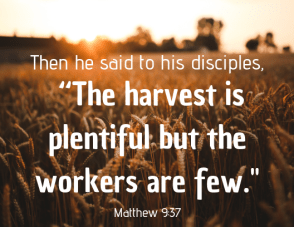
then he said to his disciples, “the harvest is plentiful but the workers are few.

The biggest problem in these 38 verses is that Jesus needed assistance to support the needs of the “harassed & helpless.” Nothing’s changed. May God stir your heart and mine this day to be a worker fit and ready to support the hurting. Let God’s “grace upon grace” compel us to action to not overthink but DO!

-Julie Driskill

Holy and Honorable and Radically Counter Cultural

1 Thess 4 4.png

I Thessalonians 4:3-8

3 It is God’s will that you should be sanctified: that you should avoid sexual immorality; 4 that each of you should learn to control your own body[a] in a way that is holy and honorable, 5 not in passionate lust like the pagans, who do not know God; 6 and that in this matter no one should wrong or take advantage of a brother or sister. The Lord will punish all those who commit such sins, as we told you and warned you before. 7 For God did not call us to be impure, but to live a holy life. 8 Therefore, anyone who rejects this instruction does not reject a human being but God, the very God who gives you his Holy Spirit.

Paul was writing this to Christians in the first century. He was calling them to live holy lives (set apart for God) in a culture where there was a great deal of immoral behavior that was accepted by society, but which went against God’s standards. Paul contrasts the believers call to live a holy and honorable life that is vastly different from the “passionate lust” that marked the life of the pagan. He warned that God would punish sexual sin and that to reject Paul’s teaching on this was to reject God.

I can’t imagine how difficult it must be for a young person or a new believer to navigate sexual morality in this age today. It’s gotta be tough. It was tough enough for me as I was a child of the 60’s and 70’s and there was plenty of confusion in society then, but at least the Church still gave a clear and for the most part unified message of what right and wrong was all about. But today, young adults are bombarded with images and messages about sexuality that are far different. So much that the Bible clearly speaks of as a departure from God’s path is considered normal by today’s society. To even question such things as premarital sex, homosexual activity, homosexual marriage, serial monogamy etc… is to be considered narrow, judgmental, or even a hate monger. So young people and those who become followers of Jesus Christ later in life face challenges in understanding and adapting to a Biblical world-view regarding sexuality. Exactly the way it was in the first century when Paul wrote this letter.

I note that Paul says that each of us must “learn to control [our] own body”. It’s a process of learning. There are difficult lessons to be learned. As most of us who have had to learn something new realize, learning is a process which takes time and seldom happens without mistakes. Those believers who are more seasoned in their walk with the Lord should remember this, and while teaching faithfulness to God to young and new believers should remember that is it is a process and be patient with those who are still learning. And even be patient with ourselves, for learning something so radically counter cultural is never easy and we are all capable of making mistakes. Truth must always be mixed with grace.

-Pastor Jeff Fletcher

My Friend Grace

Ephesians 2_8

Do you have a friend that is there for you? A friend that continues to text you even though you don’t text back till like three days later? Do you have that friend in your life that loves you even though you’re not always the best friend back?

I do, her name is Grace. She is the very best friend I could ask for. Grace is the kind of friend that is intentional, loving and always there for you. She is the type of friend that continues to reach out to you and loves you no matter what. She has taught me so much about what it means to be a friend.

When I think about Grace’s friendship I’m reminded of God’s Grace in our life. God is very intentional about his relationship with us. He loves us unconditionally even though we don’t deserve it. God gives us this wonderful gift of salvation and forgiveness despite our flaws and downfalls. This gift of grace allows us to realize our human weaknesses and failures but know that God still loves us and desires us to have a relationship with him.

I’m so grateful for my friend Grace’s continued, intentional friendship despite my flaws. In the same way I’m so thankful for God’s Grace in my life.  

Ephesians 2:8

8 For it is by grace you have been saved, through faith—and this is not from yourselves, it is the gift of God


-Elleigh Dylewski

Peacemakers

blessed are the peacemakers, for they will be called children of God

The older I get, the more I realize I’m an exact replica of my mom. We like the same movies, we think (and overthink) the same things, we’re both textbook ISFJ’s, and we both spend hours looking at houses for sale that we’ll never afford. Matthew 5:9 says, “Blessed are the peacemakers, for they will be called children of God.” If we’re children of God, we should strive to be like God, reflecting His character. When people see us, they should see the love of God in our lives.

In the face of conflict, it’s hard to be love. We often want to be right more than we want to be love. Jesus, however, is the perfect example of how to be love in the face of conflict. We often overlook that he was a human just like us; his challenges, even 2,000 years ago, are a lot like our challenges. This week, we’ve tried to answer how Jesus resolved conflict to give us insight into how to deal with our own conflicts.

Jesus resolved conflict with great urgency. Stop running away from conflict no matter how overwhelming or scary the problem may be. Don’t let unresolved conflict fester; instead, deal with it directly and quickly.

Jesus was a persistent diplomat. Jesus gave us a three-step plan to dealing with sin and conflict within the church. First, go to the culprit alone, then bring another trusted member or two of the church with you, and finally bring the conflict to the church as a whole. We don’t have the power to save people, but we can be patient, loving, persistent, and cover them with prayer.

Jesus saw each conflict as an opportunity for grace. Jesus preached that if someone hits you, don’t hit back; instead, turn your other cheek. We have the chance to be love to someone who may have never truly experienced how intense and whole God’s love is. Sure, they might not deserve grace, but neither did we.

Jesus disciplined out of love. Ah yes, Jesus flipped tables and even fashioned his own whip. Love isn’t always rainbows and butterflies; sometimes, it’s a harsh slap to the hand. As brothers and sisters, we’re supposed to refine each other so that we may all follow Jesus a little closer every day.

Jesus embodied forgiveness. Just as you have experienced the joy and freedom that forgiveness brings, give that same joy to someone else. Forgive as you have been forgiven.

Jesus submitted to God’s will even when it was hard. Jesus’ submission led him to the cross. God has prepared a cup for you, too, representing His will for your life. Will you be obedient to what God has filled your cup with?

My prayer is that you feel encouraged and equipped to tackle the conflicts in your life with love just as Jesus did.


-Mackenzie McClain

Lose-Win

whoever wants to be my disciple must deny themselves and take up their cross and follow me

Yesterday, we talked about Jesus’ procedure of dealing with sin inside of the Church, but what are you supposed to do when someone who never claimed to be a Christian sins against you? Jesus’ answer to that question may surprise you. Have you ever heard of a win-win conflict resolution approach? Well, Jesus’ approach is more of a lose-win. As followers of Christ, we give up our right to hurt people who hurt us. Instead, Jesus calls us to treat each conflict as an opportunity for grace—an opportunity to show God’s love to someone who has maybe never experienced it.

In Matthew 5:38-42, Jesus describes his upside-down approach to dealing with conflict, “You have heard that it was said, ‘Eye for eye, and tooth for tooth.’ But I tell you, do not resist an evil person. If anyone slaps you on the right cheek, turn to them the other cheek also. And if anyone wants to sue you and take your shirt, hand over your coat as well. If anyone forces you to go one mile, go with them two miles. Give to the one who asks you, and do not turn away from the one who wants to borrow from you.”

Jesus defies logic, saying that if someone mistreats you, give them grace, but Jesus doesn’t just talk about grace, he embodies it. The outcasts, the troublemakers, and the “rough around the edges” are the people we often ignore or set aside, but these were the kinds of people Jesus spent his time on earth interacting with. These were the kinds of people Jesus died for. These were the kinds of people we were before we were adopted into God’s love. Just as grace transformed you, grace can transform the people who hurt you.

If we want to be a reflection of God’s love in the midst of conflict, we must first trade in our pride, our need for justice, revenge, or being right, for humility. In Matthew 16:24-25, Jesus says to his disciples, “Whoever wants to be my disciple must deny themselves and take up their cross and follow me. For whoever wants to save their life will lose it, but whoever loses their life for me will find it.”

Today, be intentional about being love to someone who may have never truly experienced how intense and whole God’s love is. If someone hurts you, give them more grace than they know what to do with. They don’t deserve grace, but neither did we.


-Mackenzie McClain