The Throne of Him who Lives Forever and Ever

Old Testament: Lamentations 3-5

Poetry: Proverbs 31

New Testament: Revelation 4


When I was a little girl, I thought God looked something like the pictures I had seen of Jesus but with short hair. So the first time I met Greg Demmitt, I might have stared at him a little longer than socially acceptable. Obviously, I was a bit silly, but Greg was definitely a godly man and a faithful representative of Christ. I was so blessed to have known him and shared a few waffles at Waffle House with him and my family. My heart hurts that he and my uncle, Dan Kizer, both
great, godly men, both died of pancreatic cancer within four months of each other. In my earthly perspective, it was way too soon. Not because it’s from our reading, but because I need it;


Revelation 21: 1-5
1 Then I saw “a new heaven and a new earth,”[a] for the first heaven and the first earth had passed away, and there was no longer any sea. 2 I saw the Holy City, the new Jerusalem, coming down out of heaven from God, prepared as a bride beautifully dressed for her husband. 3 And I heard a loud voice from the throne saying, “Look! God’s dwelling place is now among the people, and he will dwell with them. They will be his people, and God himself will be with them and be their God. 4 ‘He will wipe every tear from their eyes. There will be no more death’[b] or mourning or crying or pain, for the old order of things has passed away.”
5 He who was seated on the throne said, “I am making everything new!” Then he said, “Write this down, for these words are trustworthy and true.”


What a balm for the grieving soul! I can’t get through reading without tearing up with joy…every.single.time.


As far as today’s reading…I got a little emotional whiplash! Lamentations was hard and gruesome to read… One of the commentaries I read said it was a book of sorrow and hope..I must have missed the hope part…except that it does seem God’s people FINALLY realize that they were being punished for their disobedience. But we aren’t told about their deliverance quite
yet. That is a story for another book of the Bible.


After all that sorrow, I read Proverbs 31….which contains the story of so many women I have been blessed to know throughout my life. I alway feel convicted that I don’t quite live up to this description. I alway feel like I can only be good at about a verse or two at a time 😀If you are a girl or woman, look to the women around you to find someone who emulates Proverbs 31. If you’ve been to FUEL you know quite a few! As I have talked about before, we all need good mentors who love the Lord, no matter what our age.


And finally, Revelation 4, our first peak at the throne of God! There is no description of God here (though I’m sure my perception is close) but a splendid description of the throne room and all those worshiping there. I used to think all that singing would be so boring, but then I heard Carrie Underwood sing All Is Well and decided if God gave us that kind of emotion stirring song now, imagine what the Kingdom will be like! But as beautiful as the Kingdom will be, and I am looking forward to seeing it, I really can’t wait to see God’s face, Jesus’s arms and all of those who will be resurrected, my mom, my grandparents, Dan, and Greg.

-Maria Knowlton

Reflection Questions

  1. Who has been a godly mentor for you? What have you learned from them? If no one comes to mind – pray and find one. And even if you don’t know everything and do everything right – you can be a mentor to someone who could use a good example, encouragement and accountability. Pray for an opportunity. And seize it.
  2. How does Proverbs 31 challenge you?
  3. What do you like most about the description of God’s throne room in heaven in Revelation 4? What do you look forward to in God’s Coming Kingdom?

What Is In You?

SATURDAY

1 Thessalonians 4_7

1Thessalonians 4:7 For God did not call us to impurity but in holiness. 8 Therefore whoever rejects this rejects not human authority but God, who also gives his Holy Spirit to you.


In looking at how to live a holy life, how to make moral decisions, we have looked at three things. Two are external to us — what have we been taught and how are we treating another person. The second was internal, i.e., what is best for me? The last is also internal, and perhaps the most amazing: what is the Spirit of God saying within me?


The most amazing teaching about our new life in Christ is that the Spirit of God is actually within us. Jesus is within us through the presence of the Spirit. As Paul writes, “Christ in you, the hope of glory” (Colossians 1:27). It’s staggering to think that we bring Jesus into our immoral actions, but can it give us hope that he is present in us and will give us the strength to do his will?


How do we live a holy life? Are we willing to ask, what does Jesus, who lives within me through the Holy Spirit, say to me?


-Greg Demmitt

The Other Person

FRIDAY

1 thessalonians 4_6 wood

1Th. 4:6 that no one wrong or exploit a brother or sister in this matter, because the Lord is an avenger in all these things, just as we have already told you beforehand and solemnly warned you.


We noted that Paul’s first instruction on morality was external, the second internal, i.e., what were you taught, then what is good for you. This third guideline for moral behavior is again outside of us, i.e., how am I treating the other person?


When I first went into youth ministry, almost 40 years ago, a study asked young people why they first had sex. The number one reason for girls was love, for guys was curiosity. The only thing that has changed over the years is that now the girls also are acting out of curiosity. As Bob Seger sang in the classic rock hit, Night Moves, “I used her, she used me, neither one cared. We were getting our share.”


As Christians, can we use another person for our personal sexual gratification? What impact does our action have on the other person?


Sometimes I think this is a special issue for Christians. Maybe worldly people can see former sexual partners as just passing acquaintances with whom they had a good time, but can it be that simplistic for Christians? Don’t we as Christians think of sex as more than a good time? It is a gift that God has given us to share with our life partner. We might think our romance is going to lead to marriage, but what if it doesn’t?


What does it mean to respect others in regard to our moral decisions?


-Greg Demmitt

Not with Lustful Passion

THURSDAY

1 Thessalonians 4 4

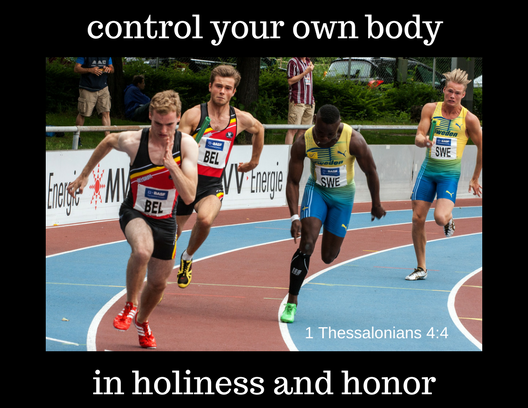
1Th. 4:4 that each one of you know how to control your own body in holiness and honor, 5 not with lustful passion, like the Gentiles who do not know God;


We wrote yesterday that the most important thing in making moral decisions is to know what God has said. The second most important is to exercise self-control. The first has an external source — what has God said? The second is internal — What does it mean to have self control?


Not everyone agrees with me, but I believe that in life, after being true to God, we must be true to self. That’s more important than anything else. That doesn’t mean, “if it feels good, do it.” the mantra of my generation, but rather, what is best for me as a one of God’s creation. Paul writes about moral decisions in these terms in 1 Corinthians:


1Cor. 10:23   “All things are lawful,” but not all things are beneficial. “All things are lawful,” but not all things build up.


This world says that we can do anything. Can we stop and ask, “What is actually good for me?”


I have worked with many people who have practiced the world’s view of sexuality, i.e., “I can do anything I want to do.” I truly love people who have been caught up in sexual sin, still see them as people for whom Jesus died, but I cannot say that their life choices have been good for them. Their choices have made them miserable, sometimes have even shortened their lives.


Making good moral decisions includes respecting ourselves and not hurting ourselves through bad choices.


-Greg Demmitt

Right from Wrong

WEDNESDAY

In understanding right from wrong, the most important thing is to know what God has said.

1Th. 4:1   Finally, brothers and sisters, we ask and urge you in the Lord Jesus that, as you learned from us how you ought to live and to please God (as, in fact, you are doing), you should do so more and more. 2 For you know what instructions we gave you through the Lord Jesus. 3 For this is the will of God, your sanctification: that you abstain from fornication;


The church at Thessaloniki was made up of mostly non-Jews, so Paul knew that it was important to teach them about sexual purity, because that was not something that was expected in their society. As Demosthenes wrote:


“We keep mistresses for pleasure, concubines for our day-to-day bodily needs, but we have wives to produce legitimate children and serve as trustworthy guardians of our homes.”

This attitude was not acceptable to God’s people. In Acts 15, when the leaders of the Jerusalem church welcomed the Gentile Christians into the body, they thought it important to remind them to abstain from fornication (Acts 15:29).


We live in such a world today. How do we make moral decisions? As we continue in this chapter we will see three more important points, but Paul begins with what we have been taught. In understanding right from wrong, the most important thing is to know what God has said. Paul writes that they have been taught to abstain from fornication, meaning every type of sexual sin.


-Greg Demmitt

Not As a Human Word

MONDAY

1 Thessalonians 2-13

Please read 1Thessalonians 2. My perspective in writing these devotions is that you are reading the scriptures. Nothing I write can be as important to you as what God can say to you as you read his word.


1Th. 2:1   You yourselves know, brothers and sisters, that our coming to you was not in vain, 2 but though we had already suffered and been shamefully mistreated at Philippi, as you know, we had courage in our God to declare to you the gospel of God in spite of great opposition. 3 For our appeal does not spring from deceit or impure motives or trickery, 4 but just as we have been approved by God to be entrusted with the message of the gospel, even so we speak, not to please mortals, but to please God who tests our hearts. 5 As you know and as God is our witness, we never came with words of flattery or with a pretext for greed; 6 nor did we seek praise from mortals, whether from you or from others, 7 though we might have made demands as apostles of Christ. But we were gentle among you, like a nurse tenderly caring for her own children. 8 So deeply do we care for you that we are determined to share with you not only the gospel of God but also our own selves, because you have become very dear to us.


1Th. 2:9   You remember our labor and toil, brothers and sisters; we worked night and day, so that we might not burden any of you while we proclaimed to you the gospel of God. 10 You are witnesses, and God also, how pure, upright, and blameless our conduct was toward you believers. 11 As you know, we dealt with each one of you like a father with his children, 12 urging and encouraging you and pleading that you lead a life worthy of God, who calls you into his own kingdom and glory.


1Th. 2:13   We also constantly give thanks to God for this, that when you received the word of God that you heard from us, you accepted it not as a human word but as what it really is, God’s word, which is also at work in you believers. 14 For you, brothers and sisters, became imitators of the churches of God in Christ Jesus that are in Judea, for you suffered the same things from your own compatriots as they did from the Jews, 15 who killed both the Lord Jesus and the prophets, and drove us out; they displease God and oppose everyone 16 by hindering us from speaking to the Gentiles so that they may be saved. Thus they have constantly been filling up the measure of their sins; but God’s wrath has overtaken them at last.


1Th. 2:17   As for us, brothers and sisters, when, for a short time, we were made orphans by being separated from you—in person, not in heart—we longed with great eagerness to see you face to face. 18 For we wanted to come to you—certainly I, Paul, wanted to again and again—but Satan blocked our way. 19 For what is our hope or joy or crown of boasting before our Lord Jesus at his coming? Is it not you? 20 Yes, you are our glory and joy!


I highlighted verse 13. We can ask ourselves, “how do I receive the word of God?” Do we see it from a human perspective, or is God speaking to us.


Let me add one thing right now. It’s likely that most of the people in Thessaloniki heard the word rather than read it. Only about 10 percent of the people could read. That means this letter was written to be read out loud. It also suggests that we might understand it better if we study it as a speech rather than a work of literature. For example, if we focus on the written word, we might spend a lot of time digging into the meaning of each word. If we take a rhetorical approach, meaning understanding it as a speech, we focus more on the impact of the words. Those who study rhetoric think that this letter sounds like a half-time speech given to a football team that is winning but needs to be encouraged to play hard in the second half. Paul doesn’t write as if the Thessaloniki Christians are messing up, but rather as if they need to be encouraged to keep doing the things that they have already been doing well.


Again we ask, “Do you hear this word as the word of the Lord?” What does it look like when someone hears the word of the Lord?


-Greg Demmitt

Let Me Introduce You to the Thessalonians

SUNDAY

1 Thessalonians 1-2,3

Acts 17:11  These were more noble than those in Thessalonica, in that they received the word with all readiness of mind, and searched the scriptures daily, whether those things were so.

This was one of my earliest memory verses. Back in that day, we called our youth group the Bereans because we searched the scriptures daily. That’s certainly a good idea, but the verse gives the Thessaloniki (this is the modern name of the still-existing city) church a bad rap. The preceding verses in Acts show that some exciting things happened during the three weeks Paul and company ministered in this ancient city.


Acts 17:1   After Paul and Silas had passed through Amphipolis and Apollonia, they came to Thessalonica, where there was a synagogue of the Jews. 2 And Paul went in, as was his custom, and on three sabbath days argued with them from the scriptures, 3 explaining and proving that it was necessary for the Messiah to suffer and to rise from the dead, and saying, “This is the Messiah, Jesus whom I am proclaiming to you.” 4 Some of them were persuaded and joined Paul and Silas, as did a great many of the devout Greeks and not a few of the leading women. 5 But the Jews became jealous, and with the help of some ruffians in the marketplaces they formed a mob and set the city in an uproar. While they were searching for Paul and Silas to bring them out to the assembly, they attacked Jason’s house. 6 When they could not find them, they dragged Jason and some believers before the city authorities, shouting, “These people who have been turning the world upside down have come here also, 7 and Jason has entertained them as guests. They are all acting contrary to the decrees of the emperor, saying that there is another king named Jesus.” 8 The people and the city officials were disturbed when they heard this, 9 and after they had taken bail from Jason and the others, they let them go.


So, while the Jews in Thessaloniki did not receive the good news about Jesus, the non-Jews did. Something very exciting happened there in a very short time, so exciting that Paul wrote this in what was his very first letter:


1Th. 1:1   Paul, Silvanus, and Timothy,  to the church of the Thessalonians in God the Father and the Lord Jesus Christ:  Grace to you and peace. 2   We always give thanks to God for all of you and mention you in our prayers, constantly 3 remembering before our God and Father your work of faith and labor of love and steadfastness of hope in our Lord Jesus Christ. 4 For we know, brothers and sisters beloved by God, that he has chosen you, 5 because our message of the gospel came to you not in word only, but also in power and in the Holy Spirit and with full conviction; just as you know what kind of persons we proved to be among you for your sake. 6 And you became imitators of us and of the Lord, for in spite of persecution you received the word with joy inspired by the Holy Spirit, 7 so that you became an example to all the believers in Macedonia and in Achaia. 8 For the word of the Lord has sounded forth from you not only in Macedonia and Achaia, but in every place your faith in God has become known, so that we have no need to speak about it. 9 For the people of those regions report about us what kind of welcome we had among you, and how you turned to God from idols, to serve a living and true God, 10 and to wait for his Son from heaven, whom he raised from the dead—Jesus, who rescues us from the wrath that is coming.


This week we will look at this letter to a very young church in which the word of God exploded in a life-changing way.


-Greg Demmitt