Contentment and So Much More

Proverbs 30

Proverbs 30 8 9 NIV

The author of this proverb, Agur, begins by belittling his understanding. The irony is that his words hold great wisdom. He is not bragging about his knowledge and understanding. He is declaring the LORD our God as unfathomably great. He asks six questions, five of which identify the power of God. The sixth is prophetic of the yet unborn son of God, Jesus. Additionally, his understanding of the perfection of God’s word and the refuge it provides us is astounding. This is a man of great wisdom who humbly recognizes his insignificance before God which in itself makes him all the more wise.

He then focuses on two requests of God; honesty and contentment. He asks that falsehoods and lies be kept far from him. He provides a variety of ways in which lies and deception can bring curses down upon our heads. They destroy our relationships and cause us to spiral ever further from the God who loves us. Entwined in these illustrations are lessons of being satisfied with what we have. Appreciating that our needs are met and being content with that is not easy when there is often so much more that we want. God provides for our needs, the author acknowledged this. Everything beyond our needs comes from our desires which are, more often than not, borne of our sinful natures.

Agur then contrasts contentment with greed. First pointing to leeches which will gorge themselves beyond their needs. Then he personifies four things which are never satisfied. Two of these are actually life-giving; the womb and land. These are bookended by destructive examples; the grave and fire.

Verse seventeen seems oddly out of place and more than a little disturbing. It actually goes with the theme of honesty. The person suffering such a creepy fate has been dishonest in action and words with their family, and likely with everyone else in their life. Ultimately they will be alone and everything they had will be scattered among the people around them.

How do the eagle, snake, ship and couple fit together? Is this what Agur did not understand? I doubt it. Each of these examples can be seen as somewhat mysterious in what path they will take. The eagle is not limited in the great expanse of the sky just as there are few obstacles that the snake could not overcome. Without a rudder and someone to steer, the ship would be tossed at the whim of the sea just as the whims of men and women often make courtship, that is dating for all those not familiar with the term, tumultuous. So how does this fit in with what Agur is trying to convey? It goes back to his self-proclaimed ignorance of, well, everything but specifically of God’s ways and will.

And then we get back to a verse that makes us scratch our head. The mention of the adulteress is actually an example of someone who is neither content with their relationship or dealing honestly with others. Additionally, she is completely without remorse as she sees nothing wrong with her actions. My prayer is that none of us would get caught up in this specific type of behavior but even more so that we would be remorseful of any actions that we take or words that we use which hurt others.

Up until verse 21, Agur has been consistent with themes of God’s power and majesty, honesty, and contentment. Somewhat enigmatic but consistent nonetheless. Beginning with verse 21 though he expands his words of wisdom. First to include the injustices of the world or what he refers to as four things by which the earth cannot bear. Of the four examples the first and last are of one who is raised to a higher position, likely without the benefit of knowledge or understanding of their responsibilities. This type of unfair promotion can lead to disaster in most cases. It is not uncommon though to see someone with little knowledge of how to manage situations or how to lead people placed in a high position. Additionally it is a warning to us not to seek after something we are not prepared or equipped to handle. I guess that goes back to one of the main ideas as well, contentment.

Agur then reminds us that wisdom and understanding are not reserved for anyone. Young and old, big and small may seek after these great treasures. His specific examples are of course of the small creatures and the wisdom found in how they act. The contrast however is of larger creatures and their “stately bearing.” The imagery used is of pride and arrogance. Perhaps a reminder of humility in our own positions, whatever they may be. Given how this proverb concludes that would certainly seem to be the final lesson.

So what have we learned from Agur, other than that he has a pretty cool name? Humility is greatly valued, especially in light of our amazing God’s power. He was in awe of the gift of God’s word that has been given to all men. He esteemed honesty and contentment as the greatest gifts to request from God. And he reminds us that it is not our age or size that matters but our willingness to seek after wisdom that counts.


To be continued…

Jeff Ransom

In This Moment – Our Relationships

Proverbs 27

Proverbs 27 1 NIV

How often do you think about tomorrow? What is it that you think of? Are you hoping for certain things to happen, praying for a specific outcome? Are you dreaming of what might be?

The implication from James 3:13-14 and 4:13-15 as well as Matthew 6:34 is that tomorrow is promised to no one. Ecclesiastes 9:11 tells us that time and chance happen to everyone. With billions of people each doing their own thing for their own reasons it is easy to see how true that last statement is. So we truly cannot boast about tomorrow for we do not even know if it will come to us and if it does, what it will bring.

We are to prepare for tomorrow, but not presume it. When we dream of tomorrow we may find ourselves imagining our own plans being better than God’s. Additionally, thinking to the future is more often than not the primary source of our anxieties. So again I say, prepare for tomorrow but always trust in our incredible God’s will. If He has called you to Him it is to succeed in His will, not to fail in it.

Of the 27 verses of the 27th Proverb, 16 deal directly with relationships (2-6, 9-11, 13-18, 21-22). It is telling of the importance of relationships to our amazing God. He places the greatest emphasis on our relationship with Him and one another all through the Scriptures.

The three points on relationships that this chapter of proverbs focuses on is a humble heart, the sting of honesty, and the destructiveness of things left hidden.

If there is something that you are really good at you are probably accustomed to receiving praise for it. While there is nothing inherently wrong with that we need to remember not to let it go to our head. If you let it, it can inflate our ego. A brilliant writer receives critical acclaim but it is likely that their talent was developed and nurtured by their parents, numerous teachers, and peers. The passion to do what they do is fueled by hundreds of authors that have come before them. Likewise a superstar athlete has family, teachers, coaches, trainers, teammates and even their competition to thank for honing their abilities. As you can see there is nothing that we do that we could honestly boast about. Everything we do and are capable of comes from others guiding us and believing in us. Ultimately this is all traced back to our LORD and Creator. In His image we are strong and creative. We are intelligent and powerful because of Him.

The second point made in this proverb deals with the pain of honesty and how good it can be for us. It can hurt when someone tells you, “You sing horribly!” Well, not so much for me because I already know that. But you get the picture. When someone tells you in such a point blank manner or preferably in a more caring way a truth that you need to hear that is for your benefit. Sometimes it is an honest remark about something we said or how we acted that we know was not right. We need to be called out from time to time over our words and actions. This is what the Bible calls a rebuke, a correction of what we do and say.

One of the honest expressions this passage speaks of is anger. Anger can be cruel, to the one who is angry as well as the one at which the anger is directed. But a sudden outburst of anger may allow us to clear the air. It can move us into a place of reconciliation and forgiveness so that healing can begin. The point is that open and honest communication is not always nice and polite. Sometimes it is not possible to be honest in a demure, quiet way. There are times when honesty hurts. Actually, most of the time honesty hurts. But can we truly grow and mature if everyone around us is sugar-coating and shielding us from the reality of a situation?

The third and final point I took from this proverb goes hand-in-hand with honest communication, burying things away. I mentioned the point of anger and the author continues by asking the rhetorical question, “Who can stand before jealousy?” Jealousy, envy, and the like are like smoldering embers. The heat is held inside, never dying down and ready in an instant to ignite at the first opportunity. They are not easily vented or burned out. While anger may subside soon after being released, jealousy and envy grow stronger the longer they are held. They feed off of our relationships, slowly burning them away to nothing. Be careful of what you hold inside for this is the very reason we have the expression, burning bridges.

There is so much more within this wonderful passage that we could have covered. The significance of being in this moment and trusting God for what may come as well as the importance of relationships is what really stuck out to me. So remember, not only do we owe God but many others for all that we are capable of. Honesty hurts but, when coupled with compassion, is helpful. And finally, be careful what you hold hidden inside for it can destroy your relationships and do great harm to you as well. We were created to be in relationship with God. Our Savior, Jesus, spoke of how vital our relationships are. He simplified the incredibly convoluted system of 613 laws that man had in place to two – love the LORD your God with all your heart and with all your soul and with all your mind; and your neighbor as yourself. The heart of these is relationships. Never forget that.

To be continued…

Jeff Ransom

A Humble View Leads to the Best View

Proverbs 25

Proverbs 25 6 NIV

Have you ever been to a big sporting event and had tickets in the “nose bleed section?” As you are watching the game, you notice there are seats available courtside (tickets you would never be able to afford) and you decide that you are just going to move yourself to those seats instead!  We like the best seats. The view is better, and even more so is the appeal.  Sitting in the best seats makes us feel a little bit superior to “ordinary” people. Until the owner of the seats shows up with an attendant and asks to see your tickets and then ultimately asks you to move!  With your tail between your legs, you quietly pick up your drink and popcorn and head back to your original seat!


The wisdom I gleaned from today’s proverb was the importance of humility. Others may view it as a lesson on being presumptuous. Proverbs 25:6-7 says “Do not exalt yourself in the king’s presence, and do not claim a place among his great men; it is better for him to say to you, ‘Come up here,’ than for him to humiliate you before his nobles.” I think being presumptuous and humility go hand in hand. Sometimes we assume we have the “right” to do something and that boldness and self-confidence can get us into trouble. This can ultimately lead to “being humbled” by someone publicly and causing embarrassment. Whereas if you start with a humble heart, your impact will be long term and the benefits will be many.


We can see a similar situation in Luke 14 where Jesus is teaching about humility.  He notices the guests trying to pick the best seat at the table and he warns that sitting in the best seat might ultimately find them publicly humiliated when they are asked to move to a lower place at the table. He suggests that they seek a lower place at the table and the host might give them a public honoring by moving them to the best seat.  He says in verse 11, “For everyone who exalts himself will be humbled, and whoever humbles himself will be exalted.”


Ralph Waldo Emerson put it this way, “A great man is always willing to be little.” Don’t worry about having the best seat at the ball game because in the end, your kingdom seat will have the best view EVER.


Erin Bormes


Serve God With a Good Attitude

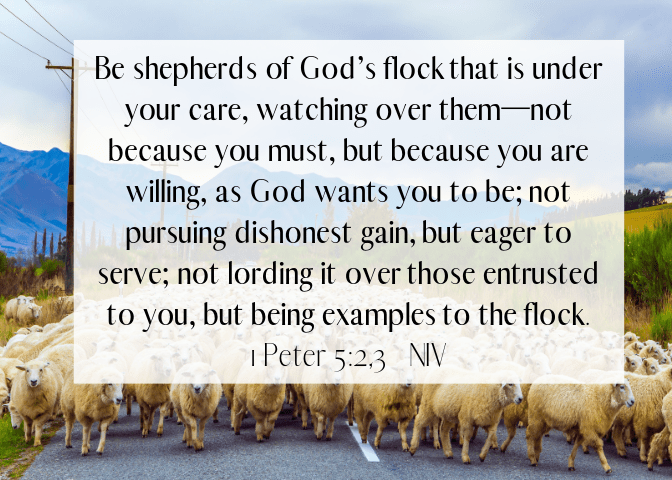
I Peter 5

1 Peter 5 2 3 NIV

There is an old Amish proverb that goes something like this:  There are two kinds of leaders: those who are interested in the flock, and those who are interested in the fleece.  In the first part of I Peter 5 there is an admonition given to pastors but it is applicable to all those  who hold leadership roles anywhere.  Leaders are to lead by example.  They are not to be dictators with an accompanying attitude but rather directors who are always directing people in the case of pastors toward Christ, and for other leaders directing people toward the greater vision with a humble attitude.

Peter encourages us and the early believers to honor one another and treat each other respectfully.  Have you ever been around someone who frequently ‘tooted their own horn’?   How annoying is that?  Does it make you want to follow that person’s lead or make you like that person very much?  Think about social media posts you have seen  like this, or maybe even posted yourself.  One Christian leader appropriately called out some posts  as the ‘humble brag’ and targeted how annoying and self-serving  they are.  As Christian brothers and sisters no one should toot their own horn but rather let others give them any due recognition.  Peter reminds us in verse 5 that God hates pride but appreciates true humility.

In serving God with a humble attitude and living a righteous life we can expect to have some opposition.  Opposition can have two effects: either failure, or strength and growth.  In the end of the chapter Peter points out that our adversary the devil  would like to see us fail, and is just waiting to help us to our demise –  but by staying the course God will give us victory.  The admonition for us is to stand firm in our faith and righteousness so that we may glorify God in this life and thus overcome the evil one.

-Merry Peterson


Oxymorons

James 1

James 1 9 (1)

I am a dad and as such enjoy the occasional (or perhaps not so occasional) dad joke. I also like to see the look on someone’s face as they decipher the unexpected oxymoron. Some of these are so common that we don’t even realize when we say them. Others take a moment to realize what has been said.

Here are some examples:

  • Act naturally – Is it really natural if it is an act, or is it natural to act, or … WHAT?
  • Random order – Which is it random or in order?
  • Original copy – By definition if it is a copy it cannot be the original.
  • Only Choice – If it is the only one it is not a choice.
  • Jumbo Shrimp – Enough said

I am clearly confused by all of these oxymorons.

James, although known to be quite practical in his writing starts out using a couple of oxymorons.

The first he uses is in the second verse, “Consider it all joy, my brethren, when you encounter various trials.” I am usually not saying, “Thank you for this traffic jam” or, “I am so glad I just stubbed my toe.” James is not saying that we will or should enjoy pain or difficulties. He is saying that as our faith is tested it becomes stronger, just like we do when we go to the gym.

Next he writes of Humble Pride. James 1:9-10 says,

9 But the brother of humble circumstances is to glory in his high position; 10 and the rich man is to glory in his humiliation, because like flowering grass he will pass away.

How can one in humble circumstances glory in his high position? The trick is we are not boasting or glorifying ourselves, but we are glorifying our God. Jesus tells us in Luke 10:42-45 that the one who wishes to become great must become least. As we serve others, we show that we are not focused on the desires of our flesh but instead we are caring for others. This shows true humility. After telling us that we are to be doing the word of God and not just hearing it James ends this chapter by telling us that pure and undefiled religion is to serve widows and orphans while keeping yourself unstained.

Sometimes when you do the right thing it may just confuse someone enough to cause them to ask why you did it. Let’s live in a way that inspires others to seek God and His Kingdom!

-Bill Dunn

“Away in a Manger”

Away in a Manger


Away in a manger, no crib for a bed,
The little Lord Jesus laid down his sweet head.
The stars in the sky looked down where he lay,
The little Lord Jesus, asleep on the hay.

The cattle are lowing, the baby awakes,
But little Lord Jesus, no crying he makes.
I love thee, Lord Jesus! Look down from the sky,
And stay by my cradle till morning is nigh.

Be near me, Lord Jesus; I ask thee to stay
Close by me forever, and love me, I pray.
Bless all the dear children in thy tender care,
And help me with others Thy mercies to share.


When Jesus was born he did not come with the splendor and pageantry that would be expected of a king; instead, Jesus was laid in a manger.  A manger is a feeding trough for hungry animals, such as cattle, horses and donkeys.  It is no place for any sleeping baby to lay, much less a king.  Although Mary and Joseph probably tried to clean the manger up before they laid Jesus down, it was still undoubtedly a dirty and rough place for a baby to sleep.

Baby Jesus was laid in a manger because there was no other place for him to lay.  “She [Mary] gave birth to her firstborn son and wrapped him in swaddling cloths and laid him in a manger, because there was no place for them in the inn” (Luke 2:7).  At first it may seem that it was just a series of misfortunate, unforeseen circumstances that resulted in the baby Jesus being laid in the manger.  However, that simply can’t be the case. God had centuries to prepare for the birth of his son.  Since the first sin in the garden, God had foretold of Jesus’ coming (Genesis 3:15). 700 years before Jesus was born Micah prophesied that Jesus would be born in Bethlehem (Micah 5:2).  So, God had plenty of time to plan every detail of his son’s birth.  God could have easily arranged to have Jesus born in a castle with an ornately decorated cradle as a bed; after all, He is God, and He can do anything.

So, why would God choose that Jesus’ first bed should be a manger? Jesus was laid in a manger as an infant king because he came to teach mankind that God’s expectations are often opposite of the world’s.  Jesus taught his followers that the last would be first and the least would be the greatest (Matthew 19:30).  He humbled himself and became a servant, washing his disciples’ feet.  Jesus’ entire life was an example of humility.  Based on Christ’s life-long example, Paul instructs us to, “Do nothing out of selfish ambition or vain conceit.  Rather, in humility value others above yourselves, not looking to your own interests but each of you to the interests of others” (Philippians 2:3-4).  In verse 8 of the same chapter Paul goes on to say, “he [Jesus] humbled himself by becoming obedient to death – even death on a cross!”  The manger was just a foreshadowing of the humility that that would lead to the cross.

What about you?  Are you ready to live humbly to follow Jesus?

“As they were walking along the road, a man said to him [Jesus], ‘I will follow you wherever you go.’

Jesus replied, ‘Foxes have dens and birds have nests, but the Son of Man has no place to lay his head’” (Luke 9:57-58).

Jesus’ first bed was a manger, because there was no other place for him to lay his head.  Later, as an adult he still had no place to lay his head.  We have been called to follow Jesus.  What are you willing to leave behind to humbly follow your Savior?  Are you ready to give up your comfy cradle for a manger?

-Jill McClain


Thankfulness and Greater Blessing

Ruth 2 13

Ruth 2:13-23

Ruth exemplified a beautiful thankful heart in the beginning of this passage. She recognizes that she is being blessed by the customs of a culture where she really has no right to reap (pun intended) the benefits. Ruth thanks Boaz for treating her with such kindness, tells him that he has put her heart at ease and hopes that she will continue to find favor in his eyes. He immediately responds to her humble heart with greater blessings that are above and beyond the custom. He invites her to eat with him — a prominent and wealthy man — as well as indicating to his servants in verse 15, As she got up to glean, Boaz gave orders to his men, “Let her gather among the sheaves and don’t reprimand her. Even pull out some stalks for her from the bundles and leave them for her to pick up and don’t rebuke her.”
When Ruth returns to Naomi with the fruit of her labor, Naomi can tell that she had been truly blessed in her work and that someone had shown her great kindness. Here we see that Boaz is actually a close relative and Naomi and she determines that he is being kind and gracious due to the familial ties.  Naomi blesses Boaz for taking notice of Ruth and encourages her to stay with Boaz’ female servants as she knows no harm will come to her while she works in his fields. I believe the most important aspect of this passage that we can take away is thankfulness and humility.  Ruth is a hard worker who also shows great thankfulness in how she speaks to Boaz.  Not in every situation are we returned greater blessing when we have a thankful heart but we are called to be thankful to God. Ruth is really living out her faith by being grateful. Take a moment to search verses in the Bible on thankfulness. The Psalms especially are riddled with praising God and being thankful to him! One way to love God more deeply is cultivating this spirit of thankfulness and gratitude. In prayer today really thank God for who HE is and what HE has done — especially through Jesus to provide a way for salvation and our hope in the coming Kingdom of God.
Praise the Lord, all nations!

    Extol him, all peoples!
For great is his steadfast love toward us,
    and the faithfulness of the Lord endures forever.

Praise the Lord! (117:1-2)

-Shelby Upton

Our Week of Unity

IMG_0272 (1)

I’ve enjoyed writing this week’s devotions and sharing with you Paul’s words on unity. Today I want to recap what we’ve learned and encourage you to start living out these ideas in your own life.


I began this week talking about the conflict-ridden times we are living in and the fact that the Church is not immune to divisiveness. The church has struggled with unity since its inception, but this isn’t how it should be. Paul wanted unity for the church in Philippi—he said this would make his joy complete. Unity is also what is needed in every church today. This is why we should pursue it.


On Monday, I said that to be unified we must be striving towards the same idea—to be of same mind. And the idea around which we should be unified is living out the Gospel. This should be our singular purpose in life and everything else should pale in comparison to it.


The next day we moved to Paul’s advice on the way towards unity. Humility, the lowering of one’s self and self-interests, is how he says we should go about achieving unity. Our agendas should be subject to God’s. Paul pointed to Christ as the prime example of living in humility and subjecting oneself to God’s will. We must follow Christ’s pattern of humility if we are to have unity in our churches.


On Wednesday, we learned about four enemies of unity and why they’re so destructive to churches. The first is pride, which promotes self-interest instead of the Gospel. The second is gossip, which divides people by pointing out others shortcomings without trying to help them. The third enemy is complaining. When we complain, we are saying that we think something is wrong, but we don’t care enough about the body to address the issue in the proper way. The fourth enemy to unity we see is argument, but not just simple disagreement. Arguments that are fueled by a desire to be proved right and arguments that are filled with bitterness instead of love drive churches apart. All four of these enemies are real dangers that we should fight against with love and humility.


On Thursday I spoke about our union with Christ and how essential it is to church unity. Union with Christ has two aspects: knowing him and being like him. In knowing him we must truly understand what he did, why he did it, and what that means for us. In being like him, we must strive to live as he lived, in subjection to the will of God and in the service of others. Christ is the head of the body; if we want unity in the body, we must be united with him.


Yesterday I spoke about Paul’s final advice for the Philippians on unity and four principles we can take from it. The first is of reconciliation. When two or more people in the church are divided, the church should work together to bring everyone back into unity. The second principle is about exercising gentleness. Just as Jesus was gentle when caring for those who were weak and needed special attention, the Church today needs that same gentleness in its ministry. The next principle is that we should live our lives worry free from the troubles that plague this age and that, when we do face struggles, we should bring them to God in prayer. The final principle we see is that we should fill our minds with things that are good instead of the rot that is a hallmark of this world. These four principles will go a long way towards promoting unity in our churches.


I hope you’ve enjoyed reading these devotions this week, along with the words of Paul to the Philippians. But we are not called to simply be hearers (or readers) of the word—we must also be doers. The words of Paul to the Philippians are challenging, but the results from following them would be life changing and paradigm shifting for the Church. If we want to see unity in the Church, we must start by applying these ideas in our own lives as individuals—living in humility, having the Gospel be our primary focus, and not gossiping, complaining, or arguing.


– Joel Fletcher

Four Enemies of Unity

Philippians 2:12-30

IMG-0276

Yesterday we learned about Paul’s advice for moving towards unity—having an attitude of humility. Today, I’d like to discuss some attitudes and actions that can hinder unity. These four enemies of unity that I will mention are just some of the obstacles that get in the way of the Church achieving unity. 

Enemy 1: Pride

Pride is the opposite of humility. In humility, we put ourselves in the service of others; in pride, we use others to serve our own purpose. It is an easy trap to fall into; pride catches those who do well and convinces them that this gives them cause to boast in themselves. It inflates their ego—giving them a reason to look down on others and view their own ideals as the be-all-end-all. When even just one person in a church body is infected by pride, it can have terrible consequences for church unity. This why Paul cautioned against boasting in one’s self and works:

“For it is by grace you have been saved, through faith—and this is not from yourselves, it is the gift of God—not by works, so that no one can boast. For we are God’s handiwork, created in Christ Jesus to do good works, which God prepared in advance for us to do.” (Ephesians 2:8-10, NIV)

Enemy 2: Gossip

There is no redeemable quality in gossip—it is a destroyer of friendships and communities. Gossip is broadcasting the shortcoming of others with no attempt to help them get better. It is a mechanism used to make the one gossiping feel better about themselves. Where gossip is present, unity cannot exist. The one being gossiped about is treated like an outsider and is pushed away from the community. Gossip is a unity killer.

“Do not let any unwholesome talk come out of your mouths, but only what is helpful for building others up according to their needs, that it may benefit those who listen.” (Ephesians 4:29, NIV)

Enemy 3: Complaining/Grumbling 

When we complain or grumble about something we don’t like, this is typically a sign we are struggling with pride and not embracing humility. If something is actually wrong, grumbling under your breath about it is not the way to go. Never will a good solution be found when it is brought to the attention of leaders through complaining. If we feel something is not being done the way it should be, we should humbly voice our concern to those in leadership after much prayer and meditation. Complainers don’t promote unity—those who genuinely want what is best for the church need to find the right way to address changes. 

Enemy 4: Arguing 

By arguing, I don’t mean mere disagreement, but an incessant need to be proved right (which also comes from pride). When a person goes around trying to convince everyone that their own views on various issues are right and then get angry when they’re not agreed with, it is not beneficial. We must always be striving to find the truth, but we must never do so in a matter that is unloving. Our discussions should be edifying and result in a more unified body; not filled with bitterness and anger which causes strife.  

“Do everything without grumbling or arguing, so that you may become blameless and pure, ‘children of God without fault in a warped and crooked generation.’ Then you will shine among them like stars in the sky as you hold firmly to the word of life. And then I will be able to boast on the day of Christ that I did not run or labor in vain. But even if I am being poured out like a drink offering on the sacrifice and service coming from your faith, I am glad and rejoice with all of you. So you too should be glad and rejoice with me.” (Philippians 2:14-28, NIV)

Each one of these enemies come about naturally from our human nature. We must fight against them just as we do with other sins. We must instead embrace humility, love, peace, and encouragement in order to promote unity and avoid these divisive enemies. 

If you struggle with any of these, start pushing them out of your life today. 

– Joel Fletcher

The Way Towards Unity

Philippians 2:1-11

IMG-0275

In Philippians 2 we find our memory verse for this week, in which Paul exhorts the church at Philippi towards unity: “If then there is any encouragement in Christ, any consolation from love, any sharing in the Spirit, any compassion and sympathy, make my joy complete: be of the same mind, having the same love, being in full accord and of one mind (Philippians 2:1-2, NRSV). In the verses that follow, Paul gives the Philippians some instruction on how they can work towards achieving that unity.


Paul’s advice for the Philippians is to pursue humility in order to achieve unity. Humility is to hold one’s self or self-interest in a low or modest regard. In practicing humility, those in Philippi would be placing the interests of others and the agenda of God above their own desires and concerns. This lowering of one’s self would allow room for the Gospel to take over each member’s life and for the church to come together for the purpose furthering the Gospel in their community. In this, they would be unified.


But Paul doesn’t stop at giving them some ideal to chase after; he offers a model to copy—a perfect one. Jesus had more reason than anyone to pursue self-interests: he was like God. When tempted to have all the kingdoms of the world put under his rule without having to suffer first, he refused (Matt. 4:8-10). Jesus always subjected himself to God. God’s agenda was the only one he cared about—even if it meant torture and death. Paul called the Philippians to have this same mentality, and we should too.


Each one of us has objects we hold as valuable (physical and otherwise), some of them justifiably and others not. We have families and jobs, both of which are important and should not be neglected. We also have ideas, opinions, and agendas that we might say (or at least our actions would suggest) are just as important. What we must remember, and what our actions must mirror, is that all of the things we find value in must pale (greatly) in comparison to the worth we place on the Gospel—God’s agenda.


Can you image what the Church would look like if we were all unified around and living out this common idea? What a sight that would be…will be.

– Joel Fletcher