My Helper

Isaiah 41-42

isaiah41_10-11

Friday, February 17


God gave us all eyes to see and ears to hear. If we are using our eyes and not seeing, and using are ears without hearing, how can we be a proper messenger of God (Isaiah 42:19)? Maybe you’ve read the whole Bible before. So what? If you saw it, but paid no attention and your ears were open, yet you heard nothing, then what good is that? The first step is reading the message, but the most important part is actually understanding it. In order for you to be a light to the world (Matthew 5:14), you need to understand the message that you’re meant to bring to people.


If you used to be on fire with the Holy Spirit, but now you’re feeling like you’re running on empty, you aren’t alone. But just because your wick is smoldering (42:3), don’t let it burn out! These winter months can be tough to stay positive but we aren’t called to be a light to the world for just three months out of the year. God is our helper and he will take you by the hand as you grow into a better servant (41:13). Get in touch with your brothers and sisters in Christ, reignite your flame, and bring forth justice to the world!

-Nathaniel Johnson

(Photo credit: http://www.verseoftheday.com/en/02262013/)

He Knows Me

Isaiah 38-40

isaiah-40-31

Thursday, February 16

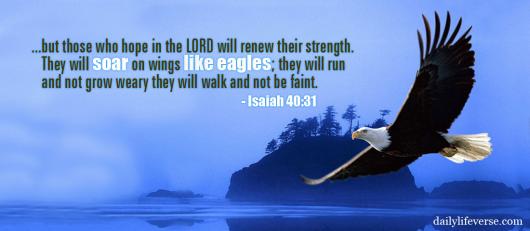
Isaiah 40:14 sounds like the questioning of a young child: “But if God created the world, then who created God?” Even though we know that God exists and that he created this world that we live in, we still can’t even begin to understand how that works (40:28). Even more unfathomable is that all the nations of the earth are nothing to God (40:1), yet he still knows me and you as individuals. God knows exactly how many hairs are on your head (Matt 10:30). God sees everything you do, the good and bad (Job 28:24, Hebrews 4:13), yet he loves you anyway (Romans 8:39). God even knows so much that he knew you well before he crafted you by hand in your mother’s womb (Jeremiah 1:4). God knows more about you than you know about yourself. He knows your hopes and dreams, what motivates you (Psalm 139:13). Honestly, it’s a little scary to have someone know you this deeply, but there is no one I would rather have know everything about me than the compassionate and gracious God, YHWH (Exodus 34:6-7).

-Nathaniel Johnson

(Photo credit: http://www.dailylifeverse.com/posts/2012/08/isaiah-40-31)


God Will Come

Isaiah 35-37

isa-35-6-ww-wall-9x

Wednesday, February 15

Today’s reading is split into two sections. The first is carrying over from what we’ve been reading earlier this week and the second is the start of a war story (chapter 36). I want to leave the war story for tomorrow once we’ve read more of it so for now let’s look at the cheerful words in chapter 35!


The words in verses 3-7 are just beautiful. Every problem you’ve ever had, every disease will be cured because “God will come” (35:4). When God comes to save us, even the most barren of places will have reason to be happy. It says that the desert will be glad. Even if you’re in a place where you feel like there’s nothing going right, your burning sands will become a pool of refreshing water.


It seems like these days, there’s always someone or something trying to trip us up. Those things are the lions. The day is coming when those beasts won’t be found anymore. They won’t be able to get on the path that we choose to take. No more running, only joy and laughter.

-Nathaniel Johnson


(Photo credit: http://www.alittleperspective.com/isaiah-34-and-35/)

The Key to the Treasure!

Isaiah 32-34

isaiah-33

Tuesday, February 14

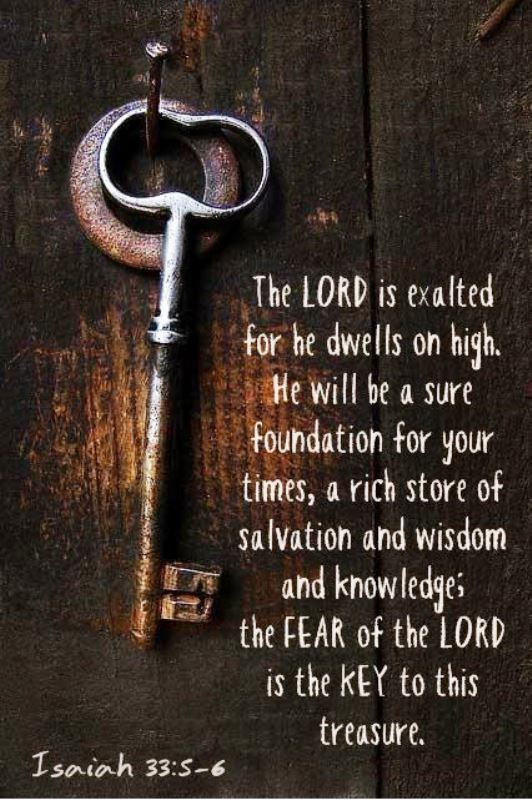
Today we are pirates. Isaiah gave us a treasure map! What’s the treasure you ask? Well, look no further than Isaiah 33:5-6. Locked up somewhere is a sure foundation for our times, a rich store of salvation and wisdom and knowledge. Huh? No cash? If none other than the creator of the heavens and the earth holds the key to this treasure, then I think it’s safe to assume that these things are better than anything that you could find in a pirates treasure chest. The most valuable things you can ever obtain in this life are listed right here: a sure foundation, wisdom, knowledge and salvation. Thankfully we know exactly how to get the key to those treasures. Fear the Lord. After all the things we’ve read in Isaiah, it’s easy to see the power that God holds. But don’t just fear God with your mouth, fear him in your heart. Then, you will get the key to these treasures.

-Nathaniel Johnson

(photo credit: http://wiirocku.tumblr.com/post/139549150857/isaiah-335-6-niv-the-lord-is-exalted-for-he)

Keep Studying

Isaiah 29-31

isa-30

Monday, February 13

Isaiah prophesied about The Little Mermaid! Not really. I didn’t think Ariel’s voice was very ghostlike (29:4). Anyway…

We got a nice little reminder today of why it’s so important to do devotions like this and to study the meaning of the Bible rather than just read it. Isaiah 29:11 warns that “this whole vision is nothing but words sealed in a scroll.” Don’t let the Bible be just words sealed in a scroll. Dig deep into the word that God gave to us so that “the deaf will hear the words of the scroll (29:11).”

It can be easy to think that the passages we’ve been reading have been distinctly separated by chapter numbers and they don’t really connect, but yesterday we talked about the role that rules play in our lives. Again today, we see another warning of letting rules be our moving force (28:13). This verse is another that you would do well to keep close to your heart. Don’t let your worship be just the words you sing. Don’t let your worship just be the words you say. Have you ever been in church singing a song and thought to yourself, “Do I really mean this?” If you haven’t, you probably should. Just because it’s coming out of your mouth, doesn’t mean it’s coming out of your heart.

-Nathaniel Johnson

(photo credit by Bob Smerecki – https://www.flickr.com/photos/snapnpiks0304/9729996902)

3 Steps

Isaiah 17-21

isa-19

Friday, February 10

In today’s reading, we have pretty much just oracles against other nations.  An oracle in the Old Testament is simply the Word of God.  Therefore, the different oracles about the separate nations are just the words of God, and the audience of the book of Isaiah is the people of Judah.  That means that these oracles are words from God to Judah concerning other nations.

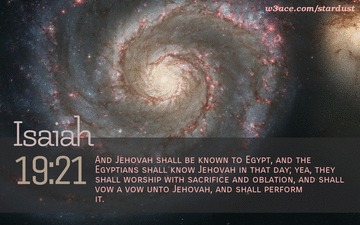
As we have been reading, these oracles concerning other nations are usually more of a judgmental tone.  Often, God states that he will take action against these nations.  This may lead to the people turning to God, and that is present in Isaiah chapter 19.  Chapter 19 contains the oracle concerning Egypt.  In this oracle, God states he will take action for their poor behavior.  As a result of God’s action, “the LORD will make himself known to the Egyptians, and the Egyptians will know the LORD in that day and worship with sacrifice and offering,” (Isaiah 19:21).  Basically there are three steps happening here: The Egyptians sin against God, God punishes the Egyptians, and the Egyptians turn to God because of their fear.

We can learn a lesson from this.  We are inevitably all going to sin in our lives.  We all have sinned, and we all will make more mistakes in the future, similar to what the Egyptians were doing.  The punishment for sin is found in Romans 6:23: “The wages of sin is death.”  Death is what we all deserve.  God is not afraid to punish us if we don’t seek Him.  Similar to the Egyptians, we should then fear God and live a life that is pleasing to Him.  When we do this, we can receive eternal salvation through Jesus Christ, and God will indeed bless us.

-Kyle McClain

(Photo credit: http://w3ace.com/stardust/scripture/book/isaiah/13)

Mercy and Compassion

Isaiah 14-16

isa-14-1-ww-cc-9x

Thursday, February 9

If someone were to look at news regarding the Middle East, there is a good chance it would have something to do with the people of Israel fighting against the surrounding nations.  Israel always seems to have problems with its neighbors.  These problems go all the way back to Abraham!  In today’s section of reading, there were several passages about neighboring nations of Israel.

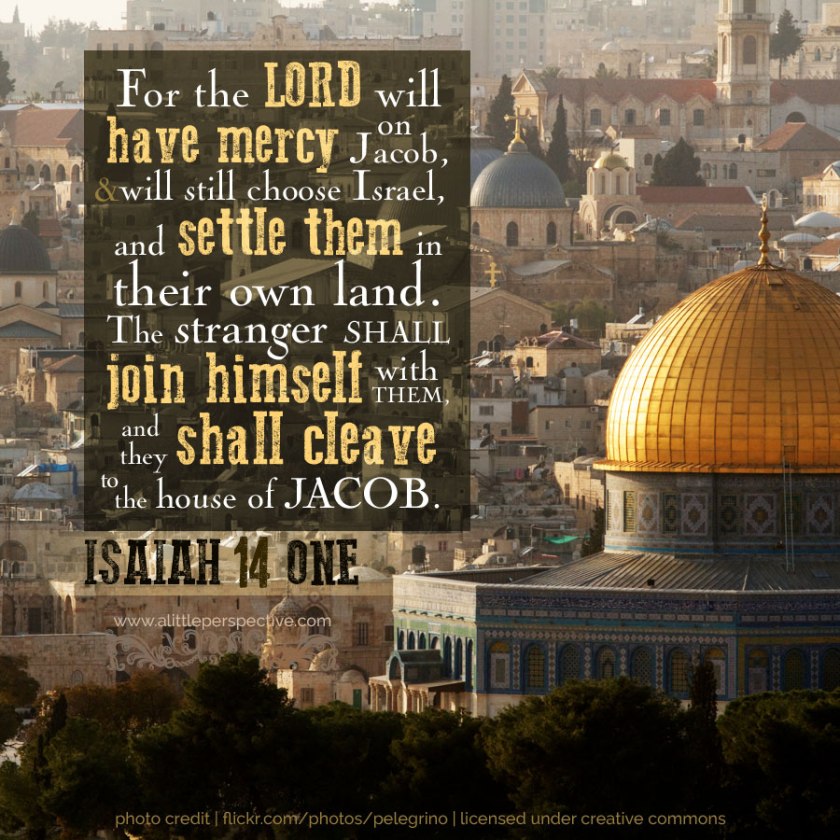
At the beginning of our reading in Isaiah 14:1, it states that “the LORD will have compassion on Jacob and will again choose Israel, and will set them in their own land.”  Even though the people of Israel were a wicked nation at this time, God was still going to have compassion on them.  This is an example of the grace and mercy of God, as He was still going to work with them and give them their own land.  Similar to God having mercy on the people of Israel, God is willing to have mercy on us.  God’s will is that no one should perish; He wants us to seek Him.  If we do, then God will have mercy on us and grant us a spot in the coming Kingdom.

The rest of our reading for the day had to deal with the oracles of the surrounding nations.  Although God was merciful towards his own people, the other nations don’t necessarily receive that same mercy.  These other nations were opposing the people of Israel, and God was not too fond of that.  He was going to redeem His people.  God has the back of the Israelites, even when they were at their worst.

Nowadays, according to Paul, “There is neither Jew nor Greek,” (Galatians 3:28).  Anyone who devotes their life to God, is seen as a chosen people from our Heavenly Father.  The chosen people in the Old Testament were pretty much the Israelites.  The chosen people nowadays are followers of Christ.  Therefore, just as God had the backs of the Israelites, God has our back.

-Kyle McClain

(photo credit: http://www.alittleperspective.com/isaiah-14-through-16/)    

What’s Your Motivator?

Isaiah 10-13

isaiah11_9

Wednesday, February 8

As we continue on with Isaiah, we also continue on with scripture about judgement.  The book of Isaiah as a whole can be split into two sections: judgement (1-39) and restoration (40-66).  Therefore, if you aren’t a fan of this judgement variety, then just stick with it and the restoration will come at the close of Isaiah.  However, even if you aren’t a fan of the judgement material, valuable lessons can still be learned from it.

When reading the judgement material throughout Isaiah, I get a bit tense.  I get tense because the judgement that is coming for so many is severe.  We see the sin of Israel and the surrounding nations causing God to become angry with people, and in reading Isaiah, we are assured that God’s wrath will come out sometime.  The following snip-it’s from this reading give a sense of the kind of judgement coming: “the LORD will utterly destroy,” “shall be cut off,” “destroy both soul and body,” “anger will be directed to their destruction,” “kill the wicked,” “destroy its sinners,” “destruction from the Almighty,” and “fierce anger”.  This is what is coming for those who do not turn their lives over to God.  Furthermore, from Isaiah 13: 6, 9, and 22 we know this day is coming soon.  Although turning our lives over to God to escape this punishment should not be our main focus or motivator, it is still a motivator nonetheless.  I know personally, I do not want this punishment that many will receive.  We know many will receive this destruction as God says, “I will make people more rare than fine gold,” (Isaiah 13:12).  Last time I checked, there wasn’t just a bunch of fine gold laying around.

Yes, escaping a severe punishment that many will receive is motivation to give our lives to God.  However, the greatest motivation of all is found in chapter 11, and that motivation is the Kingdom of God.  One thing the Church of God as a whole is great at is keeping the focus on the Kingdom of God.  One of the great Kingdom prophecies is found in Isaiah 11:6-9.  This passage describes the peace that will take place in the Kingdom.  It describes that a nursing child will play over the hole of the cobra.  Last I checked, no parent in this present age won any parenting awards for leaving their babies next to cobra holes.  However, in this future Kingdom, there will be no death, mourning, crying, nor pain in the coming Kingdom.  The earth will be full of the knowledge of the LORD.  The Kingdom is a never ending celebration.  I know that I want a part in this.  To do this, we must turn our lives over to God.  Let the hope of the coming Kingdom drive you in growing closer to God every day of your life.  The reward for living a life for God is beyond imagination.

-Kyle McClain

(Photo credit: http://www.verseoftheday.com/en/11092012/)

A Call to Be Holy

Isaiah 7-9

man in praise

Tuesday, February 7

I hope you all have enjoyed the first six chapters of Isaiah thus far.  Today, we get to continue with chapters 7 through 9, and we will get right to it.

Chapter 7 has an interesting phenomenon that some scholars within the Church of God call “agency”.  Pay special attention to who is talking when (this may seem complicated).  In 7:3, we see that God is talking to Isaiah, and God instructs Isaiah to relay a message to King Ahaz in 7:4.  7:4-9 is the message that Isaiah was to tell Ahaz.  Then in verse 10, it states, “Again the LORD spoke to Ahaz.”  God was not talking to Ahaz in the first place though; rather, God instructed Isaiah to speak to Ahaz.  Furthermore, in verse 13, the being who was talking to Ahaz says, “my God”.  Therefore, although it says “again the LORD spoke to Ahaz,” in verse 10, I believe that it was actually Isaiah speaking to Ahaz.  In summary, there are two reasons as to why I believe it was Isaiah speaking to Ahaz:

  1. God wasn’t talking to Ahaz in the first place, so the word “again” would not make sense in this context if it were indeed God talking. However, Isaiah was previously talking to Ahaz, so it would make sense to say “again” if it were Isaiah talking to him.
  2. In verse 13, this being talking to Ahaz (either God or Isaiah) says, “my God”. As we all know, the LORD does not have a god, so it wouldn’t make sense for the LORD to say this.  Also, in verse 14, it talks about the LORD in 3rd person.

This idea of “agency” is found in several passages throughout the Bible.  The idea of agency is important when at times Jesus is connected to the term “God”.  It is important to understand to defend the oneness of God.  If this interests you at all or if I made absolutely no sense (which is very well possible) but still want to learn more, then the following article can give some clarification.

http://www.21stcr.org/multimedia-2012/1-articles/re-shaliah-introduction_law_of_agency.html

Isaiah 7:14 is one of the most well-known Immanuel (God with us) prophecies.  The Immanuel, which is Jesus Christ, was prophesied to be born from a virgin.  As far as I know, there aren’t many people born from a virgin mother.  It totally contradicts what we all learned in health class.  However, Jesus himself was born from a virgin.  This alone was a miracle, and it was to be a sign for the people.

In chapter 8, there was one thing that stuck out to me found in verse 11.  It is a call to be holy.  To be holy is to be set apart or different from others, and this is exactly what the LORD told Isaiah to do.  He instructed Isaiah “not to walk in the way of this people,” meaning that he should act differently.  The people in Isaiah’s time were wicked people.  Isaiah 9:17 states, “for everyone is godless and an evildoer.”  We also know this from all the judgement in the previous chapters.  I think most of us would agree that we also live in a society that is very godless and full of evildoers.  We too then should be set apart from society.  We should not walk in the way of the people in our society.  There should be differences between you and the common person.  Are you living differently than others?

Isaiah 9:6 is a controversial verse within the Church of God that probably made many of you uneasy when reading it.  It is a verse that needs to be considered and given thought.  Similar to 7:14 it is prophecy about Jesus Christ.  However, in this prophecy, it states that the son shall be called “Wonderful Counselor, Mighty God, Everlasting Father, Prince of Peace.”  This verse, along with a few others throughout the Bible, has a Trinitarian feel to it.  I do not have all the answers myself, but this verse cannot just be ignored.  I urge you all to look more into this, and make some sense out of it rather than just ignoring it.

I hope you all have a great day!

-Kyle McClain

(Photo credit: https://amokarts.wordpress.com/2012/07/01/scripture-visualized-isaiah-79/)

“Here I Am! Send Me!”

Isaiah 4-6

is6

Monday, February 6

Today, we continue on to Isaiah 4-6.   In this section, there is one of the most well-known passages in the whole Bible, Isaiah’s vision of the LORD in chapter 6.  Before we get there though, we will talk briefly about chapters 4 and 5.

There are essentially two main purposes to the book of Isaiah: “to assure Judah that God would surely judge them for their sins… [And] to assure God’s people of God’s wonderful plan for their future,” (The 5Ws and 1H of Genesis Through Malachi, Robert Jones).  In the first three chapters, we got a sense of the first purpose, to assure Judah/Israel that God does not leave the guilty unpunished.  However, starting in chapter 4, we get a sense of God’s wonderful plan for their future.  After ridding the place of evil, God will establish a place (The Kingdom of God) that shall be “beautiful and glorious.”

Chapter 5 deals with the wicked, once again.  Verse 24 and 25 sums it up fairly well: “for they have rejected the law of the LORD of hosts, and have despised the word of the Holy One of Israel.  Therefore, the anger of the LORD was kindled against his people.”  We have two things happening here.  One, the people are rejecting the LORD and despising Him.  On the other hand, we see that the anger of the LORD is put against his own chosen people.  The people sin, and God responds by getting angry.  However, we know that God is slow to anger as he describes himself in Exodus 34:6, 7.  God’s chosen people kept sinning with no signs of repentance.  What Isaiah is describing is not a sin here or there.  Rather, Isaiah is describing a people, whom God loves very much, living a life of sin.  God’s chosen people of Israel, the same people He has performed many miracles for, were forsaking the LORD.  God does not leave the guilty unpunished, also found in Exodus 34:6, 7.

The beginning of chapter 6 sets the scene of when this was going on.  Isaiah 6:1 states, “In the year that King Uzziah died.”  King Uzziah was one of the Kings of Judah after the split of Israel, and he died in the year 740 BC.  This is not long after the Golden Age of Israel when it was a unified nation under kings Saul, David, and Solomon.  It is also before the Israelites were exiled into the Babylonian land.  Therefore, the ministry and writing of Isaiah took place before books such as Ezra and Nehemiah.  Isaiah’s ministry is taking place at the same time many of the events in 1st and 2nd Kings and Chronicles are taking place.

As mentioned before, Isaiah 6 is one of the most well-known passages in the whole Bible.  It paints a beautiful picture as to what the Throne of God looks like. You can compare this picture to the description of God’s Throne in Revelation 4.  In Isaiah’s vision, as he approaches the throne of God, he humbles himself by basically saying he was not worthy to be seeing what he was seeing.  Then, God asks Isaiah whom He shall send.  Isaiah then wonderfully replied by stating, “Here I am! Send me.”  We can learn a lot from this simple statement.  The attitude that Isaiah displayed here should be the same attitude we express in our lives.  The harvest indeed is plenty and the workers few.  The LORD is seeing who he can send to do His work.  Are you willing to do his work?

-Kyle McClain

My name is Kyle McClain, and I am currently attending the Atlanta Bible College.  It is my second year at the Bible college and I will receive my bachelor’s degree in pastoral ministry next year.  I am excited to be able to go through the first third of the book of Isaiah with you all (or y’all as they say down here in Georgia).