God’s Grace

2 Chronicles 30-32

2-chr-30-9-ww-cc-9x

Friday, December 2

Just a couple quick things to notice in these readings. One is that our readings this week have covered more than 200 years of Israel’s history. To put it in context of United States history, George Washington would have been president when this week started and most of you will be retired by the end of tomorrow’s reading. Just imagine how much has happened that we know nothing about. If you remember your readings in 1 and 2 Kings, you’ll notice differences in the story. I was surprised that this account does not include the sun moving backwards as a sign of  Hezekiah’s healing, nor does it give as dramatic an account of the defeat of the Assyrian king Sennacherib.

I want to focus now on 2 Chronicles 30:13-22. The back story is that Hezekiah is determined to celebrate the Passover like it had not been done since the time of Solomon. He is not content to celebrate only with those loyal to David in Judah, but has reached out to the northern tribes, many of whom have already been defeated and carried away captive by the Assyrians. Many have refused to come, but Judah graciously welcomes those who do.

Notice verses 18-20. “For a multitude of the people, many of them from Ephraim, Manasseh, Issachar, and Zebulun, had not cleansed themselves, yet they ate the passover otherwise than as prescribed. But Hezekiah prayed for them, saying, “The good LORD pardon all who set their hearts to seek God, the LORD the God of their ancestors, even though not in accordance with the sanctuary’s rules of cleanness.” The LORD heard Hezekiah, and healed the people.”

We have noticed throughout our readings that God gave strict instructions as to how his feasts were to be celebrated. Yet here we see grace, first in inviting those who were outside the faithful of Judah to celebrate the feast, and then in pardoning their mistakes in celebrating the feast. God understands human weakness.

We might imagine a person visiting our church who does not know how to behave in church. Perhaps she doesn’t know how to dress, perhaps he uses language that many would consider inappropriate. They don’t know the words to the songs, don’t know when to stand, when to sing, when to be quiet, what communion is about. Can we be glad they are with us, rather than focusing on their mess ups? How can we gracefully communicate that we are glad they are with us, welcoming them as Christ welcomes us?

-Greg Demmitt
Winning the Battle, but Losing the War

2 Chronicles 23-25

2-chron-25

Wednesday, November 30

I am enjoying the trailers for Rogue One, the soon-to-be-released film that chronicles the rise of the rebel alliance, setting the stage for Star Wars movies four through six. The search for the rightful ruler lies behind many such stories.


We see the same throughout Judah’s history. In today’s reading alone, we read of four different regime changes. The first is the best, as God’s priests serve as warriors defending the rightful king and overthrowing the usurping daughter of Ahab.


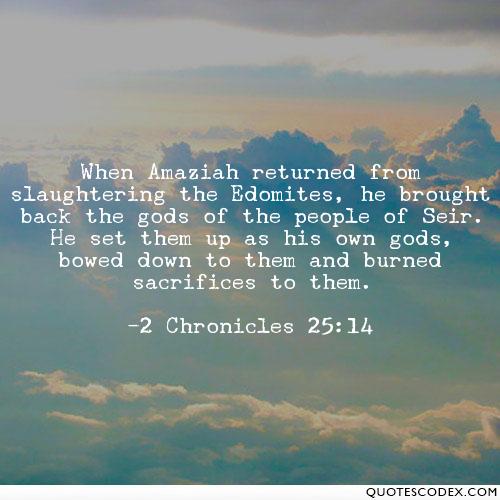
Stuart (1987) writes that the Chronicler likes to show immediate retribution for sin amongst God’s people, and we see that several times in today’s passage. One really sad event begins with King Amaziah trusting God and winning a battle against great odds, but then returning home to set up the defeated kingdom’s idols for Israel to worship. God’s prophet rightly asks him, “Why have you resorted to a people’s gods who could not deliver their own people from your hand?” (2 Chron. 25:15). Before long, Judah was overthrown by Israel.


Does life work like that today? How quickly do we experience the consequences of bad behavior?Sometimes it happens very quickly, but not always. The Apostle Paul warns us, “The sins of some people are conspicuous and precede them to judgment, while the sins of others follow them there. So also good works are conspicuous; and even when they are not, they cannot remain hidden.” (1 Timothy 5:24-25).


We must remember, however, that our life as Christians is not simply a matter of good things happening when we are good and bad things happening when we are bad. We are called into a life better than anything we read about in the Old Covenant because now we have entered into a wonderful new relationship with God because of what Jesus has done for us. We must not be dominated by the cycle of good and bad behavior that occurs in almost everyone, and instead live in faith that God loves us and enables us to live out our lives through the power of his Holy Spirit that dwells within us.

-Greg Demmitt

Douglas Stuart, Hosea–Jonah, WBC 31; Accordance electronic ed. (Grand Rapids: Zondervan, 1987), 262.

The Valley of Jehoshaphat

2 Chronicles 20-22

2-chron-20-12

Tuesday, November 29

Our reading today goes from Jehoshaphat’s greatest victory to the terrible things that his children and their wives did after he died. Let’s look at his great victory and the possibility of it happening again.


Numerous countries are aligned against Judah and Jehoshaphat knows that he cannot defeat them. He calls upon God and is told that his prayers will be answered. Instead of fighting Judah watched as its enemies destroyed each other.


Might that happen again? One of our older ministers, Don Ward from Missouri, wrote about the current situation in the middle east, where ISIS is directing most of its evil towards Islamic states. He said this could be a fulfillment of Joel 3:


1 For then, in those days and at that time, when I restore the fortunes of Judah and Jerusalem, 2 I will gather all the nations and bring them down to the valley of Jehoshaphat, and I will enter into judgment with them there, on account of my people and my heritage Israel, because they have scattered them among the nations.


Pastor Don pointed out that there is no valley in Israel named after Jehoshaphat, and instead suggested that it refers to 2 Chronicles 20 and the way Israel’s enemies destroyed each other, which could be what is happening now. I think that is fascinating to think about.

-Greg Demmitt

2-chron-20-15

A Price to Pay (2 Kings 15-17)

Thursday, November 10

2-kings-17-all-this-occurred-because-the-people-of-israel-had-sinned-against-the-lord-their-god

2 Kings chapter 15 includes multiple assassinations of rulers, a one month rule, a 6 month rule and a twenty year reign of an evil king. . . makes our U.S. terms of office and system of voting look pretty good – far from perfect – but better than the political system of the Divided Kingdoms.

Of the 7 kings listed in Chapter 15, only two of them are said to have done what is right in the eyes of the Lord: Azariah and Jotham.  It is curious that those are the only two kings listed here in which the author gives the name of the king’s mother.   Young women – never underestimate the importance of the job of raising up a new Godly generation.  Yes, young men – your children will need a Godly daddy, too!!

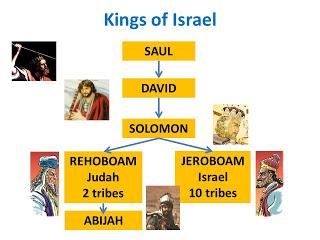
There is a repeated phrase that we have heard over and over again describing the kings of Israel: “He did evil in the eyes of the Lord…he did not turn away from the sins of Jeroboam.”  I think it is worth reminding ourselves what were the sins of Jeroboam?  When Israel divided after the reign of Solomon, Jeroboam became the ruler of the larger 10 tribes in the north, who would keep the name Israel.  However, they lost the two southern tribes which would be called Judah – as well as the holy city Jerusalem, the home of God’s special temple.  Jeroboam didn’t want his subjects trying to travel to Jerusalem to worship, as prescribed by God.  So he (not God) created new “holy places” for Israel which included golden calves and he selected new priests not from the tribe of Levi.  God’s whole system of worship (which had been carefully laid out in the books of Law) were replaced by Jeroboam – for convenience and ease.  But there would be a price to pay.

In Chapter 17 God sends the Assyrians to capture Israel.  They have used up their chances.  God is fed up with their disobedience.  Scripture says,”They followed worthless idols and themselves became worthless. They imitated the nations around them although the Lord had ordered them, ‘Do not do as they do’.” (17:15)  There is often great ungodliness – and danger – in blending in with those around us.  God’s people are to stand out as different – dedicated to His Word and commands rather than to what others are doing or what is currently convenient and accepted.  Who are you following?  Any guesses what the consequences (good or bad) are going to be?

Marcia Railton


A Good King Allies with a Bad King (I Kings 21-22)

Friday, November 4

i-kings-22-14-pic
Melissa New
Israel was suffering under the leadership of their wicked King Ahab. Even when God had obviously given them the victory over the Arameans, Ahab decides to disobey God’s instructions. Ahab is recklessly impulsive. So you might wonder why the good king of Judah, King Jehoshaphat, bothered to visit Ahab. I picture a couple of powerful men getting chummy and having a good time and then, the clever Ahab says, “Hey man, Romath-gilead should be part of my kingdom. What do you say we go to war to recapture it for me?” And Jehoshaphat says, “Why, of course! Let’s first check to see what the LORD’s thoughts are on our plans. That really is the smart thing to do. But brother, I’m already liking this idea.” (Disclosure: this is not how the Scripture exactly reads.) Ahab calls in his prophets because they always say what he wants to hear. Jehoshaphat, in a moment of clear-headedness, says they need a true man of God’s advice. Ahab admits there is a prophet who could consult the LORD for them, but he never says anything good. And Jehoshaphat says, “That’s not the way a king should talk!” (I Kings 22:8) You would think at this point King Jehoshaphat would be having second thoughts about rushing into battle with Ahab. Especially after they hear what Micaiah, the prophet, has to say!!! Ahab must have been a smooth talker. Not only did Jehoshaphat go into a needless battle with him, but he put on Ahab’s king’s robes so that he would look like the perfect target for the enemy. In the end, Jehoshaphat is remembered as a good king who “did what was pleasing in the LORD’s sight”, but there is a good lesson here for all of us. We need to be always alert to the warning bells that the company we keep may cause to go off. It may sound like a good time and we may really like the person or people we are hanging out with, but are they following God’s way?

A Second Chance Squandered (I Kings 13-15)

Tuesday, November 1

kings-of-israel-pic
written by: Melissa New
It is amazing how kind our Father is. Previously, we saw that Solomon deliberately disobeyed God and because of his sin, which in turn led many others to sin by worshipping idols, God did what He said He would do. He would “tear the kingdom away from you (Solomon) and give it to one of your servants.” (I Kings 11:11) He sent the prophet Ahijah to tell Jeroboam of some spectacular news for his future.  God was making a new covenant promise for Jeroboam! Solomon broke his covenant promise from God, and now Jeroboam is given the opportunity to enjoy a covenant promise. Could he learn from the mistakes he saw Solomon make? If he would be wholeheartedly devoted to God, as David was, then Jeroboam could have the benefits of a similar promise!
We find in these chapters that Jeroboam’s god was “power.”  He was unwilling to risk losing any of it. He didn’t trust the promise of God. He thought he could better rule the people of Israel without God. So he made golden calves for the Israelites to worship. He led the people into idolatry. But God gives Jeroboam a second chance! Just as he warned Solomon, he sent a man of God to tell of his demise.  Jeroboam’s life would come to a nasty end because of his sin.  He didn’t listen to the man of God even though he proved that what God says comes true. In chapter 13 we see that another prophet learns that what the “man of God” said was, indeed, true, but Jeroboam would not “turn from his evil ways.” In chapter 14 we see that Ahijah no longer has good news for Jeroboam. His prophecy for Jeroboam is dishonorable death and a future dispersing of the Israelites.
The legacy of Jeroboam is wickedness. Israel will have 20 kings until they are taken over by Assyria, and all of them will be BAD. Many times Christians think that a little sin in their lives only affects themselves. And it’s true that leaders, like Jeroboam, have a lot more influence, but sin has consequences for any who see or are around it. In some cases, it could have an impact on people not even born yet.