
Taming the Tongue

OLD TESTAMENT: Isaiah 46-47

POETRY: Psalm 107

*NEW TESTAMENT: James 3:1-12

Reading this passage is powerful to me.  It’s only 12 verses, so take the time and read through it if you haven’t.

The imagery just really paints a picture in your mind of the kind of control being talked about.  And what has this control?  The tiny little tongue.

It is so small, yet so powerful.

The words you say have a powerful impact on others.  A kind word can lift someone from a valley, but a negative word can push someone down who may have already been knocked down.

My 3-year-old son made the joyful revelation when talking and making faces at his baby cousin this summer – “If I’m happy at her, she’s happy at me!”  Life isn’t quite always like this, but typically, if you speak kindly to someone, you are much more likely to get a positive response from them whether it is a kind word back or help in an area you are looking for.

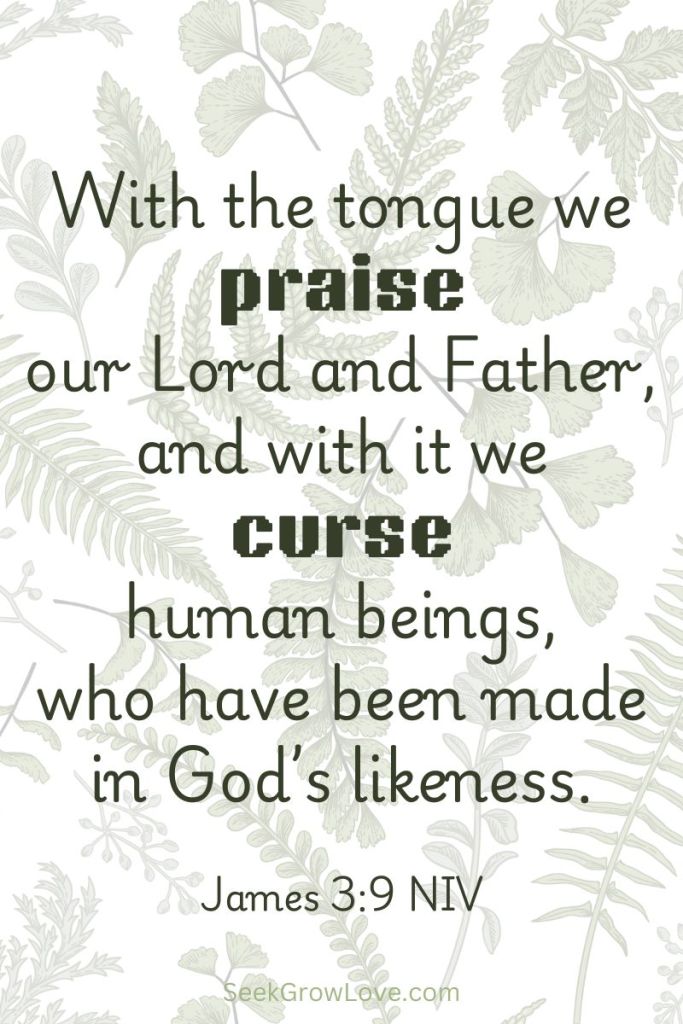
Verses 9-10 read: With the tongue we praise our Lord and Father, and with it we curse men, who have been made in God’s likeness.  Out of the same mouth come praise and cursing.  My brothers, this should not be.”

[italics added]

How can we curse someone made in God’s likeness with the same mouth we praise our God with?  Those ideas are so contradictory, yet it is easy to put people down.

For example, you may be aware that we have an election coming up soon.  There are so many negative things being said about politicians in all parties.  But how can we talk this way about someone made in the likeness of God?  I think what it boils down to is that is not how we are viewing them.  We are looking at them based on their actions or thoughts that we don’t agree with, but not looking at who they are as a person which is someone made in God’s likeness.

Let us try to view everyone in this way in order that we might better praise God. 

~Stephanie Fletcher

Reflection Questions

  1. What do you think God is thinking about those who praise Him and curse men?
  2. Watch your tongue today and see how many times you speak poorly of people – or catch yourself ABOUT to speak negatively of someone made in God’s likeness. Why do you think it is so common in the world?
  3. How can we be different? Is it possible to state your opinion about ideas without putting down people?

The Influence of the Tongue

Old Testament: Jeremiah 1 & 2

Poetry: Proverbs 4

New Testament: James 2

(I told Andy he was in charge this week so yes, he could have some days discussing various chapters from James that don’t line up precisely with the reading plan in order to have some two-part devotions. So, today’s devotion actually comes from James 3).

Have you ever hurt someone with your words? Of course, we all have. That inability to hold your tongue. The control of the tongue has both negative and positive aspects. It involves the ability to restrain the tongue in silence. But it also means being able to control it in gracious speech when that is required.

Sanctification in any area of our lives always expresses both sides. A putting off and a putting on. Speech and silence, appropriately expressed, are together the mark of the mature (compare with one of the clearest illustrations of this in Colossians 3:1–17). Nor is this James’s first reference to speech. He had already said that for a professing believer to fail to bridle the tongue is to be guilty of self-deception (1:22–25) and the hallmark of a person whose religion is worthless (1:26). He uses some imagery to explain just how powerful this tongue is. In James 3:3–5, James uses two illustrations. The tongue is like the bit in the mouth of a horse. This tiny appliance controls the enormous power and energy of the horse and is used to give it direction. James may well have been familiar with this picture from common experience in daily life. He had seen powerful Roman military horses and had probably heard stories of chariot races. The point, however, is the power and influence concentrated in one small object. That’s how it is with the tongue.

The tongue is also like the rudder in a boat. Large ships were not unknown in the ancient world. The ship that originally was to transport Paul across the Mediterranean en route to Rome held 276 people (Acts 27:37). We know that a large ship like the Isis could carry one thousand people. Yet such a big and heavy vessel was directed simply by a turn of the rudder!

Why does James speak this way? Of course, divine inspiration but also of both biblical knowledge and personal experience. The tongue as I’ve heard it said “carries into the world the breath that issues from the heart”.

We do not realize how powerful for evil the tongue is because we are so used to its polluting influence.

Jesus says the tongue projects the thoughts and intentions of the heart. It is from within, “out of the heart,” that the mouth speaks (compare with Matthew 12:34; 15:18–19). But like the smoker, so accustomed to the odor, the atmosphere in which they live, the person with polluted speech has little or no sense of it — no sense that they exhale bad breath every time they speak.

But with all of this said, James is forced into a confession. Nobody — Jesus excepted — has succeeded in mastering the tongue! Our only hope as we pursue the discipline of self that leads to mastery of the tongue is that we belong to Christ and that we are being made increasingly like him. But this battle for “vocal holiness” is a long-running one, and it needs to be waged incessantly, daily, hourly. Are we fighting it? So we get it. We don’t say mean things, we think about what we say. We use judgment with our words. Many people miss one important element in taming the tongue and that is adding Godly speech to our vocabulary. This is a life-changing, mind-altering, and wonderfully encouraging side.

Which we will get into tomorrow. 🙂

-Andy Cisneros

Reflection Questions

  1. Knowing what you now know about the tongue from James 3, what warnings and instruction on the words you say and don’t say can you apply to what James has to say in James 2?
  2. Which do you find harder – silence when silence is most appropriate or gracious speech when gracious speech is most important? Think of an example of when you should have been silent – but you weren’t. And, an example of when you could have used gracious speech – but you didn’t. How could the situation or relationship have been altered by better control of your tongue? How might your tongue be used now to help mend these relationships?
  3. Are there any specific words/phrases that your speech would be better without?
  4. In what situations do you find it difficult to control your tongue? What could you do next time you are in that situation to demonstrate that you want to become more and more Christ-like?

Wildfire

James 3

Tuesday, October 4, 2022

It can be a challenge to control what we say. James describes the tongue like a poisonous and evil beast we can’t tame. He says that it’s a fire that sets the whole cycle of nature ablaze. That’s a lot of power to ascribe to one small part of the body. How can it be so powerful?

James gives us two potent analogies for how this works. You can put a small bit in a horse’s mouth and be able to steer them wherever you want, and you can steer a large ship with a small rudder. It’s the same with the tongue. It’s a small part of the body, but it has great “steering power.”

Have you ever met someone who is just always a positive thinker? It’s equal parts encouraging and annoying how they can always manage to put a positive spin on things. On one side, it seems like they’re not acknowledging the reality of the situation, but on the other, they might have a deeper handle on reality. There is something I can learn from this kind of person. Thinking and saying positive things is like a small investment in those truths. It signals that we are aligned with them and committed to them, and when that is the case, we’ve paved the road for positive actions.

The same could be true for negative thoughts, words, and actions. If you’re putting your chips down on your dismal predictions, you want to be right. Sometimes we want to be right more than we want things to be right, so we can say, “See, I told you so.”

The influence of your tongue goes far beyond just yourself. Imagine you are having a conversation with someone you care about. Somewhere along the line, you start interpreting each other incorrectly (which happens all the time), and one or both of you gets triggered by what the other says. In such a moment, especially when you are angry, it is like all control of the tongue goes out the window. You are suddenly saying hurtful things that you are wishing you didn’t say—even before you finish saying them. The tongue takes over and starts steering the conversation into a fiery disagreement. This is real. You know it’s real because you’ve experienced it. This is the wildfire James is talking about.

For moments like those, it is appropriate to remember to be quick to listen, slow to speak, and slow to get angry (James 1:19). When my pastor, Michael Hoffman, talks about this verse, he says that is why God gave us two ears and only one mouth. If only this was something I could remember more in the moments that count. When you really put effort into hearing people, you take some of the destructive ammunition away from the tongue.

These days, we have quicker and easier ways to cause wildfire than James could ever imagine. I’m pointing at social media. The internet is an amazing innovation and it’s hard to imagine my life without it, but we were clearly not ready for it as a species. Now we are dealing with a beast more ferocious than just the tongue. Now anger, polarization, fear, disillusionment, disinformation, and pure stupidity can be spread across the world in just a short moment with a comment, tweet, post, video, or what-have-you. Those who see or hear it will likely not react or filter themselves as if they are interacting with a real human, and their response will reflect that. It’s a terrible feedback loop. To make it worse, there are algorithms lurking in the background making sure you see the things that are most likely to trigger you. If the tongue is a wildfire, social media is uncontrolled nuclear fission.

Somewhere around 10 years ago now, I realized that social media was not a healthy thing for me, for various reasons. I imagined what would happen if I just quit using it. So one day I quit, and I’ve never missed it. I’m not saying you should do the same, but if you ever find yourself burdened or distracted by it more than you know is healthy, consider it.

The things we say really do affect us. They ripple out and affect our families and friends. They touch our communities and influence our world in ways we don’t even comprehend. This is the reality that James recognizes and wants to warn us about. And given how fast and wide technology allows our communication to spread, that means we have an even higher level of responsibility for what we say.

-Jay Laurent

Questions:

1. When was the last time you started a wildfire with your words?

2. Are there any strategies you could use to help tame the beast that is your tongue?

Only You Can Prevent Forest Fires of the Mouth

Proverbs 26

Proverbs 26 20 NIV

The Smokey Bear Wildfire Prevention campaign started in 1944, and in 1947 the slogan that is familiar to many came to fruition; Only You Can Prevent Forest Fires (updated in 2001 to Wildfires). It is the longest public service campaign in the United States’ history. A campaign was derived to help the prevention of forest fires. Years of education gave the ownership to the general public to be more careful and to care for the world around you. The catchphrase reflects your responsibility.


Our family does not do “traditional” camping (unless a cabin with running water or hotel room is traditional camping to you). This doesn’t mean that we don’t love a good campfire.  This summer we spent some time in the Upper Peninsula of Michigan at our family cabin. The week was filled with cleaning out the overgrowth of trees and brush on the property, which meant a BIG campfire. Our burn pit is close to the lake, but is really in the middle of the woods (like most campfires). Being in the heart of the woods means being surrounded by a plethora of “fuel” if a fire is left to its own devices. So, before we left the cabin or went to bed, we had to make sure that the fire was out.


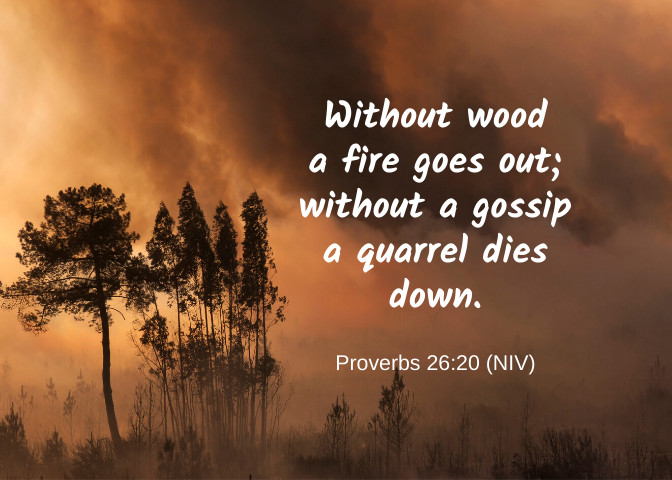
The wisdom from Proverbs 26:20 resonated with me. It says, “Without wood a fire goes out; without a gossip a quarrel dies down.” You see, a fire is only going to burn if it is fed. Our tongue is the fire and when you remove gossip or the “fuel,” it dies down. The best way to end (avoid) a quarrel? Keep your mouth shut!  Don’t get involved in what doesn’t concern you. Don’t take up offenses of others and don’t be easily offended. Don’t talk about what you don’t know and be very slow to talk about what you do know. Practice self-control in the moment and show Christ-like love at all times. Don’t be the fuel for the fire and the fight!


James 3:5-6 says “Likewise, the tongue is a small part of the body, but it makes great boasts. Consider what a great forest is set on fire by a small spark. The tongue also is a fire, a world of evil among the parts of the body. It corrupts the whole body, sets the whole course of one’s life on fire and is itself set on fire by hell.” This just reinforces that our small tongue can do big damage.


Don’t fuel the flame of gossip and cause fights, only you can prevent wildfires of your mouth!


Erin Bormes

Consistently Strong

James 3

James 3 5 NIV

Have you ever heard young boys arguing? It may begin as an argument about which is faster but many times it will end up with the two boys shouting something to the effect of, “My dad is stronger than your dad!” Often times we see our fathers as a symbol of strength, but what does strength look like? Is it a bodybuilder with bulging muscles? Is it a sprinter with unbelievable speed? These can be measures of physical strength but the strength that we are called to display is more than just strength of body.

The world tells us that a strong person should “get mad and fight like a man” God tells us through James to control our speech and even to control our anger. In chapter one he said, “Be quick to hear, slow to speak, and slow to become angry”. James 1:26 tells us “If anyone thinks himself to be religious, and yet does not bridle his tongue but deceives his own heart, this man’s religion is worthless” In Chapter 3 he says that anyone who does not stumble in what he says is a perfect man, I can tell you I am far from perfect. He goes on to explain how such a small part of our bodies can control and lead so much of our life. When I take a flight I often sit near the wing and will watch the flaps as the pilot makes adjustments to control the aircraft. It always amazes me to see that such a small change, in a relatively small piece of the plane, can determine the altitude of such a massive machine as it carries me through the air at hundreds of miles per hour. James 3:5-8 says

5 So also the tongue is a small part of the body, and yet it boasts of great things. See how great a forest is set aflame by such a small fire! 6 And the tongue is a fire, the very world of iniquity; the tongue is set among our members as that which defiles the entire body, and sets on fire the course of our life, and is set on fire by hell. 7 For every species of beasts and birds, of reptiles and creatures of the sea, is tamed and has been tamed by the human race. 8 But no one can tame the tongue; it is a restless evil and full of deadly poison.

Although the tongue is such a small part of our body it is what we use to express our thoughts and emotions to those around us. Jesus even said that our words are the overflow of our heart. Does that mean when we are sarcastic and disrespectful to those around us that is what is truly in our heart? That can be a disturbing thought sometimes. Perhaps we should use our words to view the contents of our heart.

When I lived in the South I would hear someone say something inappropriate and another person would ask, (insert your best southern accent) “You kiss yo momma with that mouth?” James says something similar but with even more force. He says, “With it we bless our Lord and Father; and with it we curse men, … these things ought not to be this way.” We should seek to honor both God and people with our words.

We should be consistent with our thoughts and actions.

We should be consistent in the strength of self-control.

It takes true strength to control your tongue.

Show strength that builds up, not tears down!

-Bill Dunn