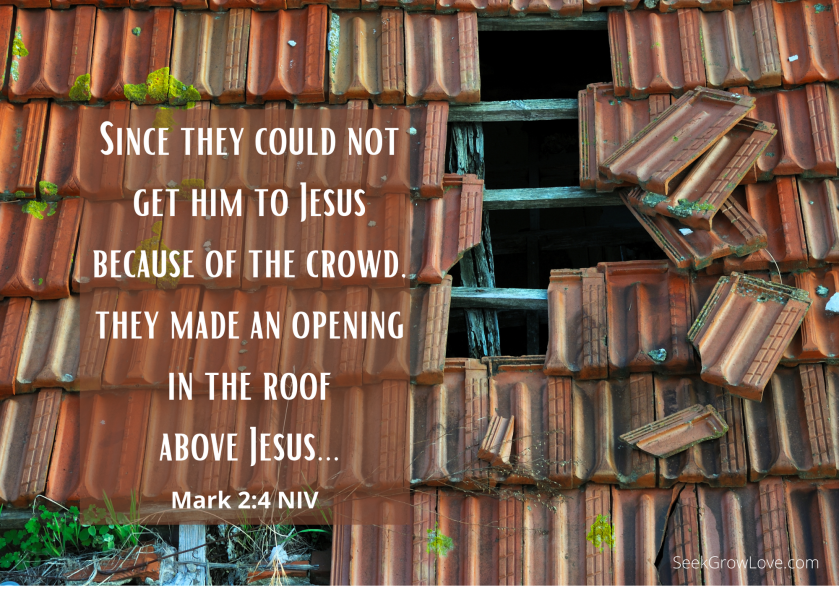
In Mark 2, we find the story of Jesus healing a paralyzed man. Jesus was becoming more well known, and more popular. He was inside a house, and some men brought their friend to Jesus so Jesus could heal him. But because such a big crowd had gathered, there wasn’t room to bring him to Jesus, not even outside the door. So the friends took the man onto the roof, dug through the roof, and let him down in front of Jesus.
I have to admire these friends. They were very concerned about their friend, and wanted to see him healed. They believed Jesus could and would heal him, if they could just get him to Jesus. They didn’t just “pray about it”, they stepped out on faith and did something about it. They dug through the roof, and let their friend get close to Jesus – and Jesus rewarded their efforts.
Mark 2:5 tells us, “When Jesus saw their faith, he said to the paralytic, “Son, your sins are forgiven.” Jesus obviously saw that the man was crippled, but Jesus saw what wouldn’t have been nearly as obvious to us. The man’s biggest problem was his sin – so Jesus healed him of that first. This is the greatest miracle Jesus performed (and still performs).
The teachers of the law said that Jesus was blaspheming, believing only God can forgive sin. I’m guessing they were thinking, “it’s easy to tell someone their sins are forgiven, since you can’t prove they are really forgiven.” Jesus then told them, “But that you may know that the Son of Man has authority on earth to forgive sins…” He said to the paralytic, “I tell you, get up, take up your mat, and go home.” So the man got up, took his mat, and walked out.
I love this story, not only because I love reading about all of Jesus’ miracles, but specifically because this is the only story I can think of where someone is healed because of the faith of his friends. We’re not told, maybe the paralyzed man asked to be taken to Jesus. But any way about it, Jesus saw the faith of the friends, forgave the man’s sins, and ultimately healed him.
This story puts me to shame. I invite you to ask yourself some questions…
Am I this concerned about my friends?
Am I willing to be uncomfortable – maybe even make a scene – to bring someone to Jesus?
Am I willing to not just “pray for” someone, but actually “do something” for someone?
Would Jesus see my faith and forgive and even heal someone I care deeply about?
Finally, do I need Jesus’ ultimate miracle for myself – to have him forgive me of my sins? This miracle meets the greatest need. It costs the most. It brings the greatest blessing. It has the longest lasting results. And Jesus is still doing it daily.
–Steve Mattison
(Originally posted for SeekGrowLove on October 6, 2020)
I used to own a pair of fish that my best friend gave me. I thought I was a decent fish owner. But then I went off to Australia for three weeks and when I returned, I came home to find that the slow-release food supply that I put into the tank, didn’t dissolve. My poor fish starved to death. Oops.
So your reservation to take seriously any of my mentioning of fish, fishing, or fishermen would totally be understandable.
But I ask that you hear me out, just this once, for this particular topic. After all, I did my due diligence and Googled some information.
Mark 1:17 says, “Come, follow me,” Jesus said, “and I will make you fishers of men.”
Being a fisherman was way back then and continues even today to be a daily job. Likewise, as we follow Jesus daily, our casting of nets should happen every day we are around others. If we are called to be fishers of men, all of our interactions need to be with the purpose of building relationships and showing others, verbally and nonverbally, what life with Jesus as our Lord looks like.
Peter and Andrew knew when the best time to go fishing was. According to www.takemefishing.org (I’m totally serious… ) the best time to fish is usually later on in the day. I know that there are probably a gazillion other variables that should be considered, so don’t go dismissing the bigger picture here. Later in the day, the fish are primed for feeding because their metabolism and digestion are roaring. There is a lesson for us here – in order for people to win others to Christ, they need to be primed. In God’s own timing, a person’s heart will be open to receive the Gospel. As fishers of men, we need to be praying for those opportunities to present themselves so we are able to discern what to say and when to say it.
We know from verse 16, that Simon (later called Peter) and his brother Andrew used nets for fishing. Not a pole, line and lure, but nets. They caught hundreds of fish at a time. When Jesus says that he will make us fishers of men, I think His intention is that we not just teach a few people about Jesus, but that we influence hundreds of people, over our lifetime, to consider what life as a follower of Jesus would look like.
We also know from verse 16, that fishing was not a solo effort. It demanded at least a pair to get the job done. Our faith is meant to be in a community. Yes, Jesus goes off to a solitary place in verse 35 of Chapter 1, but that doesn’t mean we live in a vacuum. Working and serving with other believers is how our faith is supposed to be carried out.
I fully admit that sharing the Gospel is not my strength. But as I read this verse, I became convicted that this is something that I need to take more seriously. That’s partly why I chose it to be the verse to memorize for the week. So even though it is a short verse and easy to commit to memory, it’s potential to change my life and the lives of those around me, is significant.
Wanna go fishin’?
-Bethany Ligon
(Originally posted for SeekGrowLove on September 11, 2017)
Reflection Questions
How have you been helped by your fishing community? How can you help them?
How committed are you to following Jesus and fishing for people? What do you find hardest about these jobs? What gets in the way?
Pray to God about how He would like to see you fishing for men/people. What does it look like? When and where will it be done? Who will your fishing partners be?
I would like to start off this post with a short introduction. My name is Ruth Finnegan and I am married to Sean Finnegan and we have four sons, who range from age 11 to 1 month old. It is my joy and pleasure to be a stay-at-home mom! When Sean and I first got married we had a lot of discussion about “how are we going to be.” We decided to set a few tenets or standards for our life together. These were: seek righteousness; don’t be cheap, tip generously, only use good toilet paper, and be given to hospitality. Recently, I went to the store to stock up on toilet paper and they were out of our usual brand. I bought a cheap package to tide us over until I could go to the store again. Oh man! Mistake!! Sean started declaring, “Have we lost all of our principles?? What is this, sandpaper?! Should we stop tipping too?” I burst out laughing when he said this because I was instantly brought back to that conversation early on in our marriage. I went out and bought good toilet paper for the house and got rid of the cheap stuff.
Sean and I have been married for almost 14 years and we have always been passionate about being given to hospitality (Romans 12:10). Over the years, we have had many people come stay with us. Some come for just a night and some for many months. We feel that God has given us much and blessed us abundantly and that it is our joy to bless others with our home (and with our good toilet paper). I have found that you discover a lot about people when they stay with you in your home. I thought about this as I read Acts 20:17-38.
When Paul was in Ephesus, his mission was certain. He served and lived among the people, he kept back nothing, teaching them “repentance toward God and faith toward our Lord Jesus Christ” (Acts 20:21). Paul was a true shepherd who cared for his flock and was very clear about his purpose. He made sure that he was not a burden. He took care of himself and those with him and he used every opportunity to teach and shepherd the flock there. He truly cared for people and genuinely wanted the believers to be protected from the wolves that were sure to come. Paul knew he had to leave and wouldn’t see them again. He implored them with these final words:
35 In everything I showed you that by working hard in this manner you must help the weak and remember the words of the Lord Jesus, that He Himself said, ‘It is more blessed to give than to receive.’”
And with that, he knelt down with them and prayed for them. When Paul left, they did not breathe a sigh of relief because he had inconvenienced them. No, they had deep sorrow in their heart because he had been a blessing to them.
We have had people stay with us that were all about what they needed or being served so when their time of departure came, we were thankful! We have also had the pleasure of having guests that infused our home with light and eternal blessings! They had eyes to see and wanted to be a blessing and help. When we go about our lives and come into contact with others, let’s strive to be like Paul. He was all about teaching the eternal things of life like the Kingdom of God. He was not a burden but a blessing to the believers and sincerely cared for them. He didn’t complain about his lot as a missionary, he was driven by the holy spirit even when it came to his own discomfort and sacrifice. Let’s strive to encourage others and remember it is more blessed to give than to receive!
-Ruth Finnegan
(Originally posted for SeekGrowLove on June 10, 2017 – today, Ruth and Sean’s boys are much older and taller. But I bet the whole family still enjoys using, and giving, the good toilet paper.)
Reflection Questions
How would you describe how Paul gave? What was he giving?
When have you found it to be true that, “It is more blessed to give than to receive?” What has been your favorite thing to give?
Where are you challenged to give more freely? What will you give this week? How?
Acts 18 details the cities that Paul visited on his way from Jerusalem to Greece and some of the highlights in those cities. While in Corinth Paul again has issues with the Jewish community there and instead finds a Gentile man named Titius Justus who was a worshiper of God. Paul also has a vision from the Lord saying,
“Do not be afraid; keep on speaking, do not be silent. For I am with you, and no one is going to attack and harm you, because I have many people in this city.” (Acts 18:9,10)
I understand why Paul would need this encouragement with the number of cities that he had been thrown out of after annoying the local Jewish population with his message.
What I find interesting is the fact that Paul is the first missionary to set foot on the continent of Europe and just recently we read about the first convert in the area, yet even in this “heathen” land filled with idols and false gods God is working in people’s lives and has people who worship him. These people do not know the gospel and need to hear about Jesus desperately, but even without that knowledge they are seeking God and worshiping him. We see this today in many of the mission fields that we send people into. The people do not know about Christ, but it is obvious that God has been working in their community to prepare them to hear. This is why it is so important that we get out there and evangelize. The harvest is plentiful but the workers are few.
Then while traveling in Ephesus in modern day Turkey, Paul runs into a man named Apollos who was a Jew that knew his scriptures (Old Testament) thoroughly and knew only the message of John the Baptist. With only this information he was boldly speaking about Jesus and the fact that he was the son of God. He was off on some things, but he was on fire for God and was running with it.
These verses are encouraging because they show that you do not need to have everything figured out theologically in order to follow God. You don’t need a master’s degree or years of training for him to be working in your life. Now I do think that seeking truth should be an important part of any believer’s life, but all that is needed to get started with God is faith in Jesus, and the Holy Spirit to work in your life.
-Chris Mattison
(Originally posted Feb 27, 2019 for SeekGrowLove)
Reflection & Application:
If you heard the Lord speak to you in a vision do you think he would say, “Do not be afraid; keep on speaking, do not be silent” or “Do not be afraid; START speaking, do not be silent” or something else?
Like Apollos, who didn’t first know the whole story, how has your understanding and knowledge grown? What and who has helped you in this area?
How, where, when and to whom do you think God wants you to share what you know about Him, His Son and His plan of salvation?
Acts 17 is very inspiring to me. Paul and his companions are traveling talking to others about God and our savior Jesus. They persuaded some Jews as well as God-fearing Greeks and prominent women. This made others jealous, causing them to make trouble for Paul and the believers. Paul did not stop talking, they went on to another city.
The people in the next city received the message with great eagerness and examined the Scriptures every day to see if what Paul said was true (vs 11). I pray that we have the the same eagerness that I imagine they had. I envision them diving into the Scripture and asking questions, strengthening their relationship with God. Can you guess what happens next? Yep, more trouble and they move on to another city.
In Athens Paul was greatly distressed to find the city filled with idols. I wonder how distressed he would be if he were to see the world as it is now. I know the Bible says there is nothing new under the sun and I don’t doubt that, but it seems that we have more to direct our attention away from God. We have more “things” to distract us from Him. I think that God had a plan with our reading today because Acts warns us about idols and so does Leviticus. Chapter 26:1 says “Do not make idols or set up an image or a sacred stone for yourselves, and do not place a carved stone in your land to bow down before it. I am the Lord your God.” We need to be very careful of what we worship and keep God at the center of it.
Going back to Paul’s journey, he spoke about the Messiah all over the city. Some people became followers and believed. We need to continue to speak out to others about our faith. I am not saying that we need stand on the rooftops and scream at the top of our lungs, but I am saying that we need to live each day with God in our hearts. People should be able to tell that we are followers of Christ by the way we act. If someone comes to us with something, do not hide our faith but share our love of God with others so they can have a relationship with Him as well. Who knows, you may inspire them to speak out as well.
-Jeani Ransom
Reflection Questions:
Do you have eagerness to learn and study the Scriptures?
Today we had several scriptures on our journey to read through the Bible in a year. The ones that resonated in my heart were from Leviticus 22 and 23. Chapter 22 talks a lot about sacrifices, being clean for them and what you are able to sacrifice. What comes to mind for me at first is that God wants our best. He lays out the things that need to be done in order to come before Him.
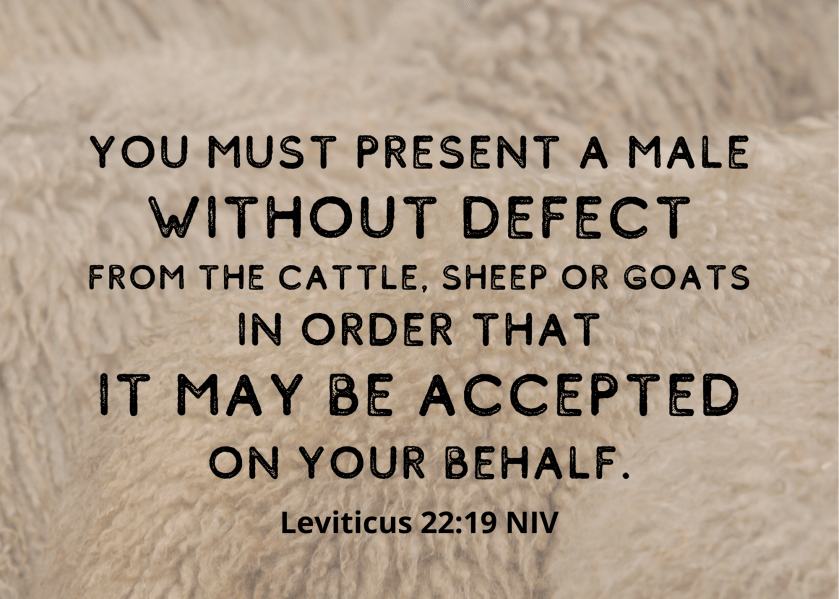
The scripture also tells us what can be sacrificed – and what can not be sacrificed. It says in 22:19 & 20 “you must present a male without defect from the cattle, sheep, or goats in order that it may be accepted on your behalf. Do not bring anything with a defect, because it will not be accepted on your behalf.” This makes me think of when I buy fruit or veggies at the grocery store, I stand in front of the strawberries looking for the best container I can get, no mold, nice and red, not soft and squishy, the best. God wants our best, unfortunately, sometimes it is hard to give him our best. We work or go to school all day, do homework, laundry, cook dinner…and the list goes on and on. The beauty of this is that Jesus died for us, we don’t have to be perfect to come to God. We just need to be children of God, have a relationship with Him, love Him and then love others. We should try to give Him our best, but we will fail (at least I do) and that is okay. We just need to keep trying.
Leviticus 23 talks about Festivals. The thing that stuck out to me was verse 3 “There are six days when you may work, but the seventh day is a day of sabbath rest, a day of sacred assembly. You are not to do any work; wherever you live, it is a sabbath to the Lord.” During each of the festivals mentioned rest is a big part of it. Making sure you take the sabbath day to rest. The rest He is speaking about is not a nap. Although I love naps, and I think they are a great thing to do, He is speaking about resting in Him. Spend time with God. I will be honest with you; this is something that I need to work on. First,I need to slow down and rest, but most importantly, I need to rest in Him. Taking some time to stop your day to give your brain a break is great but are you giving Him your time?
After receiving instructions from Moses in Leviticus 18 and 19, instructions about how to live a holy life continue in Leviticus 20 and 21. Not only are the children of Israel warned and instructed about sexual sins and moral conduct, then a law of consequence is set forth to them. The penalty for killing babies, consulting familiar spirits (devil spirits, mediums, wizards and such like) and sexual sins is death! The death penalty was necessary because the blood offerings of animals can not cover for these sins. God has been very generous with his chosen people in communicating these consequences. Wanting to please Almighty God and live a holy life requires submission to his ways and his justice. So what does one do when the laws of land permit such abominations and atrocities?
In Leviticus 20:4-5: “And if the people of the land do any ways hide their eyes from the man, when he gives of his seed (offspring) unto Molech, and kill him not; then I will set my face against that man, and against his family, and will cut him off, and all that go a whoring after him, to commit whoredom after him, to commit whoredom with Molech, from among the people.” It is not good to be cut off from God and his precious covenants. It is not good to have God’s face set against you. We are not to just shut our eyes to these kinds of sins. The people of Ammon had a god named Molech whom they worshipped by sacrificing their children. Apparently, this way of sacrificing children, killing your own offspring was after the doings of the land. The penalty for this kind of sin and also the ignoring of the sin by the people has serious consequences. Eternal life for some is on the line.
Only because of Jesus Christ and his holy sacrifice could these sexual sins and moral sins be forgiven. Acts 13:38-39: “Be it known unto you therefore, men and brethren, that through this man is preached unto you the forgiveness of sins: and by him all that believe are justified from all things, from which you could not be justified by the law of Moses.” Now’s the time to preach forgiveness of these sins and to draw men to Christ. If they do not submit to God’s way of redemption, they most surely will die from these sins and perish forever. For it is written in Revelations 21:8: “But the fearful, and unbelieving, and the abominable, and murderers, and whoremongers, and sorcerers, and idolaters, and all liars, shall have their part in the lake which burns with fire and brimstone: which is the second death.”
It is important that we take a stand and teach people how to draw to a Holy God. It’s also important for us to instruct those who oppose themselves. “God would have all men saved and come unto a (full) knowledge of the truth.”(1 Timothy 2:4).Now is the time to plead with people and invite them to know the only true God so they can see his love and why he knows what is best for mankind. If we can show people that God loves them and sent his son so they could be forgiven of these types of sins because of Jesus Christ, then at least they will have a choice. That is the real pro-choice issue. Many do not understand, because they have not been shown God’s love. We are here to be that love and to give them the real choice.
-Cindy Abbott
Reflection Questions
Is there someone you could help to see the error of their way by loving them enough to show them the truth?
Have you ever hidden your eyes from someone committing these sins, instead of lovingly imploring them with true knowledge of life and death decisions?
In what ways do you pray and ask for strength to “withstand in the evil day, and having done all, to stand.” (Eph 6:13)?
Have you ever felt like or heard the expression as you are trying to navigate through life, “Oh boy! I sure wish there was a manual for life!” Or perhaps, “Couldn’t someone write a manual for life for dummies?” After reading the book of Leviticus, it’s impossible to return to this way of thinking because there it is, plain as day, rules to live by. Not just rules though, specific instructions on how to live life without sin and how to please the Most Holy, One and Only God whose name is Jehovah! Even though these valuable instructions were written long ago, there they stand, perfectly applicable to the here and now and somehow perfectly suited to our day and age. What a God to create and not leave us without instruction!
Leviticus 18:1-5:”And Jehovah spoke to Moses, saying, Speak to the children of Israel, and say to them, I am Jehovah your God. After the doings of the land of Egypt (America, Russia, China, insert your land here and it’ll apply), where in you dwell, shall you not do: and after the doings of the land of Canaan, whither I bring you, shall you not do: neither shall you walk in their ordinances. You shall do my judgments, and keep mine ordinances, to walk therein: I am Jehovah your God. You shall therefore keep my statutes, and my judgments: which if a man does, he shall live by them: I am Jehovah.”
Next Jehovah God gives specifics about avoiding sexual sins and how to deal with our nakedness. A very specific and thorough list, so we make no mistake and do not give ourselves permission to sin in this way. In chapter 18 verse 22, “You shall not lie (to have sexual relations) with mankind, as with womankind: it is abomination.” Verses 24-25: “Defile not you yourselves in any of these things (again long list in previous verses-read for yourselves): for in all these the nations are defiled which I cast out before you: and the land is defiled: therefore I do visit the iniquity thereof upon it, and the land itself vomits out her inhabitants.” There are quite a few more verses that warn the children of Israel (which children you are, if you believe in Jesus Christ-because you are then Abraham’s seed and grafted into the family tree. See Galatians 3:29 and Romans 11:11-32).
Leviticus 19 continues on to describe the conduct and expectations of the people of God. Much of this section reiterates the 10 commandments. I had a Christian friend say to me last year that she was teaching the children’s fellowship that they no longer have to fulfill the 10 commandments of the law, because she believed we are no longer under the law. My insides were set on alarm and my eyes widened. Then her own son replied, “But, we should, right mom?” When Christ fulfilled the law and commandments, the law was not abolished; but rather, we were set free from sin so that we could fulfill the law! It gladdens our Father God’s heart for us to love him with our everything and to demonstrate our love for God by loving one another. How can we know what love is without instructions? God declares of himself that he is love (1 John 4:16). He ought to know what love is and how to be holy and without sin. An exhortation to live by is in Leviticus 19:2b: “You shall be holy: for I Jehovah your God am holy.” Following God’s instruction manual will liberate you to be holy and to love more.
Psalm 40:
“I waited patiently for Jehovah: and he inclined unto me and heard my cry. He brought me up also out of a horrible pit, out of the miry clay and set my foot upon a rock, and established my goings. And he has put a new song in my mouth, even praise unto our God: many shall see it, and fear, and shall trust in Jehovah. Blessed is that man that makes Jehovah his trust, and respects not the proud, nor such as turn aside to lies. Many, O Jehovah my God, are your wonderful works which you have done and your thoughts which are to us-ward: they cannot be recounted in order to you: if I would declare and speak of them, they are more than can be numbered. Sacrifice and offering you did not desire; mine ears have you opened; burnt offering and sin offering have you not required. Then said I, Lo, I come; in the volume of the book it is written of me. I delight to do your will, o my God: yes, your law is within my heart. I have preached righteousness in the great congregation: lo, I have not refrained my lips, O Jehovah, you know. I have not hid your righteousness within my heart: I have declared your faithfulness and your salvation: I have not concealed your lovingkindness and your truth from the great congregation…”
Oh to have the heart of David and of Jesus Christ, our forerunner! Let us not conceal the word! Let us not hide what is righteous! Let us do what is right and show others what God has done by delivering us out of the miry clay of our sins! We will be happy if we trust in Jehovah and do what is right.
Acts 13:
The gift ministries of a prophets and teachers:
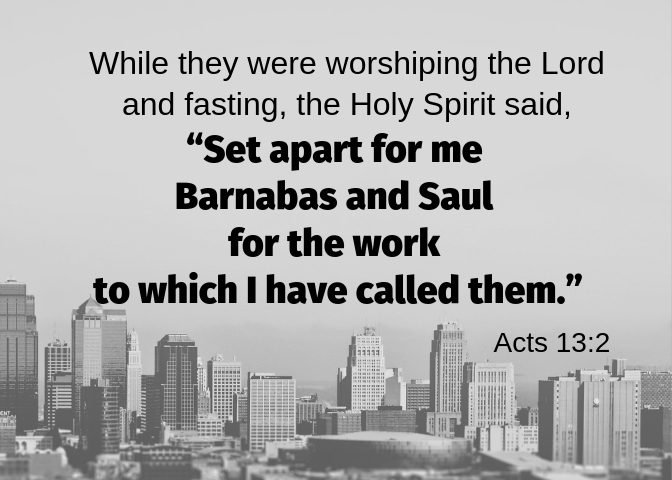
Acts 13:1-3: “Now there were in the church that was at Antioch certain prophets and teachers; as Barnabas, and Simeon that was called Niger, and Lucius of Cyrene, and Manaen, which had been brought up with Herod the tetrarch, and Saul.” (Right here there were 6 prophets and teachers recorded). “As they ministered to the Lord, and fasted, the Holy Spirit said, Separate me Barnabas and Saul for the work whereunto I have called them. And when they had fasted and prayed, and laid their hands on them, they sent them away.”
A prophet is one who speaks for God or receives information from God for the people. They speak on God’s behalf to the people. A teacher is one who expounds and conveys what God has said and what has been written in God’s word. Both gift ministries are gifts to the church to build up the people and to keep the people of God growing and on God’s track. They are gifts to the body of Christ until we all come into the full measure of the fullness of Christ.
People may not always like a prophet or a teacher; but nevertheless, they are God’s gift to the church until Christ comes in his kingdom.
In chapter 13 we have Barnabas and Saul separated unto specific work for them to do. Each prophet/teacher prayed and fasted asking God’s direction and afterwards received word from God and sent these two men on their way to do what God would have them do.
On his way, Paul first addresses a false prophet (someone not sent from God, who is not doing God’s will) and Paul being filled (filled to overflowing in the Greek text) with the holy spirit, set his eyes on the false prophet, rebukes him and blinds him! Paul made full proof of his ministry right there! Next Paul preaches on the first Sabbath and in essence rebukes the Israelites for not seeing the Christ coming and how Jesus fulfilled just what was prophesied that he would fulfill. Then Paul preached to them the forgiveness of sins through believing Jesus Christ and that they can be justified from all things. Paul warned the Israelites not to miss the boat and then comforted the proselytes (Gentiles who believed). Paul continued to preach there until “the word of the Lord was published throughout all the region.”
There are still prophets/teachers in the body of Christ today. You may see them doing these specific things as seen here. Being filled to overflowing and performing the works of God, rebuking, preaching, warning, comforting and continuing. If you are a prophet, keep doing it! If you see a prophet/teacher, thank God for them and heed them! If you feel you want to serve in this capacity, pray and ask God for the gift that can benefit the body and meet with other prophets/teachers so you can learn and grow and fulfill God’s will for your generation.
-Cindy Abbott
Reflection Questions
Is there someone in your life or at work or school who would benefit from learning the instructions in Leviticus 18 and 19?
Can you sit and appreciate all the thoughts that God is having about you this very minute? Thoughts of peace, thoughts of love, thoughts of longing for your fellowship?
Can you tell someone who is suffering and in a horrible pit how God delivered your soul and can deliver them as well?
In what ways have you seen God demonstrate his love for the body in your area through the men and women who chose to serve as prophets and teachers?
Has God called you to this gift ministry? Will you answer the call?
Yesterday, I said I was going to skip over the Paul stuff, but we’re actually going to look at parts of his story today. There’s a theme in Paul’s story that I think is often overlooked but continues through with today’s story in Acts. I want to end my week of writing for you with a note on accepting others.
Ever since I was little, and heard the story of Paul, I’ve been struck by the seemingly minor character Ananias. It is important to note, the Ananias in Paul’s story is different from the guy in Acts 5. Not much is known about him through scripture and he is not mentioned anywhere else besides in association with Paul. I’ve always felt like he got very little credit for the role he played. God performs a tremendous miracle through him in restoring Paul’s sight. Ananias must have been a man full of compassion and courage. God tells him to go seek a man who has been persecuting people with Ananias’ beliefs. Never forget, the people in the Bible have free-will. Ananias could have said no. And, if not for God asking him to go, I’d say Ananias had every right to refuse – after all, Saul wanted to kill him (Acts 9:1). Even so, Ananias had compassion on Saul. Sought him out, healed him, and loved him. Much like Jesus does with us.
Barnabas is a more well known member of the early church in Acts. If I’m being honest, my interest in this character does stem from the fact my grandmother, Gayle Ross, named a cat after him. He was my favorite cat, next to the orange tabby named Buster, whom Barnabas (the cat) coincidentally reminded my grandma of so much she got the cat’s name officially changed to Barnabuster several years later. Alas, my curiosity over his namesake led to a love for this character. Again, like Ananias, Barnabas had to be a pretty compassionate and courageous person. When Saul initially arrived in Jerusalem as a changed man, many church members were afraid of him. Once Barnabas befriended him, he took him along to meet the apostles. It was then people started to take Saul’s change of heart seriously. Barnabas took Paul under his wing, encouraged him, and supported him. Not only is this Christ-like but also something Jesus commands us to do in his teachings.
Ananias’ and Barnabas’ attitude of acceptance matches that of Peter’s in chapter 10. There are incredible connotations for Peter’s actions in visiting and eating with Cornelius. These will be further discussed in chapter 11. For now, it’s important to note there was a division between Gentiles and Jews and thus between Gentile believers and Jewish believers. Peter starts to break down this barrier with his actions in Acts 10. He even tells Cornelius “I’m a human being just like you!” (verse 26 NLT) Peter is displaying love and acceptance just as his predecessor once showed a stinky, rowdy, uneducated fisherman.
There are some Christians who have been complaining about the Super Bowl’s He Gets Us commercials. I understand some of their arguments. Perhaps the ads give off a Jesus that is accepting of sin or tolerant of sinful lifestyles. However, I think these critics might be missing the point. I think the purpose of these ads were to show the side of Jesus that is sadly overlooked in mainstream culture today. The Jesus that ate with Zacchaeus. Zacchaeus’ change of heart occurs AFTER his visit with Jesus, not before. Jesus doesn’t wait for Zacchaeus to be ready for him. He eats with this lying cheating tax collector despite his sordid reputation. In doing so, Zacchaeus is changed after experiencing the Savior’s mercy. Jesus was not accepting of Zacchaeus’ lifestyle, but he did accept Zacchaeus as a man and saw him as someone worth sharing a meal.
It is so easy to forget that while we are called to not be of this world, we are called to still live in it. This means loving the people who love the world. Who disagree with us. Now, trust me, loving is not the same as tolerating or condoning unrighteous behavior. Having said that, here’s something I have learned from my work with kids. It is so much easier to discipline once you have built a loving relationship. We need not accept sin, but we should be accepting of the sinner. It is through our example and how we treat people Jesus will be made known to the world. What sort of Jesus do you want to preach? A judgmental king or the bridge between a holy God and an unholy people.
Notes on Leviticus 12 and 13: As someone who firmly believes in the teachings in Galatians 3:28 I was perplexed to read about differences in the purification process for women after delivering a baby. Should a woman deliver a boy, she had to wait 33 days until she could be declared ceremonially clean from the bleeding of childbirth. If she delivered a girl, she would have to wait 66 days. I found an interesting and reasonable commentary on why there was a difference. Basically, the reason a woman had to wait twice as long was because she was not only waiting for herself to be purified, but the second waiting period was symbolic of her daughter’s purification period for her future menstrual cycle and childbirth bleeding. It’s not so much God is being unfair in demanding a longer waiting period. Rather, this was a way of honoring the importance of a woman’s role in Israelite culture to bring children into the world by having her mother account for a purification process on her behalf. Another thing I found interesting was the rules for skin diseases. Turns out, the same protocol the priests used is the same daycares use when it comes to Hand Foot and Mouth disease. If the sore is open, oozing and bleeding, it’s unclean and the child must be sent home. If the sore is closed up with a remaining scab, the child is good to remain at school.
-Emilee Ross
Reflection Questions
Who has been accepting of you? What can you learn from them? From Ananias? Barnabas? Peter? Cornelius? Jesus?
What sort of Jesus do you want to preach? A judgmental king or the bridge between a holy God and an unholy people.
Did you read Psalm 37 every day this week? What can be learned, remembered and treasured from this Psalm?
I am struck by the stark contrast of the priests of God in our reading today. In Exodus we are shown the beginning of the priesthood. The LORD sets apart Aaron and his sons. They were called, consecrated and ordained to serve Him. These men were anointed to serve the Lord and their anointing was to be a priesthood that could have continued “throughout their generations.”
But as we travel forward through the centuries to the time of Christ in Matthew 26, we see the high priest, chief priests and elders scheming to secretly arrest and kill Jesus. They are counting out the 30 pieces of silver to be given to his betrayer. The chief priests and the whole Sanhedrin were looking for false evidence to condemn Jesus to death. Rather than leading his people in the observance and the true meaning of Passover the high priest is interrogating Jesus. The high priest commands, “I charge you under oath by the living God: Tell us if you are the Messiah, the Son of God.” Jesus replied, “You have said so. But I say to all of you: From now on you will see the Son of Man sitting at the right hand of the Mighty One and coming on the clouds of heaven.” This truthful statement is met with the high priest tearing his clothes and pronouncing Jesus as a blasphemer. The leaders declare that he is worthy of death. They even go as far as slapping him, striking him with their fists, mocking him, and spitting in his face. How could these religious leaders fall so far from God? They were prideful of their positions and were so filled with jealousy, and hatred that they could not recognize the Son of God.
But praise God that we know our Lord Jesus is the Son of God and we know that God called him to serve as our High Priest. The book of Hebrews explains, Christ did not take on himself the glory of becoming a high priest. But God said to him, “You are my Son; today I have become your Father.” “Therefore, since we have a great high priest who has ascended into heaven, Jesus the Son of God, let us hold firmly to the faith we profess.”(Hebrews 4:14) As Jesus offered himself as a sacrifice, we should offer our lives to God. We will follow the example of our High Priest, Jesus Christ so we may be known as “a chosen people, a royal priesthood, a holy nation and God’s special possession.”
-Rebecca Dauksas
Reflection Questions
What was the job of the priests, and specifically the high priest?
How is Jesus the perfect high priest?
In what ways can you now serve as a chosen people, a royal priesthood, a holy nation and God’s special possession?








 Seek Grow Love