Change Your Garments

Old Testament: Genesis 35 & 36

Poetry: Psalm 15

New Testament: Matthew 13:31-35

Genesis 35 begins with God telling Jacob to go to Bethel and make an altar there to “the God who appeared to you when you fled from your brother Esau.” God is reminding Jacob of what He has done for him in the past. Do you remember what Rachel did a few chapters back? She stole her father’s idols! Jacob’s household STILL has these foreign gods in their possession. The very first commandment in the Ten Commandments (which will be) given to Moses is “You shall have no other gods before me”. What have Jacob’s people done? They have sinned! 

I find this next part so interesting. In verses 2 and 3 Jacob gives instructions to his people. He says “put away the foreign gods that are among you and purify yourselves and change your garments.” This is repentance. Did Jacob say that they could keep the idols in their spare room and ignore them? NO. They took everything that was an idol or connected to paganism and buried them in the ground. They cast the items of sin out of their midst. Then, after turning away, they purified themselves and changed their clothes. 

One commentary makes an interesting point about the garments. There are multiple places in scripture where garments symbolize the character of people. How interesting is it that Jacob told his people to change their garments, almost like a physical way to visualize the heart change of repentance? This gives even more depth to the verses that say things like “put on Christ” or “put on the new self”. WOW! Let’s take a second to thank the Lord for the true gift of Jesus and what that means for our personal lives. The Old Testament is filled with people making altars to God for numerous things. We don’t have to do that anymore because Jesus was the ultimate sacrifice. Now, our lives are an offering to God and Christ is the one to cover all of our sins. How amazing is that?

Okay, back to Jacob. What do you notice about God in this chapter? I notice how gracious God is. These people had taken false gods! There was no reason why they deserved to have God on their side. But He is still faithful to them! He guides them, protects them, and then blesses them by giving Jacob an incredible promise at the end of the chapter. 


How amazing it is to have a God that will forgive us. I want this story to prompt us today to think about any areas in our lives where we are holding on to sin. If we are in Christ, we are a new creation, and although that doesn’t mean we are perfect yet, it does mean that we are continually being transformed. Ephesians 4 says, “to put off your old self, which belongs to your former manner of life and is corrupt through deceitful desires, and to be renewed in the spirit of your minds, and to put on the new self, created after the likeness of God in true righteousness and holiness.” What does that look like in your life? Think about how you can “put on the new self” today.

-Katelyn Salyers

Reflection Questions

  1. What will it look like to take off your old self? What do you need to get out of your house, your heart, your life? Are you hiding any foreign gods?
  2. What will it look like to put on your new self today? How can you put on a clean set of clothes?

The Good Soil

Old Testament: Genesis 31 & 32

Poetry: Psalm 13

New Testament: Matthew 13:1-23

Today’s reading in Matthew covers the parable of the sower. I want to focus on one of the soils. The last of the four types of ground that the seeds fall on is good soil. This soil allows the seed to grow deep roots without competition from neighboring weeds. Roots play a crucial role in the life of a plant – both anchoring it to the ground and absorbing important nutrients. Jesus explains later in the chapter that the good soil is the one who hears the word of the Kingdom and understands it. 

There are a couple of other places in the New Testament that use the idea of being rooted. One of those places is Ephesians 3:16-19, which says that Christ dwells in our hearts and that by being rooted and grounded in love we may fully grasp the incredible love of Christ. I love using plants and roots as a metaphor for our lives as believers, both individually and together. When we hear the message of the Kingdom and it takes root in our lives, the power of God’s spirit strengthens us in our inward being. We have a union with Christ, as well as a union with each other as brothers and sisters in him. What does this mean for us? 

The idea of being “rooted and grounded in love” seems to imply the love of the believers around us. That together we can fully know the love of Christ. “Grounded” can also be translated as “to lay the foundation.” It is actually the same word used in Matthew 7:25 when Jesus talks about the wise man’s house being founded on the rock. This foundation, this ground that we are rooted into is love. 

Reading these verses made me think of the tree called Pando. Have you heard of this tree before? It is a one-tree aspen forest in Utah. There are over 47,000 trunks all connected through ONE root system. On the surface, they look like individual trees, but underneath, you see that they are all one–together. Crazy, right?

I think this is a beautiful representation of the body of Christ. When the word of the Kingdom is planted in your heart you join the foundation called the Church. We are built up, encouraged, and loved by each other. 

As you read this parable, I want to encourage you to think about how the gospel has taken root in your life. Can you see how your faith has grown? How are you being rooted and grounded in love in your local church body? Is there one way this week that you can build those roots further? 

-Katelyn Salyers

Reflection Questions

  1. Can you see how your faith has grown? How are you being rooted and grounded in love in your local church body? Is there one way this week that you can build those roots further? 
  2. Can you give an example of each of the other types of soil in the Parable of the Sower? Have any of these been a problem for you? 

Good Fruit, Bad Fruit

Old Testament: Genesis 29 & 30

Poetry: Psalm 12

New Testament: Matthew 12

Have you ever eaten a fresh orange straight from a tree? Or maybe an apple from an orchard? Fresh fruit is SO good. I know that some of you are currently in the thick of a snowy, cold winter. For those of us in the Southwest section of the U.S. it’s actually one of our growing seasons, believe it or not! Orange trees are fully loaded with fruit, here in Phoenix, Arizona. Well…most of them….

I have a small little tree right in the middle of my backyard. I did not plant this tree. Whoever planted it didn’t leave any information about what kind of tree it was. I’m a midwest girl and I could not tell you what kind of leaves each fruit tree has. This little dude is small enough that it isn’t growing any fruit yet (although maybe that’s more on us than this tree!). Since I can’t see its fruit, it is hard to tell what kind of tree it is. (For the record, I did google it and I think it is an orange tree.)

In Matthew 12:33, Jesus confronts the Pharisees by using trees as a metaphor for their speech and hearts. He says “Either make the tree good and its fruit good, or make the tree bad and its fruit bad, for the tree is known by its fruit.” He’s calling them out because they were attempting to “speak good” things while their hearts were “evil”. Woah. Now, Jesus was speaking to this group of people, however, I think we can take something away from his instruction. 

The Bible talks A LOT about our tongue (the words we say), and our actions. In fact, our reading in Psalms today mentions this as well! Verses 3-4 talks about those who boast with their tongue. In Ephesians 2, we see that God’s grace is what saves us so that we cannot boast about our own abilities and actions. (Kinda like the Pharisees were trying to do in Matthew 12). It is by His mercy that we can have a relationship with Him. Because of this, our “tree” can be rooted in Him – the ultimate source of life. He is the reason that we must not be conformed to the world but instead, be transformed by the renewal of our minds (Romans 12). THIS is where the good fruit comes from!

Jesus says in Matthew 12:34 that out of the abundance of our hearts, the mouth speaks. Our words are the outward reflection of our hearts. Proverbs 18:21 says that death and life are in the power of the tongue. What we say has an influence on people. I’m sure all of us can attest to this in our personal lives. 

I want to encourage and prompt you with this: we are called to be the salt and light of the world. How do we do those things? By our words and our actions. God has given us a calling to bring His light, love, and goodness to those around us. I pray that our hearts and minds may continually be transformed to be more and more like Jesus. Because of this, we will bear good fruit so that others can see God’s goodness and love.

-Katelyn Salyers

Reflection Questions

  1. How is your fruit looking and tasting? What do others see coming from your life? What does Jesus see? 
  2. What fruit have you produced that you want to create more of? What fruit from your life would you call bad fruit? How can you alter production to produce more of the good fruit and less of the bad fruit?
  3. Jesus goes on to say, “For by your words you will be acquitted, and by your words you will be condemned.” (Matthew 12:37) Do we often forget the power and consequences of our words? Will your words spoken last week acquit or condemn you? How can you better control the words you say?

Your Father’s Care

Old Testament: Genesis 25 & 26

Poetry: Psalm 10

* New Testament: Matthew 10

Have you ever been outside somewhere and simply sat in silence for a while? Maybe it was in your backyard, a forest, or a beach. Often, if we quickly look at a landscape we only notice the “big picture” things – the mountain in the background, the fact that there are trees in certain places, maybe we notice a path up ahead. But if we take a couple of minutes and just observe the area around us, we begin to realize that there is a lot more happening than we first thought. You might notice how the leaves move in the wind, or see bugs crawling over the dirt, or maybe you can spot where the birdsong is coming from in the canopy above. 

It takes intentionality to notice the small details around us. 

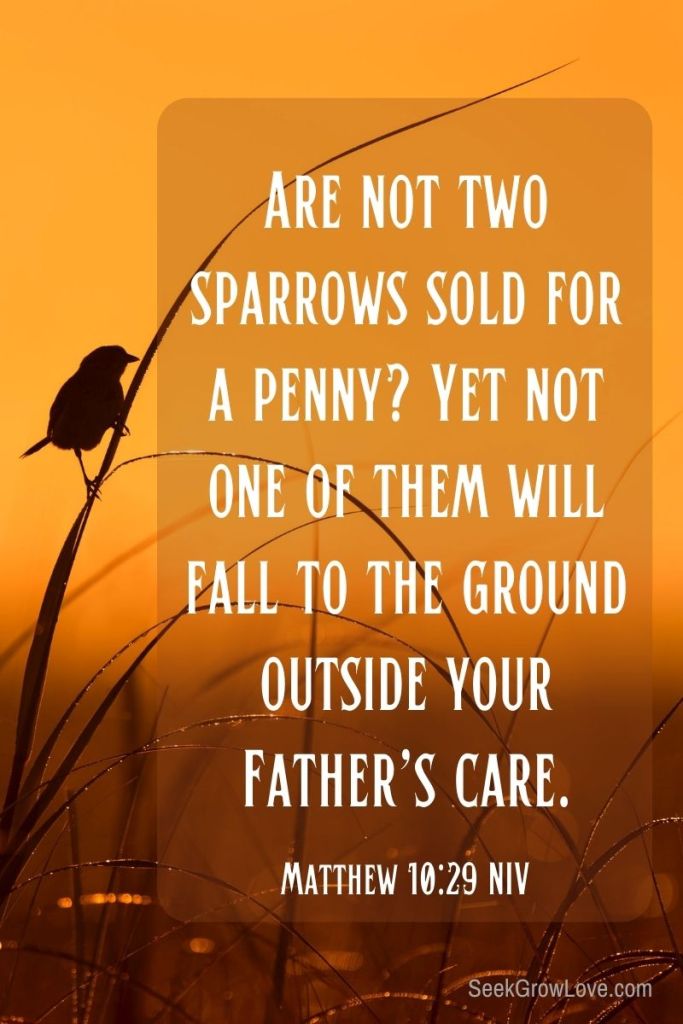
Matthew 10:29-31 has always been one of my favorite portions of scripture. Sparrows are small, ordinary, brown birds that are very unimpressive in the world of birds. You probably won’t brag to your friends about the sparrows you saw on your bird-watching trip. However, the Bible mentions these little guys multiple times! 

Luke 12 gives us a little more insight into just how insignificant these birds were. You could buy 5 sparrows for two Roman coins that were each worth less than an hour’s wage. They were cheaper when you bought more. These birds were pretty much worthless in Jesus’ day. 

Look at what Jesus says! He says that the Father sees every single one. 

We might pass by a tree, completely unaware that a little bird is perched in the branches. But the creator of the universe knows exactly where it sits. 

Let that sink in for a moment.

Jesus then makes a comment about the hairs on your head. Now I don’t know if you’ve ever tried to count each of your hairs…but I did when I was a kid. I remember hearing this verse and being the determined child that I was, I sat down to try. I didn’t get very far. I don’t think I even got past one teeny little section of hair! God can count ‘em! How crazy is that?? 

We then read in verse 31, “Fear not”. Why is Jesus telling them not to be afraid? If we look at the previous portion of Matthew 10 we see Jesus calling his disciples. This calling is pretty intense, right? He tells them that they will be doing all of these amazing things but they will ALSO be persecuted, hated, brought to trial, and sent as sheep in the midst of wolves. That sounds pretty terrifying if you ask me! 

That is when Jesus speaks these incredible words – that even one of the insignificant and seemingly worthless little birds (that we might totally pass by, unaware) is not forgotten by the Father. You are of more value than many sparrows, and our God sees you. And He knows you. And even then, He still loves you.

I want to make a note. Some of us have read this passage countless times. We may even have it memorized. I really want to encourage you (myself included) to let these verses sink deeply into our hearts. Take a moment to meditate on what it truly means to be seen and known by God. How will knowing this impact your life? How will you live your everyday life, with the understanding that even in all the chaos of life and in the grand scheme of the world, the Almighty God cares for you? I hope you find immense comfort and joy in that beautiful truth.

-Katelyn Salyers

Reflection & Application

  1. It is a little too cold in some parts of the world today to ask you to go outside and sit for awhile, so if you have to do your sitting inside, that works, too. But, as Katelyn suggests, take some time and consider what this passage means to you. What thoughts and feelings do you have when you hear each of these statements: God sees you, God knows you, God values you, God loves you. Pray to Him about it. 
  2. What COULD you be afraid of right now? How does knowing and believing Matthew 10 help combat fear? 

All His Wonders

Old Testament: Genesis 23 & 24

Poetry: Psalm 9

New Testament: Matthew 9

Psalm 9 is packed with so many insights into God’s character! Take a moment and read this Psalm if you haven’t yet. Keep an eye out for where David talks about God and His character. 

In this Psalm, David is comparing those who know God and those who are wicked. He mentions God’s holiness, justness, and provision – contrasting God’s response to both groups of people. David also mentions multiple times that he will “tell of your deeds” as he reminisces on the wonders that God has done in his life. David has confidence and faith in God because he knows that the LORD is faithful. 

Ok just a second though… in David’s time, Jesus hadn’t died and risen yet, let alone even been born. But look at how firm David is in his praise! He knows that God has done wonders and will do even more. He knows that God cares about His people.

How much more thankful can we be because we know of Jesus? We can have a beautiful perspective when we read the Old Testament because we know what happens in the New. The hope of God’s throne, of His provision, and judgment have an exponentially greater meaning to us with the hope of the Kingdom. 

Like David in verse 11, we can tell those around us the wonderful things God has done (and will do). We can even see this topic in the New Testament. If we flip to the other side of our Bibles, we see in Hebrews 10:23-25 that we have a steadfast hope because of the faithfulness of God through the sacrifice of Jesus. With this foundation, we can encourage each other as brothers and sisters. This encouragement will lead to love and good deeds – loving God and loving others!

Let’s take some time today to praise God for His faithfulness. That He has done wonderful deeds (Psalm 9:1), that He is a stronghold in times of trouble (9:9), that He hears the cry of the afflicted (9:12), and that He does not forget the needy (9:18). I find it so amazing that Matthew 9 reveals the heart of God even more. Jesus’ mission was to do his Father’s will, which means that we can see God’s character through the actions of Jesus. 

In Matthew 9:12-13, Jesus says that he isn’t calling the righteous, but the sinners – the ones who are sick and need healing. WOW! Friends, that’s all of us. Even those of us who have been believers for a while. We must remember that we too were and are sinners and have been saved! Thank you God for seeing the needy, the poor, the hurt, and the sinners. Now THAT is something to praise God with our WHOLE HEART (Psalm 9:1) for. Let us be glad in that. 

Today, I want to encourage you to think about the wonderful deeds that God has done in your life. See if you could ask that same question to another believer in your life. Sharing God’s faithfulness encourages and edifies both ourselves and those around us.

-Katelyn Salyers

Reflection Questions

  1. What wonderful deeds has God done in your life?
  2. Today who will you ask to tell you what wonderful deeds God has done in their life?
  3. Why is it important to tell yourself and others what God has done? What happens when we forget?