The Power of Pride

Old Testament: 2 Chronicles 26-28

Poetry: Psalm 9

New Testament: 1 Timothy 5

            I just realized something today.  I’m getting kind of old.  I know this comes as a shock to most of you who know how young I look (wink wink, nudge nudge).  Seriously, I’ve been alive during all or part of the presidencies of 12 different US Presidents, from JFK to Joe Biden- and several of them served 2 terms. Yikes!  To borrow from an old Clint Eastwood western, some of those presidents have been good, some have been bad and some have been ugly.  As we read through Chronicles and see the history of the kings of Judah, we could make the same observations, some were good, some were bad and some were down right ugly when it comes to their faithfulness to God

            Amaziah was one of the ugly ones. After defeating his enemies in battle he took their idols as plunder and brought them back and worshipped them.  A major no-no.  God really, really hates idolatry and gets very jealous when his people start worshipping other things as god or the ultimate in their lives.  In fact, in 2 Chronicles 25 (see yesterday’s reading) God punished Amaziah by having him routed in war against Israel, and then his own people assassinated him.  He was decisively rejected by both God and his kingdom.

            In today’s reading from 2 Chronicles we see that Amaziah’s son Uzziah followed him as King.  Uzziah was young, only 16 when he began to reign.  He got a great start because he sought God.  He found a godly teacher, Zechariah, to show him the way of God and he intentionally tried to do things God’s way as he ruled over Judah.  Because of his faithfulness, God blessed Uzziah with a prosperous reign: “as long as he sought the Lord, God made him prosper.” 2 Chronicles 26:5 

            Today’s reading shows how successful Uzziah was while he followed God.  His army grew more powerful, he defeated their enemies. He fortified his territory. His fame spread and other nations brought him gifts acknowledging his power and success.  His country did well agriculturally as their herds and flocks grew and their vineyards were productive. 

            The blessings were really flowing for King Uzziah and he was on top of the world and felt really good about his accomplishments.  He had not made the same terrible mistakes that his father Amaziah made, there was no hint of the worship of idols under Uzziah’s rule.  But…unfortunately, as often happens in times of prosperity, Uzziah grew proud.  He started thinking that he was “all that and a bag of chips.” (do they still say that or is that from 20 years ago… I’ve lost track).  Anyway, he was FULL of himself.

            Let me back up a minute.  Going back to the time of Moses as leader of Israel there was a strict division of labor among God’s people.  You had judges and later Kings, who did the political leading, and you had the priests who oversaw the religious rituals.  Sometimes the lines got a little blurry and there was some overlap as with Samuel who was both a priest and a judge.  But by the time Kings were instituted it was clear that the Priests were the only ones allowed to go into the temple and offer sacrifices.  Offering sacrifices was a no go for the King.  King Saul had previously gotten himself in hot water for offering sacrifices (See 1 Samuel 13 for more details).  In short, Uzziah should have known better.

            Unfortunately, King Uzziah let his success lead to pride which led to his downfall.  “But when he was strong, he grew proud, to his destruction. For he was unfaithful to the Lord his God and entered the temple of the Lord to burn incense on the altar of incense.” 2 Chronicles 26:16  Uzziah was doing what was forbidden for a king, to usurp the priestly role of  burning incense on the altar of the temple.

            The priests were horrified at what King Uzziah was doing and they stopped him (it took 80 of them).  Uzziah became enraged that they challenged him.  He was unwilling to stand down even with 80 priests telling him “no”.  So then God intervened and instantly struck him down with leprosy.  Leprosy was a skin disease that rendered the leper ceremonially unclean.  Uzziah was instantly cut off from temple worship and was made an outcast.  He had to leave his palace and remained an outcast until his death.

            What a sad and tragic end to the reign of a king that had begun so well.  Uzziah, as a young man had seen how bad his father had been as he pursued idols.  Uzziah sought the Lord, was faithful, God blessed and prospered him and all was well, until he gave in to the deadly sin of pride. 

            Why is pride a sin?  In the US June was just celebrated as Pride Month.  I was reminded of this literally everywhere I went.  When I turned on my computer at the hospital where I serve I was reminded that it was pride month.  I watched a baseball game featuring the Baltimore Orioles hosting the Seattle Mariners and there were rainbows and pride flags on the field, in the stands and surrounding all of the player stats.  Pride is celebrated in the world today as a wonderful and glorious thing.  But the Bible hasn’t changed- Proverbs 16:18 still says: “Pride goes before destruction, a haughty spirit before a fall.”Proverbs 16:8.  Whether it’s being proud to tell everyone that you are gay, or being proud of your accomplishments as king, pride is destructive. 

Pride is a deadly sin because it causes us to focus on who we are and what we accomplish and take our eyes off  of who God is and what he accomplishes.  Pride is a subtle form of idolatry.  Instead of worshipping another god in the form of a statue or object, pride is the worship of ourselves.  Uzziah was full of pride so he thought he was above following God’s law that said only priests could go into the temple and offer sacrifices on the altar.  Pride leads one to reject God’s laws and God’s authority to tell us what we can and what we cannot do which is ultimately a rejection of God as God.  If, in my pride, I tell God that I don’t have to listen to him, he has no authority over an area of my life, then I’m turning myself into my own idol.  That’s exactly what Adam and Eve did in the Garden of Eden.  It’s what Uzziah did in the temple, it’s what we do whenever we say, “I know that God has said this is wrong, but I reject God’s authority to tell me what I can and cannot do with my body, my life.”   Pride has caused the deaths of untold millions of people, including unborn babies.  Pride has caused countless people to turn away from their faith in God and from following Jesus Christ in order for them to follow their own “truth” about who they are and what they think should be right.

Uzziah was punished by God with leprosy which caused him to lose his access to both worship and to his role as king.  He died miserable and alone.  That’s where pride usually leads.  We need to avoid pride like the plague.

-Jeff Fletcher

Reflection Questions

  1.  Why do you think God was so harsh and immediate in striking King Uzziah with leprosy.  After all, he’d been pretty faithful up till that point in his life?
  2. What do you think of the ways that Pride has been exalted in our culture?  Can you see any ways that pride could be leading toward societal destruction?
  3. What are the danger areas of pride in your own life?  Is there an area where pride could be leading you away from God.  Are there any areas where you reject God’s teaching in  your life and you are proud of it?
Who Do You Listen To?

2 Chronicles 23-24

From yesterday’s reading, we learned that a baby named Joash was hidden when his grandmother attempted to wipe out the whole royal line, so she could rule unopposed.  Joash was abducted by his aunt, and her husband, Johoiada, the high priest.  (The fact that his aunt was godly, coming from such a wicked family is nothing short of miraculous.)  Joash was hidden in the temple for 7 years.  (What better place to hide someone from the wicked queen, Athaliah?  She would never go there!)

When Joash was 7, Jehoiada arranged for Joash to be crowned king, and had Athaliah killed.  We’re told in 2 Chronicles 24:3, “Joash did what was right in the eyes of the Lord all the years of Jehoiada the priest.”  Jehoiada chose two godly wives for Joash.  Joash also commanded that God’s temple be repaired.  Because of this, many people consider Joash a godly king.  

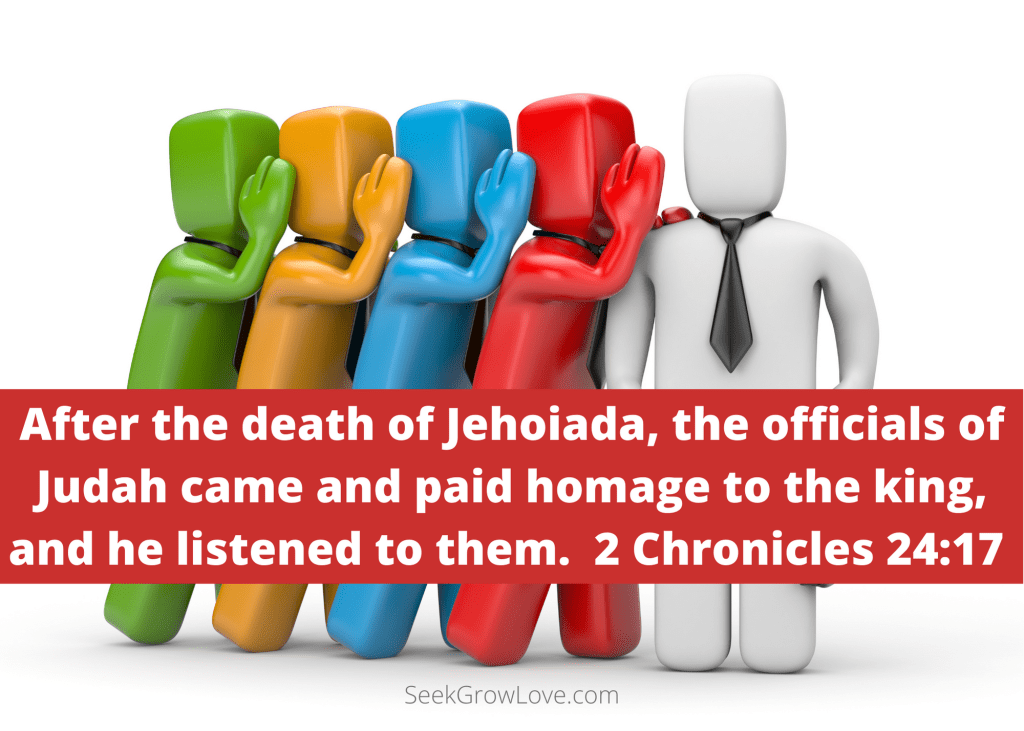
When Jehoiada died, he was buried with the kings because of all the good he had done for God and his temple.  I wish the story stopped here, but it doesn’t.  After Joash’s godly mentor died, he listened to the officials of Judah, and abandoned the God of their fathers to worship Asherah poles and idols.  God sent prophets, but the king wouldn’t listen.  Joash even killed Zechariah, the son of Jehoiada (who had raised Joash).

As punishment, God sent Aram raiders to plunder Judah.  We’re told in 2 Chronicles 24:24, “Although the Aramean army had come with only a few men, the Lord delivered into their hands a much larger army because Judah had forsaken the Lord …)  

Joash was wounded in the battle, and some of his own officials conspired to kill Joash for murdering the son of Jehoiada.  Joash was not buried with the kings because of the evil he had done.

In this story, we see an example of someone who started out zealously serving the Lord.  As long as his godly mentor was there to remind him to follow God, he did follow God.  Once that godly influence was dead, Joash was enticed away from God through peer pressure. His life was a downward spiral after that, then he died.

This highlights the importance of surrounding ourselves with godly mentors and godly friends.  It’s so easy to be enticed away from God.  I picture sin sort of like an addiction.  Every one of us should think of ourselves as needing to join a program so we do not relapse.  Every one of us can say, “Hi, I’m Steve (substitute your name here), and I have a problem.”  We need godly friends to hold us accountable to live for God.  And we have to be vigilant ourselves.

If we’re surrounded by worldly friends, we will almost certainly crash and burn like Joash.

I’d like to encourage you to think about each of your close friends, and think about how each of them is helping you draw closer to God or is drawing you away from God.  And while you’re at it, how are you influencing your friends?

I understand that if someone has an addiction, one important step in the recovery process is to cut ties with old friends who would cause you to relapse.  After all, if they cause you to relapse, they are helping destroy you, so are they really a friend?

I’ll close with James 4:4, which says, “You adulterous people, don’t you know that friendship with the world means enmity against God? Therefore, anyone who chooses to be a friend of the world becomes an enemy of God.”

-Steve Mattison

Today’s Bible reading passages can be read or listened to at BibleGateway here – 2 Chronicles 23-24 and Romans 11

What do you want to be known for?

2 Kings 23-25; Proverbs 16

Life is fleeting. We’re all passing through this age like the grass of the field. Today we live. God holds tomorrow.

As I’ve finished the last three chapters of the book of 2nd Kings and read another chapter in Proverbs, I’ve thought about our time in this age. This age is short compared to eternity. What we do in it matters.

The lives of the final kings of Judah mattered and were recorded for us all to see. We know what each of those last 5 kings was forever known for. They can be summed up into two basic categories. A good king and evil kings.  

All but one of the last 5 kings of Judah were known for doing evil in the sight of Yahweh. If we included the whole lot of the kings of Judah and Israel to this list, there wouldn’t be a significant pendulum swing in the opposing direction towards Yahweh God.

When we come to the end of our earthly lives, what will we be known for? Will we be known for doing good or evil in the sight of God through Jesus Messiah?

The good kings, like Josiah were known for their hearts and humility, practicing obedience to God’s Law. Good kings did stumble but when they repented, they renewed their status with God.

If we want to be known for doing good in our day and age, similar qualifications apply. Good disciples of Jesus will be known for their hearts and humility, practicing obedience to the Law of Christ (aka producing fruit). 

The whole law can be summed up with one word. Love. Our “goodness” can be measured to the extent that we love as Christ loved. How did he love? He loved his God and served him alone with all of his heart, with all of his soul, with all of his mind, and with all of his strength. He loved his neighbor to the point of death on the cross.

When I come to the end of my life, I want to be known as a good disciple of Jesus Messiah. I want to hear my master say, “Well done, good and faithful servant!” If this is my heart, my life will reflect that.

-Juliet Taylor

Today’s Bible reading passage can be read or listened to at BibleGateway here – 2 Kings 23-25 and Proverbs 16

His Story

1 Kings 15:1-24 & 2 Chronicles 13-16

2 Chronicles 15 15b NIV sgl

History is a curious thing.  Today’s reading covers two different kings of Judah, Abijah and Asa, from the perspective of two different writers.  It is quite interesting to see what is remembered and omitted and concluded from the lives of these two kings from the two different authors writing at different time periods for different purposes.

Let’s look at Abijah, King David’s great grandson.  It is easy to love the Abijah recorded in 2 Chronicles 13.  King Jeroboam of Israel is closing in with an army twice the size of King Abijah’s of Judah.  But Abijah responds with courage, faith in God and a rousing speech.  He speaks of Israel’s united history under David and God and then records the sins of Jeroboam (& Israel) in breaking with God, the God-ordained priests, and the house of David.  He concludes that, “As for us (Judah), the LORD is our God, and we have not forsaken him….God is with us, he is our leader.” (2 Chronicles 13:10,12). And then, even though an army twice their size is before and behind them, God gives the victory and Abijah’s army wipes out over half of Jeroboam’s fleeing and destroyed army.  It’s exciting to see how God shows His strength through Abijah.

And then we read the account of King Abijah as recorded in 1 Kings 15.  The details of his life agree completely with what is recorded in 2 Chronicles: reigned 3 years, son of Rehoboam and Maacah, there was war between him and Jeroboam, and his son Asa would rule after his death.  But, absolutely nothing is said of the moving speech or victorious battle or God as his leader.  Instead, the writer of Kings sums up Abijah’s life by saying, “He committed all the sins his father had done before him; his heart was not fully devoted to the LORD his God, as the heart of David his forefather had been.” (1 Kings 15:3).

Oh, Abijah, we had such hope for you from that one outstanding snapshot of your life.  Your sermon that day was so full of convicting truth – that you forgot?  What went wrong?  How was your heart divided that sin won out?  Didn’t you daily recall how God fought for you?  Did you think you did that on your own?  It is discouraging to see what could have been, or once was, a strong testimony for God crumble and cave to sin and a divided heart.

But, it is also encouraging to see what God can do for His purposes – even when He’s working with and through sinful, broken people.  He can use the Joshua’s, the David’s and the Abijah’s and you and me.  He has and can and will have the victory any time He wants – and He can do it using any one He wants.

It is also interesting to see what one chooses to remember when looking back on history.  How do we portray and ultimately judge the heroes and the villains?  Which statues do we decide to pull down, if any, or why not all?  Everyone is certainly a mix of wise and foolish choices.  Some of our forefathers had some really good, faithful days (like Abijah’s) and these can still be celebrated today.  Remember the Chronicles were written long after these events took place and were written to encourage the returning exiles.  They needed to remember the faithful God who worked through the house of David and the priestly line.  They were being prepared for the coming arrival of a Messiah from the house of David who would be a priest like none before.  It would be helpful for them to remember their history as they prepared for their future.  It was time to bolster their courage and faith and remind them that God is their leader.  They needed the story of Abijah’s Really Good Day and the God who supplied it.

And, it is also valuable to consider the bigger picture of someone’s life to see what to avoid in order to get us where we want to go.  Rather than using our own flawed measuring stick to judge (popularity, wealth, good speaker, etc…), whenever possible it is helpful to know what God thought of the man.  That is going to be what really counts, so that is what I want to pay attention to so I am not setting up heroes for my life that God would disapprove of.

All that and we finally get to Asa – one of the few kings recorded as, “good and right in the eyes of the Lord his God” (2 Chronicles 14:2).  And the writer of Kings agrees completely.  There are some beautiful passages you won’t want to miss about God’s provision and Asa’s seeking and working for God wholeheartedly, even when it meant going against some of his family.  Although, for all his wise and courageous decisions, he still had a rough spot towards the end of his reign when he chose to rely on man instead of God – and there was a price to pay for that error.  But it would be a mistake for us to judge and remember Asa only for that sin that sadly would affect him and many others for years to come.

History is interesting, as is our record of it, and our judgement of those who have come before.  But first and foremost lets learn to us it to grow closer and closer to living a life seeking and serving with an undivided heart the God who created all history and present and future.  What would He have you learn from His Story today in order to live better today and prepare yourself for His Future?

Keep Reading His Word and Seeking Him

Marcia Railton


Today’s Bible passage can be read or listened to at https://www.biblegateway.com/passage/?search=1+Kings+15%3A1-24%2C+2+Chronicles+13-16&version=NIV

Tomorrow’s Bible reading will be 1 Kings 15:26-16:34 & 2 Chronicles 17 as we continue on the 2020 Chronological Bible Reading Plan