
Judgment: The Positive and The Negative

Old Testament: Ezekiel 33 & 34

Poetry: Psalm 105

New Testament: Revelation 20

     Revelation 20 involves God’s judgment, and it may make sense to put 19:20-21 in your mental image of the passage so the beast, the false prophet and their armies are in there. Verse ten reiterates the judgment of the beast and the false prophet, pairing them with the devil they had served. I see the passage with alternating sections of negative and positive references to judgment (19:20–20:3, 7-10, 15) and (20:4-6; 11-14). Grouped this way the text has every use of “lake of fire” (a different phrase appears in 21:8).

     After 19:20-21 establishes the punishment of those who served the dragon, chapter 20 opens with very satisfying language about the serpent not being able to deceive the nations. He is chained and sealed away for a thousand years.

     The description of the saints’ resurrection which follows in verses four to six may seem notably out of sequence. The first resurrection takes place at the last trumpet, in the twinkling of an eye (meaning in the time it takes to blink; 1 Corinthians 15:52). At Christ’s return the dead in Christ rise first, at the sound of the trumpet, and his servants who remain alive rise to meet him just afterward (1 Thessalonians 4:14‑17). That happens before Jesus fights the armies of the antichrist. It seems that the first resurrection was skipped over in Revelation 19. It also seems questionable for there to be an evaluation of the martyrs like is described in the vision. God knows all about them – they are raised because of who they are. It seems that the evaluation was described just for the sake of the vision, and what this passage presents as “judgment” clearly would need to be a fully positive judgment.

     Recognizing all of that, I think God wanted this text here, after a description of what happened to the devil. It contrasts what happened with those who accepted the mark of the beast (dead) and the leaders of the conspiracy (burning) and the one who inspired that conspiracy (imprisoned for a thousand years) to those who stood firm against it (they come to life and reign with Christ for a thousand years). Considering what these martyrs suffered, God wants to emphasize their acceptance and glorification, although that called for it being addressed out of sequence.

     In verses seven to nine Satan is again free, for a short time. Perhaps this represents a winnowing of the nations before God makes the next big change in the status of earth. Satan again deceives the nations who are willing to be deceived and assembles them for judgment (even if he doesn’t understand that is what he is doing). And this time judgment comes on him as well. God is closing out the books, after this there won’t be anyone else around able to be tempted. God could have left this entire story unmentioned, but He wanted us to know this part of the future, to be aware that our enemy will be permanently dealt with. (Not that Genesis 3:15 didn’t already indicate it.)

     I like the imagery in verse 11, as though perhaps God’s majesty surges up, and all that is nearby is not holy enough to remain. “Earth and heaven fled away, and no place was found for them” (v. 11). We continue to be reminded that this is a vision, as the lake of fire is still present for the later part of the vision and did not flee away. Maybe this is looking toward the next part of the story, that God is in the process of replacing heaven and earth (2 Peter 3:12). The description of death and Hades being thrown into the lake of fire is very positive (v. 14), but also serves as another reminder that we are reading about a vision (as it is hard to figure how John knew this happened except by being made aware of it).

     Elements of both the positive judgment scenes (v. 4-6, 11-14) can be found in Daniel 7:9ff, with the thrones, the books, and the fire, but they are mixed. It is a common statement that prophets of the Old Testament saw future events like we might see a distant mountain range, unable to tell very well how large a valley was between the peaks. Events from Christ’s first coming and second coming could be discussed right next to each other in a passage. With Daniel 7, making distinctions relevant to the existence of multiple resurrections wasn’t purposeful. And with Revelation John could not see and appreciate all the things happening in fully accurate order.

     I questioned whether to think of the judgment in Revelation 20:11-15 as neutral, or to break it between a positive first four verses and a ‘negative’ verse 15, because it raises the idea of someone’s name not being found in the book of life. It is interesting to think that verse 15 involves a resurrection too late in history to be relevant for the reader and so may not be intended as a warning for us. But I suppose it will be a warning to people during the millennium.

     Lord, your judgments are true. Thank you for offering your mercy. Please open my heart to accept your gracious offer, for myself, and for others. Don’t allow me to remain burdened with the past. Don’t let me be held back by refusing to forgive. Lord, let me listen so well to you now that I will not be deceived by the evil one or accept any of his lies. Let me seek your truth, and love it. In the name of your beloved son, Amen.

-Daniel Smead

Reflection Questions

  1. What do you think it will be like for people in the millennium to read the Bible?
  2. How does it make you feel to think that God is eager to praise those who have faithfully served Christ?
  3. The text refers to “priests of God and of Christ” who will “reign with Him for a thousand years” (v. 6) – have you given much thought to what that might involve?
The Marriage Supper of the Lamb AND The Great Supper of God

Old Testament: Ezekiel 31-32

Poetry: Psalm 104

New Testament: Revelation 19

     At the start of Revelation 19 heaven rejoices over God’s actions regarding Babylon the great. Soon we hear about the coming of the marriage supper of the lamb, and John is informed that the bride is clothed in fine linen which “is the righteous acts of the saints” (v. 8). He is also told to write that those who are invited to the wedding supper are blessed. This feels a bit like when Jesus commented in 16:15 “I am coming like a thief,” drawing our attention forward to coming attractions rather than remaining in sequence with events.

     The voice which spoke about the marriage supper came from God’s throne, and hearing it speak caused John to fall and want to offer worship. John is corrected for this and told that only God is to be worshipped (v. 10). But it seems like in this case he made an understandable error. Throughout Revelation voices come from a variety of exalted sources, among them angels, strong angels, mighty angels, an angel standing in the sun, the Temple, the altar, and the horns of the altar. For John it may have been like experiencing holy surround sound, never knowing where the next proclamation would emerge from. Maybe degrees of grandeur are indicated by who spoke from where, giving different impacts to their statements. It wasn’t always clear to John what the intention was.

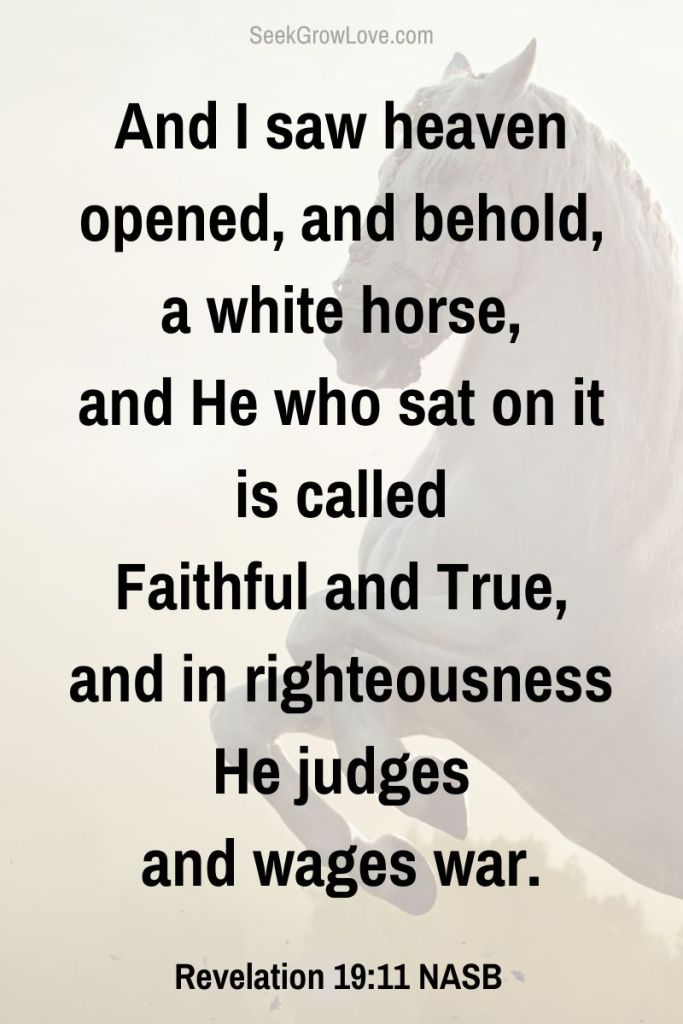
     The message of the chapter proceeds, announcing the arrival of Christ, and of the armies of the world gathered for Armageddon. In fact, the word “Armageddon” is only named back in 16:16 where its origin is explained. Here the battle is previewed as “the great supper of God” – a supper for the birds, to eat the carrion it will provide, in contrast to the wedding supper of the lamb (v. 17‑18). With Jesus on the move there is no contest (2 Thessalonians 2:8). Jesus seems to be given credit for the entire victory: the gathered forces “were killed with the sword which came from the mouth of Him who sat on the horse.” That is, except for the beast and the false prophet. Those two are removed from the scene and dropped into the lake of fire, receiving their punishment for serving the dragon and for deceiving the nations.

     The description of Christ includes having “a name written on Him which no one knows except Himself” (v. 12). Note that this mirrors part of Christ’s letter to the third church, Pergamum. There Christ said he would give overcomers a white stone with a new name written on it, which only the recipient would know (2:17). (That same letter identifies Christ with the sharp two-edged sword, shown in John’s opening vision sticking from Christ’s mouth, much as in chapter 19; 1:16; 2:12.) I like the idea of these names which are known only to oneself. I wonder if I am being fanciful in thinking this new name involves having a sense of your own identity. You won’t need to share that with anyone else. There will be no need to. There will no longer be self-doubt, rivalry, jealousy, any of the potential bitterness that plagues our current lives. It will be a wonderful time. I hope to see you then.

     Lord, I look forward to the day when your kingdom has come on earth as you now reign in heaven. You have been waiting for a long time, allowing more people to be saved through the grace of your son. May your glory and your majesty be shown in my life while I wait for that day. Let me be empowered and enthused to perform righteous actions that will please you. Let me set my mind on the things of the Spirit, live as your humble servant, and exalt you. Let my light so shine before men that they will glorify you. Let me present my body as a living and holy sacrifice, acceptable to you. Renew my mind, so I may prove what your will is. Thank you, my God. In Jesus’ name I pray these things, Amen.

-Daniel Smead

Reflection Questions

  1. Do you ever think about the fact that it is our opportunity, and honor, to clothe the bride of Christ in righteous acts?
  2. Who are some of the people you want to sit with at the wedding supper of the lamb? What do you think you will talk about there?

God wins.

Revelation 20

Monday, December 5, 2022

The title of this post is unassuming. Two words: a noun, the subject, and a verb in the future tense. 

I am in the business of speaking, teaching, training, sermonizing. And sometimes (less often than I’d like to admit) I may have a sermon that God uses in spite of all my failures and faults. But if I were to have all the power of the greatest speakers, the powerful conviction of Billy Graham, the clarity and precision of Andy Stanley, the dedication of pastors from Martin Luther to Martin Luther King Jr. and beyond, more than a thousand eloquent sermons could not compare to the truth of the future of the world summed up in these two words. 

God wins. 

I don’t want to take away from that truth, but I do want to flesh it out a bit. 

In the earlier parts of Revelation, the beheaded souls have been calling out from beyond the grave to the God who will give them justice (Rev. 6:9-11). God promised the victors that they would have reward upon reward (Rev. 2:7, 11, 17, 26-28; 3:5, 12, 21). When God wins, those who placed faith in God above even their own lives have the incredible promises. For time out of mind (1000 years) they will reign with Christ, they will not be hurt by the second death. While the language of two resurrections is not common in the rest of the NT*, the truth is that they are SO ASSURED of their salvation its as if they cannot possibly be brought to judgment. The joy of this resurrection is that we who are powerless, weak, poor, and oppressed will one day win, be victorious and live forever with God and his Christ, because God wins. 

And Satan can’t win. The dragon’s wings are clipped, and the serpentine body is prepared for the flames. In this world, God has power to throw the serpent of old, the devil and Satan, and bind him for 1000 years. During that time, his temptation and power are cast down. In the end, the devil who deceived the world was thrown into the lake of fire and brimstone. This is a threat and a promise. Moreover, Satan KNOWS this is his end. The battle between God and Satan is not a cinematic, climactic masterpiece. There is no worry about who will win. Satan is not trying to win, because he can’t. He IS trying to make YOU LOSE, because that is a possibility. But God will help you overcome sin, fight temptation, and come through faithful. God can protect you from the defanged, declawed, clipped-wing dragon, because God wins. 

In some sense, part of the glory of God, part of his winning, is allowing humans to choose their outcomes. God allows people to determine their final state. While we are only and forever able to be saved by the glory and grace of God, God both does not force his salvific will upon us and does not preclude us from choosing him. God gives people what they desire. The books are opened; the dead are judged. Christ is our hope (Col. 1:27), our peace (Eph. 2:14), our resurrection and life (John 11:25). If any person has rejected Christ, what have they done but rejected peace with God and people? Rejected hope of eternal life? Rejected the resurrection and the life? God gives them exactly what they demanded. God doesn’t put up with those who were rebellious against him in this life. Because…

God wins.

No ifs, ands, buts. 

No amount of persuasive words will make it less true. 

No force of hell can stop Him, not a dragon or an atheist. 

The promise is true:

God wins. 

– Jake Ballard.

* There are hints of two resurrections in the rest of the NT, but nowhere is it explicitly stated like here in the apocalyptic work of Revelation. 

Reflection Questions

  1. How significant is the phrase “God wins” to you? To elaborate, in what areas of your life are you losing? Temptation and sin? Suffering and pain? Anxiety, depression, stress? What would it mean for you to stop trying to fix it all yourself, and let God win, allowing him to be victorious where you haven’t been yourself?
  2. In the ultimate sense, Satan is powerless. While we might be attacked, tormented, and tempted by evil today, that is not the way the world will be forever. How does it make you feel to know that all evil and wickedness are going to be overcome by the power of God? Will you allow God to protect you, so the battle is one-sided in your favor today?
  3. There is no peace, hope, resurrection or life without Christ. Have you given him control of your life, allowing him to be your savior and lord?