A Lesson from Nicaragua: Community


Missions Spotlight: Nicaragua
alex davila

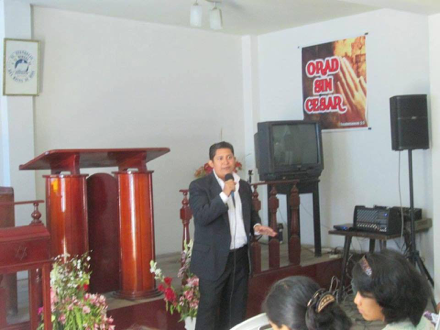
Alex Davila leads a small group Bible study in Nicaragua.  He also maintains a public YouTube channel and radio broadcast, sharing the Good News.  If you would like to check his website out (La Biblia y las religions: The Bible and religion), you can visit http://labibliaylasreligiones.com. He is also a perfect Spanish-English bilingual and would love to hear an encouraging message from you! 


Pictured above is Alex preaching at the Lima Church in Peru.  We love it when Alex accompanies us when we travel to Peru. 


Community is a compound word: common and unity.  This means that we are a group of people unified by what we have in common.  This is a perfect example of the Body of Christ: unity through common beliefs. Just like our human bodies are unified by the drive to survive, the body of believers are unified by Christ.


Sometimes, as Christians, we can get caught up in our differences.  Quarrels over wine vs. grape juice for communion, tattoos vs. no tattoos as a Christian, and Sunday school before or after the church service take place all over the nation.  Now, some of these quarrels seem silly, but you know as well as I do that feelings are hurt over simple differences in ideas.  In Galatians 5:6, Paul reminds us “for in Christ Jesus neither circumcision nor uncircumcision means anything, but faith working through love”.  It is our faith, exemplified by our love, that counts, not the small differences (or similarities) we may have.


Today, I want to remind you that we have more in common with one another than we have differences.  The Church should be the tightest-knit group of people in the universe.  We should have the highest sense of morale and comradery.  Watching the Olympics gets me hyped as I see hockey teams, and ice skating duos, curling teams (yes, even curling can be exciting) accomplish big things together.  Their sense of togetherness and years of hard work to achieve a common goal awakens my drive to seize the day.  Guess what, we have GOD and His son, JESUS CHRIST living in US!!! Imagine the radical acts of love we can achieve with divine power, strength and grace living in us.   Jesus says that the world should be able to know who we are by how we love one another.  What are you doing to show your neighbor your radial love?


You have probably heard this verse before, but I want to take it back to its original Greek.  1 Corinthians 6:19 – “Do you not know that your body is a temple of the Holy spirit, who is in you, whom you have received from God?  You are not your own..”. All of the times that you and your are mentioned in this verse they are actually plural which translates from the Greek into English as ‘you all’. Grammatically, this is known as the second person plural, and something our English Bibles hide from us sometimes because we do not have a direct translation for the second person plural that sounds nice in English. The closet thing we have in English is ‘you all’ or if you are in the south then ‘y’all’. Can you imagine your Bible saying “do you not know that y’all’s bodies are a temple of the Holy spirit”? Due to the mistranslation of this verse into English people usually take this verse on an individual level. The meaning of this text then becomes a verse used to support exercise to keep your “temple” nice however what the author originally intended was to mean the body of Christ is the temple. This means that how we treat each other as the body directly correlates to what the temple is like. That is a very important statement! When we are angry with or hate our fellow believers, we are desecrating the new temple that God has set up.


If you look at how the temple was treated in the Old Testament we see how holy and sacred it was. We need to translate the holy aspect of the Old Testament temple to the body of Christ today. So what exactly does it look like to be holy to each other? It is patience, kindness, forgiveness, and love. Next time you want to be angry at someone remember that how you treat them affects the holiness of the temple, the place that God dwells. Reading the passage for its original meaning is much more difficult than a simple command to exercise and eat well.  It is a command on how we should be as a community. Try reading the passage in this way, “Do you not know that your community is a temple of the Holy spirit, who is in you, whom you have received from God”. This is Paul lifting the community of believers to a higher level. I encourage you to take up that call and to bring even more glory to God’s community of believers.


The latter half of Acts 2 describes a true community of Christ.  The Church devoted themselves to teaching, to fellowship, to breaking bread together, to giving to the needy, and all the while with glad and sincere hearts (Acts 2:42-47).  Let’s reach out to each other.  Let’s strive to love each other in a radical way that makes the world hunger for what we have.


Reaching out is exactly what Alex is doing in Nicaragua with his radio ministry.  Our love doesn’t stop within our culture, or backyard or our nation; we are an international community.  Although we can’t break bread with our brothers and sisters in Nicaragua, we can encourage them even from afar.  Alex would love to hear from you!  Just a simple message saying hi, the church you attend, and that you are thinking of him can go a long way.  You can find him on Facebook under the name ‘Alexander Davila’.  Remember, he is a perfect bilingual, so no need to use a translator.  Radical love awaits us ❤


Love,

Josiah & Amber Cain



Walk in Love

2 John

pb marriage

“And wuv, twue wuv, will fowwow you foweva… “ – The Princess Bride (Shout out to my fellow Princess Bride fans!)


Wouldn’t it be great if true love would just follow us forever, like the impressive clergyman said in The Princess Bride? I mean, love would be so pure and effortless. That’d be wonderful!


Relationships are a lot of work. It does not matter if it’s between you and a friend, a significant other, a parent, a sibling, or even someone you may not be too fond of. These relationships can feel like sunshine and roses. But in every relationship, there will be some conflicts that rise, fights that break out, and anger that ensues.


It happens.


When those moments occur, we need to be prepared. Love is a decision and a commitment. We need to decide to walk in love, rather than expecting love to follow us. Because most of the time, love won’t.


Let me explain.


Some say that love is just a passing emotion. Love is weak. Love is a cop out for conflict resolutions. Love is just a feeling that should be stuffed deep inside. Love is only for your significant other. Love cannot be given to people who hate you.


Those beliefs could not be more incorrect. Because, if you don’t walk in love, you walk out of love, out of relationships, and out of God’s plan for your life. That is a dangerous path to walk, my friends.


So walk in love. Make the commitment to love intentionally. Yes, relationships will be frustrating, and sometimes you will want to just throw some punches – physically and/or emotionally. Although it is hard work, walking in love is God’s command.


That’s easier said than done. Because to walk in love you must do the following things (and more!):


Forgive those who harm you. Encourage. Apologize. Express gratitude. Smile. Be Patient. Serve. Have compassion. Listen.


Walking in love is not just a feeling; it’s a decision, an action, and a major commitment. Are you up to the challenge?


– Madison Cisler

2 John 6a

Love God First

1 John 2

1 John 2 15

I love cats, ice cream, and succulents. I love big, comfy sweatshirts and the smell of old books. I love a lot of things.

You’re probably thinking, “Ok, that’s nice I guess… But what do old books and weird plants have to do with anything?”

We all have things that we love. Maybe you love coffee, sports, or your phone. Fill in the blank! Loving those things is not a bad thing. In fact, many of those things can be extremely helpful in our day to day lives – until they become worldly distractions and priorities.

When repotting my succulent becomes higher on my priority list than homework, there’s a problem. When I am engulfed in a book and lose sleep to read “one more chapter,” there’s a problem. When I eat massive amounts of ice cream every day, there’s a problem.

God should be the priority – not your facebook status, not repotting your succulent, not watching a football game. Those things are nice, and it’s great that you like them, but we find that when they are higher on our list of priorities than God, there is a MAJOR issue.

I mean, God can give us immortality. He, through Jesus, forgave us despite all of our imperfections, shortcomings, and sins. He loves us, and we, as Christians, love Him. But then we go and kill two days of our life on the couch binge watching a season on Netflix instead of using that time to pray, read the Bible, or glorify Him in general.

Catch my drift?

We need to strive to make God a priority in our lives and to love Him first. Because our stuff will break, get old, wear out, be replaced – but God will never break, get old, wear out, or be replaced. When we put God as our number one priority, everything else falls into place. So love Him first.

– Madison Cisler

1 John 2 17

The Earth is the Lord’s

Psalm 24

versepsalm24

I absolutely love to see God’s creation. I love the snow falling on the bare, winter trees, covering them perfectly. I love to see the sun beams shining through a forest. I love the ocean and beaches with the seemingly never-ending water and countless (for me, not God) grains of sand. I also love rocks and mountains and caves. It’s amazing how different each nature scene can be, yet, each created by God.

Not only did God make these beautiful landscapes for us to see, but He also made YOU! Psalm 24 is one of my favorite chapters because of the first verse.

“The earth is the Lord’s, and everything in it, the world, and all who live in it;”

 I love how this verse is a great reminder of how God made the earth and breath-taking landscapes along with all the people in it. In fact, we’re created in the image of God (Genesis 1:27). Each of us are created in the image of God, which shows how we should treat others with kindness and love, because they too are made in the image of God, just like yourself.

Going back to the 24th Psalm, verse one, helps me realize that sometimes, I just need to step back and remind myself that this beautiful earth is God’s and the people that live on it, are made by God, too. Next time you get to experience new parts of the world you’ve never seen before or even the next time you look outside your window or step outside your house – see the nature you pass by every day and remember who made it. Remember who the earth belongs to. Remember that you belong to God, too, and that’s pretty special!

-Moriah Railton

Connected

bred.png

As a soldier, you would never storm the enemy by yourself. You need a team standing beside you to support you, uplift you, and challenge you.  Spiritual battles are the same; you cannot stand alone. There is always safety in numbers, as the enemy hunts for those who are outcast. Connection, both to each other and to God, is the best defense against the enemy.

Yesterday’s devotion was about how the people of the early church were persecuted, yet stood in boldness. They were able to stand so boldly because they stood together. In Acts chapter 2, we are given an inside look into just how connected the Church was:

“They devoted themselves to the apostles’ teaching and to fellowship, to the breaking of bread and to prayer. Everyone was filled with awe at the many wonders and signs performed by the apostles. All the believers were together and had everything in common. They sold property and possessions to give to anyone who had need. Every day they continued to meet together in the temple courts. They broke bread in their homes and ate together with glad and sincere hearts, praising God and enjoying the favor of all the people. And the Lord added to their number daily those who were being saved” (Acts 2:42-47).

The early believers were an impenetrable front. They ate together, prayed together, performed miracles together, gave generously together, met in the temple together, and praised God together. The Church, being the people and not the building, is the Bride of Christ. If Jesus was so passionate about believers meeting together, I think we should be, too. The depth of this connection that we have with each other is ultimately dependent on the depth of our connection to God.

“The Kingdom of God is not going to be advanced by our churches becoming filled with men, but by men in our churches becoming filled with God.” –Duncan Campbell

Connection to our Creator is the first priority. Connection to God, like connection to the Church, doesn’t come without effort. Building a strong relationship takes time and an open line of communication, prayer. Your prayer life is the biggest factor of your connectedness with God, which then strengthens your connection to your fellow believers.

“Let us hold unswervingly to the hope we profess, for he who promised is faithful. And let us consider how we may spur one another on toward love and good deeds, not giving up meeting together, as some are in the habit of doing, but encouraging one another—and all the more as you see the Day approaching” (Hebrews 10:23-25).

~Mackenzie McClain

Bold

If you want to leave a lasting impact on this world, you must first learn to be different than the rest of the world. Boldness rejects popularity for the truth, and comfort for the cross.

When Jesus died, the world saw him as a criminal. After Jesus ascended into heaven, the apostles were tasked with changing the world’s hearts, from yelling “Crucify!” to calling Jesus Savior. This was no easy job, yet they went forward with boldness.  They rejected popularity for the truth, and comfort for the cross. They persevered through persecution and hardship.

As Peter and John, two of Jesus’ closest friends, were speaking to the people at the temple about Jesus and even healed a crippled man, they received great opposition. They were approached by the priests and Sadducees, who “were greatly disturbed because the apostles were teaching the people and proclaiming in Jesus the resurrection of the dead” (Acts 4:2). Peter and John were thrown in jail and met before the rulers, elders, and teachers of the law that made up the Sanhedrin the next day. The Sanhedrin poses the question, “by what power or what name did you do this?” (Acts 4: 7). Peter responds with such a boldness we should imitate today,

“Rulers and elders of the people! If we are being called to account today for an act of kindness shown to a man who was lame and are being asked how he was healed, then know this, you and all the people of Israel: It is by the name of Jesus Christ of Nazareth, whom you crucified but whom God raised from the dead, that this man stands before you healed. Jesus is ‘the stone you builders rejected, which has become the cornerstone.’  Salvation is found in no one else, for there is no other name under heaven given to mankind by which we must be saved” (Acts 4:8-12).

The rulers, elders, and teachers of the law were astonished by the courage of Peter and John, who were just ordinary men. Before Jesus called them, they were lowly fisherman, yet they approached the courts with such assurance and strength. After the hearing, Peter and John were commanded “not to speak or teach at all in the name of Jesus” (Acts 4:18). Despite the opposition, they answered with confidence in their Savior, “judge for yourself whether it is right in God’s sight to obey you rather than God. For we cannot help speaking about what we have seen and heard” (Acts 4:19 & 20).

You, too, have seen and heard all that Jesus has done. The Kingdom message, which is compared to a pearl of great value, has been revealed to you. Will you shamefully keep your pearl hidden, or will you unashamedly share that pearl with the world who so desperately needs it?

Just like in the times right after Jesus’ death, believing that Jesus is Lord and Savior is an unpopular opinion, yet the Great Commission still stands: “go and make disciples of all nations, baptizing them in the name of the Father and of the son and of the Holy Spirit, and teaching them to obey everything I have commanded you” (Matthew 28:19 & 20). Spoiler alert, God’s side is going to win the war when He establishes His Kingdom on the earth. In the meantime, fight this battle to win over hearts for that Kingdom. You may receive opposition, but do not be afraid because you already know the outcome of the war. Go forward with the same confidence Peter and John had. Be bold.

~Mackenzie McClain

GIVE even when we don’t get what we want

Luke 6

Luke 6 pic

“But love your enemies, do what is good, and lend, expecting nothing in return. Then your reward will be great, and you will be sons of the Most High. For He is gracious to the ungrateful and evil. Be merciful, just as your Father is also merciful. ” Luke 6:35-36


To me, Luke chapter 6 is a call to action. After being introduced to the Lord Jesus in the previous 5 chapters, we now start to gain first-hand accounts of his teachings.


One particular section of scripture in this account is when Jesus is speaking about love. He explains that it is easy for us to love someone who loves us, but having to show love to someone who won’t give that in return is what is a challenge.


When I first read this, my response was, yes of course. I should love my enemies. I should give and expect nothing in return.


But putting those words into practice is SO much harder than I thought.


We as people want things. We want to feel affection. We want to be accepted. We want to be loved. And, might I add, that all of that is valid. It is okay to feel that way.


But, I propose a “take it or leave it” thought to carry with you as you read: As Christians, we are called to give even when we don’t get what we want.


I’ve learned the hard way that sometimes we have to “grin and bear it”. We must persist. We must endure. This includes being kind to someone who wronged you. This includes waking up and going through the motions of life even when it seems unbearable. This means that we must go through the hard stuff.


Because if we don’t go through the hard stuff, we won’t be ready for the great big things that the Lord calls us to. Everything has a purpose. Don’t lose sight of the hope that has been gifted to you by our Father through the Lord Jesus Christ.


And when we think about it, after all the Lord has done for us, obeying his command to love our enemies is the least we can do, right?


-Leslie Jones


The Other Person

FRIDAY

1 thessalonians 4_6 wood

1Th. 4:6 that no one wrong or exploit a brother or sister in this matter, because the Lord is an avenger in all these things, just as we have already told you beforehand and solemnly warned you.


We noted that Paul’s first instruction on morality was external, the second internal, i.e., what were you taught, then what is good for you. This third guideline for moral behavior is again outside of us, i.e., how am I treating the other person?


When I first went into youth ministry, almost 40 years ago, a study asked young people why they first had sex. The number one reason for girls was love, for guys was curiosity. The only thing that has changed over the years is that now the girls also are acting out of curiosity. As Bob Seger sang in the classic rock hit, Night Moves, “I used her, she used me, neither one cared. We were getting our share.”


As Christians, can we use another person for our personal sexual gratification? What impact does our action have on the other person?


Sometimes I think this is a special issue for Christians. Maybe worldly people can see former sexual partners as just passing acquaintances with whom they had a good time, but can it be that simplistic for Christians? Don’t we as Christians think of sex as more than a good time? It is a gift that God has given us to share with our life partner. We might think our romance is going to lead to marriage, but what if it doesn’t?


What does it mean to respect others in regard to our moral decisions?


-Greg Demmitt

Hearts of Flesh

Empathy

This week, we have explored the ways in which empathy informs and shapes our call as Christians to love one another.  We’ve learned how empathy is sitting with and understanding another’s perspective.  We’ve looked at how empathy allows us to love others in ways that uniquely speak to their circumstances.  We’ve even seen how we have a high priest in Christ who’s empathy has brought us salvation.


Today, I would like to end our time together by encouraging each one of us to live our lives more empathetically in light of our readings.  In a society that often seems more and more connected, we can increasingly find ourselves alone.  At its very root, empathy stands against such isolation by opening our own hearts to those around us.


This is hard.  This is dangerous.  It’s a path that has even led to the cross.  But when we refuse or close our eyes to the full humanity of those around us, we begin to break the very ties that make us human.  Because out of everything that God has made, only loneliness was not good.


To be human – the way that humanity is meant to be – is to be in community, relationship, and connection with all those around us.  Who is our neighbor? Everyone.  Am I my brother’s keeper? Yes.  Who should I love? Even my enemies.


The work of God, from the emancipation of the Israelites to the salvation of the resurrection, is a story of an ever widening circle of people that are called to love and care for one another in the glory of God.  That cause has not changed even today.


We are called to love and care and expand the boundaries of our own comfort so that the unlovable will be cared for and the lonely will no longer be alone.


Empathy is the tool that protects our hearts from becoming stone.


As we part ways today, my prayer for each of us is that we are transformed and empowered to carry hearts of flesh that can love beyond human comprehension.

-Graysen Pack

Pasta! And Empathy

Friday

Luke 6-31

When talking about empathy in Bible, this one verse probably comes to mind before all others.

Luke 6:31 Do to others as you would have them do to you.

If empathy is about being able to see and understand the world from another’s perspective, then a deep understanding and practice of empathy should be a prerequisite for enacting this command.


There are two ways that we can approach this Christian calling.  The first and easier of the two requires only that we understand what we want and then providing that for others.  For instance, I love pasta.  All kinds of pasta.  So, I will pasta unto others as I would want others to pasta unto me.  But there’s a catch.  My wife can’t have gluten.  So, if I just pasta unto her all the pastas I love, then she will quickly not love them or me at all.


This kind of action only requires us to reflect upon ourselves.  What is it that we want?  How do I understand what is good and pleasurable and worth sharing?  At its heart, this is still a self-centered approach to loving others because my interests are the center of my actions.


The second kind of approach requires us to reflect on both what we appreciate and the context in which we find ourselves (an awareness of those around us).  In this situation, I know that I love pasta when I’m hungry.  I see that my wife is hungry and I want to provide her with the same satisfaction I get when someone gives me pasta.  But since she can’t have gluten, I know that I need to give her something that will be as delicious and comforting as pasta would be for me.


In this version of the story, I have taken my own desires out of my focus and instead placed her at the center.  Now I want to create the same type of joy in her that I experience, but in a way that is specific to her life and preferences.


OK – pasta may be a silly example, so let’s take it up a notch.  What about when someone approaches you and asks for some spare change.  What do you do?  If I simply place myself into their shoes and imagine what it would be like to be in such a dire situation that I would ask strangers for money, then I may reach into my pocket.  But what have I done in that moment?  I haven’t actually engaged in an act of empathy, but rather in an act of pity.


Empathy requires that we first acknowledge and open ourselves up to another.  We have to take the time to learn what it means for another to live in their shoes.  It means engaging with them as an equal and full person.  Pity minimizes another’s humanity.  Empathy embraces and supports it.


Doing unto them as I would want done unto me may mean that they still get my change in the end.  But it would only be after I had engaged with them as a full person.  That may mean I find out who they are, where they’ve been, what their life is like, and how I can be an encouragement/help to them today.  It may mean sitting down for a meal on the curb or even being honest about giving money.  In any situation, it means engaging with them on a personal level – like you would with a friend in the hall who you haven’t seen in a while.


This is the tricky part of empathy.   It always requires a unique action for each unique situation.  But it always demands that we interact and engage with others in the fullness of their humanity.

Today, may your fullness be recognized and may you encourage the fullness of life in others.

-Graysen Pack