
Flesh & Blood

Luke 22 & John 13

Devotion by JJ Fletcher (Minnesota)

Throughout Jesus’ ministry, we see him bring a new level of focus and understanding to different laws or topics. When the Pharisees question Jesus about why his disciples are doing something on the Sabbath, Jesus says that the Sabbath was made for man, not man for the Sabbath. It was a day to honor and remember God, but it was also a day of rest.

In the lead-up to Jesus’ arrest and trial, we see the hustle and bustle of everyone getting ready for the Passover. Passover was the remembrance and celebration of the Israelites’ deliverance from Egypt and takes its moniker from their firstborn being spared during God’s final plague that killed the firstborn of Egypt.

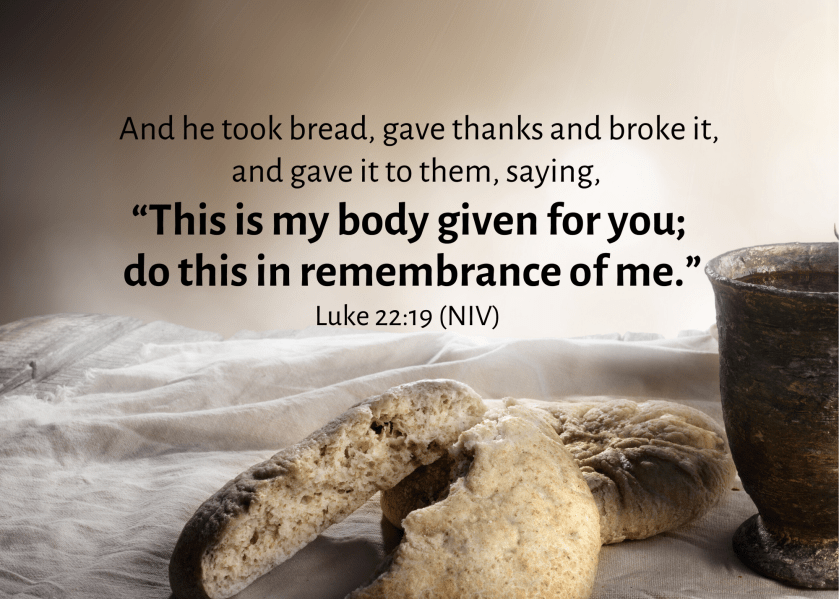
This was already a day of remembrance and of sharing a meal, but Jesus is giving it a new context as the birth of his church grows near. This will be a time to reflect on the New Covenant. Jesus’ physical blood marks the sealing of the New Covenant, so this cup of wine will be a reminder of his blood that would be poured out just a few days after the meal they were sharing. The bread is a reminder of Jesus’ body, which would be beaten and abused. Breaking the bread is a reminder of how his body would essentially be broken through the abuse and execution that were upcoming.

Today, we get to celebrate the Lord’s Supper under much different circumstances. We have the context that the disciples didn’t. A resurrected Jesus and the testimony of his disciples. We can also celebrate this as often as we’d like, but typically it is monthly (at least in my church). We perhaps do the remembrance part right, but later, Paul talks about the need to examine oneself. We should be examining how we’re doing. Are we doing an okay job living our lives for Jesus, or do we need to refocus? I would add that there is also an element of fellowship here. Typically, we observe the Lord’s Supper during a service, but it would perhaps be a good thing to observe it during a meal. Engaging in meaningful interactions with brothers and sisters during celebration.

One other thing to take away from Jesus’ last supper, he’s doing all this with Judas at the table. He knows what’s about to happen, but he doesn’t let that derail this important gathering. When we are having interpersonal issues in the church, we should be striving to repair what is wrong. We should, however, also be able to set aside our differences as we observe the remembrance of Jesus by fellowshipping and breaking bread together. If Jesus can face Judas, you can face someone who has done far less by comparison.

Reflection Questions:

1.        Is it easy to let communion become a rote practice and not a real time of reflection? How can that be changed?

2.        Have you participated in different ways of observing the Lord’s Supper? Were some practices more impactful than others? Why or why not?

3.        A monthly observance was mentioned earlier. Is there a benefit to observing communion more or less frequently? Why do you think this? If you don’t have an opinion, why do you think someone else might have strong opinions on the frequency of observation?

Trusting Prayers

Old Testament: 2 Kings 20

Poetry: Psalm 86

New Testament: Luke 22


Scripture:
“Return, and say to Hezekiah the leader of my people, ‘Thus says Yahweh, the God of David your ancestor: “I have heard your prayer; I have seen your tears. Look, I am about to heal you. On the third day you shall go up to the temple of Yahweh.”’” — 2 Kings 20:5 (LEB)
“Listen, Yahweh, to my prayer, and attend to the voice of my supplications.” — Psalm 86:6 (LEB)
“Father, if you are willing, take away this cup from me. Nevertheless, not my will but yours be done.” — Luke 22:42 (LEB)


In 2 Kings 20, King Hezekiah is faced with a life-threatening illness. His immediate reaction is to pray earnestly to God, and God responds with compassion, healing, and an extension of his life. This powerful story of prayer and divine intervention resonates deeply with themes found in Psalm 86 and Luke 22, reminding us of the importance of prayer, God’s compassion, and surrendering to His will.


When the prophet Isaiah tells Hezekiah to prepare for his imminent death, Hezekiah turns to God in earnest prayer and weeping. God hears his prayer and responds with a message of healing and an additional fifteen years of life. This account underscores the power of heartfelt prayer and God’s readiness to respond to His people’s cries.


Psalm 86:6 echoes the sentiment of Hezekiah’s plea: “Listen, Yahweh, to my prayer, and attend to the voice of my supplications.” This verse highlights the assurance that God listens to our prayers and attends to our supplications. Hezekiah’s experience validates this promise, showing us that God is attentive to our deepest needs and concerns.


In Luke 22:42, Jesus prays in the Garden of Gethsemane, expressing His desire to avoid suffering but ultimately surrendering to God’s will. This prayer, “Nevertheless, not my will but yours be done,” mirrors Hezekiah’s trust in God’s plan. Even in our most desperate moments, we are called to trust God’s sovereignty and submit to His will, just as Hezekiah and Jesus did.


Hezekiah’s sincere prayer, Psalm 86’s plea, and Jesus’ prayer in Gethsemane all highlight the importance of coming to God with our deepest concerns. God listens and responds with compassion and grace. God’s response to Hezekiah’s prayer and Jesus’ submission to the Father’s will reveal His compassionate nature and sovereign authority. He understands our struggles and holds ultimate control over our lives. Hezekiah’s trust in God’s healing power and Jesus’ surrender to the Father’s will teach us to trust God fully and submit to His plans, even when we face difficult circumstances.

-Jeff Ransom


Reflection Questions:


How do you typically respond to difficult news or situations? How can you make prayer your first response?

In what areas of your life do you need to trust more fully in God’s sovereignty and compassion? How can Hezekiah’s and Jesus’ examples encourage you to pray more earnestly and surrender to God’s plan for your life?


This week, reflect on these questions and consider how you can deepen your prayer life and trust in God’s compassion and sovereignty. Turn to Him with your concerns, knowing that He hears and cares for you.

How Could They?

Luke 22

Thursday, December, 29, 2022

            Can you imagine if you lived in Bible times and the son of God handpicked you to be a part of his very exclusive inner circle?  How amazing that would have been to be chosen as one of the twelve disciples!  Spending time in conversation with him daily, watching him perform many miracles, listening to him teach the people and reveal the coming kingdom, and just being around the most awesome dude ever would have been incredible.  Surely, that group of twelve would be so devoted to him that they would never turn against him.  Or, maybe they would.

            Let’s start with Judas.  I’m not making excuses for him, but Luke 22:3 does say that Satan entered into Judas right before he went to the chief priests and officers to devise a plan to betray Jesus so he could be put to death.  Although, how in the world could one of the twelve disciples get to the point where Satan would be allowed to have so much influence over him.  He didn’t have to go along with the temptation Satan presented to him, but he willingly did turn his back on Jesus.  I don’t really understand how he could have justified in his mind such an evil plan, but clearly, he was weak in the faith department and not strong enough to not give in to the temptation.

            I think we accept the fact that Judas betrayed Jesus – because he was Judas.  Who has anything good to say about Judas?  It’s not like he was John, James, or Peter, some of the most impressive disciples.  They would never turn their back on Jesus, until Peter did.

            Peter showed over and over that he loved Jesus and was totally onboard for the cause.  His faith was pretty strong also – strong enough to walk on water for a little bit.  So what went wrong?  How could he have denied Jesus three times in one night.  Furthermore, to make it worse, Jesus even told him right beforehand that he was going to deny him three times.  It seems like after the second time he would have thought, “Okay, that was two times, but there’s no way I’m messing up a third time.  I’m not falling for that one.”  But one of the most devoted of Jesus’ inner circle was not strong enough to not give in to the temptation.

            Let’s fast-forward to today.  How strong is your faith?  Are you onboard with the cause 100% or are you a fair-weather Christian?  What can you do to make sure you don’t give into temptation when tough times hit?  There is one suggestion from Jesus that he stated in verse 40 and again in verse 46.  He told the disciples to pray that they wouldn’t enter into temptation.  I find it interesting that he didn’t tell them to pray to not enter into sin; he told them to pray to not enter into temptation.  Temptation is not wrong.  Jesus was tempted in the same way we are tempted, but he did not give into the temptation and sin.  That is deep, at least to me it is.

-Rick McClain

Time to ponder:

Many of us spend time figuring out how we are not going to enter into sin, but have you ever thought about what you could do (or not do) to not enter into temptation?  That seems like a great place to be because you will probably not sin if you are not tempted to sin.

Is there anything else you can do to prepare yourself to be strong enough to not give in when strong temptations arise?

I’m not going to give you a third question because I think it would be wise to use your time to keep thinking about the first two questions.  There really is a lot there to think and pray about.