Tell the Next Generation

1 Chronicles 7-10

Psalm 78 4b NIV


I believe today’s reading will be the last of the genealogies for awhile.  There are a lot of names, a lot of generations.  Father to son.  Father to son.  Father to son – and sometimes a daughter.  Father to son. A whole lot of heritage.  A whole lot of passing along from one generation to the next.  It reminds us that our life is not just what we see and experience today.  We have a past that has shaped us and we (and our children) have a future for which to prepare.


I am reminded of a passage in Psalm 78 that we read last week but didn’t have time to discuss directly.


My people, hear my teaching;
listen to the words of my mouth.
I will open my mouth with a parable;
I will utter hidden things, things from of old—
things we have heard and known,
things our ancestors have told us.
We will not hide them from their descendants;
we will tell the next generation
the praiseworthy deeds of the Lord,
his power, and the wonders he has done.
He decreed statutes for Jacob
and established the law in Israel,
which he commanded our ancestors
to teach their children,
so the next generation would know them,
even the children yet to be born,
and they in turn would tell their children.
Then they would put their trust in God
and would not forget his deeds
but would keep his commands.
They would not be like their ancestors—
a stubborn and rebellious generation,
whose hearts were not loyal to God,
whose spirits were not faithful to him.

Psalm 78:1-8


I am thankful for a father who passed along to me the spiritual heritage he received from his father and grandfather.  Both of my parents brought their children up to seek and serve the Lord first – it is by far the most important life lessons that they taught.  In fact, today’s photo is a Bible timeline that I inherited from my dad, and one of my favorite treasures from him. He spent hours researching and meticulously drawing out this timeline to help illustrate for his Bible students (including his children) God’s faithfulness and plan for the ages.  And, he lived it out with his life, too.


So, now it is my turn to pass along what I have heard and learned.  How do I do that with the words I speak, with the priorities I set and with the life I live?  How do I help my children seek God, grow in faith and love Him more and more?


There are so many negative influences and evil that would love to help us and our children forget God’s great deeds, His law, His faithfulness and His plan for the ages.  But we must not forget.  Nor is it enough to just remember for ourselves.  We have a great responsibility to hand these truths down to the next generation so they can hand them down to the generation after them, etc…until Jesus returns.


Maybe you cannot celebrate an upright Godly spiritual heritage in your genetic past.  You don’t have the benefit of an antique family heirloom Bible timeline rolled up in your closet.  That’s okay.  Paper rips and ink fades, but if you have a love for the LORD you have priceless spiritual mentors you can call mom and dad.  And, then, we must in turn create a spiritual heritage rich in God’s goodness, laws, and plan for salvation for those around us: our children, grandchildren and those children of all ages and colors and countries who need to know what God’s Word says and who God is.


God’s genealogy doesn’t end here in 1st Chronicles.  It is continuing today, and into the future.  Will it be recorded that you passed along what is of the most importance to those that came after you?  Don’t let yourself, or your children, be listed as the ones that forgot.  Tell of His goodness.  Put God first.  Pass it on.

Marcia Railton


Too important to not mention: I love verse 6 in Psalm 78 (above) where we see the value and great worth of, “the children yet to be born”.  Whether the children are conceived or not, born or not, they were planned to play a part in God’s design of the passing along of family and faith.  How tragic that this link has been broken time and time again when the children yet to be born are killed for convenience before they even get a chance to hear, learn and share of their Creator.  Tell of His goodness.  And His Word and His law.  Do not forget.  And do not ignore the evil that rejoices when God is forgotten.  We need to speak louder since voices in the chain are silenced.


Today’s Bible reading can be read or listened to at https://www.biblegateway.com/passage/?search=1+Chronicles+7-10&version=NIV

Tomorrow’s reading will be Psalms 102-104 as we continue the 2020 Chronological Bible Reading Plan

A Scrapbook of God’s Goodness

Psalm 81, 88 & 92-93

Psalm 92 4 NIV


“For you make me glad by your deeds, O LORD; I sing for joy at the works of your hands.

How great are your works, O LORD, how profound your thoughts!…

The LORD reigns, he is robed in majesty; the LORD is robed in majesty and is armed in strength.  The world is firmly established; it cannot be moved.”

Psalm 92:4,5 & 93:1


I love the idea of keeping a Covid-19 scrapbook/journal/photo album to chronicle what you want to remember about this time in your life.  Sometimes a picture says 1,000 words and many emotions.  Some things are harder to capture in a photograph and you might want to add some of your own words.  But, here are some starter questions to get going – some of which were inspired by the snippets of Psalms above.

How did you spend your days?

What changed in your life?

What stayed the same?

What brought you joy?

What works of His hands made you smile?

How did you see God move?

How did you search out God’s thoughts?

What Bible verses meant the most to you during this time?

When or how were you reassured of God’s majesty and strength?


The Psalms can be viewed as the poets’ scrapbook of their lives and how they witnessed God at work.  What made them rejoice?  What made them mourn?  How did they see God?  What did they learn about themselves?  About their Creator?  About their world?  About those who reject God?  These are all still great questions to be considered today.  And it is well worth the time to look into the Psalms to see their answers as you work on your own.

I will talk less today so you have more time to work on your personal or family scrapbook.  Even if you don’t make a physical project, take a few minutes to answer some of these questions – or make your own questions.  A great starter is to scroll through your pictures to see what works of God make you glad – and thank Him – and share them.

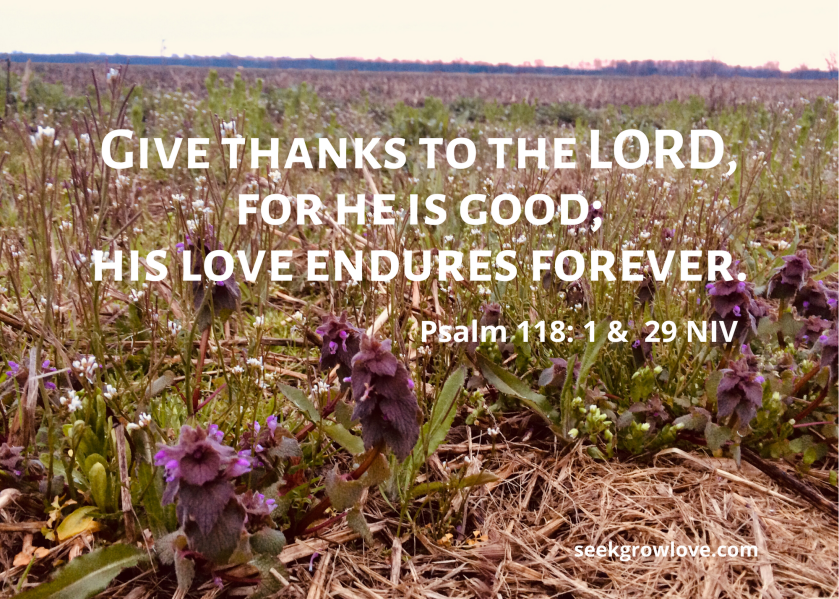
OK – I will start.  The photo which accompanies this post was taken last weekend during a family hike.  So many things that made me glad – the warmth of the spring sunshine, family time – with no devices, and the health and ability to enjoy the rebirth and beauty of God’s creation.  The wild flowers growing off the path reminded me of God’s loving care and that He is still watching over us and I do not need to worry but I do need to seek Him & His Kingdom  (Luke 12:27-31).  I know, I am not quite as poetic as the psalmists, but that is okay.

Now it’s your turn.   You can post a comment below or share some pictures and thoughts with family and friends.   However you do it, just like the psalmists, take the time to ponder and share what the LORD has done for you.

Marcia Railton

Interesting Side Note- did you catch the Psalm in today’s reading that actually mentions the very modern problem of everyone on their own devices?   Hint – read Psalm 81 again – in the NIV.  Then, make sure you are not in that sinking boat.  Listen to the LORD.  Keep reading His Word and seeking Him as the psalmists did.  He has many treasures He is wants to reveal to you!


Today’s Bible reading can be read or listened to at https://www.biblegateway.com/passage/?search=Psalm+81%2C88%2C+92-93&version=NIV

In tomorrow’s Bible reading, 1 Chronicles 7-10, we will finish off the introductory genealogies and start in on the stories of the kings of Israel saved for us in the Chronicles.  2020 Chronological Bible Reading Plan


Strike up the Band!

1 Chronicles 6

1 Chronicles 6 32a NIV

As our Bible reading today we have just one chapter in the book of 1st Chronicles (chapter 6) – still in the genealogies.  This chapter is devoted to the tribe of Levi.  Levi was one of the 12 sons of Jacob and his descendants would be the ones God chose to be the Levites for the nation of Israel.  They were set apart for service to God.  They would be the care takers of the tabernacle (where people sought God), and later the temple.  From their tribe would come the family line that would serve as priests and the most holy role of high priest, which later Jesus himself would take upon his shoulders.

But, that’s not all – some of the Levites (those listed in verses 33-47) – were given the responsibility of temple musicians.  They were to play, sing, and make music to the Lord – to lead the temple-goers in their worship of the Most High.

I love that God created us to enjoy music.  I love the power of music – just read any article on music and the brain or music therapy – or better yet – listen to the nurse as he plays his guitar in the hall of his covid-19 ward.  Or witness the miraculous turn-around of the struggling infant when his big sister sings to him the song that she always sang to the baby in her mommy’s belly.  Or hear the band play as the Titanic sinks.  Music grips us and moves us in many ways.  Let music be a source that moves you toward God as you come to worship.

As our church has gone online during this time of isolation, I miss the community lifting their voices and instruments together in worship.  But even now, music remains as a powerful means to move us closer to God.  Look up the words to an old hymn.  Pick up an instrument you have neglected too long.  Thank those who have used the gift of music to lead you into meaningful worship.  Share with your family a song that reminds you of God’s love, character and promises.  Search for Bible verses about music.  Play worship music as you go about your day.  Research how many instruments are listed in the Bible?  Post a song of Christian joy and hope on social media.  Write your own psalm of praise – maybe you will even set it to a tune.

Music was a powerful part of worship long ago, it is still today, regardless of our situation – and it will be in the future as well.  I love the verses in Revelation where the faithful will sing in worship to God and the Lamb Jesus Christ as the Kingdom of God is preparing to unfold.  Let’s get started practicing today to be a part of that choir!  God and His Son are worthy of our worship!  Sing it out!


Marcia Railton


Today’s reading can be read or listened to at https://www.biblegateway.com/passage/?search=1+Chronicles+6&version=NIV

Tomorrow we go back to the Psalms – 81, 88, & 92-93 as we continue on the 2020 Chronological Bible Reading Plan

I found it all oppressive, UNTIL…

Psalm 73, & 77-78

Psalm 73 17 NIV

Yesterday we read the short short story (2 verses) of Jabez (1 Chronicles 4:9, 10).  He prayed.  God granted his request.  Remember, we don’t know the timeline for the life of Jabez.  Since he had requested from God the expansion of his territory (amongst other things) I feel it is most likely that this answer didn’t come with a snap of the fingers  -though God can certainly work that way when He wants to. I wonder if this answer was achieved over a period of time, with some persistence and wisdom and work required from Jabez.  But still – it sounds so simple and sweet. A fairy-tale ending in just two verses. Jabez prayed.  God granted his request.

But, what about the times when the answer isn’t coming.  We may be praying hard – with a good measure of persistence, wisdom and work, too.  But, it’s just not coming together like we thought a good God would do.

I think of Job and the 41 long, difficult, trying chapters of his story – before the final 42nd chapter when we see God finally shower Job once again with double the blessings.  It would be great to read the book of Job today to remember Job’s anguish – and God’s answer.  Or, you can read Psalm 73 – it is like a mini book of Job boiled down into one powerful psalm.

The author of this psalm begins by acknowledging that he knows God is good.  And, yet, he personally had nearly lost his way and his faith because of his own serious struggles while simultaneously watching the wicked prosper.  He saw boastful, callous, violent, evil men succeeding and growing in popularity and wealth, all while denying and even mocking God.  Are we sure this wasn’t written in 2020, perhaps during a Covid-19 epidemic?  Haven’t we seen and heard the same thing this week and shook our heads and asked, “Where is God?  This isn’t right or just or fair?  The world is too messed up!”  And we sink down deeper in our despair.   As the psalmist said, “When I tried to understand all this, it was oppressive to me…” (Psalm 73:16)

UNTIL…

Yes – keep reading!  The good stuff is coming – just like it came for Jabez and Job and the psalmist,  it is coming for you and for me.  Though it does require a little bit of action on our part.  The psalmist reveals the secret.  He wrote, he was oppressed UNTIL he, “entered the sanctuary of God; then I understood their final destiny.” (Psalm 73:17).  Look to God.  Put yourself smack dab in His presence.  Intentionally seek Him out.  Change your focus.  Consider the whole timeline, the big picture.  Look into the future.  Consider the consequences and coming judgement.  Rest in knowing God has got this.  And He has got me.  And if you let Him, He has got you.

The rest of this psalm has beautiful passages of God’s strength, guidance, comfort, plan, wisdom, & protection in any and every situation.  Don’t miss the chance to read it for yourself and soak it in.  Which verse is your favorite in Psalm 73?


Also, don’t miss out on the powerful truths in Psalm 77 & 78.  Psalm 77 begins much the same way Psalm 73 did – in agony and despair.  And maybe you have been there yourself sometime?  Perhaps you have asked yourself, “Has his unfailing love vanished forever?..Has God forgotten to be merciful?” (Psalm 77:8, 9).

And yet – here again we will see a great turn-around.  In a few short verses he will be writing, “Your ways, O God, are holy, What god is so great as our God?” (Psalm 77:13).  What makes the difference?  What happened in-between verse 9 and 13?  Did he win the lottery?  Did he get all his wishes granted in the sudden snap of his fingers?  It had looked so hopeless.  What changed?

10 Then I thought, “To this I will appeal:
    the years when the Most High stretched out his right hand.
11 I will remember the deeds of the Lord;
    yes, I will remember your miracles of long ago.
12 I will consider all your works
    and meditate on all your mighty deeds.”

His situation did NOT change.  His thinking did.

What he was focusing on changed.  He rewired his brain, his thought processes, his attitude, his words, his outlook.  He remembered the good God had done.  He meditated on God’s work.

The anguish and oppressive depression doesn’t have to win, even in a situation that appears so bleak.  You may find yourself in the dark, questioning God.  You are not alone.  But, don’t allow yourself to remain in the dark.  Keep stepping towards the light.  You don’t have to wait until your circumstances change.  Instead, change your view.  Enter His Sanctuary.  Search for the good things He has done – in the past and today.  Seek Him.  Read His Word. Remind yourself of His power, faithfulness and love.

Marcia Railton


Today’s Bible reading can be read or listened to at https://www.biblegateway.com/passage/?search=Psalm+73%2C+77-78&version=NIV

Tomorrow we will jump back to 1 Chronicles – for just one chapter (6) as we continue our 2020 Chronological Bible Reading Plan

God is No Magic Genie

1st Chronicles 3-5

1 Chronicles 4 10 b NIV

When we began 1st Chronicles two days ago we likened the beginning of this book to a family reunion.  It was written for the people of God who were returning to the Holy Land after years of captivity and living amongst foreign people who did not worship God (which had been their punishment for forsaking God).  Now, they were returning and receiving a history lesson on what it means to be God’s people.  If we listen in, I believe we can also benefit greatly from this lesson.

In today’s reading our list of genealogies is broken up in chapter 4 with a passage about Jabez.  In two short verses we learn: “he was more honorable than his brothers”, “his mother had named him” – PAIN (in Hebrew Jabez sounds like pain), he prayed to be blessed, “and God granted his request.” (1 Chronicles 4:9,10).  Makes you wonder why we don’t have any babies today named Epidural?

Seriously though, I hurt for this man Jabez.  It doesn’t seem very nice of his momma to pass along the brief pain she felt at childbirth (I know, in the midst of it, it doesn’t feel brief) to her son to bear the name PAIN the rest of his life.   Can you imagine the jokes he heard from the neighborhood boys?  We also know it can be very painful growing up with less than honorable brothers.

It could have been a rough life for poor PAIN/Jabez.  BUT – it wasn’t.  Even though he had a few strikes against him in his early years, he knew to cry out to God.  And, perhaps because of Jabez’s honor, and I am guessing his heart was in the right place, God was ready, willing and able to fulfill his request.

Just what was his request?  “Oh, that you would bless me and enlarge my territory!  Let your hand be with me and keep me from harm so that I will be free from PAIN.”  It is a touching prayer knowing his background.  Other versions have slightly different interpretations – I especially love the NKJV, “Keep me from evil, that I may not cause pain.” It sounds so much more noble.  But, either way, he cried out to God and God “granted his request”.

Does anyone else get a vision of a genie, or is it just me?  Jabez cried out (with a list of 4-5 wishes) and his wishes were granted.  Poof.  Who wouldn’t take a God like that!  I can fill a whole book with my wishes and cry out to God and all my wishes will be met.  Never mind what God requires of His children.  Never mind the timeline and big picture that God is working with in His infinite wisdom.  Never mind the growth, compassion and character that develops in the midst of trials.  I want no pain.  I want it now.  Give it to me, God.

I would love to read the rest of Jabez’ story – the daily details, his life’s timeline.  I highly doubt that he never felt ANY more pain – never stubbed his toe, never lost a friend or family member, never needed to cry out to God again.  But, we know that God was faithful.  He blessed Jabez and He answered his prayer.

God wanted the returning Israelites to know the story of Jabez.  He wanted them to know of God’s faithfulness and the good gifts that He brings to His children who are honorable and cry out to Him.  Likewise, God wants you and me and the world today to know the story of Jabez.  God takes us in our pain and gives us blessings.  God is good.  God is powerful.  God is love.  God is faithful.

BUT don’t be fooled.  God is no magic genie.   In fact, He is so much more.

Our history lesson continues.  Keep reading, in chapter 5 (verses 23-26) we meet the half-tribe of Manasseh.  They were God’s people. God had already fought their battles and given them land.  They had prospered and become numerous.  Their leaders were “brave warriors, famous men, and heads of their families” (1 Chronicles 5:24).  It sounds so good.  It looks like they were leading a charmed life.  God’s goodness and power have provided for these people.  We see God’s blessings – but do they?  NO!  “But they were unfaithful to the God of their fathers and prostituted themselves to the gods of the peoples of the land” (1 Chronicles 5:25).  In their pampered state they turn from the One who has blessed them.  They leave their Provider and Protector to run after false gods.  They chase what the ungodly society calls good – rather than clinging to their Creator, the God of their fathers.

And, their foolishness comes with consequences.  They don’t get more wishes granted.  What they have is taken away.  God uses the Assyrians to remove them – to place them into exile in a foreign land.  They have earned themselves a Big Time-Out which will last several years, until God prepares the way for the exiles to return.

God wanted the returning Israelites to know the story of the half-tribe of Manasseh.  He wanted them to know of the serious consequences that He puts into action when His children flaunt their waywardness.  Likewise, God wants you and me and the world today to know the story of the half-tribe of Manasseh.  God has given blessings, how will we respond?  God is just.  God is powerful.  God is faithful.  His loving kindness requires our faithfulness, too.

Marcia Railton

Today’s reading can be read or listened to at https://www.biblegateway.com/passage/?search=1+Chronicles+3-5&version=NIV

Tomorrow’s Bible reading will be Psalm 73, & 77-78 as we continue on the 2020 Chronological Bible Reading Plan
A Time-Out

Psalm 43-45, 49, 84-85 & 87

Psalm 85 8c NIV

Sometimes when I am reading through the Psalms I just get this weird feeling that someone must have copy and pasted a new verse into my Bible while I was sleeping – and there it is for me in the morning.  It is so relevant and timely and hits me where my heart is.  Surely this wasn’t written 3,000 years ago, was it?  Just think of all the differences from their society to ours: architecture, technology, transportation, languages, clothing, careers, and entertainment, just to name a few.  How could that ancient book speak to me today in 2020?  And yet, the most important things have not changed at all.  God – and human nature.  He is still the Almighty.  And we are not.  But as His created beings, even thousands of years later, we still have all the same emotions, fears, desires, weaknesses, hopes, pride, and insecurities.  So thus, these ancient words, were written for me, today.

One such verse that stuck out to me in today’s reading is Psalm 85:8.  Read it a few times.

“I will listen to what God the Lord will say;

he promises peace to his people, his saints —

but let them not return to folly”

So much in this verse:  The importance of listening to God – He is talking but am I listening?

God promises peace.  We know trouble comes, expect it, deal with it, knowing that God gives His Son – and peace – to his people.  (John 16:33)

Be His people – His saints.  Strive for righteousness – it’s what His kids do.  Be His people – His saints – to get the peace (see above).

And – today’s kicker – “But let them not return to folly.

As we sit today in Covid-19 isolation and everyone is chomping at the bit to return to “normal”,  I wonder, how much of “normal” would God call folly?

I checked the dictionary to see what exactly is the definition of folly.  Lexico.com defines folly as “lack of good sense; foolishness; a foolish act, idea, or practice.”  Sounds like a good thing to avoid.  There was another definition for folly that I found interesting and perhaps strangely fitting: “A costly ornamental building with no practical purpose, especially a tower or mock-Gothic ruin built in a large garden or park.”  What type of structure was our previous  “normal” building?  What are the dangers of spending our time and finances and priorities on a life/building that looks really good on the outside, but lacks any “practical purpose”? That would be folly, indeed.  What practical purposes would God want us to pursue?  Where did our priorities lie?  What did we always want to do – but never had time for?  What did we do with the majority of our time?  What about our finances?  What role did the pursuit of wealth play in our old normal?  A lot is said about that in another one of today’s passages, Psalm 49.  Make sure you give it a read and see what it says about “riches without understanding”.  How much of our life was a beautiful outside,  but lacking a purpose – folly – foolishness.  

I pray we don’t go back to “normal”.  I pray I don’t return to folly.  I pray through this time we evaluate our purpose, even better yet, God’s purpose.

As a parent and day-care provider for over 20 years I have sat many a cute little behind in the all-powerful time-out chair.  And it is always with the hope that when the time of isolation and consideration is past the offender will walk free – but not to return to their former folly.  The purpose of the time-out chair is to ponder – what is my real purpose?  Do I want to get that prized toy, regardless of how it might hurt my friend?  Will anger, sulking and a bad attitude make my day better?  Are my wants and wishes the only ones I should consider?  And, so often, the preschool time-out chair shows its worth in returning a child, not to normal or to folly, but to a fresh purpose – be the best I can be.

We have been given a little time-out.  Let us use our time-out wisely.  Consider our past folly.  In what ways are we beautiful outsides – with no practical purpose?  What part of “normal” will you work to avoid?  What can we do today, and how can we plan for tomorrow, to concentrate on seeking God, His purposes and His peace.

With Much Love and Prayers,

Marcia Railton


Today’s Bible reading can be read or listened to at https://www.biblegateway.com/passage/?search=Psalm+43-45%2C49%2C+84-85%2C87&version=NIV

Tomorrow we read some more of the family reunion genealogies from 1 Chronicles 3-5 as we continue the 2020 Chronological Bible Reading Plan.

Seek.   Grow.   Love.   

A Family Reunion

1 Chronicles 1-2

1 Chronicles 2 1 NIV (1)

Right now family reunions look a little different as we face our current situation with Covid-19 and all that brings.  Yet there is still great joy in hearing that familiar voice on the phone or interacting with your family on Zoom or facetime.  Remember those family reunions with multiple generations where the old dusty photo albums are brought out to celebrate and learn about those who have gone before?


As we read the Chronicles we are reading a family reunion.


In our chronological Bible reading plan we have just begun the book of 2nd Samuel to read of David as king.  And, at the same time, we are reading various Psalms, many of which were written by David.  And, now, we are going to begin yet another book, 1st Chronicles, which will include several of the same stories as 2nd Samuel, and later 1st & 2nd Kings.


Why the overlap?


They were written for different people at different times, but both are still relevant to us.  The books of Samuel (originally one book) were written shortly after David’s son, Solomon’s, death, at a time when the kingdom of Israel was going to be fractured and face the tragedy of many evil kings which would ultimately lead to the downfall of their nation(s).  It was important at that time to preserve a record of how Israel became a nation with a king – and thus the book(s) of Samuel.


Many years later, after the Israelites had been conquered and in foreign captivity for generations, they would be preparing to return to Jerusalem and their homeland.  This was now a totally different people in a totally different situation.  They needed to be taught that they were indeed the people of God, and what that means.  They needed to be reminded of their roots.  They needed a good old family reunion.


Break out the photo albums, or – in this case – the genealogies!


I know, it’s not very exciting for us to read long lists of names, many of whom we have NO clue who they are or what they did or even how to pronounce their name.  But, if you count yourself among the people of God – this is your family tree, too!   And, you know what they say – every family tree has a few nuts.  So, indeed, this family tree has the good, the bad and the ugly.  They don’t have time or space to write of the stories for everyone, but several names bring to mind a picture of righteousness (Noah, Abraham, Joseph and David).  Other times the writer takes the time to remind his family reunion participants of the sad lessons learned from those who had strayed:


1st Chronicles 2:3 – “Er, Judah’s firstborn, was wicked in the Lord’s sight; so the Lord put him to death.”


1st Chronicles 2:7 – “The son of Carmi: Achar, who brought trouble on Israel by violating the ban on taking devoted things.”


So, dig in – enjoy your little trip down the Israelite memory lane today – there will be more on Friday.  And, pause to think, just how do you fit into God’s family tree?


Also – now is a good time to reconnect with your more immediate family too (maybe 3-4 current generations, what about your church family, too)  Check in on them and share how God is blessing you today.  See what God is teaching them today.


Marcia Railton


Today’s Bible reading can be found at https://www.biblegateway.com/passage/?search=1+Chronicles+1-2&version=NIV

Tomorrow’s reading will be back in the Psalms (43-45, 49, 84-85, 87) – we will save more of the genealogies for Friday.  Continue on the journey with us by printing your own copy of our 2020 Chronological Bible Reading Plan – and keep reading His Word to you.
Not the Human Nature Way

2nd Samuel 1-4

2 Samuel 2 1 NIV

Today our Bible reading begins the book of 2nd Samuel.  It is somewhat an odd name for the book, since Samuel died in 1st Samuel 25 and he will not appear as a character at all in this second book named after him.  Rather, this book is all about David, as king: his rise to power, the growth of his kingdom, his personal weaknesses and sins, as well as the sins and trials of his sons.  But we can remember David’s beginnings – the young shepherd boy God chose to be the one anointed by Samuel to one day replace Saul as king and rule over Israel.  So, while Samuel will not play a part in this book personally, he was the one who acted on God’s behalf to set the stage for David’s performance.

In the same way, your story today was shaped by many who went before you.  Perhaps they spoke God’s words over you, as Samuel did over David, to shape you into who you are and what you do today.  Their names are written all over your book, even if they aren’t with you today.

Don’t miss the opportunity you have to be a Samuel for a young David.  Pour God’s spirit on the young minds and hearts of those who will be the Christian fathers and mothers and pastors and Sunday School teachers and youth leaders of the next generation.  Encourage them.  Mentor them.  Let them know that even when they feel they will always be the least in their family and community that God can raise them up for works for Him.  And in this way your story will last into the future.

Your sphere of influence is much wider – and longer – than you realize.

As David was poised here on the edge of a new chapter in his life, I am certain he remembered where it all started.  He remembered Samuel and the day that changed the trajectory of his life.  He remembered playing his harp for King Saul.  He remembered the day he slew the giant with a stone.  He remembered how his popularity grew as God gave great success in his exploits against the enemy Philistines.  He remembered Saul’s jealousy and rage.  He remembered the ten long years of fleeing from the king who wanted to kill him, even though David remained loyal to him.

And, now King Saul is dead.  What will David do?  He has a golden opportunity to seize the day and the power and make himself king by force.  No longer needing to fear Saul he can safely trash talk the dead king and let bitterness over ten lost years control his emotions and decisions.  He could.  But he doesn’t.

Instead, he truly mourns the loss of the king and his 3 sons.  He writes a beautiful song of lament, speaking of Saul and Jonathan’s might and splendor and the great loss faced now with their death.  Others expect him to celebrate Saul’s death (and reward the messenger who claimed to have a part in it).  It would be natural to, since Saul had treated David so poorly time and time again.  It would be normal to, since Saul’s death now paved the way for him to set up his own rule as king.  But, David rose above what was natural and normal.  Rather than letting human nature rule, he acted in a way deserving of the title “Man after God’s Own Heart”.  He rose above revenge, and in so doing became a man that others wanted to follow.

Rather than making rash, though natural and normal, human decisions, “David inquired of the Lord.” (2 Samuel 2:1).  Should he return to his homeland, Judah?  If so, where?  God answered, “Yes, Hebron.”  So, David went.  In his last ten years he seems to have learned a thing or two about relying on God’s timing and answers rather than striking out on his own human reasoning and inclinations.

How are you doing at inquiring of the Lord?  Not reverting to natural, normal human behavior and bitterness? Rising above revenge?  Honoring those God put in authority, even when we don’t agree with them?  Having a heart of mourning for what God mourns?  Being a person of God that others want to follow?  Being a Samuel for a young generation of Davids?   Today is a great day to strive to be a man or woman after God’s Own Heart?


Marcia Railton


Today’s reading can be read or listened to at https://www.biblegateway.com/passage/?search=2+Samuel+1-4&version=NIV

Tomorrow we will be reading more of the Psalms – 6, 8-10,14, 16,19 & 21 as we continue the 2020 Chronological Bible Reading Plan
He Watches Over Me

Psalm 121, 123-125, 128-130

Psalm 121 1 2 NIV

Today’s Bible reading is 7 Psalms, each titled  “A song of Ascents”.  They were written to be traveling songs.  I know there isn’t much traveling going on right now, but remember when we would travel to visit family and friends and exciting destinations?   Remember the great fun of planning a trip and hitting the open road – though sometimes there were unplanned surprises around the bend.

Several years ago, right after church the three kids and I were taking the 2 hour jaunt from our hometown in northern Indiana up to my native Grand Rapids, Michigan to enjoy a Sunday dinner with my extended family.  Half-way there, my tire blew and we were stranded on the side of a busy highway.  I did what I could in my dress in the rain, but it quickly became obvious I was going to need some help (and this was back when all my kids were shorter and weaker than I was).  How fortunate for us that an off-duty police officer who was taking his son to the circus saw us in our distress, covered us with his protection, gave of his time and changed our tire for us.  With great relief we thanked him, watched them leave and continued on our way – for a matter of yards.  It didn’t take much for our old spare tire to shred to bits and there we were on the side of the road again, with no spare and our Good Samaritan just out of sight and getting further and further from us.  But with one phone call, my brother left the family dinner table, drove an hour, brought my parent’s spare tire that fit my van, changed the tire and followed us all the way to our destination.

There was no doubt I knew I was very protected and watched over and blessed on that journey, even though it was far from the journey I had planned or expected.  The journey was not without trouble or danger or delay.  It didn’t go according to my time schedule.  But my God was watching over us every step (and tire) of the way.

In today’s psalms the Israelites are traveling up to the temple – to Jerusalem on Mount Zion – to worship the One who never forsakes them.  They don’t have to worry about flat tires, but there would have been many other possible dangers along the way.  In the 8 short verses of Psalm 121 the word “keeps” (also translated “watched over”) is used 6 times.  How comforting to remember the times – over and over again – that God has watched over the Israelites.  And the times that God has – over and over again – watched over me.  And, this protector is not weak.  He is not asleep.  He is not surprised.  He is here.  He is powerful.  He is the Creator of the Universe.  And He cares for you and for me.  We must lift up our eyes to seek Him and acknowledge Him.

You may not be planning a trip today – but you are no doubt on a journey.  A journey of life that includes some unforeseen challenges and flat tires along the way.  Sometimes we will feel weak and stranded. But, Praise God, we are being watched over.  The Maker of Heaven and Earth is keeping us safe.  He is not sleeping on the job.   We can rejoice in rising up to thank the One who protects and guides and cherishes His children, even when our journey has some bumps along the way.

Also, remember God often uses people to do His work.  How will you be a part of God’s rescue of someone who feels weak and stranded and perhaps ready to give up?  How will you provide protection from the dangers on the road?  Maybe you thought you were off-duty and heading to the circus, but God will show you someone who needs your help along the way.  You will arrive just a little later and a little wetter to the circus; but, someone will know you cared – even if you couldn’t provide a permanent fix.  Maybe you will be the brother who leaves the feast to help someone in need get going in the right direction.  God has provided for you.  He has blessed you and supplied you with what you need to be a very valuable part in His rescue of others.  Rejoice in the way He has watched over and provided for you – and let Him use you today.

Marcia Railton


Today’s Bible reading can be read or listened to at https://www.biblegateway.com/passage/?search=Psalm+121%2C+123-125%2C+128-130&version=NIV

Tomorrow we continue the events of David’s life as we begin 2nd Samuel, chapters 1-4 on our journey through the 2020 Chronological Bible Reading Plan.  It’s a great time and place to jump on and travel with us.  Look up and seek Him!

Who Are You Blaming?

Job 29-31

Job 31 2 NIV

I love the orderly layout for Job’s final 3 chapters of his defense before God and man.


In chapter 29 Job longs for his earlier days, “When the Almighty was still with me and my children were around me” (Job 29:5).  He isn’t dwelling on all the wonderful material  goods he once enjoyed, though we know they were many.  Rather, he is fondly recalling the interactions he had with others – the respect he felt, the ability he once had to help others: serving as the father to the needy, rescuing the fatherless, and comforting the mourners.  And, then he became the mourner.


In chapter 30 Job details his current despair.  Now he is detested by men.  He has lost all former dignity and safety and feels terror instead.  He is physically suffering with gnawing pain; blackened, peeling skin; and fever.  And perhaps worst of all, he feels like God is ignoring his cries for help.


In chapter 31 Job affirms his righteousness, denying his friends’ claims that he must now be suffering because of great past sins.  He describes many sins: lust, dishonest business transactions, marital infidelity, injustice, not caring for the poor and fatherless, abusing power, greed, idolatry, rejoicing over one’s enemy’s misfortune, and hiding guilt.  For each sin he says, I didn’t do it.  And for each sin he names a punishment a just God could give to him or anyone else who did that evil.


The problem is Job – and his friends we have heard from in the past many chapters – don’t understand that there are multiple reasons why we may be enduring trials.  His friends say trials are a result of God’s punishment.  And they were right – but only partially right.  They were erroneously blaming Job for his current trials because he must have deserved it.  Job says he was righteous (not sinless, but righteous) and thus shouldn’t be experiencing trials if God was just.  But, just who is God?  And why does He allow suffering?  These are still the questions that need answers today.


Last month I was delighted to watch the youth of our church develop and share a Youth Sunday based on several “apologetic” questions people ask about God.  Does God exist?  Did He create the world?  Is the Bible accurate and reliable?  Are science and the Bible enemies?  AND the biggie – why does God allow suffering?  Too many times a faithful person can believe all the right things and live the right life (just like Job) – until trouble comes.  And then the blaming and questioning tears them away from what they knew was true and the God that loves them.  It was powerful seeing these young people studying truth (guided by godly mentors) and gaining this understanding which will prepare them for trials to come.


I want to share with you a brief outline which youth group members, Kaitlyn and Addie, presented on “Why Does God Allow Suffering?”

  • The Fall (Genesis 3:14-19, Romans 5:12)
  • The Devil Causes Evil (2 Corinthians 4:4, 1 Peter 5:8,9)
  • God’s Judgments (Romans 6:23, Genesis 19:13) – this was the one Job’s friends knew about
  • God Uses Suffering for Good (Romans 8:28, James 1:2-4)
  • Sometimes People Don’t Get Healing Because of a Lack of Faith (Matthew 9:22-24, Mark 9:29)
  • Time & Chance (Luke 13:1-5, Ecclesiastes 9:11)


Many sermons could be written about any of these but I want to say just a few words about the devil, Satan, the accuser, the serpent, or the god of this age…the list goes on.  He goes by many names – perhaps a part of his deception and secret identities.  I find it very interesting that he plays a KEY role in Job 1 & 2 – and yet is not mentioned again by either Job or his friends.  He is the one bringing about these trials (which God is allowing) but everyone is pointing the finger at God rather than at Satan.  It is true that the Old Testament has a very limited number of references to Satan.  They did not yet have a very thorough understanding of many things God would reveal to His people through time – the Messiah, the resurrection, and Satan.


When Jesus enters the scene, he works to bring a clearer understanding of all these things.  All 4 gospel writers record Jesus speaking about (and sometimes directly to) the devil/Satan and the power he wields to tempt, deceive and inflict.  Every New Testament writer references the devil or Satan.  I believe we still point the finger at God often times when we ought to be recognizing, and fleeing from, the power of the god of this age.  Perhaps there is something you need to stop blaming God for and give the “credit” to Satan instead.


And, that is just ONE of the other Biblical reasons for our trials.  So much to think about in the book of Job!


I enjoyed looking into Job with you this week and I greatly look forward to the coming week when we get to hear from Cayce (Ballard) Fletcher as we get into the BEST parts of the book of Job!


Keep Reading and Seeking, Growing and Loving
Marcia Railton


To read or listen to today’s Bible passage check out – https://www.biblegateway.com/passage/?search=Job+29-31&version=NIV


Tomorrow’s reading will be Job 32-34 as we continue the 2020 Chronological Bible Reading Plan