Examining Your Work and Way

2 Chronicles 11-12

Psalm 79

Colossians 3

-Devotion by Juliet Taylor (TN)

In the previous chapters, I concluded that Rehoboam was wrong in dividing the kingdom of Israel in two, because he followed the advice of his young friends over the elders, whom I assume advised him to listen to God’s will in the matter, as they are often more inclined to adhere to the word of God than youth, having gained wisdom in their years. But now we read that God says that the dividing of the kingdom of God was from him, and that Rehoboam should not fight against his relatives to restore the one kingdom.

This is what I think is going on:  God allows us to make our own decisions. If we make a bad choice about what’s good for us without his wisdom about it, he decides the next move, not necessarily that he planned everything out the way it goes. And accordingly, we have the chance again to seek his will and choose to follow it or not. He moves as we move, though we should strive to move as he moves. We’ll see more of this happening in today’s readings. 

This time, Rehoboam listens to God’s words (his wisdom about what to do). His choice to listen to God yields to the creating of many notable fortified cities and prosperity in gaining his kingdom food, oil, and wine. Perhaps most importantly, the priests and the levities who were in all of Israel came to serve God with Rehoboam – at least for 3 years.

There is so much going on in Rehoboam’s reign that I think relates to this present age. It is after being established and strong that Rehoboam (and likewise most) forsook the law of the LORD again. Think about that. When we’re weak and in need, we tend to call upon the LORD. But when we’re healthy, strong, established, wealthy, etc., we forsake the Lord and his laws by going our own way (seeking our own will/wisdom about what we should do).

Why? The bible talks about this often. When we rely on our own wealth/power/established state, we forget God and all that he’s done for us.

In response, the LORD brings word that since Rehoboam forsook God, he’ll forsake him (and his kingdom which God gave him). This time, their response was good, though their repentance wasn’t without punishment. God sent an army against them. But because they humbled themselves, instead of allowing them to perish, he allows them to become slaves, “so that they may learn the difference between My service and the service of the kingdoms of the countries.” (2 Chron. 12:8).

Though it may sound harsh, it is good to realize how good we’ve got it when we are in service to the LORD, rather than in service, or a slave, to another. God’s wisdom about this is also all throughout scripture. We must learn to understand that punishment is good for us, when it is ordained by God. It can humble us.

Now read Psalm 79 and ponder upon the humility displayed from those who are God’s who have been downcast. Now read Colossians chapter 3.

This life in Christ is supposed to be one wherein we live as Christ lived, not how those whom we read about in the past lived. They should have continuously looked to God’s laws and been thankful for them, so that they could do them and live well.

We have more wisdom than they I think, to be able to do God’s will, because we are in Christ. The “how to” though often finds a way to baffle us.

In his letter to the Colossians, Paul talks as if the things we need to do come naturally to those of us in Christ – at least that’s how it has been perceived by me when preached.

I find myself more inclined to think that the things Paul writes about affect me much in the same way they affected Rehoboam and Jeroboam, though in Christ, I received the spirit of Christ, urging me to follow him. Every act I make is a decision to let God be the judge of what’s right and to do accordingly, or to let myself, my flesh, be the judge and act foolishly.

But by remembering Christ, what he did, God’s plan of salvation through him, and who I am in him, I can be prudent to humble myself in good times and in bad and walk as he walked. This takes prayer. It takes the reading of God’s word. It takes much action from me.

My actions may be to make my days routine full of what it says we should be doing in Colossians 3 by reading God’s word, by discussing it with my brothers and sisters in Christ, by allowing myself to be taught and admonished by them and vice versa; to sing with them and gush with thankfulness to God in unity.

I can be a wife subject to my husband as unto the Lord (and he thus to me, both with love for each other). I can raise my children to be obedient but without causing them to lose heart, teaching them the love of Christ and why it is so good to desire that he rules over us, admonishing them when they miss the mark. It is all a part of God’s plan of salvation, which is so good for us.

I can think of the things I decide to do in word or in deed as actions I take for the Lord Jesus, thanking God our father through him. I can decide to work heartily for the Lord, and not merely for men when in my job, as an employee to my boss, doing my best to please my Lord (I liken this to a slave working for her master in Paul’s time). And I can do it all with a mindset that I want all whom I come across to be affected by my behavior, acting in such a manner to win others to Christ because it is so good for them.

QUESTIONS:

1.      Do you think that under the New Covenant we’ve entered into that God will forsake us if we forsake him? What does that even mean?

2.      Do you think that under the New Covenant we’ve entered into that God allows us to be slaves to sin when we follow the urging of the flesh instead of the urging of the spirit to do what is right so that we may learn the difference between his service in Christ and the service to sin again?

3.      Paul gives the Colossians a lot of instruction regarding what they should do in Christ. However, it doesn’t read as if he’s giving them laws to follow under the New Covenant like that of the Old Covenant. To me it sounds like he gives them a lot of great wisdom relating to their lives that they can adhere to or not. What do you think?

PRAYER:

Dear God of wisdom and might – I want to follow You well all of my days. May I abide by your will with a heart of humility, eagerly doing the work You have for me to do. Help me to show the world that You are a good God and that there is great joy in serving Your Son Jesus Christ. In his name I pray, Amen.

What is Your Heart Set on Seeking?

2 Chronicles 11-12

Solomon died and his son, Rehoboam became king. The people requested that he lighten the harsh labor and the heavy yoke that the king was requiring of them and they would serve him. It takes a lot of taxes and hard work to support the extravagant lifestyles of a family of 700 wives and 300 concubines.   By following the poor advise of his peers, he unwisely threatened to increase the harsh labor and make the peoples’ yoke heavier. He arrogantly pronounced “My father made your yoke heavy; I will make it even heavier.” Nope. That was it. No more. The people had enough. They refused to support the king any longer.

The united kingdom of Israel was divided. There was now a northern Kingdom of Israel and the southern Kingdom of Judah which included Jerusalem and was ruled by Rehoboam. Jeroboam, the king’s rival becomes the king of Israel.

We can learn a lot from Rehoboam’s mistakes.  We can take advice from godly individuals with more life experience and we can sympathize with others who are experiencing difficulties especially if we are leading those individuals. But perhaps the most important thing we should learn from his example is that Rehoboam “did evil because he had not set his heart on seeking the LORD.” Our life purpose should be to experience a loving relationship with God through Jesus. What portions of our lives might be torn apart because we reject God? What portions of our lives will receive blessings by seeking the LORD?

-Rebecca Dauksas

Today’s Bible reading passages can be read or listened to at BibleGateway here – 2 Chronicles 11-12 and Romans 5

So Many Choices to Make

2 Chronicles 12 6 NIV sgl

2 Chronicles 10-12

Today’s reading (from 2 Chronicles) begins where yesterday’s reading began (in 1 Kings) – Solomon has just died and his son Rehoboam has been made king of all Israel.  It is a good time to use a lot of wisdom, especially since there are discontented citizens and a prophecy has been made that the kingdom (or 10 of the 12 tribes) would be torn out of the hand of Solomon’s son and given to Jeroboam (1 Kings 11:9-13 & 26-40).

When the potential revolters knock on the palace door asking Rehoboam how he will rule them, Rehoboam responds first with wisdom.  Rather than giving a rash answer he might regret later he asks them to return in 3 days – and he consults with his elders.  Well done, Rehoboam.  The wise elders advise the new king to be a servant leader and his countrymen would always be faithful to him (1 Kings 12:7, 2 Chronicles 10:7).  It wasn’t the answer Rehoboam was looking for.  He was looking forward to having great power, authority and fame – perhaps even greater than that of his dad Solomon or his grandpa David.  He didn’t see how a kind “servant” fit into the picture of leadership.

So, he goes to his young buddies he grew up with (perhaps about 40 years old 🙂 – 2 Chronicles 12:13) and asks them how he should proceed.  They are inexperienced, power hungry, arrogant, foolish “young” men.  But Rehoboam rejects the wisdom of the elders he asked first and follows the foolish advice of his friends and tells the people he will be a harsh and firm ruler.  Not too wise, Rehoboam.

Rather than submitting to these fear tactics, Israel revolts and 10 tribes go with Jeroboam, leaving just Judah (and parts of Benjamin) loyal to the house of David and his grandson Rehoboam.  This is exactly what God told Solomon would happen, as a result of his turning away from the Lord (1 Kings 11:9).  Like father, like son – it’s not enough to start out wise – you must stay the course and firmly resist the easy, enticing, foolish way that the worldly friends would lead you down.

In the next couple chapters we see Rehoboam, continue to yo-yo between good choices and bad choices.  He wisely listens to the word of the Lord and abandons plans to attack Israel and start an all-out bloody civil war with their dissenting brothers (2 Chronicles 11:4).  But then, “After Rehoboam’s position as king was established and he had become strong, he and all Israel with him abandoned the law of the LORD.” (Chronicles 12:1).   Too often when we are feeling strong, comfortable and sure of ourselves…our pride makes us think we don’t need God anymore.  And that is a dangerous place to be – for Rehoboam and the country of Judah as well as for you and me and our country.  In God we trust.  Or, we did once?  How sad and hauntingly eerie to read God’s proclamation against the nation that rejects God: “This is what the LORD says, ‘You have abandoned me; therefore, I now abandon you to …’ ” (2 Chronicles 12:5b).  And in came the invaders from Egypt.

The good news is, the story doesn’t always have to end there – and it doesn’t for Rehoboam!   He still had a bounce back left in his up/down/repeat journey.  Rehoboam’s pride had brought him down, turning from God, and leading to punishment.  Now, at the bottom, faced with a foreboding enemy he gets another chance to choose his response –  wise or foolish, humble or proud, repentant or heard-hearted?  Rehoboam and his countrymen chose wisely this time – they, “humbled themselves and said, ‘The LORD is just.’ ” (2 Chronicles 12:6).   God still sent the invaders from Egypt – to shake them up a little and teach them a lesson they needed to learn – there is a price to pay for turning from God and proudly putting your trust in yourself instead.   But, because of their humble response, God did not let the Egyptians annihilate them.

That would not be the end of Rehoboam.  He would reign in Jerusalem 12 more years.  But sadly the few wise choices we saw in Rehoboam were not enough.  In the end, it was recorded, “He did evil because he had not set his heart on seeking the LORD.” (2 Chronicles 12:14).

In reality, we are all a mix of wise and foolish choices.   There are consequences for the foolish ones and rewards for the wise.  But which will you be known for in the end?  Let us each work hard to make wise choices everyday.  Daily seek the LORD with humility – acknowledging our need for Him, our desire to follow His wise and right way, our willingness to set aside the selfish, prideful desire for power and and instead offer ourselves as a servant.

Seek Him!

Marcia Railton

Today’s Bible passage can be read or listened to at https://www.biblegateway.com/passage/?search=2+Chronicles+10-12&version=NIV

Tomorrow’s reading will be 1 Kings 15:1-24 and 2 Chronicles 13-16 as we continue the 2020 Chronological Bible Reading Plan

Following God not Man

Don’t Be Deceived!

1 Kings 12 28c NIV sgl

1 Kings 12-14

Perhaps we will be able to learn a thing or two about unity and peace and not being deceived and the supreme importance of following God’s purpose and plan as we read the historical accounts of the break-up of the Old Testament country of Israel.  What a sad and difficult time it must have been.

Remember back to those who had insisted that they wanted to have a king in order to be a real nation like all the neighboring tribes and countries.  Samuel told them they didn’t need a king if they had God, but they didn’t listen.  They wanted to be just like everybody else.  So, sure enough, they got themselves a king – and all the heartache and turmoil that comes with trying to follow man instead of God.

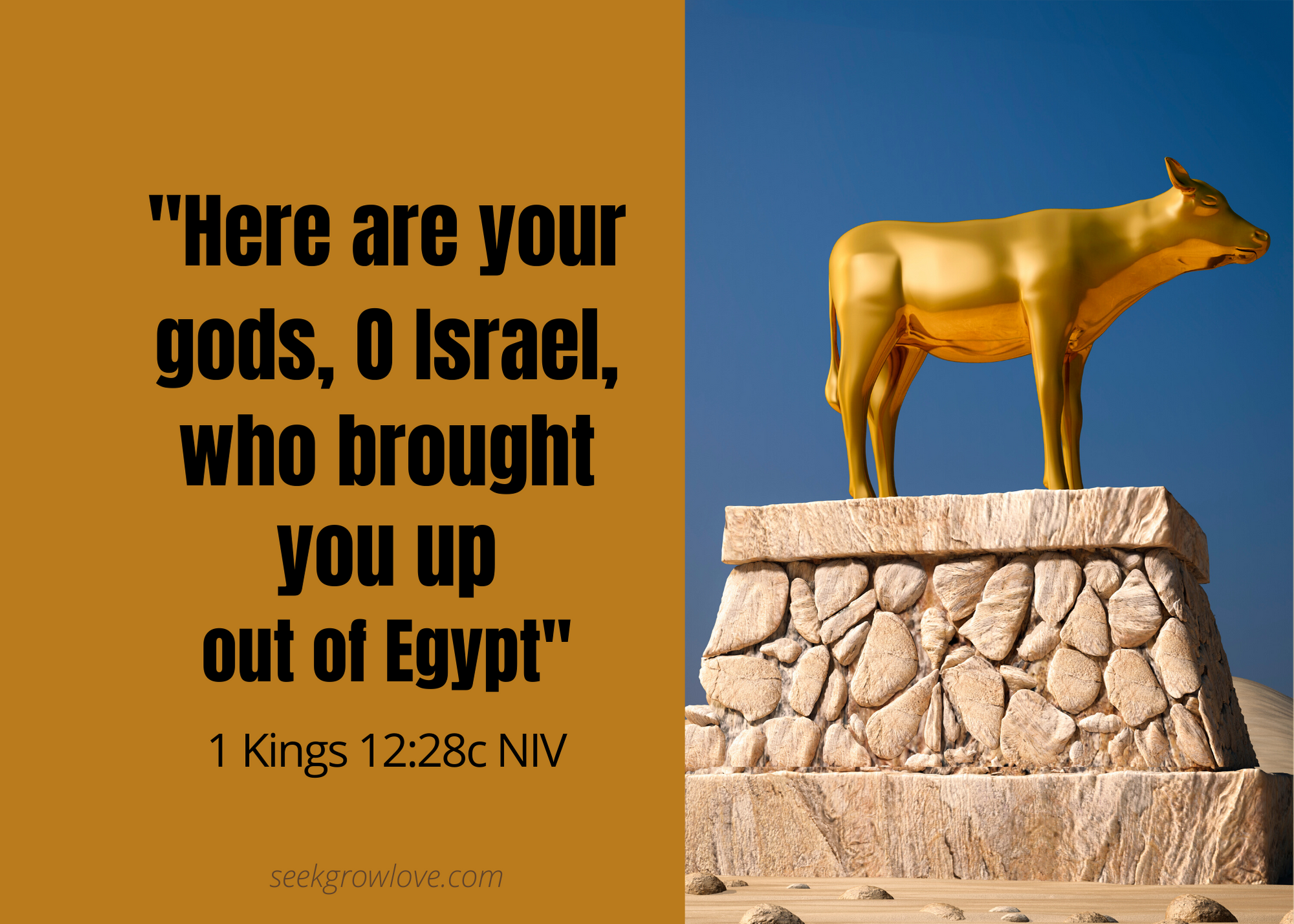
As we begin our reading today Israel had survived almost 100 years under 3 kings (Saul, David and Solomon).  And, as Solomon’s son Rehoboam is poised to take the reigns, the split comes and Jeroboam takes control of most of the country.  The land previously given to the tribe of Judah (home to Jerusalem and the beautiful temple Solomon built for the whole nation to worship the one true God in) remains as Rehoboam’s territory.  Jeroboam quickly decides he must build something for all the rest of Israel to worship, so that they don’t return to Jerusalem.  Two golden calves were created.  If the people knew God and their history a little better this should have sent all sorts of red flags.

God sent one new, large, red flag for the people.  A man of God came from Judah to speak God’s Word and reveal God’s power against this new idol worship.  He turns down King Jeroboam’s invitation to dinner because the word of the Lord said he must return home without eating or drinking in this land he was speaking against.  However, when an old prophet lies and says that an angel appeared to him and told him to have the man of God come to his house….the man of God goes.  But that same day judgement is prophesied against this man of God (from God through the previously lying prophet of God).  And sure enough while traveling home the man of God is killed by a lion (who “strangely” enough, does not eat him, just kills him).

I must say I have had some trouble with this story.  Here’s the man of God on special assignment from God – and doing it quite faithfully.  Speaking God’s word, showing God’s power, turning down even the King’s attempt to wine and dine him.  He seems totally devoted to what God wants him to do.  And, then, someone lies to him.  Someone who calls themself a prophet – should be a good person to listen to, right?

Not always!

Don’t believe every word from one who says they speak for God — without consulting what GOD has to say about it!  God had not changed what He had said to the man of God.  And, so that is what the man of God was responsible to be listening to and following.  The man of God was deceived because he listened to the lie – and it cost him his life.  God is serious about people following Him and His Word, rather than what man says about God.

So, too, today I fear there are many who, like the man of God in 1 Kings 13, are trying to speak God’s word – who are at the same time being deceived – and it just might cost them their lives – as it did for the man of God.   2 Timothy 3:13 lumps both the deceivers and those who are being deceived together in one sad group.   It seems harsh.  But, God has revealed himself as a jealous God who requires obedience to Him, and not to man and man’s ideas.  There is a price to pay for turning from His life-giving words of truth to the lies man (and even kings or “prophets”) have said about God and what He requires.

There are countless voices speaking today.  It can be hard to know what to believe and listen to.  The truth is not always spoken by the one who speaks loudest or longest or believed by the largest crowd.  But the truth is always in God’s Word.  Seek It!   And ask yourself – is it actually GOD’s Word you are following, or just someone who says they are speaking for God?  Are you following man-made traditions that have been handed down about God – or are you following GOD?  Do a little research and find out where the religious traditions you believe come from.  Do they come from God’s Word or from human traditions?  Did we get the idea of going to heaven when we die from the Bible or from Plato?  Did God, Moses, Jesus, the disciples and Paul teach about One God or about a triune God theory that developed centuries after Jesus’ life on earth?

How will you make sure you are not following a man-made religion – perhaps one just as dangerous as the golden calves Jeroboam set up in his country?  Not all lies and false gods are as blatantly obvious as a golden calf crafted by the king.  Sometimes it may come in the form of a seemingly harmless new word from the prophet, a slight contradiction or addition to God’s eternal Word.  Remember God is the perfect teacher – His words do not need to be added upon to be enhanced or explained better.   You are responsible for not listening to the lies.  God gave us the Bible – His Word that is full of truth.  Let’s dig in deep and find what it says and follow it with our whole being so we will not be led astray with a lie like the people who followed a golden calf built by a king or like the man of God who listened to the lie of the prophet rather than the word given to him by God.  There are consequences for what you believe and who you listen to and follow.  Take it seriously.  God does.

Marcia Railton


Today’s Bible passage can be read or listened to at https://www.biblegateway.com/passage/?search=1+Kings+12-14&version=NIV

Tomorrow we will read 2 Chronicles 10-12 as we continue seeking God’s truth and how it affects our lives today in the 2020 Chronological Bible Reading Plan