
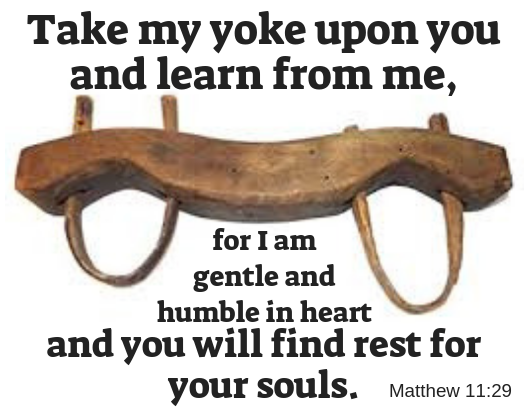
An Invitation to be Yoked

Matthew 11

Devotion by Shelly Millard (Nebraska)

Take a look around you.  You might see people who are exhausted and depleted by life and all the challenges it brings.  You may hear phrases like “I never have enough time”, “There is always too much to do”, “I’m always stressed about money”, “I am feeling so isolated and lonely”, “My anxiety is paralyzing me”.  Those common phrases bear witness to people who are struggling to manage life burdens and feeling continually overwhelmed with no relief in sight. All of us feel the weight of life at times whether it be physical exhaustion, emotional depletion, or spiritual unrest.   Jesus had been teaching his disciples and followers that the law only brought burdens, but a relationship with him provides the freedom and lightness that comes with shared burdens.  The passage we will explore out of Matthew 11 offers hope in the midst of life challenges.  

It begins with an invitation from Jesus to “come”.  It’s a simple imperative statement. It’s not a question or a plea—it is a gentle command to connect with him and to create a relationship with him.  It is an invitation to bring whatever is weighing you down and share the burden with him without shame, guilt or fear.  He is inviting us into a safe space where he will share the burden and offer some respite to you from bearing it all yourself. 

With this invitation comes the metaphor of putting on a yoke with him, which at first glance, may feel like even more of a burden and more constrictive.  He uses a yoke as a metaphor to help us picture the beauty of that “shackling”.  A yoke joins two animals, such as oxen, together so that the animals can share the workload and become more productive. The farmer may choose to shackle an older ox with a younger one or an unruly one with one that is steadier in order to help them both in the work.  The biblical scholar William Barclay describes the creation of a yoke by a carpenter who measures the ox and followed by several fittings, creates a customized yoke that gives the ox comfort while he works.  He also says that there is a legend about Jesus which may or may not be true, that as a carpenter, Jesus had a reputation of making some of the best yokes in the region and had a sign about his door that said, “My yokel fits well”!  Fact or fiction, this is the type of yoke that he is inviting us to take on with him—one that is comfortable, that allows him to lead and gives us relief from bearing burdens by ourselves.   

In the book, The Ragamuffin Gospel, Brennan Manning addressed a specific audience, and as it happens, the same audience Jesus’s invitation is for. He said that the “ragamuffin gospel” is for:

The bedraggled, beat-up, and burnt-out. It is for the sorely burdened who are still shifting the heavy suitcase from one hand to the other. It is for the wobbly and weak-kneed who know they don’t have it altogether. It is for inconsistent, unsteady disciples whose cheese is falling off their cracker. It is for poor, weak, sinful men and women with hereditary faults and limited talents. It is for earthen vessels who shuffle along on feet of clay. It is for the bent and the bruised who feel that their lives are a grave disappointment to God. It is for smart people who know they are stupid and honest disciples who admit they are scalawags.

What would it look like if we actually did this?  We wake up in the morning knowing that we can’t bear the burden of the day and just simply asked him to share the burden?  How would your life be different?

This is an invitation to join with Jesus who describes himself as gentle and humble in heart so that we might find rest for our souls.  In this, he will equip us, teach us, support us, relieve us and guide us as we live our lives. It is a clear path. . . Come to him, Take his yoke, learn from him, and find rest for your weary soul. 

Questions for reflection

What is your initial response to the command to “come”?  What then is your initial response to be “yoked”?

Why do you think we tend to handle our burdens by ourselves?  Why might we hesitate to share the burdens with Jesus?

When you think about being “yoked” together with Jesus, does that feel constrictive or freeing? How do you think you could more intentionally share your burdens as a result of this invitation?

Good Question

Old Testament Reading: Genesis 19 & 20

Psalm Reading: Psalm 12

New Testament Reading: Matthew 11

Where is the darkest place you have been? So dark, you were scared to take a step? The most difficult place you’ve been? So difficult, you doubted? When have your dark, difficult, trying circumstances caused you to doubt what you previously knew to be true?

You are not alone. John has been there, too. Sometimes referred to as John the Baptist or the Baptizer for his message of repentance and baptism, John had faithfully worked for years. Known for his simple lifestyle, his ministry was not about him – but about the one who was to come – the Messiah. He had prepared the way for Jesus’ entrance. He had not taken the easy road. He had not backed down from authority. He continually stood for what was right and true – even when it landed him in prison. The ruling Herod and his wife didn’t appreciate John speaking out against their unlawful marriage.

With his ministry and freedom taken from him, and his future in question, John had a lot of time to think in the darkness of his circumstances. Why? What if…? Was it worth it? Was this supposed to happen? Had he been right? Or wrong? We don’t know all the questions John asked in his prison cell. But, we do know the most important one. The one he needed an answer to. He sent his disciples to ask Jesus, “Are you the one who was to come, or should we expect someone else?” (Matthew 11:3)

And Jesus answered. Restating the truth that John needed to hear again. Pulling up Old Testament scripture from Isaiah and giving evidence of how his own ministry lined up with what had been foretold: the blind see, the lame walk, the leper is cured, the deaf hear, the dead are raised and the GOOD NEWS is preached to the poor (Matthew 11:5).

In our dark days and when we question what we knew to be true, we would do well to return to Jesus. Tell me again, Jesus. Give me proof of who you are. Read again who he is, what he has done, what he taught, what he did for me. The story of Jesus never gets old, but we do need to be reminded of what we know. And then we have the beautiful opportunity and mandate to tell others of what we have seen and heard.

In the rest of this chapter (as well as the previous one) Jesus demonstrates that following him can be hard. People will criticize everything – our job is not to make people happy. There will be many unrepentant people (and cities) who do not accept the work that Jesus has done for them or the path that Jesus has laid out. Don’t be swayed, know that judgement will come and make sure you are on the right side. Stay close to the one who knows and reveals the Father. Jesus, the Son of God, is the only way. Work with him. Stay attached to Jesus. Take his yoke upon you (Matthew 11:29).

-Marcia Railton

Reflection Questions

  1. Who is Jesus? Do you know that he is the one who was to come? How do you know this? What is the value in reading the Old Testament? What is the value in reading the New Testament?
  2. What is repentance? Why is it important? Without it, what will happen? (Matthew 11:20-24)
  3. What do you learn about God in today’s reading? What do you learn of His Son?

The Weight of Sorrow

Matthew 11

Matthew 11 28.png


There is a destiny that makes us brothers:

None goes his way alone;

All that we send into the lives of others

Comes back into our own. —Markham


Today’s chapter is a solemn one for me. Jesus just finished the send-off of the 12 disciples out into the proving grounds and I imagine was watchful about the results. As word of the disciples broaden, John the Baptist hears about the Messiah’s latest turn of events and sends a question to Jesus in (verse 3): “Are you the one who is to come, or should we expect someone else?”


This question intrigues me because of what it doesn’t ask. “Why won’t you help me? Do you not care that I sit suffering in this prison cell?” John the Baptist was the cousin, a dear friend, and a mentor of sorts who baptized Christ himself. He knew Jesus and Jesus knew John. They most likely grew up together. Jesus simply replied, (verse 4-6)  “Go back and report to John what you hear and see: The blind receive sight, the lame walk, those who have leprosy are cleansed, the deaf hear, the dead are raised, and the good news is proclaimed to the poor. Blessed is anyone who does not stumble on account of me.


While this is a message of good report for the current gospel cause, what strikes me is what isn’t said to his friend. John would surely have known by this response that Jesus was referring to Old Testament prophecies like Isaiah 29:18-19, 35:5-6, or 61. These were the credentials of sorts that the coming Messiah would fulfill. Isaiah 61 is one of the most famous passages using phrases of comfort  like “ bind up the brokenhearted,” “proclaim freedom for captives,” and “release prisoners from darkness.” Yet, Jesus doesn’t convey any of THOSE phrases in the reply to John because he knew they couldn’t be upheld. Silence often speaks louder than words.


Have you ever had a friend or family member truly in sorrow and are unable to comfort them due in part to the schedule you must maintain? Maybe they were grieving a death, consequence, job loss, betrayal, or abandonment. You want nothing more than to stop everything and sit with them in their sorrow and to share the load. I have to believe this is what Christ wanted more than anything with John the Baptist, but his circumstances made this impossible and he ultimately knew that freeing John from prison was not the will of the Father. John was soon to die. Jesus sent a loving message of “omittance,” perhaps suggesting that he had not forgotten John, nor his sufferings. The tribute upon which Jesus bestows upon John in the next 14 verses following this makes me believe he was hurting for his brother. He wanted nothing more than to comfort, but his schedule and AGENDA would not allow.    


Jesus models a very important lesson here and later in Matthew 14 upon reaction to the terrible death of John the Baptist. SOMEtimes the best way to ease heartache is by getting back to work. Use your grief to empower your ministry. Rather than turning in on yourself and thinking “woe is me,” turn outward to serve and to love the crowds. It is ok to cry. It is ok to mourn for lost people or situations, but we must not let our emotions turn inward for long, lest it becomes pity. In our brokenness God is able to use us mightily. In desperation our dependence on Him will serve as a powerful testimony to a lost and dying world.


Is your heart broken today? Does life seem empty? Do you feel like giving up? Take hope in the example of Jesus. Take up whatever duties lie before you and dedicate them to God. Refuse the luxury of self-pity. Do something to lift the burdens of others and Jesus will strengthen you.

The final verses (28 – 30) of Matthew 11 confirm this truth. “Come to me, all you who are weary and burdened, and I will give you rest. Take my yoke upon you and learn from me, for I am gentle and humble in heart, and you will find rest for your souls. For my yoke is easy and my burden is light.”


When you serve others you will find yourself.


-Julie Driskill


matthew 11 29