Three Pictures of Judgement

Matthew 25

Devotion by Jacob Rohrer (Rhode Island)

Today as we look at Matthew 25 we should take notice that though we are starting a new chapter the context surrounding this chapter is the same as that of chapter 24. Matthew 24 and 25 are a single unit of thought. This can be seen in verse 1 with the word “then” (the NIV says “at that time”) indicating what Jesus was speaking about in chapter 24 is continuing into chapter 25. The focus of the chapter is about the end of this age when Jesus returns and the judgement that he will enact. 

There are three pictures of judgement in chapter 25. The first two are parables (the parable of the ten virgins and the parable of the talents) and the last one is a description of the judgement scene. 

In the first parable there are ten virgins who wait for the bridegroom. The bridegroom delays in appearing and all fall asleep but suddenly the bridegroom appears but only five are ready for the bridegroom while the other five are not ready and they are denied entrance into the wedding feast. The virgins denied entrance are then told by the bridegroom he never knew them. 

The second parable is about a master and his slaves. The master gives each slave a talent (an amount of money) and went on a journey. When the master returns only two of the three slaves honored the master with what they were given. The third slave squandered his talent and is rebuked by the master and the slave is thrown out into the outer darkness.

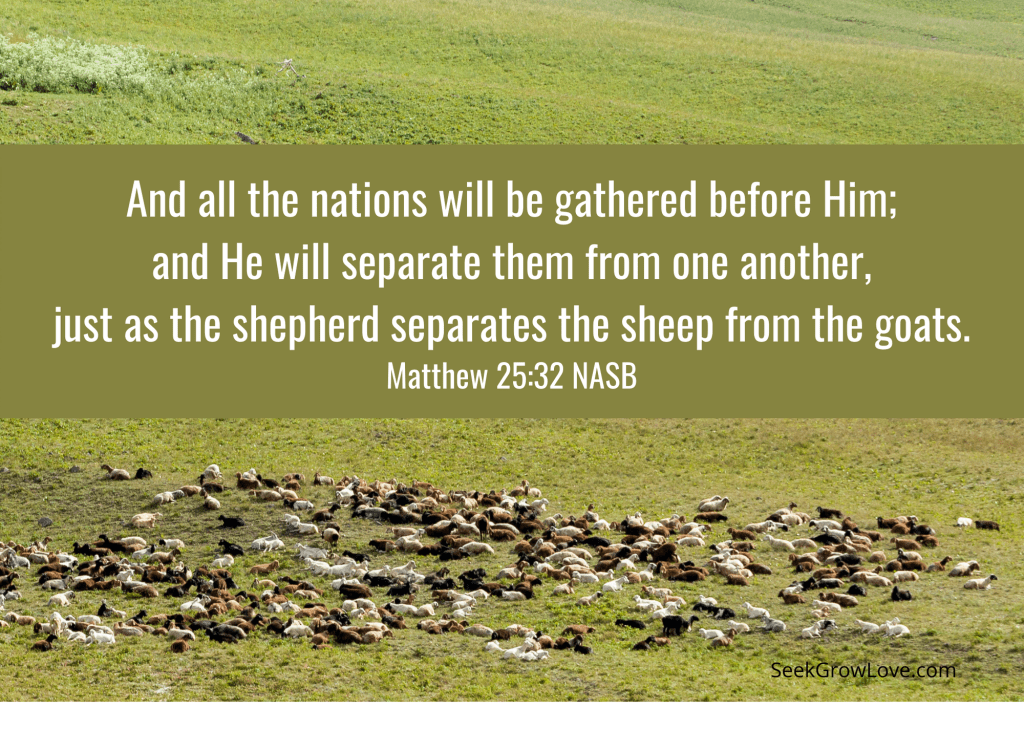
The third picture of judgement involves Jesus separating goats from sheep among the nations. The sheep and goats represent those who belong to Jesus and those who do not. The sheep (believers) are rewarded with the kingdom and the goats (non-believers) are cast into hell with satan and his demons. 

What are we to make of this chapter? What does Jesus want us to learn from these three pictures of judgement? I believe it is this.

There is a judgement coming and not everyone who calls themself a Christian will enter into life. The reality is, not everyone who calls themself a Christian is a true believer. In all three teachings there is one group of people who are then divided into those who are accepted and those who are rejected. Many people comprise the Church but not everyone who attends church is a true believer. The judgement of Christ sorts out the self-deceived from the real believers. Jesus himself teaches this earlier in Matthew 13.24-30, 36-43 in the parable of the tares. And he also teaches this in Matthew 7.21-22. 

Who are you? Are you deceived or a true believer in Christ? The five virgins were accepted into the feast because they were ready and prepared. The 2 slaves were honored by the master because they were faithful with what the master had given them. And the sheep entered the kingdom because they loved and served other Christians in need. 

A true believer will have evidence of salvation in their life. A true believer bears the fruit of the spirit, they grow in holiness, they grow in their disdain for sin, they hunger for the scriptures, they serve other Christians and people. A real believer matures and grows in Christ.

Paul tells the Corinthians in II Cor. 13.5 to test themselves against the scriptures to see if they are in the faith. Compare yourself to scripture and to the words of Jesus. Have you really received salvation from God? In addition to this, talk with mature believers closest to you about this serious matter if you question your salvation.

(Originally posted for SeekGrowLove on November 7, 2020)

Reflection Questions:

  1. What do you think Jesus wants you to learn from Matthew 25?
  2. “Who are you? Are you deceived or a true believer in Christ?” What does a true believer look like, sound like, do, believe?
  3. What can you do today to be more prepared to be judged by Jesus?

What Have You Done with It?

Old Testament: Exodus 25 & 26

Poetry: Psalm 30

New Testament: Matthew 25:14-30

Have you ever been given a huge gift of money, equal to say, 20, 40 or even 100 years of wages? I am going to guess your answer, like mine is “No!” So instead I will ask, what would you do if you were given a huge gift of money like that? Houses, cars, boats, RV’s, college, investments, and even some donations. I can dream up a few things and I am sure you can, too. 

But what would you do if you were entrusted with a huge amount of money worth 20, 40 or 100 years of wages? It’s a totally different question. The money isn’t yours. But you are responsible for it. The owner has put it in your care (whether you wanted it or not). And he is going to be returning (sometime) to see what you have done with it. 

You have some options. You could totally screw up and spend it all as yours and have nothing for the master when he returns. But that would be totally unwise because of what the master would do when he returns. You could hide it under your mattress and just keep it safe so you can return it when the master comes. This option is ruled by fear: fear of losing, fear of the master, fear of things not turning out right, fear of trying. Only trouble is, the master has a few different words for the fearful afraid servant who hid his alloted resources: wicked, lazy and worthless. Well, that’s not really the only trouble because the LARGER trouble is what becomes of that fearful, afraid, wicked, worthless and lazy servant: the master orders him to be  thrown, “into the outer darkness; in that place there will be weeping and gnashing of teeth.” (Matthew 25:30). His eternal destination is decided because he was too afraid to try to use what the master entrusted to him. 

In order to please the master, everyone needs a ministry in which they are putting to work what God has entrusted to him or her. Your ministry doesn’t have to look like your neighbors or pastors or parents. God has given each one of us different resources, bags of gold and talents and spiritual gifts and skill sets. But he didn’t give them to us for us to foolishly squander on ourselves or fearfully hide away. In fact, he didn’t give them to us for us to keep. But he entrusted them to us for us to put them to work for him. He expects us to grow them. And when we do, he welcomes us to come share in his happiness and even gives us more. 

Which words will you hear from the master? It depends on what you have done with what he has entrusted to you. 

-Marcia Railton

Reflection Questions

  1. What resources, talents, gifts, skills and passions has God entrusted to you? How are you putting them to work for him? 
  2. Are there times when you have allowed fear to keep you from investing God’s talents He’s given you?
  3. Which words will you hear from the master? 

Ready for the Day. And Ready for the Night.

Old Testament: Exodus 23 & 24

Poetry: Psalm 29

New Testament: Matthew 25:1-13

Are you ready for the day? Do you have clean clothes to wear, you have your keys, phone and wallet, your homework is done, you have prepared for the meeting or test, and you remembered to brush your teeth before leaving the house. It’s a good feeling to be ready. 

When was the last time you were caught unprepared? You scrambled to put together a clean (maybe matching) outfit because the dirty hamper was overflowing, the teacher gave a pop quiz, visitors found a messy house, you didn’t have the project complete when the boss wanted it, the bill wasn’t paid by the due date, and in the rush to get out the door you forgot to brush your teeth. It’s no fun not being ready. 

In Matthew 25 today we read of the Parable of the Ten Virgins, or Bridesmaids, depending on which version you read. They are all anxiously waiting for the bridegroom’s arrival and they all have a lamp/torch/light with them as it is day now but they don’t know when he might come, so they (seem) prepared to wait even if it grows dark. And it does. 

Jesus tells us five of the virgins (typically referring to purity) were wise and five (still, pure virgins) were foolish. And since they all had their lamps with them and were anxiously awaiting the bridegroom’s (Jesus’) arrival I feel it is safe to say that all ten would call themselves “Christians” or Jesus followers. The five foolish aren’t chasing after the world and doing immoral, evil things. They have their lights and are waiting, right along with the five wise.  I think they are even sitting in the church pew and doing all the right things right along with the wise, all day long.

And then it grows dark. BOTH the wise and foolish get drowsy and even begin to sleep. BOTH are wakened with the great news, “The Bridegroom is coming!” But now we run into trouble. Well – half of them/us do. 

Five of them didn’t bring oil to keep their lamps burning, their lights are going out, and they haven’t seen the bridegroom yet. They desperately demand to get some oil from the five wise who brought oil with them, but the wise know they don’t have enough oil for both their light and another light. In the final moments the foolish run off scrambling to go buy more oil. And it is in those final moments that the long anticipated arrival of the bridegroom takes place. He finds the five wise waiting with their lights burning bright and he ushers them into the wedding feast. The door is shut and the party begins. 

In the previous chapter Jesus had just warned of the darkness that would proceed his second coming: increased wickedness, love of most growing cold, many deceived by false prophets and false christs, war, famine, earthquakes, and persecution. He warned that during that time of darkness many Jesus followers will fall away. They are the 5 foolish. They are the ones who won’t have enough fuel to keep their light burning through the darkness. They are the ones who will miss the party and be left out in the dark and will hear the Savior say, “I don’t know you.” 

Each person needs to be prepared – and stay prepared – even in the final dark days/moments/hours. Just having a light in the daytime is not enough. Just walking with the wise, right crowd is not enough. It won’t work to get into the Kingdom with a spouse, parent, grandparent, pastor, or friend who is prepared. You need your own light – AND the oil to keep it burning bright all night long if needed. 

Which half will you be a part of? Are you prepared? Are you ready? Do you have your light with you? That’s a good first step! But are you also prepared for the coming darkness that will indeed come before the Savior arrives? Do you have enough fuel to keep your light burning bright until you are ushered into the great wedding feast? Are your ready for the day? Are you ready for the night?

-Marcia Railton

Reflection Questions

  1. First off, are you a Jesus follower, waiting for his return, prepared with a light?
  2. Are you prepared to keep your light burning in the darkness?
  3. What part of the darkness scares you most (wickedness, deception, natural disasters, famine, persecution)? How can you work on strengthening your stand now and preparing for the darkness so you won’t fall away in the darkness? 

Put IT to Work

Old Testament Reading: Genesis 47 & 48

Psalms Reading: Psalm 26

New Testament Reading: Matthew 25

In Matthew 25:14-30, Jesus tells a parable about a man who entrusts his money to three of his servants while he is away. They each receive a different amount of wealth: 10, 5, and 1. The master doesn’t instruct them on what to do with it; he simply leaves it in their possession and takes off. The first two double their money: the 10 now having 20, and the 5 now at 10. However, the servant who only had 1 chose not to risk losing it; he chose to bury it in the ground so that his master wouldn’t be upset with him. He was terrified of what his master might do to him if he was to lose his one and only amount of money. Unfortunately for him, this was the wrong choice and he was punished for it, because he could have made at least a little amount from it at the bank.


The parable is revealing of our Christian walk as well. Our Master, Jesus, has entrusted us with different things in this life to use and bring others to saving faith. Some of us have more money and opportunities than others, but every single one of us has been entrusted with something. You might have money, people, a position at work or school, a certain hobby, physical health, or a variety of different gifts. Jesus expects us to use whatever we have been given for the sake of the Kingdom of God. He doesn’t want us to waste it, and honors it when we give it a shot (did you notice that both of those who tried doubled their investment?). When we choose not to make an attempt, we are operating out of fear, which is the opposite of what Jesus and God empowers us with (2 Timothy 1:7).


What have you been entrusted with by your Master? Take some time to write down what skills, people, and possessions you have been given in a column on a piece of paper. How can you use that to further the gospel message of the Kingdom? Take some time to brainstorm and write down in a separate column next to that first list any ideas that come to mind.


You’ve been given something; don’t waste it. And Jesus is with you always through the process, so don’t fear anything (Matthew 28:20)

-Talon Paul

Reflection Questions

  1. Take some time to create your two columns: What have you been entrusted with by your Master? and How can you use that to further the gospel message of the Kingdom? Return to it throughout the weekend with more thoughts. What have you been given that you never considered using to spread the good news of the Kingdom?
  2. Has fear stopped you from using your talents? What should we be most fearful of (men, what others think, what if I mess up – or – what will happen when the Master returns)?
  3. What can we learn from the other two parables in Matthew 25?
  4. What do we learn of God and His Son Jesus in our reading today?

Listening to Jesus

Today’s Bible Reading – Matthew 25 and Genesis 49 & 50

                I Love stories, don’t you?

Here’s a story by CS Lewis found in the book: The Voyage of the Dawn Treader as retold by Jennifer Neyhart:

               “Eustace is a character you kind of just want to punch in the face until his transformation experience with Aslan. He was arrogant, self-centered, and all around annoying to Edmund and Lucy.

On one of the islands the crew lands on, Eustace finds a dragon’s lair and is very greedy for the treasure. He puts on a gold bracelet and falls asleep, and when he wakes up, he has been turned into a dragon. Lewis writes, “Sleeping on a dragon’s hoard with greedy, dragonish thoughts in his heart, he had become a dragon himself.” Eustace had fleeting thoughts of relief at being the biggest thing around, but he quickly realizes he is cut off from his friends, and all of humanity, and he feels a weight of loneliness and desperately wants to change.

That night, Aslan comes to Eustace and leads him to a large well “like a very big round bath with marble steps going down into it.” Eustace describes the scene to Edmund after the fact. He says the water was so clear and he thought if he could get in there and bathe it would ease the pain in his leg (from the gold bracelet he had put on when he was human). But Aslan told him he had to undress first. And doesn’t God ask this of us? As Lewis wrote in Letters to Malcolm: “We must lay before him [God] what is in us; not what ought to be in us.”

Eustace found that no matter how many layers of dragon skins he managed to peel off of himself, he was still a dragon.

“Then the lion said – but I don’t know if it spoke – ‘You will have to let me undress you.’ I was afraid of his claws, I can tell you, but I was pretty nearly desperate now. So I just lay flat down on my back to let him do it.

“The very first tear he made was so deep that I thought it had gone right into my heart. And when he began pulling the skin off, it hurt worse than anything I’ve ever felt. The only thing that made me able to bear it was just the pleasure of feeling the stuff peel off. You know – if you’ve ever picked the scab off a sore place. It hurts like billy-oh but it is such fun to see it coming away.”

“Well, he peeled the beastly stuff right off … And there was I as smooth and soft as a peeled switch and smaller than I had been. Then he caught hold of me – I didn’t like that much for I was very tender underneath now that I’d no skin on – and threw me into the water. It smarted like anything but only for a moment. After that it became perfectly delicious and as soon as I started swimming and splashing I found that all the pain had gone from my arm. And then I saw why. I’d turned into a boy again…” – C. S. Lewis, The Voyage of the Dawn Treader

 This scene always grabs my heart. It reminds me that I cannot fix myself. It paints a beautiful picture of baptism and transformation to new life. It humbles me as I put myself in Eustace’s place. And even long after our initial baptism we have the ongoing challenge of surrendering to God’s work in our lives which can be painful at times, even when it’s a good pain.

And I like Lewis’s note of narration at the end of this scene as well:

“It would be nice, and fairly nearly true, to say that “from that time forth Eustace was a different boy.” To be strictly accurate, he began to be a different boy. He had relapses. There were still many days when he could be very tiresome. But most of those I shall not notice. The cure had begun.”        

https://www.jenniferneyhart.com/2014/10/c-s-lewis-undragoning-of-eustace.html

End of Story.

Jeff’s comments:

                Stories have a way of capturing our attention and keeping our interest.  In a really good story like the undragoning of Eustace we might discover after reading it that it stays with us, that it somehow changes the way we see the world or the way that we are in the world.

                Jesus was a master storyteller.  Throughout the Gospels we hear him telling stories, and amazing stories they were as they somehow manage to transcend time and place and language and cultural barriers.

                In Matthew 25 Jesus tells three stories.  One story is about bridesmaids and oil, one is about masters and servants and bags of gold, and one is about sheep and goats.  Jesus told these stories just a few days before he was to be arrested, tried, condemned and nailed to a Roman cross and publicly executed. 

If you’ve ever been around someone who knew that they were going to die soon, you know that near the end of life people usually want to focus on those things which are most important.  They want to say “ I love you” to people they care about.  They want to say “ I’m sorry” to the people they have hurt or they want to say “I forgive you” to the people who have hurt them.  Since Jesus is running out of time and opportunities to preach and teach before his arrest you can imagine that what he has to say is very important to him. This is Jesus saying “I love you” to people he cared deeply about.

I encourage you to read and reflect on those stories in Matthew 25. 

Why is he talking about weddings and bridesmaids and having enough oil and the danger of missing out on the wedding banquet?  What does he want us to do or not do?

Why is he talking about a rich landowner going away on a long trip and leaving behind something valuable and asking his trusted workers to manage his valuable gold well?  What does he want us to do or not do?

Why is he talking about sheep and goats and why is he praising and rewarding some for the good things they do to help others (and him) and condemning  and punishing others for the good things that they fail to do to help others (and him)?  What does he want us to do or not do?

Spend some time thinking about each story.  Imagine yourself there in the story.  What’s it like to be a bridesmaid who wasn’t ready and missed out on your friend’s wedding?  What’s it like to be a worker who gets praised and rewarded for working hard when the master returns?  What’s it like to be called a goat (not The G.O.A.T. –a.k.a. Michael Jordan or Drew Brees) but a goat who failed to care for the sick, the hungry, the prisoners and the naked and gets turned away by Jesus?

Listen to Jesus’ stories and allow them to teach you whatever Jesus wants you to learn.

-Pastor Jeff Fletcher

Test Yourself!

Matthew 25

Today as we look at Matthew 25 we should take notice that though we are starting a new chapter the context surrounding this chapter is the same as that of chapter 24. Matthew 24 and 25 are a single unit of thought. This can be seen in verse 1 with the word “then” (the NIV says “at that time”) indicating what Jesus was speaking about in chapter 24 is continuing into chapter 25. The focus of the chapter is about the end of this age when Jesus returns and the judgement that he will enact. 

There are three pictures of judgement in chapter 25. The first two are parables (the parable of the ten virgins and the parable of the talents) and the last one is a description of the judgement scene. 

In the first parable there are ten virgins who wait for the bridegroom. The bridegroom delays in appearing and all fall asleep but suddenly the bridegroom appears but only five are ready for the bridegroom while the other five are not ready and they are denied entrance into the wedding feast. The virgins denied entrance are then told by the bridegroom he never knew them. 

The second parable is about a master and his slaves. The master gives each slave a talent (an amount of money) and went on a journey. When the master returns only two of the three slaves honored the master with what they were given. The third slave squandered his talent and is rebuked by the master and the slave is thrown out into the outer darkness.

The third picture of judgement involves Jesus separating goats from sheep among the nations. The sheep and goats represent those who belong to Jesus and those who do not. The sheep (believers) are rewarded with the kingdom and the goats (non-believers) are cast into hell with satan and his demons. 

What are we to make of this chapter? What does Jesus want us to learn from these three pictures of judgement? I believe it is this.

There is a judgement coming and not everyone who calls themself a Christian will enter into life. The reality is, not everyone who calls themself a Christian is a true believer. In all three teachings there is one group of people who are then divided into those who are accepted and those who are rejected. Many people comprise the Church but not everyone who attends church is a true believer. The judgement of Christ sorts out the self-deceived from the real believers. Jesus himself teaches this earlier in Matthew 13.24-30, 36-43 in the parable of the tares. And he also teaches this in Matthew 7.21-22. 

Who are you? Are you deceived or a true believer in Christ? The five virgins were accepted into the feast because they were ready and prepared. The 2 slaves were honored by the master because they were faithful with what the master had given them. And the sheep entered the kingdom because they loved and served other Christians in need. 

A true believer will have evidence of salvation in their life. A true believer bears the fruit of the spirit, they grow in holiness, they grow in their disdain for sin, they hunger for the scriptures, they serve other Christians and people. A real believer matures and grows in Christ.

Paul tells the Corinthians in II Cor. 13.5 to test themselves against the scriptures to see if they are in the faith. Compare yourself to scripture and to the words of Jesus. Have you really received salvation from God? In addition to this, talk with mature believers closest to you about this serious matter if you question your salvation.

-Jacob Rohrer

Today’s Bible passage can be read or listened to at BibleGateway here – Matthew 25

Tomorrow we will read Matthew 26 and Mark 14.

Investment 101

investment 101

Matthew 25

Jesus just finished telling his disciples to expect His return. Now he tells parables about how we should prepare for the return. It’s always nice to have concrete instructions. These ones are in the form of parables, but they aren’t terribly cryptic.

The first parable is about a wedding. There are a bunch of people waiting to meet up with the groom so that they can go to a feast with him. Initially, there are ten of these people patiently waiting. They were expecting him to arrive during the day, but on his way, he was delayed. Once the sun fell, only five of them stayed to wait for the groom because they were prepared for darkness. They thought ahead and brought extra supplies.

In this parable, Jesus is the groom and we are the virgins or bridesmaids waiting for his arrival. Notice that initially there were many who expected his coming. Most of us reading this believe that Jesus will come back. There have been times in the past when a biblical scholar has declared that he deduced the time at which Jesus would return (you can find a nice list of these occurrences on Wikipedia). I imagine many of the people who ended up believing these claims were disappointed when the proclaimed date rolled by without ushering the Kingdom of God. Many of them probably fell away from faith because they had expected their groom to show up during the day, yet they failed to wait through the night. The same is true now. Even if we don’t see an exact date for His return, we must continue to wait. We must be especially aware that soon the sun will set. Darkness will fall. But that doesn’t mean that the groom has forgotten his people and his feast. In fact, darkness will certainly precede His coming.

The second parable is about a hedge fund manager. This man gives his underlings various amounts of seed money and expects them to use it wisely. More precisely, he expects huge returns out of them. Two of his employees manage to achieve returns of 100%. The final employee merely broke even. Of course, the manager is happy with the first two. The returns that they managed are nearly unheard of. For example, to get a 100% return on your investment today, you would have had to invest in Apple stock 5 years ago (more precisely, April 17, 2014). The parable doesn’t tell us how long the manager was away, just that it was a long time. Long-term investment is one of the safer ways to grow your money and short-term investments are considerably riskier. Perhaps the third employee knew this and said, “Rather than take a loss on my boss’s money, I’ll just sit on it.” Perhaps this employee thought his manager would only be gone for 3 months. If he had invested in Apple stock three months ago, then he would have lost 27% of what he invested. That wouldn’t make the manager terribly happy, but the 0% gains that he presented still provoked the manager’s anger. The manager said that he would be gone for a long time, but the third employee didn’t take that to heart and decided to do nothing.

Shortly after Jesus ascended into heaven, the Holy Spirit was poured out on believers. The Holy Spirit is the investment that Jesus gives us. The Spirit gives us each special gifts. In Romans 12:6-8, Paul lists a few of them: prophecy, service, teaching, encouragement, giving, leading, showing mercy. These are the talents that Jesus gives to us. He expects us to invest these gifts for the long-term. This might mean pursuing one person for years to show them the Love and Truth of Jesus. In can be risky to try to convert someone in a day, like a short-term investment. You win that person over, but you could also completely ostracize them forever. This short-term investment is certainly not ideal compared to the safer returns of long-term investment in people. Jesus wants to get returns on the gifts that he gives to you. So put them to use for the long-term.

The final parable is like the first two. Some will claim to know Jesus, and some will serve Jesus. Those who serve will be like the sheep, separated from the goats and placed at the right hand of the King. Those who never believed, or who believed but refused to serve, refused to make a return on the investment that Jesus gave them, will be tossed out. They will be tossed out just as the devil himself will be tossed out. But the righteous, those who invest wisely, will receive eternal life.

-Nathaniel Johnson